ONE BUSINESS / INSIGHTS / ARTICLE 21
Abu Dhabi Finance Week 2026: How Partner-Led Investment Networks Are Reshaping Global Capital and Creating New Opportunities for Entrepreneurs
Understanding the institutional architecture of international investment, the strategic value of partnerships, and what entrepreneurs can learn from Abu Dhabi's evolving position in the global financial economy.

The future of international business is increasingly influenced by a fundamental economic question: how can capital, knowledge, institutions, and entrepreneurial capabilities be brought together to transform major economic challenges into commercially viable opportunities? Across the global economy, technological transformation, artificial intelligence, energy infrastructure, financial innovation, and changing international trade relationships are creating investment requirements that cannot always be addressed effectively by individual companies or financial institutions acting independently. These developments are changing how investors evaluate opportunities, how governments organize economic priorities, and how enterprises position themselves within increasingly interconnected capital markets.
The emergence of partner-led investment platforms provides an important perspective on this transformation. Rather than approaching international financial gatherings exclusively as conferences where economic experts present their views, major institutions are increasingly using collaborative forums to develop relationships, examine investment opportunities, exchange specialized knowledge, and explore partnerships that can extend beyond the events themselves. The distinction matters because the economic value of an investment ecosystem does not depend simply on how much capital it contains, but on how effectively that capital can be connected with credible opportunities, productive capabilities, and institutions capable of supporting long-term development.
This relationship is particularly visible in Abu Dhabi, where the interaction between sovereign investment, financial institutions, strategic enterprises, international partnerships, and government economic priorities has become an increasingly significant component of the United Arab Emirates' economic development. The announcement of an expanded partner-led programme for Abu Dhabi Finance Week 2026 provides an opportunity to examine these developments from a perspective that extends beyond financial markets and institutional investment. It also offers important lessons for entrepreneurs who want to understand how capital moves, how strategic partnerships develop, and how companies can prepare themselves to participate in larger economic ecosystems.
On November 20, 2026, Abu Dhabi Finance Week announced its largest programme of partner-led activities for its fifth edition, scheduled for December 7–10, 2026. Hosted by Abu Dhabi Global Market (ADGM), the event will take place under the theme The Capital Community, Powered by Partnerships. Major international and regional organizations are expected to participate in summits, specialized forums, private leadership discussions, and investor engagements addressing global finance, asset management, technology, energy, and economic growth. The initiative reflects a broader effort to strengthen Abu Dhabi's position as a place where global financial institutions and economic actors can establish relationships and examine emerging investment opportunities.
The announced programme includes participation from institutions such as L'IMAD, Abu Dhabi Commercial Bank, Hanwha, XRG, Modon, Mubadala, First Abu Dhabi Bank, Hub71, and several international financial and technology organizations. Their involvement illustrates the diversity of capabilities present within a modern investment ecosystem. Sovereign investors, commercial banks, asset managers, technology platforms, infrastructure enterprises, and entrepreneurial development organizations perform different economic functions, yet they may become interconnected when investment opportunities require financing, operational expertise, technological innovation, institutional coordination, or access to international markets.
For entrepreneurs seeking to understand the contemporary UAE, this development should not be interpreted merely as another indication that significant financial resources are concentrated in Abu Dhabi. Its deeper significance lies in the relationships through which capital can become economically productive. Understanding these relationships helps entrepreneurs move beyond the superficial objective of finding an investor and toward the more demanding task of building an enterprise that possesses the capabilities, commercial credibility, governance structures, and strategic position necessary to participate in institutional investment ecosystems.
This perspective also connects with the economic history of the United Arab Emirates. The country's transformation involved more than the discovery of natural resources or the accumulation of financial wealth. It required decisions about infrastructure, institutions, enterprises, investment, and the development of capabilities that could support progressively more sophisticated economic activities. The relationship between capital and economic development is examined throughout The Economic History of the United Arab Emirates, a five-volume research collection presented by ONE Business Dubai. Understanding that history provides context for examining why Abu Dhabi's contemporary financial ecosystem combines substantial investment institutions with economic development priorities, international partnerships, and a growing emphasis on innovation.
For the international entrepreneur, the lesson is both historical and practical: capital becomes strategically important when it is connected with an organization capable of using it productively. Attracting financing is not the final objective of entrepreneurship. The objective is to develop an enterprise capable of transforming available resources into commercially valuable products, services, capabilities, and sustainable economic activity.
From Sovereign Wealth to Strategic Capital Networks: Understanding Abu Dhabi's Financial Architecture
Abu Dhabi's position within international finance has developed through a distinctive combination of natural resources, sovereign investment institutions, long-term economic planning, and the progressive diversification of productive activity. Oil revenues expanded the financial resources available to the emirate, but the economic significance of those revenues depended on how they were managed, invested, and converted into assets and capabilities beyond the original resource sector. The creation and expansion of sovereign investment institutions consequently became an important component of Abu Dhabi's economic development.
The distinction between possessing capital and building a productive economic system is central to understanding this transformation. Financial resources can support consumption, public expenditure, financial investment, infrastructure construction, or enterprise development, but these activities produce different economic consequences. Investments in transportation, energy, industrial capacity, telecommunications, education, and financial institutions can contribute to the creation of capabilities that influence future economic opportunities. Their effectiveness depends on project selection, institutional quality, execution, financial sustainability, and the surrounding economic environment.
The historical development of Abu Dhabi provides an important illustration of how resource wealth can contribute to the construction of financial institutions and long-term investment capabilities. As examined in The Economic History of the United Arab Emirates, the transformation of oil revenues into financial capital, infrastructure, enterprise development, and international investment forms part of a wider process through which the UAE built its contemporary economy. The resulting institutions did not emerge simultaneously, nor did they perform identical functions. Their development involved changing economic priorities, investment strategies, organizational capabilities, and relationships with international markets.
Today, Abu Dhabi's investment environment includes institutions operating across different categories of capital allocation. Sovereign investors may pursue long-term portfolio objectives, strategic investments, or economic development mandates. Commercial banks provide financial services to enterprises and individuals, while investment managers organize capital according to particular investment strategies. Private equity and venture capital investors typically examine ownership opportunities, commercial growth, management capability, and potential financial returns. Development-oriented institutions and public-sector organizations may also participate in initiatives where economic or social objectives interact with commercial investment requirements.
These institutional differences matter because the expression investment capital can conceal substantial variation in objectives, risk tolerance, investment horizons, financial structures, and decision-making responsibilities. Capital intended to finance a large infrastructure project is not evaluated in the same way as funding for an early-stage technology enterprise. A long-term institutional investor managing liabilities over several decades faces different considerations from a venture capital fund seeking growth opportunities within a defined investment strategy. A commercial bank providing debt finance examines repayment capacity, credit risk, and financial obligations rather than evaluating every opportunity through the same criteria used by an equity investor.
Entrepreneurs who understand these differences are better prepared to identify which financial institutions may be relevant to their business models. A founder developing software for a narrowly defined customer segment should not assume that a sovereign investment institution is the natural source of financing simply because substantial capital is available in Abu Dhabi. Similarly, a company proposing a complex energy infrastructure project may require relationships involving technical partners, lenders, infrastructure investors, regulators, and specialized contractors rather than the kind of financing typically associated with a small commercial startup.
This is where partner-led investment programmes become especially relevant. They create opportunities for institutions with different capabilities to examine themes that may require cooperation across organizational boundaries. An investment opportunity involving artificial intelligence infrastructure, for example, may involve financing requirements, energy consumption, computing facilities, technology providers, regulatory considerations, and customers capable of generating demand for the infrastructure. Understanding these dependencies requires more than the financial capacity of a single investor.
The same logic applies to large-scale energy projects, industrial development, healthcare infrastructure, and other capital-intensive sectors. Investors must evaluate how financing interacts with technology, project execution, customer demand, regulation, and the long-term operation of assets. A project can appear economically attractive in principle but remain difficult to finance when its governance, contractual arrangements, operational requirements, or risk allocation have not been adequately developed.
Partner-led forums can support the exchange of knowledge needed to identify and examine these questions. They may help participants understand how other institutions evaluate risk, which capabilities are available through potential partnerships, and what conditions would be necessary for a proposed investment to proceed. However, the existence of a collaborative forum does not itself establish that specific transactions will occur, that investors have committed capital, or that regulatory changes have been approved. Such outcomes require independent decisions, formal arrangements, due diligence, and the relevant institutional authorizations.
The official programme for Abu Dhabi Finance Week 2026 reflects the breadth of subjects involved. Its announced thematic days encompass Abu Dhabi's economic development and global markets, asset management and private wealth, artificial intelligence and financial innovation, and sustainable finance and long-term resilience. These themes are related because they concern different dimensions of how economic resources are accumulated, allocated, organized, and applied to future opportunities.
From an entrepreneurial perspective, the fundamental question is how these institutional developments affect the environment in which companies operate. A growing investment ecosystem can influence access to financial services, demand for specialized professional capabilities, the development of new industries, and opportunities for cooperation between emerging enterprises and established organizations. Yet these possibilities are not distributed automatically among every company established in the UAE. Entrepreneurs must understand the actual economic needs arising within each sector and determine whether their enterprises possess capabilities capable of addressing them.
Consider the development of artificial intelligence infrastructure. Increased investment interest in computing capacity can generate requirements involving energy supply, equipment, cooling systems, data management, cybersecurity, professional services, facility management, and specialized technological expertise. These requirements may create commercial opportunities for enterprises that do not own data centers or develop foundational artificial intelligence models. Their potential contribution lies in providing capabilities required by the wider ecosystem.
This is an important distinction because entrepreneurs sometimes associate major investment announcements exclusively with opportunities to obtain funding. In reality, investment activity can also create demand for suppliers, contractors, technical specialists, software providers, training services, and businesses capable of solving operational problems. The opportunity may not be to receive investment directly, but to become a commercially valuable participant in the economic system that investment helps develop.
Understanding institutional capital therefore helps entrepreneurs identify both financing opportunities and the markets that capital formation may create. The distinction encourages founders to examine what investors intend to build, which capabilities those investments will require, and how their enterprises might contribute useful economic functions within the emerging environment.
The development of Abu Dhabi's financial ecosystem also demonstrates why long-term strategic positioning matters. A company that wishes to serve institutional clients must often develop capabilities before a contract or investment opportunity becomes available. These capabilities can include professional governance, reliable financial reporting, technical expertise, relevant experience, operational procedures, and the ability to satisfy demanding contractual requirements.
Entrepreneurs who begin preparing only after a potential investor or major customer expresses interest may discover that they lack the documentation, internal systems, or organizational capacity necessary to proceed. Conversely, a company that develops those capabilities systematically improves its readiness to participate in more complex commercial relationships.
The economic lesson is not that every small business should imitate the governance structure of a sovereign wealth fund or a multinational financial institution. Different enterprises operate at different scales and under different requirements. The transferable principle is that the quality of an organization's capabilities influences the kinds of economic relationships it can support.
A business seeking to participate in sophisticated investment ecosystems must therefore consider how its organizational development, market positioning, and financial preparation correspond to the expectations of the institutions with which it hopes to work.
Why Partner-Led Investment Programmes Matter for Entrepreneurs and Global Business Growth
The movement toward partner-led financial programmes reflects an important change in how complex investment opportunities are discussed and evaluated. Traditional conferences can provide valuable information, but information alone does not resolve the practical requirements of investment execution. Institutions interested in major projects need to understand the financial structures, responsibilities, technical capabilities, operating risks, contractual relationships, and regulatory conditions affecting a proposed opportunity.
Partner participation can improve these discussions when organizations contribute their own expertise and commercial perspectives to the development of the programme. Financial institutions understand capital allocation and risk management, technology companies possess specialized knowledge of emerging systems, infrastructure developers understand project delivery, and regulators can explain the institutional requirements governing particular activities. Bringing these perspectives into a common discussion can help reveal dependencies that might remain invisible when opportunities are evaluated from only one organizational perspective.
The strategic significance of this approach lies in recognizing that many important economic opportunities are not simply discovered as fully developed investment propositions. They require preparation before they become investable. A technically promising project may lack a financially sustainable revenue model, while an attractive market opportunity may depend on infrastructure that does not yet exist. An enterprise may possess valuable intellectual property but lack commercial partners capable of implementing it at scale.
In these circumstances, investment development involves a process of coordination. Potential participants need to understand what the project requires, which organizations can contribute necessary capabilities, how responsibilities might be divided, and whether the proposed arrangement can generate sufficient economic value to justify the resources committed. Financial structuring becomes inseparable from commercial and operational design.
A discussion involving investors, developers, regulators, and technical organizations may therefore be valuable even when it does not produce an immediate transaction. It can help identify which conditions must be satisfied before an opportunity becomes viable. Understanding those conditions allows participating organizations to determine whether the project deserves further investigation, whether particular risks can be managed, and whether cooperation could produce an economic outcome that none of the organizations could achieve as effectively independently.
For entrepreneurs, this provides a fundamentally different perspective on investor relations. The common assumption that a founder's principal task is to persuade an investor to provide capital places excessive emphasis on presentation and insufficient emphasis on the underlying architecture of the enterprise. A compelling pitch may attract attention, but institutional investment decisions generally require evidence concerning the business model, customers, financial performance or projections, management capabilities, market conditions, governance, and the specific risks associated with the proposed transaction.
The entrepreneurial task is not merely to communicate an opportunity convincingly. It is to develop the opportunity until its economic logic, operational requirements, and potential value are sufficiently clear to be evaluated by the appropriate financial partners.
This distinction applies beyond the venture capital sector. An entrepreneur seeking financing for a manufacturing operation must understand production capacity, market demand, operating costs, and potential cash flows. A technology founder pursuing growth investment must demonstrate the commercial relevance of the product, the characteristics of the customer market, and the resources required to expand. A company developing infrastructure-related services must understand the contractual and operational requirements of the projects it intends to support.
The relevance of Abu Dhabi Finance Week 2026 becomes clearer through this perspective. The event's announced partner-led programme brings together organizations associated with investment, banking, technology, energy, real estate, and entrepreneurial development. It also includes activities connected with Hub71, which focuses on the development of the technology and startup ecosystem. Such participation helps illustrate how institutional finance and entrepreneurship can become connected through organizations whose roles extend beyond the direct provision of investment capital.
Entrepreneurial ecosystems become more useful when founders can access appropriate information, commercial relationships, professional capabilities, customers, and institutions relevant to their development. Funding is important, but financing without a commercially viable enterprise does not create sustainable economic activity. Similarly, an entrepreneur may possess a promising business model but struggle to expand without suitable partnerships, technical knowledge, or market access.
A partner-led approach encourages consideration of these relationships as part of the same economic problem. Investors require viable opportunities, enterprises require resources and markets, and institutions influence the conditions under which transactions can occur. When the interests and capabilities of participants are sufficiently aligned, cooperation can help reduce barriers that would be difficult for individual organizations to address alone.
This does not imply that institutional collaboration is free from conflicts of interest or competing commercial objectives. Investors differ in their return requirements, companies compete for market share, and public institutions have responsibilities that cannot be reduced to the financial interests of private participants. Effective partnerships must therefore address the differences among participants rather than assume that shared participation in an investment forum automatically creates common objectives.
The ability to recognize these differences is valuable for entrepreneurs considering strategic partnerships. A business relationship should not be pursued solely because a potential partner possesses substantial capital or a recognized international reputation. The entrepreneur needs to understand what that organization seeks to accomplish, which resources it can provide, what commitments it expects, and whether the proposed cooperation supports the enterprise's development.
A strategic partnership becomes economically meaningful when the contributions of the participating organizations complement one another. A technology developer may contribute specialized intellectual property, while an industrial enterprise provides manufacturing capacity and access to customers. A logistics company may possess operational infrastructure that enables a smaller firm to distribute products across additional markets. A financial institution may provide capital or financial services under arrangements that correspond to the enterprise's needs and risk profile.
The effectiveness of such relationships depends on their actual commercial structure. Ownership arrangements, governance rights, financial obligations, intellectual property provisions, performance expectations, and termination conditions may all influence whether the partnership creates sustainable value. Entrepreneurs must therefore distinguish between announcing a relationship and developing a functioning partnership capable of supporting business activity.
The same distinction applies to co-investment. Multiple investors may participate in an opportunity when the structure, risk allocation, investment objectives, and legal conditions are appropriate. However, the creation of co-investment arrangements requires detailed financial and legal work. It cannot be assumed that institutions participating in the same event will automatically establish shared investment vehicles or harmonize their requirements.
The practical entrepreneurial lesson is that access to financial networks creates possibilities, while preparation, credibility, and compatible economic interests determine whether those possibilities can develop into business relationships.
Entrepreneurs who understand this principle approach investment ecosystems more intelligently. Instead of collecting contacts without a defined purpose, they investigate the institutions relevant to their activities, examine the requirements of those organizations, and develop specific propositions demonstrating where their enterprises can contribute value.
An international founder interested in Abu Dhabi's technology ecosystem, for example, should understand whether the enterprise serves a market relevant to the institutions and commercial partners operating within that ecosystem. The founder must also consider the maturity of the product, the quality of the team, existing customer relationships, financial requirements, and the resources needed to advance to the next stage of development.
Similarly, an entrepreneur whose business serves infrastructure or energy companies should investigate the procurement requirements, technical standards, commercial risks, and operating conditions associated with those sectors. Participating in a major investment event may provide information and relationships, but those benefits become useful only when the entrepreneur can relate them to a specific commercial strategy.
This is why the value of events such as Abu Dhabi Finance Week should be evaluated through the quality of the knowledge and relationships they help participants develop, rather than exclusively through attendance figures or the nominal value of assets managed by organizations represented at the event.
The presence of institutions overseeing substantial financial resources demonstrates the scale of the financial community involved, but it does not represent capital automatically available for investment in businesses attending the conference. Entrepreneurs should interpret those figures as an indication of institutional participation, not as a measure of accessible funding.
A more productive approach is to understand the investment themes being examined, identify the types of enterprises those themes may affect, and assess whether the founder's capabilities correspond to emerging commercial requirements.
Entrepreneurial Business Architecture: Turning Capital Access into Sustainable Business Capability
The relationship between capital, partnerships, institutions, and entrepreneurial development can be examined through the perspective of Entrepreneurial Business Architecture (EBA). This contemporary discipline provides an analytical framework for understanding how entrepreneurs develop capabilities, identify and evaluate opportunities, organize enterprises, build commercial relationships, and create the conditions necessary for sustainable growth.
From this perspective, financing is one component of enterprise development rather than an independent guarantee of commercial success. Capital can support the acquisition of equipment, the development of technology, the recruitment of specialized talent, expansion into additional markets, or the construction of operational infrastructure. However, its economic effectiveness depends on whether those investments strengthen capabilities that correspond to real commercial opportunities.
An enterprise may receive substantial funding and still encounter difficulties if customer demand has been misunderstood, operating costs cannot be supported by revenue, management systems are inadequate, or growth proceeds faster than the organization can sustain. Conversely, a business possessing strong customer relationships, specialized capabilities, and a coherent commercial model may be better prepared to evaluate when external financing is appropriate and which form of capital best supports its development.
The application of EBA begins with understanding the enterprise's economic position. The entrepreneur must determine which customer problems the business intends to solve, what capabilities are required to deliver the proposed value, and how the enterprise will compete within its chosen market. Financial decisions should be connected to these questions because capital has different implications depending on the activities being financed and the economic stage of the company.
A business developing a technology product may require financing before substantial revenue becomes available, while an established service enterprise may fund part of its expansion through retained earnings. An infrastructure-related company may need longer investment horizons and contractual arrangements capable of supporting significant capital expenditure. The appropriate financial architecture must correspond to the operating characteristics and commercial objectives of the enterprise rather than follow a universal model.
The partner-led investment environment highlighted by Abu Dhabi Finance Week provides an opportunity to examine these differences. Institutional investors and financial organizations approach capital allocation according to their mandates, strategies, and responsibilities. Entrepreneurs therefore need to understand how their enterprises might correspond to the requirements of particular categories of capital rather than assume that every investor represents an equally suitable source of financing.
This is particularly important for founders who want to enter sectors benefiting from large institutional investments. Artificial intelligence, advanced technology, infrastructure, energy transition, healthcare, and other strategic industries may attract substantial financial attention, but each sector contains different opportunities and levels of complexity. Some require significant physical assets, while others depend primarily on specialized knowledge, software development, technical services, or commercial coordination.
EBA encourages entrepreneurs to examine these ecosystems through the capabilities necessary to create value. A founder may recognize that an emerging industry requires products or services the company can provide, but the opportunity must still be tested against market demand, competition, operating requirements, and the resources available to the enterprise.
The availability of institutional capital can influence the development of a sector, yet financing alone does not establish a commercially viable opportunity for every participant. Entrepreneurs need to understand where investment is directed, what economic activities those investments are intended to support, and which requirements may arise as projects and enterprises develop.
This approach also provides a useful perspective on public-private collaboration. Major economic development initiatives may involve governments, public investment institutions, financial organizations, and private enterprises performing complementary functions. Infrastructure investment can change the conditions under which businesses operate, while private companies may develop products and services that make use of the resulting capabilities.
The relationship should not be reduced to an assumption that governments create opportunities and entrepreneurs simply receive them. Enterprises must identify commercially relevant needs and develop the ability to meet them. Public institutions may influence the economic environment, but the success of an individual business remains dependent on its commercial proposition, operating performance, and ability to adapt.
Understanding these relationships is one of the reasons economic history matters for entrepreneurs. The development of the United Arab Emirates illustrates how natural resources, capital, leadership, infrastructure, institutions, and enterprise interacted over time. None of these factors adequately explains the country's economic transformation in isolation.
As explored in The Economic History of the United Arab Emirates, the development of sovereign investment institutions and major economic enterprises forms part of a broader history of transforming resources into productive and financial capabilities. That historical perspective helps entrepreneurs understand why Abu Dhabi's contemporary investment ecosystem should be examined as a system of interconnected institutions rather than simply as a concentration of financial wealth.
The relevance of this knowledge becomes particularly significant when entrepreneurs consider the long-term development of their businesses. A company intended to grow beyond its initial market must progressively develop capabilities associated with management, finance, operations, commercial relationships, and organizational continuity. These requirements become more demanding as the enterprise expands and interacts with larger customers, financial institutions, and strategic partners.
An entrepreneur who understands the relationship between capital and capabilities is better prepared to identify which investments are necessary and which forms of growth may create excessive risk. The objective is not simply to increase the size of the enterprise but to strengthen its ability to generate value sustainably.
The principal EBA lesson is that capital should be incorporated into the architecture of the enterprise, not treated as an external solution to unresolved business-model problems. Financing becomes more useful when the entrepreneur can explain how it will be deployed, which capabilities it will develop, what commercial results are expected, and how the enterprise will manage the associated financial and operational obligations.
This understanding also improves the quality of potential investment partnerships. Entrepreneurs who can demonstrate a coherent relationship among market opportunity, organizational capability, capital requirements, and commercial execution provide investors with a more substantial basis for evaluating their proposals.
They also become better prepared to recognize when external investment is not appropriate. Not every enterprise needs institutional financing, and pursuing investment can introduce obligations, ownership consequences, governance requirements, or growth expectations that do not correspond to the entrepreneur's objectives. Understanding different forms of capital helps business owners determine whether financing supports their strategy rather than allowing the availability of funding to dictate the direction of the enterprise.
This analytical perspective provides the connection between the institutional themes of Abu Dhabi Finance Week and the practical concerns of entrepreneurship. A financial conference may examine large-scale investment structures, sovereign capital, international partnerships, and complex markets, but the underlying questions are relevant at different organizational scales: how should resources be allocated, which opportunities deserve investment, what capabilities must be developed, and how can organizations coordinate different forms of expertise to produce economic value?
Entrepreneurs face these questions with smaller resources and different responsibilities, but they benefit from understanding the broader mechanisms through which capital is transformed into productive activity.
What Abu Dhabi's Emerging Capital Networks Mean for International Entrepreneurs
The continued development of Abu Dhabi as an international financial and investment center contributes to a wider economic environment in which entrepreneurs can investigate opportunities connected with specialized industries, international partnerships, technology, and enterprise development. Its institutional ecosystem also complements the distinct commercial strengths developed across the UAE, including Dubai's position in international trade, logistics, professional services, tourism, and business connectivity.
Understanding these differences matters because the United Arab Emirates does not operate as a single undifferentiated economic market. The seven emirates possess distinct historical foundations, investment priorities, institutional capabilities, and commercial environments. A business opportunity associated with Abu Dhabi's sovereign investment and industrial ecosystem may differ considerably from one developed around Dubai's international trading and service activities.
For an international entrepreneur, this diversity creates a need for informed market evaluation. Establishing a company in the UAE should begin with understanding where the intended customers, partners, institutions, and commercial activities are located. A founder entering the market primarily to serve financial institutions may evaluate different commercial relationships and regulatory requirements from an entrepreneur establishing an international trading company or a technology consultancy.
The growing sophistication of Abu Dhabi's capital ecosystem reinforces the importance of these decisions. Entrepreneurs pursuing opportunities connected with financial services, institutional investment, infrastructure, or emerging technology need to understand the requirements of the relevant industries and the legal frameworks applicable to their proposed activities.
ONE Business Dubai approaches international entrepreneurship through the relationship between business opportunities, market knowledge, corporate establishment, and strategic enterprise development. Our perspective emphasizes understanding the economic environment before selecting a company structure and recognizing that legal registration is only one component of building a functioning business.
For entrepreneurs considering entry into the UAE, company formation can establish the institutional foundation for commercial activity. However, the appropriate structure depends on the business model, intended activities, customers, location of operations, and applicable regulatory requirements. Financial services and investment-related activities may require specialized authorization and should not be confused with the permissions available under ordinary commercial licenses.
ONE Business Dubai provides company formation services for eligible UAE business activities, including same-day incorporation arrangements for a professional service fee of USD 1,200 plus applicable government and licensing costs, subject to the jurisdiction, documentation, activity and authority approvals.
Explore UAE Company Formation Services — ONE Business Dubai
The broader entrepreneurial challenge remains the development of an enterprise capable of participating effectively in the UAE's economy. Company formation provides the corporate structure, but market understanding, commercial relationships, financial preparation, and organizational capabilities determine how the business can operate and grow.
This is where the study of economic history and contemporary investment developments becomes particularly valuable. Understanding the historical construction of Abu Dhabi's financial institutions helps entrepreneurs interpret the significance of modern capital networks. Examining current investment themes provides information about the industries and capabilities attracting institutional attention. Applying an EBA perspective helps connect that information with the practical decisions required to develop an enterprise.
The combination encourages a more disciplined approach to international entrepreneurship. Rather than assuming that proximity to substantial capital automatically creates an investment opportunity, entrepreneurs learn to investigate what institutions need, what commercial activities they support, and which capabilities their enterprises can contribute.
The same reasoning applies to participation in international investment gatherings. The value of attending an event such as Abu Dhabi Finance Week depends partly on preparation. A founder should understand the event's themes, identify institutions relevant to the enterprise, investigate their areas of activity, and determine which relationships could support identifiable business objectives. Following the event, the entrepreneur must evaluate whether the knowledge and contacts acquired justify further commercial investigation.
A conference can provide access to information and people, but the development of meaningful opportunities requires subsequent analysis, communication, and execution. The existence of a potential relationship does not establish its commercial value until the participating organizations determine whether their objectives and capabilities are sufficiently compatible.
This distinction reinforces the central argument of partner-led investment programmes. Collaboration becomes economically significant when it helps connect appropriate resources with opportunities that can be developed through viable organizational arrangements. Its value lies not simply in the number of institutions gathered but in the quality of the economic relationships those institutions may be able to establish.
The announcement of Abu Dhabi Finance Week 2026 therefore offers more than information about an upcoming financial event. It provides an opportunity to examine how global capital markets are becoming increasingly connected with technological development, infrastructure requirements, institutional cooperation, and entrepreneurial ecosystems.
The UAE's economic history helps explain why these developments matter. Abu Dhabi's financial position emerged through the accumulation and organization of capital over decades, supported by institutions and investment strategies that evolved alongside the country's broader economic transformation. Dubai's commercial development followed another trajectory, demonstrating how trade, infrastructure, international connectivity, and enterprise development can create economic opportunities through a different combination of capabilities.
Together, these experiences illustrate the importance of understanding distinct economic models within the same national environment.
For entrepreneurs, the fundamental lesson is that economic opportunity exists within systems of relationships among capital, institutions, markets, technology, infrastructure, and enterprise capabilities. The ability to recognize these relationships improves entrepreneurial preparation, while the development of suitable capabilities strengthens the organization's ability to participate in them.
Financial resources are essential to many forms of growth, but their availability does not eliminate the requirement for a viable market, capable management, reliable operations, and appropriate institutional arrangements. Successful business development requires these elements to be brought together coherently.
Abu Dhabi Finance Week 2026, scheduled for December 7–10, provides a contemporary setting in which many of these relationships will be examined by financial institutions, investors, policymakers, technology organizations, and business leaders. Its partner-led programme reflects an emphasis on the connections among organizations whose capabilities influence investment and economic development.
The historical foundations and contemporary implications of these relationships can be explored further in The Economic History of the United Arab Emirates, presented by ONE Business Dubai. Across five volumes and forty chapters, the collection examines the economic development of the UAE from its early foundations to the institutions, enterprises, investment structures, and strategic decisions influencing its present and future.
Discover The Economic History of the United Arab Emirates — Complete Five-Volume Digital Collection
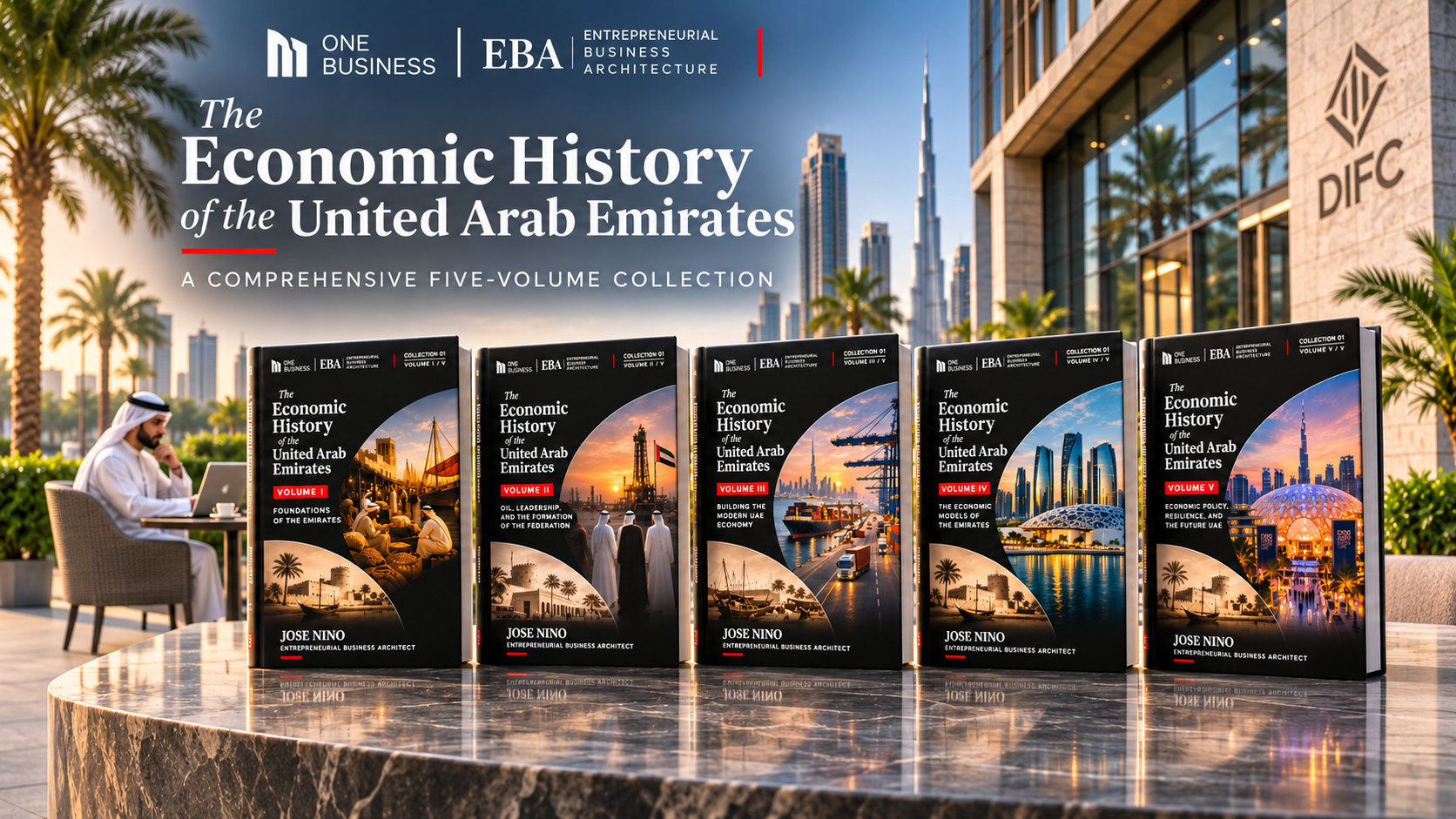
Understanding how the UAE developed its economic capabilities helps entrepreneurs interpret the investment environment emerging today. Studying contemporary capital networks, in turn, reveals how financial institutions, strategic partnerships, and productive enterprises interact to influence future opportunities.
The future of capital is not simply a question of how much money is available or which institutions control it. It is a question of how financial resources can be organized, allocated, and combined with capabilities capable of producing sustainable economic value.
For entrepreneurs, this perspective changes the objective from merely seeking investment toward developing businesses that deserve investment, attract suitable partners, serve real markets, and possess the organizational capacity to create lasting value.
Understand where capital is moving. Develop the capabilities that markets need. Build enterprises capable of participating in the next generation of economic growth.
ONE Business Dubai — Strategic Entrepreneurial Business Architecture Advisory Firm.
Editorial research based on the Abu Dhabi Finance Week 2026 programme announcements, ADGM institutional information, and the economic and entrepreneurial interpretation developed by ONE Business Dubai.
This article provides economic analysis and entrepreneurial education. It does not constitute investment advice, an offer of securities, or a representation that any institution participating in Abu Dhabi Finance Week will provide financing, establish co-investment vehicles, or enter into commercial agreements. Financial and regulated activities require appropriate professional advice and authorizations.