ONE BUSINESS / INSIGHTS / ARTICLE 01
Before Dubai Became a Global Business Hub
The Economic Foundations Every Entrepreneur Should Understand

Every year, entrepreneurs, investors, business founders, and international companies arrive in Dubai with plans to establish new enterprises, expand their commercial operations, access international markets, and participate in one of the world's most internationally connected business environments. Their preparations typically begin with questions about company formation, business registration, commercial licenses, free zones, taxation, banking arrangements, office requirements, and the practical conditions necessary to begin operating. These are legitimate and important considerations because every enterprise requires an appropriate legal and operational foundation. Yet there is another dimension of business preparation that receives considerably less attention, despite its importance for understanding the environment in which these entrepreneurs intend to invest their capital, develop their organizations, and pursue commercial opportunities: the economic history of Dubai and the United Arab Emirates.
The contemporary image of Dubai is so strongly associated with international finance, advanced infrastructure, modern architecture, aviation, tourism, real estate, logistics, and global commerce that it is easy to overlook the historical processes that made these achievements possible. The modern city presents the visible results of generations of commercial activity, institutional development, strategic investment, infrastructure construction, political leadership, and entrepreneurial adaptation. What visitors encounter today is not simply a collection of successful industries or impressive buildings. It is the outcome of an economic transformation that developed through changing historical circumstances, beginning long before the discovery of oil, the formation of the United Arab Emirates, or the emergence of the contemporary international business environment.
For entrepreneurs seeking to establish a business in Dubai, this distinction matters because understanding an economic environment requires more than identifying its present advantages. A commercial opportunity becomes more intelligible when the entrepreneur understands why a particular market developed, how its institutions emerged, what kinds of economic activities shaped its commercial culture, and which historical decisions contributed to its current structure. The conditions that make Dubai attractive to international business did not appear independently of one another. They developed through relationships among geography, trade, infrastructure, capital, institutions, political decisions, and private enterprise. Understanding those relationships can help entrepreneurs move beyond the immediate mechanics of company registration toward a deeper appreciation of the economic system in which their businesses will operate.
This is the central proposition behind The Economic History of the United Arab Emirates, a five-volume work by Jose Nino, published by ONE Business Learn. The collection examines the country's economic development from its earliest commercial foundations through oil, federation, institutional transformation, modern enterprise development, the distinctive economic models of the seven emirates, and the challenges shaping the future UAE economy. Its purpose is not merely to describe historical events, but to investigate the economic mechanisms through which opportunities were recognized, resources were mobilized, capabilities were developed, markets were connected, and economic systems were progressively constructed.
The first volume, Foundations of the Emirates, begins where any serious examination of the UAE's development must begin: before the modern country existed. It explores the geography, resource constraints, settlements, maritime commerce, trading relationships, ruling families, political arrangements, and distinct regional economies that formed the historical foundations of the contemporary Emirates. For business founders, these subjects offer more than historical background. They introduce fundamental questions about economic opportunity, commercial positioning, adaptation, resource allocation, and the development of capabilities under conditions of uncertainty.
The Modern Dubai Economy Cannot Be Understood Only Through Its Present Achievements
Dubai's contemporary business environment is frequently described through the industries and institutions that distinguish the city today. International entrepreneurs encounter a sophisticated network of commercial services, specialized business districts, transportation infrastructure, financial institutions, professional service providers, logistics facilities, and regulatory arrangements designed to support different forms of economic activity. These capabilities contribute to Dubai's position within international commercial networks and help explain why the city attracts entrepreneurs interested in regional expansion, international trading operations, professional services, technology, investment, and other business activities.
However, describing the present economic environment does not fully explain how that environment emerged. An airport, a port, a financial center, or a commercial district represents a capability that has been constructed through investment, organization, institutional arrangements, and accumulated experience. Its economic significance depends not only on its physical existence, but also on its relationships with customers, suppliers, enterprises, transportation networks, capital providers, regulatory systems, and international markets. The same principle applies to a city's wider business environment. The value of commercial infrastructure emerges from the activities it enables and the economic relationships it helps sustain.
Dubai's development therefore raises questions that are relevant to anyone studying business formation and entrepreneurship in the UAE. Why did commerce become such an important element of Dubai's economic identity? How did the city establish relationships with markets beyond the Arabian Peninsula? What made maritime connectivity economically significant before modern ports and airports existed? How did merchants respond to changing commercial conditions, and how did political leadership influence the environment in which trade and enterprise developed? These questions cannot be answered adequately by examining the contemporary skyline or the current procedures for obtaining a business license.
The historical foundations of Dubai's commercial economy were established through circumstances very different from those confronting modern entrepreneurs. Communities along the southern Gulf coast operated in environments characterized by limited freshwater, demanding climatic conditions, restricted agricultural possibilities, and relatively modest local resources. Their economic activities depended upon combinations of fishing, pearling, maritime transportation, oasis agriculture, regional exchange, and commercial relationships extending beyond their immediate territories. These activities were not modern entrepreneurship in the institutional sense, but they demonstrate that economic organization and commercial initiative existed long before contemporary corporations, free zones, or international financial centers.
The significance of this earlier history lies in understanding that the modern UAE did not emerge from an economic vacuum. Commercial practices, trading relationships, political institutions, maritime capabilities, and accumulated knowledge already existed. Later economic transformation would alter these foundations, sometimes dramatically, but it did not begin without historical precedents. For entrepreneurs, recognizing this continuity provides a more complete understanding of how commercial environments develop and why established economic relationships can remain influential even when industries, technologies, and institutions change.
Geography, Scarcity, and the Origins of Economic Opportunity
The economic history of the Emirates begins with geography because the physical environment established many of the constraints and possibilities that shaped the region's earliest economic activities. The southern coast of the Arabian Gulf did not possess the combination of extensive fertile land, abundant freshwater, and large agricultural resources that supported economic development in other regions. Desert conditions limited settlement and production, while access to water, coastal locations, navigable routes, and suitable trading points influenced where communities could establish durable economic activities. These constraints shaped the choices available to the people who inhabited the territory long before the modern Emirates emerged.
Yet geographical limitations did not eliminate economic possibilities. The coast also provided access to maritime routes connecting communities with commercial networks extending toward Persia, India, East Africa, and the wider Indian Ocean. Coastal settlements could participate in exchange relationships that were not dependent upon the productive capacity of their immediate surroundings. Maritime commerce allowed goods, people, knowledge, and commercial relationships to move across distances that would otherwise have restricted local economic development. In this environment, the significance of geography depended partly upon whether communities possessed the capabilities necessary to use their location effectively.
This distinction between possessing an advantage and developing the ability to exploit it is fundamental to economic history. A favorable location does not automatically produce a prosperous commercial center, just as access to a market does not guarantee the success of a business. Economic value emerges when resources, capabilities, relationships, and institutions are organized in ways that make productive activity possible. The coastal communities of the Gulf developed maritime knowledge, commercial practices, transportation capabilities, and relationships with external markets because these activities provided opportunities within an otherwise demanding environment.
The pearl economy illustrates how particular geographical conditions could support specialized economic activity. The shallow waters of the Gulf provided environments suitable for pearl oysters, creating opportunities for diving, maritime organization, financing, trading, and the development of commercial relationships connected to the demand for pearls in external markets. The industry involved more than the extraction of a natural product. It depended upon boats, labor, merchants, financing arrangements, distribution networks, and buyers whose willingness to purchase pearls connected local economic activity to broader commercial conditions.
For contemporary entrepreneurs, the historical importance of these relationships lies in the way they demonstrate the interaction between resources and economic organization. An opportunity does not become commercially valuable merely because a resource exists. It must be connected to demand, supported by operational capabilities, financed where necessary, and integrated into a system through which value can be exchanged. This principle remains relevant to businesses entering the UAE today, although the resources, technologies, institutions, and markets involved are fundamentally different from those of the historical pearl economy.
The entrepreneurial lesson is not that modern founders should reproduce historical trading practices. It is that opportunities must be evaluated in relation to the specific conditions of the environment in which they arise. A business model that performs effectively in one market may encounter different requirements in another because customer expectations, distribution systems, commercial relationships, regulatory arrangements, and competitive conditions differ. Understanding the economic characteristics of a market is therefore a necessary part of determining how an enterprise should be organized.
The Emirates Were Connected to International Commerce Before Modern Globalization
One of the most important historical foundations of the UAE economy is its longstanding connection to commercial activity beyond the Arabian Peninsula. The contemporary prominence of international trade can create the impression that the region's global commercial orientation emerged primarily through modern transportation infrastructure, international aviation, and specialized economic zones. These developments undoubtedly transformed the scale and sophistication of commercial activity, but the underlying relationship between the Gulf coast and wider trading networks has much older origins.
Maritime connections enabled coastal communities to participate in systems of exchange involving neighboring territories and more distant markets. These relationships were shaped by geography, sailing capabilities, seasonal conditions, political arrangements, merchant networks, and the economic demand for particular goods. Commercial activity required knowledge of routes, trading partners, prices, risks, and the practical conditions governing exchange. Merchants operating across these networks depended upon relationships and accumulated experience because commercial transactions often involved distance, uncertainty, and limited access to the institutional protections associated with modern business systems.
The development of such networks reveals an important characteristic of commercial economies: their productive possibilities are not determined exclusively by the resources available within their territorial boundaries. A community can develop economic activity by connecting producers and consumers, facilitating exchange, organizing transportation, providing commercial services, or occupying a position within a wider network of trade. The economic importance of an intermediary location depends upon the functions it performs within that network and the reliability with which those functions can be sustained.
This historical perspective helps explain why connectivity occupies such a prominent position in discussions of the contemporary UAE economy. Modern ports, airports, airlines, logistics enterprises, financial institutions, and business districts operate at a scale that would have been unimaginable to earlier generations. Nevertheless, they continue to address a fundamental economic problem: how to connect markets, mobilize resources, reduce obstacles to exchange, and create conditions under which commercial activity can expand.
For an entrepreneur considering company formation in Dubai, this history encourages a more precise examination of the intended business model. The relevant question is not simply whether Dubai is internationally connected, but how those connections can contribute to the particular enterprise being established. An international trading company may depend upon logistics and supplier relationships, while a professional services business may depend upon access to clients, specialized talent, and contractual networks. A technology enterprise may require different capabilities involving intellectual property, digital infrastructure, financing, and market access. The presence of an internationally connected business environment creates possibilities, but the entrepreneur must still determine which capabilities are necessary to convert those possibilities into a viable enterprise.
The economic history of the UAE demonstrates that connectivity becomes valuable through use, organization, and accumulated commercial activity. The modern entrepreneur must therefore distinguish between the general advantages of a location and the specific advantages that can be incorporated into an operating business. That distinction is particularly important when evaluating different emirates, free zones, mainland structures, and business activities, because their suitability depends upon the requirements of the enterprise rather than upon the general reputation of a particular commercial destination.
Dubai Before Oil: The Development of a Commercial Economy
Dubai's economic history is especially important for entrepreneurs because the city's commercial orientation developed before oil became a significant source of financial resources. Although hydrocarbons contributed to subsequent development, the foundations of Dubai's trading economy were established through earlier relationships involving maritime commerce, merchant communities, regional exchange, and political decisions affecting commercial activity. Understanding this history helps explain why Dubai cannot be adequately described as an economy created solely through petroleum wealth.
The development of Dubai as a commercial center involved the interaction of geographic position, access to maritime routes, the activities of merchants, and an evolving environment in which commercial exchange could take place. The economic significance of these relationships depended upon the ability of traders and commercial institutions to connect external markets, facilitate transactions, and adapt to changing economic conditions. Over time, commercial activity contributed to the accumulation of knowledge, relationships, and organizational capabilities that would influence later stages of development.
The pre-oil economy was not a continuous story of prosperity. Maritime industries were vulnerable to changing demand, competition, economic disruptions, and technological developments. The decline of the traditional pearling industry demonstrated the risks associated with dependence upon particular sources of income and external markets. Communities and merchants confronted circumstances in which established activities could no longer provide the same economic opportunities, requiring adaptation and the development of alternative commercial possibilities.
These experiences are relevant to modern entrepreneurship because they illustrate that economic development is not simply the expansion of activities that have previously succeeded. Markets change, technologies alter competitive conditions, and sources of demand can weaken or disappear. Enterprises that depend excessively upon a single product, customer group, distribution channel, or economic assumption may encounter difficulties when the environment changes. The capacity to recognize these changes and develop alternative capabilities is therefore an important component of entrepreneurial resilience.
Dubai's later development would involve infrastructure, institutions, enterprises, and investments that transformed the scale of its commercial economy. However, understanding the earlier period is necessary because it reveals the historical context from which those transformations emerged. The modern business environment was built upon a territory where commercial exchange, external market relationships, and adaptation had already shaped economic life. The specific institutions and technologies changed, but the broader importance of connecting economic opportunities with practical capabilities remained central.
For business founders, the lesson is not that historical success provides a model that can be copied without modification. Rather, Dubai's development encourages entrepreneurs to examine how economic opportunities are created, how commercial relationships are sustained, and how organizations respond when their original sources of advantage become insufficient. These are questions that remain relevant whether the enterprise operates in international trade, professional services, manufacturing, technology, hospitality, or another sector of the contemporary UAE economy.
The Seven Emirates Did Not Develop Through One Economic Model
Another essential principle in understanding the UAE economy is that the seven emirates possess different economic histories, resource positions, geographical characteristics, commercial traditions, and development priorities. The formation of a federation created a common national framework, but it did not eliminate the distinctions that had shaped the individual emirates over earlier generations. These differences are important for historical interpretation and remain relevant when entrepreneurs consider where and how to establish businesses within the country.
Dubai's development was strongly influenced by commerce and connectivity, while Abu Dhabi's economic trajectory reflected a different combination of geographical conditions, oasis activity, maritime livelihoods, natural resources, and the later transformation associated with petroleum. Sharjah developed through maritime activity and commercial relationships that would subsequently interact with industrial, educational, and cultural development. Ras Al Khaimah, Fujairah, Ajman, and Umm Al Quwain also followed distinct paths influenced by their locations, resources, populations, institutional circumstances, and opportunities for economic specialization.
The existence of these different trajectories demonstrates that economic development cannot be understood through a single universal formula. Similar regional conditions can produce different outcomes when communities possess different resources, face different constraints, establish different institutions, or pursue different economic activities. The modern UAE reflects this diversity through a national economy in which individual emirates contribute distinct capabilities and offer different environments for particular forms of enterprise.
This historical diversity has practical implications for international entrepreneurs. Establishing a company in the UAE should not automatically be treated as a decision about Dubai alone, nor should every business be directed toward the same type of registration structure. The appropriate jurisdiction depends upon the intended activity, commercial objectives, regulatory requirements, ownership arrangements, operating needs, customer relationships, and other relevant conditions. A business that requires a particular industrial facility may have different location requirements from a consulting firm, an international trading operation, or a digital services company.
Understanding the economic characteristics of different emirates provides context for evaluating these choices. Historical knowledge does not replace legal, regulatory, or commercial due diligence, but it helps explain why different economic environments developed and why their institutional and commercial characteristics may not be interchangeable. Entrepreneurs benefit from examining the relationship between their intended business model and the particular environment in which that model will operate.
The broader lesson is that business location should be treated as a strategic decision rather than a purely administrative procedure. Registration establishes a legal framework for an enterprise, but the long-term development of that enterprise depends upon its ability to access relevant markets, organize operations, attract appropriate resources, and establish productive relationships. The diversity of the UAE economy creates opportunities for different forms of business, but those opportunities must be evaluated individually.
What the UAE's Economic Foundations Teach Modern Entrepreneurs
The first volume of The Economic History of the United Arab Emirates introduces a recurring relationship among economic constraints, opportunity recognition, capability development, and commercial organization. Historical communities did not possess the technologies, institutions, financial resources, or international infrastructure available to contemporary businesses. Their decisions belonged to different circumstances and should be understood within those circumstances. Nevertheless, examining the economic mechanisms involved can reveal patterns that remain useful for entrepreneurial reasoning.
One such pattern concerns the distinction between recognizing an opportunity and possessing the capability to develop it. A geographic position may offer access to trading routes, but economic activity requires transportation, relationships, knowledge, organization, and demand. A natural resource may provide a potential source of income, but its commercial value depends upon extraction, financing, distribution, and markets. In modern entrepreneurship, a promising idea similarly requires capabilities involving products, customers, operations, capital, people, and execution. Opportunity recognition is important, but it is not sufficient by itself.
A second pattern concerns the importance of understanding the specific environment in which an enterprise operates. The early Gulf economy was shaped by conditions that made certain activities possible and others difficult. Successful economic organization required responses to those conditions rather than the assumption that the same activities could be developed everywhere. Modern entrepreneurs confront an analogous analytical requirement when evaluating industries, jurisdictions, customer groups, and competitive environments. A business model must be designed around the actual conditions of its intended market rather than around general expectations about economic opportunity.
A third pattern involves commercial relationships and access to external markets. The historical trading networks of the Gulf demonstrate that economic activity can depend upon connections extending far beyond the immediate productive resources of a territory. Modern enterprises similarly operate within networks of suppliers, customers, financing institutions, logistics providers, professional advisers, technology systems, and commercial partners. Their performance often depends upon how effectively these relationships are developed and coordinated.
A fourth pattern concerns adaptation. Economic activities that appear durable during one historical period may become vulnerable when markets, technologies, or external circumstances change. The history of pearling and regional commerce demonstrates the importance of understanding economic dependence and the consequences of changing demand. For contemporary businesses, this encourages attention to resilience, diversification where appropriate, operational flexibility, and the continuous evaluation of assumptions about customers and markets.
These lessons should not be interpreted as guarantees of commercial success. Historical experience provides evidence about how economic actors responded to particular circumstances, but it cannot eliminate the uncertainty associated with entrepreneurial decisions. Its value lies in improving the questions entrepreneurs ask, the relationships they examine, and the assumptions they consider before committing resources to a business.
Why Economic History Should Be Part of Your Preparation Before Starting a Business in Dubai
Entrepreneurs preparing to enter the UAE market frequently dedicate considerable attention to administrative requirements because those requirements are visible, immediate, and necessary. They compare company formation packages, licensing authorities, mainland and free zone options, banking requirements, and establishment costs. These decisions deserve careful analysis, particularly because the appropriate structure can depend upon the nature of the proposed activity and the commercial arrangements under which the business intends to operate.
However, administrative preparation should form part of a broader process of understanding the market. Obtaining a commercial license does not establish demand for a product, create relationships with customers, secure access to suitable suppliers, or determine whether an enterprise possesses the capabilities necessary to compete. The legal existence of a company is an important starting point, but it is not equivalent to the creation of a sustainable business. Entrepreneurs must also understand the economic environment, the commercial opportunities available to them, and the practical requirements of developing their intended activities.
The history of Dubai and the UAE provides a valuable foundation for that broader understanding because it explains how the contemporary environment developed. It reveals the significance of commercial connectivity, geographical constraints, merchant networks, institutions, and the different economic paths followed by the emirates. These subjects help entrepreneurs recognize that business opportunities emerge within economic systems that possess particular histories, capabilities, and institutional characteristics.
For an international founder, historical knowledge can therefore complement contemporary market research and professional advice. It can encourage a more informed examination of why particular industries developed, how economic relationships became established, and what kinds of capabilities have supported commercial activity over time. It also helps prevent the assumption that the visible success of a city automatically translates into commercial success for every enterprise established within it.
A founder who understands the historical importance of connectivity may ask more precise questions about access to customers and distribution networks. An entrepreneur who studies economic specialization may examine which emirate or commercial environment best supports a particular activity. A business owner who understands historical adaptation may place greater emphasis on resilience and the capacity to respond to changing conditions. These connections between historical knowledge and contemporary decisions represent the central educational value of studying economic development through an entrepreneurial perspective.
Introducing The Economic History of the United Arab Emirates — Volume I: Foundations of the Emirates
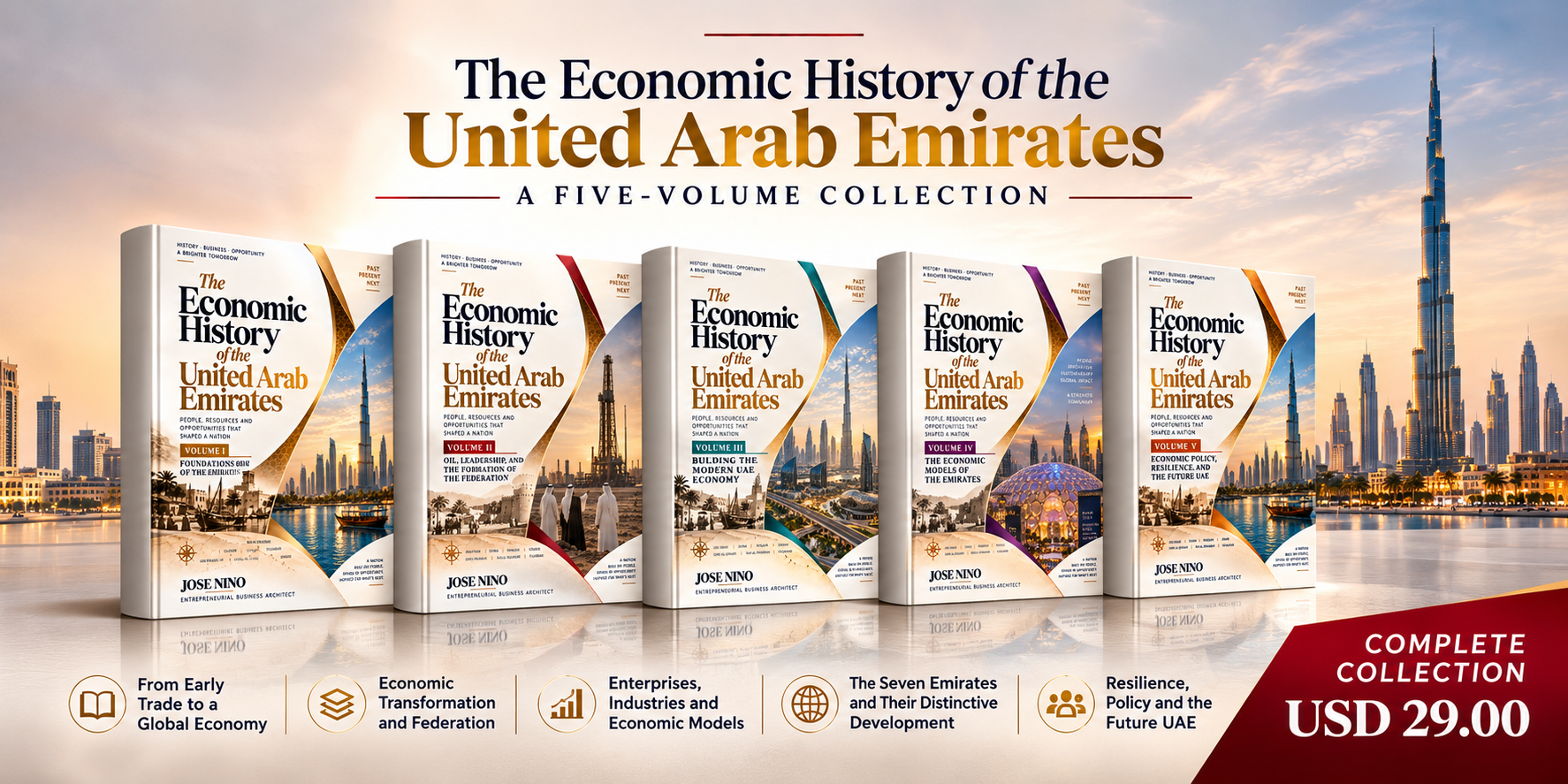
The Economic History of the United Arab Emirates, written by Jose Nino and published by ONE Business Learn, was developed to connect historical understanding with contemporary economic and entrepreneurial reasoning. The complete work consists of five volumes organized across forty chapters, examining the development of the Emirates from their earliest economic foundations through the institutions, enterprises, policies, and strategic transformations that shaped the modern UAE.
Volume I, Foundations of the Emirates, contains the first nine chapters and establishes the historical context necessary for understanding the country's subsequent economic transformation. Its opening chapters examine the geography and economic constraints of the Gulf coast, early settlements and regional trade networks, the emergence of ruling families, the maritime power of the Al Qasimi, and the treaties with Great Britain that influenced the political and commercial environment of the Trucial States. The volume then examines the distinct economic foundations of Dubai, Abu Dhabi, Sharjah, and the smaller emirates before the major transformations associated with oil and federation.
The complete five-volume collection continues with the historical and economic transformations associated with petroleum development, the formation of the federation, the construction of modern infrastructure and institutions, the development of commercial enterprises and industries, the distinctive economic models of the individual emirates, and the policies and challenges influencing the future UAE economy. Together, these subjects examine the relationship between resources, capital, leadership, infrastructure, institutions, commercial development, enterprise formation, economic specialization, resilience, and economic transformation.
The work also incorporates Entrepreneurial Business Architecture (EBA) as a contemporary analytical perspective where appropriate. Historical events are examined within their original economic and institutional circumstances before entrepreneurial lessons are considered. This distinction is important because the purpose is not to suggest that historical actors followed modern business frameworks, but to investigate whether their experiences reveal economic mechanisms that can inform contemporary entrepreneurial understanding.
The collection is intended for entrepreneurs, founders, investors, business owners, executives, students of economic development, and international professionals who want to understand the UAE beyond its contemporary commercial image. It offers a historical foundation for examining how opportunities emerged, how capabilities accumulated, how economic institutions developed, and how the seven emirates became part of a modern national economy connected to international markets.
Discover the Complete Five-Volume Collection — USD 29.99
The Economic History of the United Arab Emirates by Jose Nino is available as a complete five-volume digital PDF collection for USD 29.99. Explore the historical foundations of the Emirates, the transformation associated with oil and federation, the enterprises that built the modern economy, the distinctive development models of the seven emirates, and the economic strategies shaping the country's future. The collection is published by ONE Business Learn and delivered in digital PDF format, with all five volumes included in the collection price.
From Understanding the UAE Economy to Establishing Your Own Business
Historical knowledge provides a foundation for understanding an economic environment, but entrepreneurs who intend to establish commercial operations must also translate their objectives into appropriate legal and operational arrangements. Choosing where to register a company, determining the relevant business activity, understanding licensing requirements, and coordinating the necessary documentation are practical steps that require attention to the circumstances of each proposed enterprise.
ONE Business Dubai supports entrepreneurs, founders, investors, and international companies interested in establishing and registering businesses in the United Arab Emirates. Our UAE Company Formation & Business Registration Services are designed to assist clients with the company establishment process, including preliminary guidance concerning available registration options, coordination of relevant requirements, preparation and submission support where applicable, and assistance throughout the agreed formation process.
The appropriate company structure depends upon the proposed business activity, the emirate or jurisdiction, the applicable licensing authority, and the operational requirements of the enterprise. Mainland companies and free zone entities may involve different regulatory conditions, licensing arrangements, and commercial considerations. For that reason, company formation should begin with an evaluation of the intended business rather than with the assumption that a particular registration package is suitable for every entrepreneur.
UAE Company Formation & Business Registration Services — Professional Fees from USD 1,200 + Government Fees
ONE Business Dubai assists entrepreneurs and international investors seeking to establish businesses in Dubai and across the United Arab Emirates. Our professional service fees start from USD 1,200, excluding applicable government charges, commercial license fees, immigration-related costs, and other third-party expenses where required. The final scope of services and total estimated cost depend upon the jurisdiction, business activity, registration requirements, and services requested. Contact our team to discuss your proposed enterprise and request a tailored quotation.
Request UAE Company Formation & Business Registration Assistance
Conclusion: The Future of Your Business Begins With Understanding the Economic Foundations of Its Market
The economic history of the United Arab Emirates demonstrates that the development of a commercial economy involves much more than the possession of natural resources, a favorable geographic position, or access to capital. Economic opportunities become productive through the development of capabilities, the organization of commercial relationships, the construction of institutions, the mobilization of resources, and the ability to adapt when circumstances change. The modern UAE reflects the cumulative effects of these processes across different historical periods and among seven emirates whose economic trajectories were never identical.
For entrepreneurs arriving in Dubai today, understanding this history offers an opportunity to approach the business environment with greater depth. The city that now attracts international companies, investors, and founders was shaped by commercial traditions, maritime connections, economic constraints, institutional decisions, and generations of adaptation that preceded its contemporary achievements. Recognizing these foundations can help entrepreneurs distinguish between the visible advantages of a market and the economic mechanisms through which those advantages developed.
The first volume of The Economic History of the United Arab Emirates begins this exploration by examining the world that existed before oil, federation, and the construction of the modern economy. It establishes why geography mattered, how communities developed commercial capabilities, why trading networks became important, and how the individual emirates began following distinct economic paths. These foundations provide the context necessary for understanding the transformations examined throughout the remaining volumes.
Entrepreneurs cannot reproduce the historical development of an entire economy, nor can the study of history guarantee the success of an individual enterprise. They can, however, learn to examine opportunities more carefully, recognize the importance of capabilities and relationships, understand the conditions that shape markets, and approach economic decisions with a stronger appreciation of uncertainty and adaptation. The value of economic history lies not in providing a formula for success, but in developing the knowledge and perspective necessary to make more informed entrepreneurial decisions.
Before building a business in Dubai, understand how Dubai was built. Discover The Economic History of the United Arab Emirates, the complete five-volume digital collection by Jose Nino, and explore the historical decisions, commercial networks, economic institutions, and entrepreneurial lessons that help explain the country's remarkable transformation.
Discover the Complete Five-Volume Collection — USD 29.99
Contact ONE Business Dubai for UAE Company Formation Services