ONE BUSINESS / INSIGHTS / ARTICLE 31
Business Bankability and Financial Readiness in the UAE
Building financially credible, resilient and investment-ready businesses in the United Arab Emirates

Establishing a company in the United Arab Emirates is an important entrepreneurial milestone, but legal incorporation alone does not make a business financially prepared for growth. Entrepreneurs must also develop the financial capabilities, operational systems and organizational discipline necessary to transform a registered company into a credible economic enterprise.
Dubai and the wider United Arab Emirates offer an entrepreneurial environment supported by sophisticated financial institutions, international capital markets and business development initiatives. However, the ability to benefit from these opportunities depends substantially on how entrepreneurs design, manage and develop their businesses.
Business bankability should therefore be understood not simply as the ability to obtain a loan, but as the capacity of an enterprise to demonstrate financial credibility, economic viability, operational consistency and sustainable repayment capacity. These characteristics must be developed throughout the entrepreneurial journey rather than improvised when external financing becomes necessary.
Understanding Business Bankability
Business bankability describes the extent to which an enterprise can demonstrate that it represents a credible financing opportunity. A bankable business possesses an economic structure that allows financial institutions to understand its activities, evaluate its performance and assess its ability to meet financial obligations.
For entrepreneurs operating in the UAE, this means developing a business that can explain where its revenue originates, how its resources are allocated, what generates its profitability and how its financial commitments will be fulfilled. A compelling entrepreneurial vision is valuable, but financial credibility requires evidence that the vision can be translated into sustainable economic activity.
Bankability is not a permanent certification or a guarantee of financing. It is a condition that evolves alongside the enterprise, influenced by its financial performance, management capabilities, market environment and the requirements of individual financial institutions.
Financial Readiness Begins Before Financing
One of the most consequential mistakes entrepreneurs make is treating financial preparation as an activity that begins when a business needs money. By that stage, the enterprise may already be experiencing liquidity pressures, operational difficulties or limitations that make obtaining financing more challenging.
Financial readiness begins during business design. Entrepreneurs must understand their initial capital requirements, operating expenses, revenue assumptions, working capital needs and the financial consequences of their commercial decisions.
A business designed around realistic economic assumptions is better positioned to identify funding requirements before they become emergencies. This proactive approach also allows entrepreneurs to distinguish between financing that supports productive expansion and borrowing that merely postpones unresolved operational problems.
Building a Financially Sustainable Business Model
Financial readiness requires more than identifying a profitable business opportunity. It requires designing an enterprise capable of converting that opportunity into recurring economic value.
Entrepreneurs must understand their revenue model, pricing strategy, customer acquisition costs, operating expenses and contribution margins. These interconnected elements determine whether the business can generate sufficient resources to maintain its operations, reinvest in development and fulfil financial obligations.
For example, a distribution company operating in Dubai may experience substantial revenue growth while simultaneously facing deteriorating liquidity. If customers receive extended payment terms while suppliers demand immediate payment, every additional sale may increase the company's working capital requirements.
Without appropriate financial planning, commercial success can paradoxically create financial instability.
A financially sustainable business model must therefore consider the relationship between profitability, liquidity, operational capacity and growth. Entrepreneurs should evaluate not only how much money the business can generate, but also when that money becomes available and how much capital is required to sustain operations.
Developing Financial Intelligence as an Entrepreneurial Capability
Financial management should not be regarded exclusively as the responsibility of accountants, financial directors or external advisors. Entrepreneurs must develop sufficient financial intelligence to understand the economic consequences of their decisions.
Hiring employees, expanding into new markets, acquiring equipment, offering customer credit and increasing marketing expenditure are all decisions with financial implications.
An entrepreneur who understands financial information can distinguish between productive investment and unnecessary expenditure, recognize emerging liquidity problems and evaluate whether the enterprise possesses the financial capacity to pursue new opportunities.
Developing this capability does not require every entrepreneur to become a professional accountant. It requires understanding how financial information reflects the operational reality of the business and using that information to make better strategic decisions.
Financial intelligence becomes particularly important in internationally connected business environments such as Dubai, where companies may operate across multiple currencies, jurisdictions, supply chains and customer markets.
Establishing Reliable Financial Records
Reliable financial records provide the foundation upon which business credibility is constructed. Without accurate and consistent financial information, entrepreneurs may struggle to understand their own performance or demonstrate the economic viability of their enterprises to financial institutions.
A business should maintain accounting records that accurately reflect its revenues, expenses, assets, liabilities and financial commitments. Supporting documentation should allow transactions to be understood and reconciled with actual business activity.
Financial statements should be developed as management instruments rather than documents prepared exclusively for regulatory compliance or financing applications.
The income statement allows entrepreneurs to evaluate profitability. The balance sheet provides insight into the financial position of the enterprise. The cash flow statement helps explain how financial resources move through the organization.
Together, these instruments enable entrepreneurs to assess whether their businesses are becoming stronger, maintaining stability or experiencing underlying financial deterioration.
Separating Personal and Corporate Finances
One of the foundational principles of financial readiness is establishing a clear distinction between the entrepreneur's personal finances and those of the enterprise.
During the early stages of entrepreneurship, founders frequently contribute personal capital, cover business expenses using personal funds or reinvest income directly into operations. Although this may be necessary during business creation, these transactions should be documented appropriately.
As the enterprise develops, maintaining unclear boundaries between personal and corporate finances can create accounting inconsistencies, complicate tax compliance and reduce the transparency of business operations.
A financially credible enterprise should establish clear procedures for shareholder contributions, director remuneration, expense reimbursements, distributions and other transactions involving its owners.
This financial separation reinforces the organizational independence of the business and supports its development into an enterprise capable of operating beyond the immediate financial circumstances of its founder.
Cash Flow as the Foundation of Financial Resilience
Profitability does not automatically translate into liquidity. A profitable business may still encounter serious financial difficulties when incoming payments arrive later than its financial obligations become due.
Cash flow management allows entrepreneurs to understand whether sufficient resources will be available to pay employees, suppliers, landlords, government obligations and financing commitments.
Consider a hypothetical UAE technology services company generating AED 150,000 in monthly invoiced revenue and incurring AED 110,000 in monthly operating expenses. Although the company appears profitable, customers may take several months to settle invoices.
If operating expenses must be paid immediately, the enterprise may require significant working capital simply to maintain normal operations. This illustrates why financial readiness cannot be evaluated solely through revenue or accounting profit.
Entrepreneurs should develop rolling cash flow forecasts that reflect realistic collection periods, contractual obligations, seasonal fluctuations and potential delays.
The objective is not to predict the future perfectly but to anticipate financial pressure early enough to make informed decisions.
Managing Working Capital Strategically
Working capital connects the commercial activities of an enterprise with its financial capacity to operate.
Businesses involved in international trade, manufacturing, construction and distribution may need to commit substantial resources before receiving payment from customers. They may purchase inventory, pay transportation costs, finance production or execute contractual obligations weeks or months before generating cash receipts.
Entrepreneurs must understand the duration and financial implications of this operating cycle.
Negotiating supplier payment terms, improving receivables collection, managing inventory efficiently and establishing appropriate customer credit policies can reduce the amount of capital required to sustain operations.
These improvements may strengthen the financial position of the enterprise without requiring additional borrowing.
In this context, working capital management becomes an entrepreneurial capability that contributes directly to financial independence, operational resilience and sustainable business development.
Understanding Financial Performance Indicators
Financial readiness improves when entrepreneurs establish measurable indicators that allow them to evaluate business performance consistently.
Gross profit margins help determine whether products and services generate sufficient economic value relative to their direct costs. Operating margins provide insight into the efficiency of the organization. Liquidity indicators help evaluate the company's capacity to meet short-term obligations.
Debt service coverage provides another useful perspective by comparing available cash flow with scheduled debt payments.
For example, if an enterprise generates AED 360,000 annually in cash available for debt service and faces annual debt repayments of AED 240,000, its illustrative debt service coverage ratio is 1.5.
This indicates that the company generates AED 1.50 in available cash for every AED 1.00 of scheduled debt service under the assumptions used in the calculation. It does not establish automatic financing eligibility, since financial institutions may use different definitions, adjustments and assessment requirements.
Entrepreneurs should monitor these indicators over time rather than relying on isolated measurements. The objective is to identify patterns, understand emerging risks and determine whether business development is producing genuine financial improvement.
Developing Financial Forecasts and Scenario Planning
Financial projections help entrepreneurs understand the potential consequences of strategic decisions before committing substantial resources.
A credible financial forecast should be supported by realistic assumptions concerning customer demand, pricing, operating costs, payment periods, capital expenditure and financing requirements.
Entrepreneurs should avoid developing projections that merely demonstrate attractive growth rates without explaining how that growth will be achieved.
Scenario planning strengthens financial readiness by examining how the business might perform under different economic conditions.
A company considering expansion in Dubai could evaluate how its financial position would change if sales developed more slowly than expected, operating expenses increased or customer payments were delayed.
By understanding these possibilities in advance, entrepreneurs can establish contingency measures, maintain appropriate reserves and make more disciplined investment decisions.
Building Organizational Credibility Through Corporate Governance
Corporate governance is often associated with large corporations, but its underlying principles are equally relevant to startups and small businesses.
Financially credible enterprises establish clear responsibilities, documented decision-making processes and appropriate controls over the use of company resources.
Entrepreneurs should understand who has authority to approve expenditure, enter contractual commitments, manage banking relationships and make significant investment decisions.
These procedures become increasingly important as a company grows, employs additional professionals, attracts investors or establishes international operations.
Sound governance reduces organizational dependence on individual founders and helps demonstrate that the enterprise possesses the institutional capabilities necessary to manage resources responsibly.
Choosing Financing That Matches the Business Opportunity
Financial readiness also involves understanding which forms of financing are appropriate for different entrepreneurial objectives.
Short-term working capital requirements differ fundamentally from the financial requirements associated with purchasing machinery, establishing production facilities or expanding into new markets.
Using short-term borrowing to fund investments that will generate returns over several years may create unnecessary liquidity pressure. Conversely, obtaining long-term financing for a temporary operational requirement may introduce unnecessary costs and commitments.
Entrepreneurs should evaluate the relationship between the purpose of financing, the expected economic return, the timing of cash generation and the repayment structure.
In the UAE, institutions such as Emirates Development Bank provide financing solutions covering areas such as productive assets, working capital, business expansion and credit guarantees, subject to applicable eligibility criteria and institutional assessment.
The existence of these opportunities reinforces the importance of developing enterprises capable of identifying and utilizing suitable financial resources responsibly.
Preparing a Continuous Financial Readiness System
Rather than assembling financial documentation only when external financing becomes necessary, entrepreneurs should establish a continuous system of financial preparation.
Monthly accounting reviews can help ensure that records remain accurate. Regular cash flow forecasts can identify emerging liquidity requirements. Periodic strategic reviews can evaluate profitability, customer concentration, capital requirements and operational performance.
Contracts, corporate records, financial statements, bank statements and relevant regulatory documentation should be maintained systematically.
This approach allows entrepreneurs to respond more effectively when commercial opportunities arise.
A business that receives an unexpected opportunity to expand its operations should be able to evaluate the financial implications using existing information rather than beginning an extensive process of reconstructing its financial history.
Continuous financial preparation transforms bankability from an occasional administrative exercise into a permanent organizational capability.
Entrepreneurial Business Architecture and Financial Readiness
Within Entrepreneurial Business Architecture (EBA), financial readiness is understood as an outcome of the systematic development of entrepreneurial capabilities and organizational structures.
Through MasterUP, entrepreneurs strengthen their personal effectiveness, financial intelligence and decision-making capabilities. ExploreUP supports the identification and evaluation of economically viable business opportunities.
The Startup framework addresses the development of the organizational, legal, operational and economic foundations necessary to establish an enterprise. PresenceUP and MarketUP support the development of commercial visibility, customer relationships and market-generated revenue.
ScaleUP addresses the organizational and financial capabilities required to expand an enterprise sustainably.
Financial readiness connects these frameworks because the capacity to obtain and manage capital depends on the quality of the business architecture developed throughout the entrepreneurial process.
An enterprise with weak market validation, inadequate operational systems or inconsistent financial management cannot become sustainably bankable merely by obtaining additional capital.
The objective is to create businesses that use financing as a strategic instrument for productive development rather than as a substitute for sound entrepreneurial architecture.
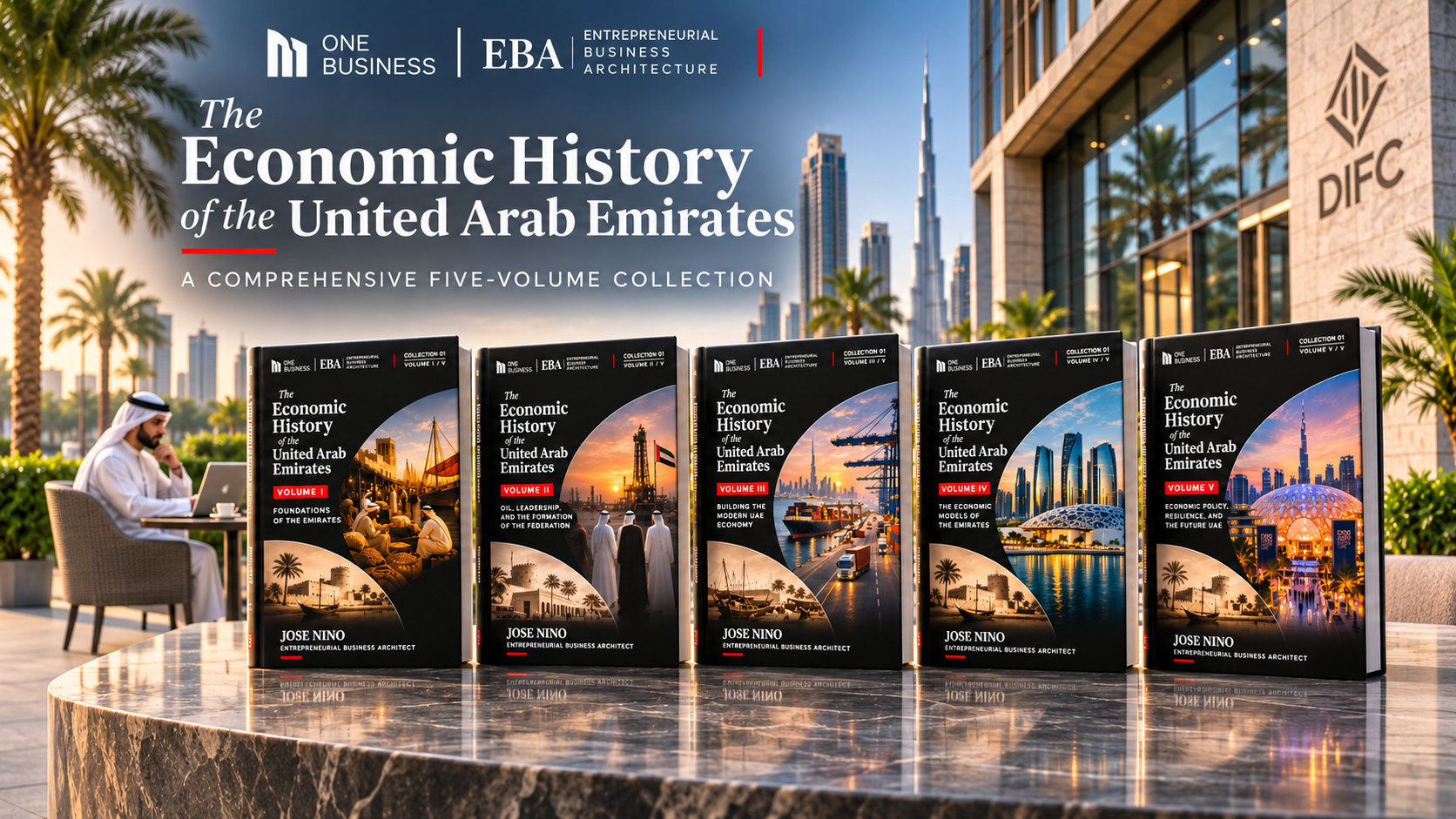
Understanding the Economic Development of the United Arab Emirates
The financial opportunities available to entrepreneurs in the UAE are closely connected to the country's historical economic transformation.
Understanding how the Emirates developed their commercial institutions, infrastructure, international trade relationships and financial ecosystem provides entrepreneurs with a broader perspective on the environment in which they establish and develop their businesses.
The Economic History of the United Arab Emirates, part of our Entrepreneurial Business Architecture educational collection, explores the historical processes that contributed to the country's emergence as a globally connected economic centre.
Through this five-volume collection, entrepreneurs can develop a deeper understanding of the relationship between economic development, institutional transformation, entrepreneurship and business opportunity.
Explore The Economic History of the United Arab Emirates — Complete Collection
From Company Formation to Financially Credible Enterprises
International entrepreneurs establishing businesses in Dubai and the United Arab Emirates should approach company formation as the beginning of a structured business development journey.
Selecting an appropriate legal structure, identifying suitable business activities and establishing the corporate foundations of an enterprise are important decisions that influence its subsequent operational and financial development.
ONE Business Dubai assists international entrepreneurs with company formation and business registration while promoting a broader educational approach through Entrepreneurial Business Architecture.
Our philosophy is to help entrepreneurs understand not only how to establish companies but also how to develop economically viable, organizationally sustainable and financially responsible enterprises.
Company registration does not guarantee access to banking services or external financing. However, combining appropriate corporate foundations with continuous entrepreneurial development and disciplined financial management can help businesses become better prepared to pursue future opportunities.
Conclusion: Build Bankability Before You Need Capital
The most financially resilient businesses are not necessarily those with the greatest access to borrowing. They are those that understand their economic structures, manage resources responsibly and possess the organizational capabilities necessary to pursue sustainable growth.
For entrepreneurs in the United Arab Emirates, developing financial readiness should remain a strategic priority throughout the entrepreneurial journey.
By combining financial intelligence, accurate records, effective cash flow management, responsible governance and disciplined business architecture, entrepreneurs can strengthen the credibility and long-term sustainability of their enterprises.
Bankability is not simply something an entrepreneur requests from a financial institution. It is something an entrepreneur progressively builds.
Start Your Business in Dubai and the United Arab Emirates
ONE Business Dubai provides professional company formation and business registration services in Dubai and across the United Arab Emirates for a professional service fee of USD 1,200, plus applicable government fees.
To facilitate international business formation, we offer flexible payment options for entrepreneurs worldwide:
- Bank Transfer: USD, EUR, GBP and AED.
- Credit Card: Subject to an additional 5% processing fee.
- Cryptocurrency: USDT via the TRC20 or Polygon network.
Through Entrepreneurial Business Architecture (EBA), our educational resources, our book collection and our professional business formation services, we help international entrepreneurs develop the knowledge and establish the legal foundations necessary to create and grow their businesses in the United Arab Emirates.
Contact ONE Business Dubai today to discuss your business formation requirements, request a personalized quotation and begin your entrepreneurial journey in the UAE.