ONE BUSINESS / INSIGHTS / ARTICLE 26
Corporate Social Responsibility in Dubai: How Entrepreneurs Can Build More Competitive, Profitable, and Sustainable Businesses
How the UAE Companies for Good 2031 Strategy, Majra's national initiatives, and Entrepreneurial Business Architecture can help international entrepreneurs strengthen business performance, develop organizational capabilities, and create lasting economic and social value.

Dubai has become one of the most internationally recognized destinations for entrepreneurs seeking to establish companies, develop commercial relationships, and participate in an economy characterized by international connectivity, infrastructure development, institutional innovation, and access to diverse markets. Every year, international founders examine opportunities in the United Arab Emirates with ambitions ranging from establishing small professional service businesses to developing technology companies, manufacturing enterprises, international trading operations, and organizations capable of expanding throughout the Gulf region. Their initial attention frequently concentrates on company formation, commercial licensing, taxation, banking arrangements, and the practical requirements necessary to establish a legal business presence. These matters are essential because entrepreneurs need an appropriate corporate foundation before undertaking many commercial activities. However, the creation of a legally registered company does not automatically produce a competitive enterprise, sustainable profitability, or the organizational capabilities required for long-term growth. Those outcomes depend on how effectively entrepreneurs identify genuine opportunities, understand their customers, develop their people, organize resources, and build businesses capable of creating meaningful value.
Within this increasingly sophisticated business environment, corporate social responsibility has emerged as an important consideration for entrepreneurs who want to develop enterprises capable of competing successfully while contributing to broader economic, environmental, and social objectives. Corporate social responsibility has traditionally been associated with charitable donations, community sponsorships, employee volunteering, and initiatives undertaken by established companies to support social causes. Although these activities remain valuable when they address genuine needs, the contemporary significance of responsible business development extends beyond philanthropy. It concerns the way organizations manage their operations, employ and develop people, establish relationships with suppliers, communicate with customers, protect resources, and respond to the wider consequences of their commercial decisions. For entrepreneurs in Dubai, these responsibilities create opportunities to improve operational efficiency, strengthen commercial credibility, reduce avoidable risks, and develop capabilities that support the long-term performance of their businesses.
The relationship between responsible business practices and commercial success becomes clearer when entrepreneurs recognize that many economic, environmental, and social challenges are connected to operational inefficiencies and unmet market needs. A logistics company that improves transportation planning may reduce operating costs while lowering unnecessary fuel consumption. A hospitality enterprise that manages inventory more effectively may protect its profitability while reducing food waste. A manufacturing business that improves production efficiency may decrease material losses while strengthening quality and delivery reliability. Similarly, a professional services company that invests in employee development may improve customer satisfaction while creating opportunities for individuals to acquire valuable competencies. In each case, the responsible activity is connected to the business model through a practical mechanism capable of producing economic value. The opportunity does not arise simply because the organization adopts a positive social message; it arises because the entrepreneur identifies a problem, develops an effective solution, and incorporates that solution into the organization's productive activities.
This approach is consistent with the principles of Entrepreneurial Business Architecture (EBA), which examines entrepreneurship and enterprise development as an integrated process beginning with the individual and progressing through entrepreneurial capability development, opportunity discovery, business creation, market development, and organizational growth. From this perspective, responsible enterprise development is not a separate activity that founders consider only after achieving profitability. It is a dimension of the decisions through which a business is designed, established, managed, and expanded. Entrepreneurs who incorporate responsible practices into their original business architecture can develop organizations that are better prepared to manage resources efficiently, respond to customer expectations, maintain credible commercial relationships, and adapt to changing economic conditions. This does not mean that every socially responsible initiative will generate a financial return or that every sustainable business model will succeed. Rather, it means that entrepreneurs should systematically investigate where responsible practices can strengthen the capabilities through which their enterprises create value.
The economic development of the United Arab Emirates provides a valuable historical context for understanding this relationship. The country's transformation into an internationally connected economy emerged through decades of interaction among leadership, institutions, infrastructure, productive resources, commercial relationships, and entrepreneurial activity. The development of ports, transportation systems, industrial facilities, financial institutions, business jurisdictions, and specialized economic sectors helped expand the opportunities available to individuals and enterprises. These processes demonstrate that economic transformation is not produced by capital accumulation alone; it also depends on the capabilities through which resources are organized and converted into productive economic activity. Entrepreneurs interested in understanding these historical foundations can explore The Economic History of the United Arab Emirates, the comprehensive five-volume research collection presented by ONE Business Dubai. The collection offers important insights into how the country's economic environment developed and why institutions, productive capabilities, and commercial relationships continue to shape contemporary entrepreneurial opportunities.
For international entrepreneurs considering entry into this market, the first practical step is establishing an appropriate legal structure for the intended commercial activities. ONE Business Dubai provides professional company formation and business registration services in the United Arab Emirates for USD 1,200 plus applicable government, licensing, and third-party costs, supporting entrepreneurs as they evaluate available establishment options and prepare the foundations of their businesses. Eligible applications may be completed within 24 hours where the selected jurisdiction, proposed business activities, complete documentation, and relevant authority approvals permit. Entrepreneurs can learn more about these services through ONE Business Dubai's company formation services. Once the legal foundation has been established, however, the entrepreneur's central responsibility becomes developing an organization capable of converting opportunities into sustainable commercial performance. Corporate social responsibility can contribute to that objective when it is integrated intelligently into the enterprise's operating model and long-term development strategy.
From Corporate Philanthropy to Competitive Advantage: Understanding the Business Value of Responsibility
The traditional relationship between corporate philanthropy and economic activity has often involved businesses generating profits through their ordinary operations and subsequently allocating a portion of their financial resources to charitable organizations, cultural activities, educational initiatives, or other community projects. This model can provide meaningful assistance to individuals and institutions, and charitable contributions have played an important role in the social and cultural life of the United Arab Emirates. Nevertheless, entrepreneurs should distinguish the value of philanthropic activities from the broader responsibilities involved in operating a commercially sustainable enterprise. A company may make significant donations while maintaining inefficient processes, inadequate employee-development practices, unreliable customer service, or weak financial controls. Although the charitable contribution may benefit its recipients, it does not necessarily improve the internal capabilities of the business or address the effects of its ordinary commercial activities. A more integrated understanding of corporate responsibility requires examining the relationship between the way an enterprise creates economic value and the consequences of that process for its customers, employees, suppliers, communities, and operating environment.
The concept of shared value offers an important framework for entrepreneurs seeking to understand this relationship. Shared value describes circumstances in which enterprises pursue commercial opportunities through activities that also address meaningful economic or social needs. The objective is not simply to redirect profits toward worthwhile causes but to investigate whether the organization's products, services, operations, and capabilities can generate benefits that reinforce its commercial performance. Consider a Dubai-based entrepreneur developing technology that helps commercial buildings monitor and reduce unnecessary energy consumption. Property owners and facility managers have financial reasons to control operating expenses, while reducing avoidable energy consumption may also contribute to environmental objectives. If the technology performs reliably and customers are willing to pay for the resulting savings, the enterprise can generate revenue through a product whose commercial value is directly connected to improved resource efficiency. Its environmental contribution becomes part of the mechanism through which the business serves its market rather than an unrelated activity financed through charitable expenditure.
The same principle can be observed in manufacturing, hospitality, transportation, professional education, and numerous other industries that contribute to Dubai's economic development. A manufacturing enterprise may improve its production processes to reduce material waste, lower costs, and strengthen product quality. A restaurant may improve inventory management, demand forecasting, and purchasing practices to reduce spoilage and protect its operating margins. A logistics business may develop more efficient delivery schedules that improve customer service while reducing unnecessary travel. An educational enterprise may provide commercially viable training that helps individuals develop capabilities relevant to employment or entrepreneurship. These examples illustrate how economic performance and broader positive outcomes can sometimes reinforce one another, although the strength of that relationship must be established through actual commercial and operational evidence. Entrepreneurs should avoid assuming that environmental efficiency, employee development, or responsible sourcing automatically generates superior financial results. Every initiative requires appropriate analysis of costs, customer demand, implementation requirements, and measurable performance.
For early-stage entrepreneurs, this distinction is particularly important because financial resources are usually limited and decisions involving capital allocation can determine whether a business survives its initial development period. Founders frequently encounter competing priorities involving licensing, facilities, equipment, marketing, technology, recruitment, inventory, and working capital. An ambitious corporate responsibility program that consumes substantial resources without contributing to customer value, operational reliability, or another clearly defined objective may weaken the organization. By contrast, initiatives that improve the efficiency of existing activities can help entrepreneurs develop responsible practices while protecting the financial foundations of their enterprises. The appropriate starting point is therefore not to imitate the corporate social responsibility programs of multinational organizations but to examine the specific problems and opportunities present within the business being created. The entrepreneur should investigate where resources are wasted, where customer expectations are not being satisfied, where operating risks exist, and where improvements could create benefits that justify the investment required.
Operational efficiency provides one of the clearest connections between responsible business development and commercial competitiveness. Every organization consumes resources to produce and deliver products or services, including employee time, materials, energy, transportation, equipment, facilities, technology, and financial capital. When these resources are poorly managed, the enterprise incurs costs without necessarily generating corresponding customer value. Better procurement procedures can reduce excess inventory and purchasing errors, while improved production planning may decrease material losses and operational interruptions. More effective internal communication can reduce repetitive administrative work, and appropriate training may strengthen employees' ability to perform their responsibilities. Some of these improvements can also reduce environmental pressures or contribute to employee well-being, but their commercial significance depends on actual results. Entrepreneurs should measure whether the changes improve profitability, reliability, productivity, customer satisfaction, or another relevant performance indicator rather than relying on general assumptions about the benefits of sustainability.
Responsible business practices also influence the development of corporate reputation, which is particularly important in an international commercial environment where customers and suppliers frequently establish relationships with organizations they have not previously encountered. Reputation is not created exclusively through advertising, public relations, or promotional statements. It develops through repeated experiences involving product quality, contractual reliability, transparent communication, fair commercial practices, and the consistency with which companies fulfill their commitments. An organization that treats its employees responsibly, maintains accurate corporate records, communicates clearly with customers, and delivers dependable services may strengthen its credibility over time. However, such outcomes are neither automatic nor guaranteed; reputation depends on the experiences of stakeholders and the extent to which the business demonstrates consistent performance. Entrepreneurs should therefore understand responsible conduct as part of the capabilities that support trust rather than a superficial means of improving brand appearance.
In Dubai, where businesses compete for relationships with international corporations, institutional customers, investors, and commercially sophisticated buyers, this credibility can become particularly relevant. Different customers may evaluate suppliers according to distinct combinations of price, technical performance, operational reliability, compliance, governance, and environmental or social characteristics. A construction company may need to demonstrate suitable safety procedures and dependable project execution, while a technology provider may be evaluated through information security, service availability, and responsible data management. A food supplier may face requirements concerning quality control, traceability, and reliable delivery, whereas a professional consultancy may differentiate itself through confidentiality, expertise, and transparent commercial arrangements. Responsible business practices contribute to competitive advantage when they correspond to genuine customer expectations and strengthen the organization's capacity to satisfy those expectations. This is why entrepreneurs should investigate the purchasing criteria of their intended market before deciding which initiatives deserve priority.
The relationship between corporate responsibility and competitiveness therefore requires a disciplined understanding of enterprise development. Entrepreneurs must identify opportunities through market research, examine the resources and capabilities necessary to address them, and design organizations capable of delivering consistent value. Responsible practices should influence these decisions where they improve business performance, support stakeholder relationships, or reduce meaningful risks. They should not replace the commercial discipline required to establish an enterprise capable of generating sustainable revenue. Within Entrepreneurial Business Architecture, this integration is essential because the quality of a business depends on the interaction of its capabilities rather than the attractiveness of its individual initiatives. A responsible enterprise becomes more competitive when its commitments are translated into stronger operations, better customer outcomes, credible governance, and commercially sustainable activities.
Majra, the UAE Companies for Good 2031 Strategy, and the Institutional Development of Responsible Business
The United Arab Emirates has developed institutional initiatives intended to encourage corporate responsibility, strengthen private-sector contributions to national development, and improve the visibility of activities that generate measurable economic, environmental, and social value. Within this environment, Majra — National CSR Fund plays an important role in promoting responsible enterprise practices and encouraging organizations to align appropriate initiatives with wider national objectives. For international entrepreneurs, understanding Majra is useful because it illustrates how corporate responsibility is becoming connected to institutional expectations concerning transparency, measurable outcomes, and cooperation among businesses, public bodies, and community organizations. However, the existence of a national initiative should not be interpreted as evidence that every company engaging in responsible activities will receive financing, government contracts, or other commercial advantages. Entrepreneurs must distinguish the objectives of public initiatives from the specific requirements governing participation, recognition, and commercial opportunities.
The development of this institutional environment became particularly visible with the announcement of the UAE Companies for Good 2031 Strategy in July 2026. The strategy seeks to expand corporate social responsibility participation and strengthen the contribution of businesses to national development priorities. Public information associated with Majra indicates that approximately AED 3.23 billion in corporate social responsibility contributions were recorded for 2025, while the national ambition is to exceed AED 20 billion in cumulative contributions by 2031. These figures demonstrate the scale of the initiative and the growing attention assigned to the role of the private sector in wider economic and social development. Nevertheless, they must be interpreted carefully. The national objective does not constitute an investment fund that individual entrepreneurs can automatically access after establishing a company, nor does it establish that participation in corporate responsibility programs provides preferential access to public procurement or commercial licensing. The more meaningful implication is that responsible enterprise development has become an increasingly visible component of the institutional environment in which businesses operate.
For entrepreneurs considering new opportunities in Dubai, these developments provide reasons to examine how their commercial capabilities may correspond to national priorities. Businesses specializing in engineering, resource efficiency, education, technology, healthcare, manufacturing, logistics, and professional services may possess knowledge or operational capabilities that can contribute to wider developmental objectives. An engineering company may develop commercially viable solutions that improve energy management, while an educational enterprise may strengthen professional competencies through specialized training programs. A technology business may create services that improve operational accessibility, and a manufacturer may investigate processes that reduce unnecessary material consumption. These opportunities should be evaluated as potential commercial activities rather than assumed to be profitable because they correspond to a public policy objective. Entrepreneurs still need to establish customer demand, understand competition, calculate costs, investigate regulatory requirements, and demonstrate that their proposed solutions can create sufficient value to sustain the enterprise.
The Majra Impact Summit 2026, held at Expo City Dubai on November 26 under the theme Unifying Collective Good for the UAE, provided an important setting for discussions concerning corporate responsibility, collaborative initiatives, institutional development, and measurable impact. Such events are significant because they bring attention to the relationship between national development priorities and the capabilities of organizations operating within the economy. Entrepreneurs can use the publicly communicated themes of these discussions to identify subjects that deserve further investigation, understand institutional concerns, and recognize opportunities for professional engagement. Nevertheless, the strategic value of a summit should not be confused with an automatic commercial result. Participation in an event does not establish eligibility for financing, provide formal institutional endorsement, or guarantee access to government projects. Any partnership or commercial opportunity arising from institutional engagement must be evaluated according to its own objectives, eligibility conditions, financial requirements, and legal framework.
This distinction is particularly important when entrepreneurs consider partnerships with public institutions or participation in projects involving government entities. Corporate responsibility initiatives can involve cooperation among businesses, educational organizations, community institutions, and specialized entities, but these relationships differ from formal public-private partnerships and government procurement arrangements. A business may provide expertise to a community project without becoming a government contractor, and participation in a social initiative does not eliminate the technical, financial, or administrative qualifications required for public tenders. Entrepreneurs must therefore investigate each arrangement independently, evaluate its commercial implications, and ensure that commitments are supported by clear responsibilities and appropriate documentation. The most productive partnerships are those in which the participating organizations contribute complementary capabilities toward defined objectives, with transparent arrangements for implementation, resource allocation, and evaluation.
Majra's initiatives also emphasize the importance of documenting contributions and distinguishing organizational commitments from demonstrated outcomes. A company that organizes an educational program may report the resources invested and the number of participants attending, but the significance of the initiative depends on whether it contributes to meaningful learning or professional development. Similarly, a business that introduces resource-saving technology should determine whether the implementation produces measurable improvements rather than describing the initiative as successful solely because new equipment was installed. Entrepreneurs seeking institutional recognition should examine the applicable procedures, reporting expectations, and eligibility criteria of the specific program. Registration, participation, verification, and formal recognition should not be represented as interchangeable achievements, and businesses should communicate their status accurately to customers, partners, and other stakeholders.
For small and medium-sized enterprises, the institutional development of corporate responsibility creates an opportunity to adopt more disciplined management practices without attempting to imitate the administrative structures of larger corporations. A new company can begin by selecting a responsible initiative that corresponds to its business model, establishing a realistic objective, determining how performance will be measured, and documenting the resources committed. As the organization develops, it may investigate partnerships or recognition programs that are appropriate to its activities and capabilities. This gradual approach allows entrepreneurs to build experience and assess results before committing substantial resources to more complex initiatives. It also reduces the danger of pursuing certifications or public recognition without first establishing meaningful operational improvements.
An important distinction must also be made among guidance documents, management-system certifications, and institutional recognition programs. The international guidance standard ISO 26000, for example, provides organizations with principles and recommendations concerning social responsibility but is not designed as a certifiable management-system standard. Consequently, a business should not claim that it has received ISO 26000 certification. Other standards, such as ISO 14001 for environmental management systems, have different requirements and certification arrangements, while institutional recognition initiatives administered by organizations such as Majra operate according to their own procedures. Entrepreneurs should understand the purpose, scope, and actual requirements of each framework before committing financial resources or making commercial representations about compliance and certification.
The broader lesson for entrepreneurs is that institutional initiatives can contribute to a more structured environment for responsible enterprise development, but the economic value of participation must ultimately be created through the organization's own capabilities and activities. National strategies can indicate priorities, encourage cooperation, and establish mechanisms for documenting contributions, yet they cannot substitute for market demand, operational competence, sound governance, or effective leadership. Businesses that understand this distinction are better prepared to investigate opportunities without confusing public policy ambition with commercial certainty. Within EBA, the development of responsible enterprises therefore requires a connection between institutional understanding, entrepreneurial opportunity discovery, business architecture, and measurable performance.
Responsible Operations, Human Development, and Measurable Results: Building the Capabilities Behind Sustainable Growth
For entrepreneurs establishing or developing companies in Dubai, the practical challenge of corporate social responsibility lies in translating broad commitments into operating procedures that improve the organization's performance and produce credible results. Many small enterprises cannot allocate substantial budgets to sustainability departments, extensive reporting systems, or sophisticated community initiatives, particularly during their early stages. This limitation does not prevent them from incorporating responsible practices into their activities. It requires them to identify priorities that correspond to the business model, operational risks, financial resources, and needs of their stakeholders. A restaurant, logistics enterprise, professional consultancy, technology company, and manufacturing business will encounter different challenges because they rely on different resources and perform different productive activities. Each organization should therefore begin with an examination of its own operations rather than adopting a generic corporate responsibility program that may have little relevance to its circumstances.
One useful starting point is an evaluation of the enterprise's value chain, including the activities through which resources are acquired, transformed into products or services, delivered to customers, and supported after the transaction. Procurement decisions are particularly important because purchasing practices influence quality, operating costs, inventory requirements, supplier relationships, and financial performance. Entrepreneurs frequently compare suppliers according to purchase prices, but the least expensive quotation does not necessarily represent the lowest total cost of doing business. Poor product quality, delivery delays, inconsistent specifications, inadequate documentation, and unreliable service can create additional expenses that undermine the apparent savings associated with a lower purchase price. Responsible procurement requires examining the complete value offered by suppliers and considering how commercial arrangements affect the organization's ability to serve its customers consistently. Environmental and social characteristics may also be relevant where they influence legal obligations, market expectations, or operational outcomes, but they should be evaluated using appropriate evidence rather than unsupported assumptions.
Consider a Dubai-based hospitality business that experiences recurring losses because food purchasing is poorly coordinated with actual customer demand. The company may initially attempt to improve profitability by increasing advertising expenditure and attracting additional customers, but an investigation of operating practices could reveal that inventory spoilage, inconsistent portion management, and inaccurate demand forecasting are reducing margins. Improving these processes may allow the enterprise to control costs without reducing service quality, while also decreasing unnecessary food waste. The founder can evaluate the results through purchasing expenses, spoilage rates, inventory turnover, gross margins, and customer satisfaction. The significance of this example is that responsible operations can contribute to financial performance when they address a clearly identified problem and are managed through appropriate information. The business does not need to describe ordinary efficiency improvements as extraordinary environmental achievements; it needs to establish whether the changes produce meaningful economic and operational outcomes.
A similar approach can be applied to transportation, manufacturing, and professional services. A logistics company may investigate route planning, vehicle maintenance, delivery schedules, and communication with customers to determine whether operational improvements can reduce costs and increase reliability. A manufacturer may examine material consumption, production defects, equipment performance, and maintenance procedures to identify losses that can be reduced without compromising product quality. A professional consultancy may discover that inefficient document management or repetitive administrative processes consume substantial employee time, delaying customer service and increasing operating expenses. Appropriate technology, clearer workflows, and improved training may help address these problems. The broader principle is that corporate responsibility becomes useful when it contributes to disciplined management rather than functioning as a separate activity supported only by general statements about sustainability.
Human-capital development represents another fundamental component of responsible enterprise architecture. Every business depends on individuals whose knowledge, judgment, discipline, and professional capabilities influence the quality of its products and services. A company with sophisticated technology and substantial financial resources may still experience operational difficulties if its employees do not possess the competencies required to perform their responsibilities effectively. Training, professional development, appropriate supervision, and constructive communication can contribute to stronger organizational performance when they respond to genuine capability gaps. Entrepreneurs should therefore examine which competencies are essential to their businesses, how those competencies can be developed, and whether training produces improvements that can be demonstrated through actual work. The objective is not simply to accumulate training hours or prepare reports describing employee-development activities; it is to strengthen the capabilities through which the organization delivers customer value.
This emphasis on individual development is especially important within Entrepreneurial Business Architecture because the entrepreneur and the people who participate in the enterprise form the human foundation of business performance. Personal development contributes to the ability to evaluate evidence, solve problems, communicate effectively, manage resources, exercise leadership, and respond constructively to changing circumstances. These capabilities influence not only individual professional achievement but also the performance of the organizations in which individuals participate. Entrepreneurs who invest in meaningful development opportunities can contribute to the growth of their employees while strengthening their enterprises' capacity to operate, innovate, and serve customers. The economic and social dimensions of this relationship reinforce one another when professional development produces capabilities that individuals can apply productively.
In the United Arab Emirates, workforce development also connects with national priorities concerning the participation and professional advancement of Emirati citizens within private-sector employment. The Emiratisation framework establishes requirements for specified categories of private-sector employers, including relevant obligations for companies with 50 or more employees and eligible establishments employing between 20 and 49 individuals in designated sectors. However, the precise obligations depend on the company's characteristics, activities, workforce, and applicable requirements. Entrepreneurs must investigate their specific responsibilities rather than assuming that every newly registered enterprise is subject to identical employment targets. Corporate responsibility can encourage businesses to move beyond a narrow understanding of compliance by developing genuine professional opportunities, mentorship arrangements, and relevant career-development practices, but these initiatives must correspond to actual organizational needs and applicable labor requirements. Meaningful workforce development should not be reduced to symbolic recruitment or promotional claims about national participation.
Responsible corporate governance is equally important because the capacity of an enterprise to create value depends on the reliability of its organizational arrangements. Businesses must make decisions concerning ownership, commercial contracts, financial management, employee responsibilities, customer information, supplier relationships, and legal obligations. When these decisions are managed informally or documented inadequately, the company may encounter disputes, operational interruptions, financial losses, or difficulties attracting commercial partners. Sound governance involves maintaining accurate corporate records, establishing clear responsibilities, implementing appropriate financial controls, communicating transparently, and ensuring that important decisions are supported by suitable procedures. A small company does not need the administrative complexity of a multinational corporation, but it should develop governance practices proportionate to its size, activities, and risks. These foundations become increasingly important as the organization expands into new markets, employs additional people, or undertakes more complicated commercial arrangements.
The measurement of responsible business performance requires similar discipline. Entrepreneurs frequently describe their initiatives through the activities undertaken rather than the outcomes achieved. A company may report that it organized training sessions, installed energy-efficient equipment, supported a community event, or introduced new purchasing guidelines. These statements describe actions, but they do not necessarily demonstrate that the intended benefits occurred. Reliable evaluation requires identifying the expected outcome, establishing an appropriate baseline, collecting relevant information, and examining whether the observed changes can reasonably be connected to the initiative. A training business may compare participant competencies before and after an educational program, while a logistics enterprise may evaluate fuel consumption in relation to delivery volumes, distances traveled, and vehicle use. A manufacturing company might measure material waste per unit of production rather than reporting only total waste volumes. These comparisons help businesses understand whether apparent improvements reflect more efficient operations or changes in the scale of activity.
Social return on investment can provide an additional framework for evaluating certain initiatives, particularly when an organization seeks to understand the value of social or environmental outcomes relative to the resources committed. Nevertheless, rigorous SROI analysis involves more than dividing an estimated benefit by the amount invested. It requires identifying stakeholders, understanding the changes experienced, assessing the contribution of the initiative, considering what might have happened without the intervention, and documenting the assumptions used to estimate value. A company that claims a particular social return should be able to explain the evidence and methodology supporting that figure. For smaller enterprises, a limited set of meaningful indicators may initially be more practical than attempting complex valuations that cannot be substantiated. The purpose of measurement is to improve decision-making, allocate resources effectively, and determine whether the initiative should be continued, modified, or expanded.
Corporate communication represents the final connection between responsible practices and commercial reputation. Businesses increasingly use terms such as sustainable, environmentally responsible, ethical, and impact-driven to describe their products and activities, but these expressions can become misleading when they are not supported by appropriate evidence. Greenwashing occurs when environmental claims create an inaccurate impression of a product's or organization's actual characteristics or performance. Entrepreneurs should therefore distinguish commitments concerning future actions from achievements already demonstrated, explain the scope of reported results, and acknowledge important limitations. A company that has reduced energy consumption within one facility should avoid suggesting that all its operations are environmentally neutral unless it can substantiate that broader claim. Similarly, an enterprise that provides employee training should communicate the activities undertaken and the competencies developed without assuming that every participant achieved a particular employment or entrepreneurial outcome. Transparent reporting protects credibility because it allows stakeholders to evaluate the organization's performance based on information rather than promotional exaggeration.
The central management lesson is that responsible practices produce their greatest value when they become part of an enterprise's ordinary decision-making systems. Procurement, operations, workforce development, governance, measurement, and communication should not function as unrelated initiatives controlled by separate promotional objectives. They should contribute to a coherent approach through which the business improves performance and responds to stakeholder needs. This integrated perspective corresponds to the logic of EBA: organizational success depends on the interaction of capabilities, resources, processes, relationships, and strategic decisions. Entrepreneurs who understand those relationships are better prepared to develop responsible practices that support sustainable growth without sacrificing the financial discipline required for business survival.
Establishing and Growing a Responsible Enterprise in Dubai: The Entrepreneurial Business Architecture Perspective
For international entrepreneurs preparing to establish businesses in Dubai, the principles of responsible enterprise development should influence decisions before and after company incorporation. The first challenge is not selecting an attractive corporate responsibility initiative but identifying a genuine commercial opportunity that can support a viable enterprise. Entrepreneurs must investigate the needs of their prospective customers, understand existing alternatives, determine whether their products or services offer meaningful value, and evaluate the financial resources required to begin operations. Responsibility becomes part of this process when founders examine the consequences of their proposed business models and identify opportunities to improve outcomes through the way the organization is designed. A business that seeks to provide environmental technology, professional education, healthcare services, or operational efficiency solutions must demonstrate commercial value to its intended customers rather than relying solely on the attractiveness of its social purpose.
The development of entrepreneurial capabilities is essential because founders must make decisions under conditions of uncertainty, allocate resources among competing priorities, and establish organizations that can operate beyond their personal ambitions. An entrepreneur who lacks financial understanding may struggle to evaluate whether a responsible initiative creates sufficient value to justify its costs. A founder without effective leadership capabilities may find it difficult to develop employees or maintain consistent organizational standards. An individual who is unwilling to examine evidence critically may continue investing in an idea whose commercial assumptions have not been validated. Personal development therefore becomes a foundation for responsible entrepreneurship because it strengthens the judgment, discipline, adaptability, and professional capabilities required to establish effective organizations. This relationship reflects the broader purpose of Entrepreneurial Business Architecture, in which the transformation of individuals through personal development and entrepreneurship contributes to the creation of enterprises capable of generating economic and social value.
Once an opportunity has been investigated, the entrepreneur must establish an appropriate legal and operational foundation. The United Arab Emirates offers different business establishment arrangements, including mainland companies and specialized free-zone structures. Each option may involve distinct licensing conditions, permitted activities, facilities requirements, government fees, and operational obligations. The appropriate choice depends on the business being developed rather than on a generic assumption that one jurisdiction is suitable for every entrepreneur. A technology consultancy, industrial manufacturer, hospitality business, international trading company, and regulated financial enterprise may require different structures and approvals. Entrepreneurs should therefore evaluate incorporation as a strategic decision that influences how their organizations will operate, develop customer relationships, and expand into additional markets.
ONE Business Dubai assists international entrepreneurs with UAE company formation and business registration for a professional service fee of USD 1,200 plus applicable government, licensing, and third-party costs. Our services help founders navigate the establishment process and organize the legal foundation necessary for their intended business activities. Eligible registrations may be completed within 24 hours, depending on the jurisdiction selected, the proposed activities, complete documentation, and relevant authority approvals. We also assist with the business bank account application process, subject to the compliance requirements and independent approval decisions of the financial institution concerned. Company incorporation does not guarantee banking approval, investment financing, residency, or eligibility for institutional initiatives, and entrepreneurs should evaluate those matters separately. International founders interested in establishing their business presence can review ONE Business Dubai's company formation and registration services to understand how professional assistance can support the initial establishment process.
After incorporation, the entrepreneur must begin the more demanding process of developing commercial operations and market relationships. Business success depends on acquiring customers, delivering products or services reliably, controlling costs, responding to competition, and strengthening the capabilities necessary to maintain performance as activity increases. Responsible practices can support this development when they improve operational reliability, resource efficiency, workforce capabilities, customer relationships, and governance. However, they should be implemented according to the organization's actual priorities. A small consulting firm may benefit more immediately from reliable documentation, ethical commercial practices, information security, and employee training than from a costly environmental reporting program unrelated to its principal operations. A manufacturing business may need to focus on process efficiency, workplace safety, and material management before investing in sophisticated public communication campaigns. The appropriate sequence depends on the opportunities, constraints, and capabilities of the enterprise.
As the organization expands, these responsibilities become increasingly significant because growth introduces additional complexity into the business. A company serving a small number of customers may initially depend heavily on the founder's personal involvement, but expansion requires documented procedures, capable employees, reliable information systems, financial controls, and appropriate management responsibilities. Without these capabilities, rapid sales growth can create operational difficulties that undermine profitability and customer confidence. Responsible enterprise development contributes to organizational resilience when it helps companies establish systems capable of preserving quality and managing risks as they become larger. The objective is not simply to increase the volume of business activity but to develop an organization whose capabilities can support that expansion sustainably. In this respect, responsible practices are closely connected with the architectural requirements of business growth.
The economic history of the United Arab Emirates provides valuable lessons about these relationships because the country's development involved the progressive construction of productive capabilities rather than a single isolated transformation. Maritime commerce, regional trading networks, the discovery and development of hydrocarbon resources, the formation of the federation, infrastructure investment, industrial development, and the establishment of international financial and commercial institutions contributed to the emergence of different economic opportunities across the seven emirates. These historical developments demonstrate that growth depends on the interaction among resources, leadership, institutions, knowledge, enterprises, and markets. Entrepreneurs who understand the country's economic history are better positioned to interpret why particular industries emerged, how different emirates developed distinct strengths, and why contemporary business opportunities are influenced by the broader architecture of economic development.
This historical perspective is explored in The Economic History of the United Arab Emirates, the complete five-volume research collection presented by ONE Business Dubai. The collection examines the foundations of the Emirates, oil and the formation of the federation, the construction of the modern economy, the economic models of the individual emirates, and the policies influencing resilience and future development. For contemporary founders, these subjects provide more than historical information. They help explain the relationship between productive activity, institutional development, international connectivity, and entrepreneurial opportunity. Understanding these connections can strengthen the judgment of entrepreneurs deciding where to establish companies, which sectors to investigate, and how to develop organizations capable of participating in the country's evolving economic environment.
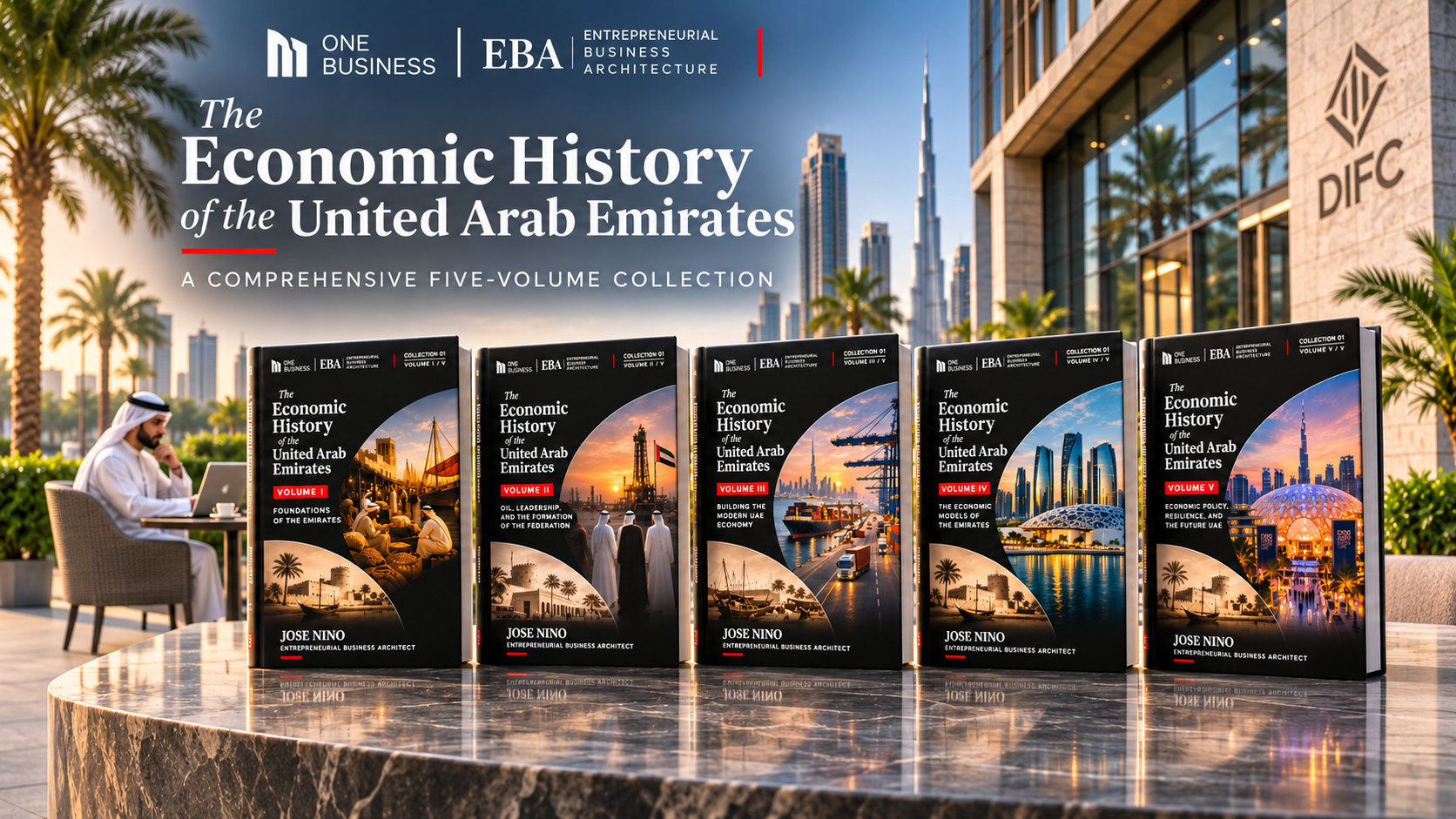
Explore The Economic History of the United Arab Emirates — Complete Five-Volume Collection
The five-volume digital collection examines the historical processes through which the United Arab Emirates developed its economic capabilities and established the foundations of its contemporary business environment. Entrepreneurs, executives, investors, and international business professionals can use this research to understand how geography, leadership, resources, infrastructure, institutions, and enterprise development influenced the country's transformation. The collection also provides a wider perspective on the relationship between economic history and contemporary business opportunities, helping readers recognize that successful enterprises develop within economic systems shaped by decisions and investments made over many years. The complete five-volume digital collection is available for USD 29.99, and readers can explore The Economic History of the United Arab Emirates — Complete Collection through the official ONE Business Dubai book page.
The connection between corporate social responsibility and economic development becomes clearer when these historical lessons are considered alongside the challenges facing contemporary entrepreneurs. Enterprises contribute to prosperity through the products and services they provide, the economic opportunities they create, the capabilities they develop, and the resources they organize into productive activity. A company that improves operational efficiency strengthens its competitiveness while potentially reducing unnecessary environmental pressure. A business that invests in meaningful professional development can improve organizational performance while creating opportunities for individuals to expand their capabilities. An enterprise that maintains transparent commercial relationships and reliable governance can strengthen customer confidence while contributing to a more dependable business environment. These contributions are not automatically produced by corporate registration or positive intentions; they depend on the quality of the decisions, systems, and capabilities through which the organization operates.
The institutional initiatives associated with Majra and the UAE Companies for Good 2031 Strategy provide an important national context for this understanding of responsible enterprise development. They demonstrate growing attention to the role that businesses can play in creating measurable economic and social value, while encouraging organizations to consider how their capabilities correspond to broader development objectives. Nevertheless, entrepreneurs should approach these initiatives through commercial discipline rather than assuming that institutional participation will guarantee business success. The most productive opportunities arise when a company can demonstrate that its activities solve meaningful problems, deliver value to customers, operate sustainably, and generate outcomes supported by credible evidence. Responsible enterprise development becomes a source of strength when it contributes to the organization's capacity to perform, adapt, and grow.
For international founders, Dubai offers an environment in which business formation, market development, and responsible enterprise practices can be connected through an integrated entrepreneurial strategy. Establishing a company creates the legal foundation, but the entrepreneur must develop the capabilities necessary to transform that foundation into an operational and commercially viable organization. Corporate responsibility can strengthen this process by encouraging better resource management, meaningful workforce development, reliable governance, and transparent relationships with customers and partners. These practices should not be pursued as substitutes for profitability or commercial competitiveness but as elements that may support the development of a stronger enterprise when they are relevant to its activities and managed effectively.
At ONE Business Dubai, we believe that entrepreneurship is one of the most powerful instruments through which individuals can transform their lives and contribute to the economic and social development of their communities. This transformation begins with personal development because entrepreneurs must acquire the knowledge, judgment, discipline, and capabilities necessary to identify opportunities and establish successful businesses. It continues through the creation of enterprises that solve problems, serve customers, develop people, and generate productive economic activity. Corporate social responsibility reinforces this philosophy by emphasizing that the quality of an enterprise should be examined not only through its financial results but also through the way it creates those results and the value generated for those who participate in or are affected by its activities.
Entrepreneurs ready to begin this journey can establish their corporate foundation through ONE Business Dubai's professional UAE company formation services for USD 1,200 plus applicable government, licensing, and third-party costs. We help international founders navigate the registration process and prepare the legal structure for their intended business activities, with registration within 24 hours available for qualifying applications where jurisdictional requirements and authority approvals permit. Founders can explore our company formation and business registration services and take the first step toward developing an enterprise capable of creating economic value in the United Arab Emirates. The opportunity is not merely to register a company in Dubai but to build an organization that reflects entrepreneurial ambition, commercial discipline, responsible management, and the capacity to contribute meaningfully to the markets and communities it serves.
ONE Business Dubai — Discover Opportunities. Develop Capabilities. Build Businesses. Transform Your Future.
Editorial note: This article provides general entrepreneurial education and business analysis. References to Majra, the UAE Companies for Good 2031 Strategy, and other institutional initiatives do not imply affiliation, endorsement, guaranteed financing, preferential commercial treatment, or automatic regulatory approval. Licensing, employment, banking, and other legal requirements must be evaluated according to the circumstances of each enterprise.