ONE BUSINESS / INSIGHTS / ARTICLE 14
How Dubai Turned Economic Constraints into Entrepreneurial Opportunity: The Business Architecture Behind the UAE Free Zones
Understanding how the United Arab Emirates transformed economic limitations into specialized business environments — and what this history teaches international entrepreneurs about building successful enterprises today.
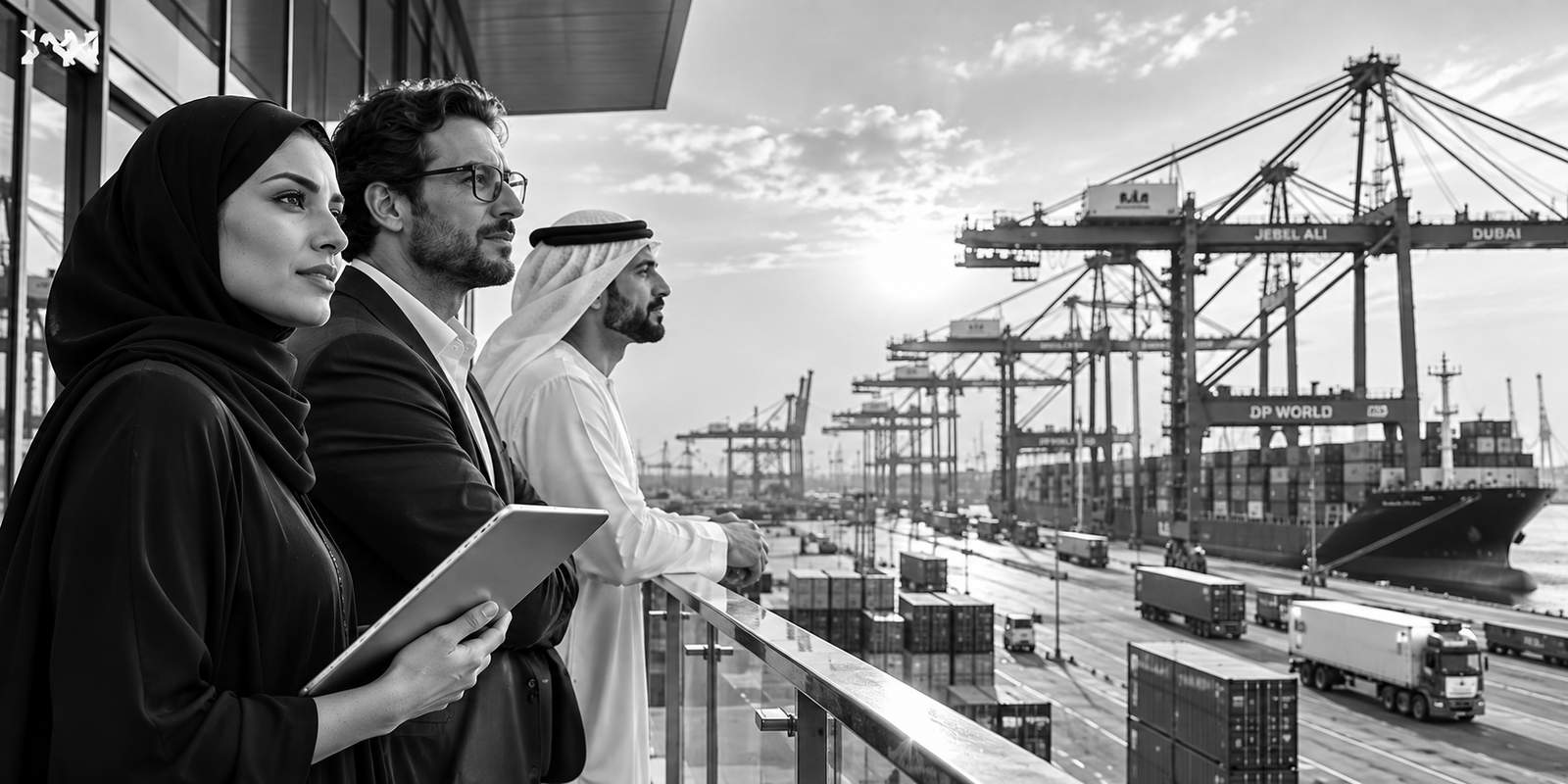
Understanding the Past to Build a Business in the UAE
Every year, entrepreneurs from different parts of the world consider establishing businesses in Dubai and the United Arab Emirates. Some are launching their first international ventures, others are expanding established companies into new markets, and many are exploring the possibility of developing businesses that can serve customers across the Middle East, Africa, Asia, and the wider global economy. Their attention is frequently attracted by the country's international connectivity, commercial infrastructure, business formation opportunities, and reputation as an environment that welcomes entrepreneurial initiative.
Yet many approach the decision to establish a UAE company without understanding the historical processes that created the business environment they intend to enter. They compare company registration packages, licensing costs, free-zone jurisdictions, ownership arrangements, and administrative procedures, but rarely investigate why those structures exist, how they developed, or what economic problems they were originally designed to solve. As a result, they may understand the mechanics of establishing a company without fully appreciating the economic architecture within which that company will operate.
To build a successful business in the United Arab Emirates, entrepreneurs benefit from understanding where the country came from, where its economy stands today, and the direction in which its economic development is moving. This knowledge does not guarantee commercial success, but it provides a deeper foundation for evaluating opportunities, interpreting the business environment, identifying potential constraints, and making strategic decisions. The UAE's economic history is not simply a record of past achievements. It is an account of how geographic limitations, commercial traditions, institutional decisions, infrastructure investments, and entrepreneurial activities progressively created new economic possibilities.
Few developments illustrate this process more clearly than the emergence of the country's free zones. What international entrepreneurs encounter today as a diverse system of specialized business jurisdictions began as a response to fundamental economic challenges. Dubai needed to expand beyond its limited natural resources, strengthen its international trading position, attract productive investment, and create conditions in which foreign enterprises could establish meaningful commercial operations. The solution was not merely to invite businesses into the emirate, but to construct environments that made their activities more practical, competitive, and economically valuable.
The history of the UAE's free zones therefore provides an important entrepreneurial lesson: economic opportunities are not determined exclusively by the resources an individual, enterprise, or territory already possesses. They can also emerge from the deliberate development of capabilities, institutions, relationships, and operating environments that make previously constrained activities possible. Understanding how Dubai applied this principle offers valuable insights for entrepreneurs who are considering establishing businesses in the UAE today.
Dubai Before the Free Zones: The Commercial Foundations of an Entrepreneurial Economy
Long before the establishment of Jebel Ali Free Zone, Dubai had developed a commercial identity shaped by maritime activity, merchant relationships, regional exchange, and the economic opportunities associated with its geographic position along the Arabian Gulf. Its trading connections extended toward Persia, India, East Africa, and other markets linked through the wider Indian Ocean commercial system. These relationships enabled merchants to participate in exchanges that were not confined to the limited productive resources available within the emirate itself.
Dubai's early commercial development was particularly significant because the territory faced substantial environmental and economic constraints. Limited freshwater resources, arid conditions, relatively small local markets, and restricted agricultural possibilities made economic diversification essential long before petroleum revenues transformed the region. Maritime commerce, fishing, pearling, and regional trade provided opportunities, but each activity depended on external conditions and commercial relationships that could change. The decline of the pearling economy during the twentieth century demonstrated how vulnerable an economy could become when important sources of income were disrupted.
Nevertheless, Dubai's commercial relationships, merchant capabilities, and experience in regional exchange provided foundations upon which new economic activities could develop. The emirate's location was advantageous, but its geographic position alone did not create prosperity. Commercial value emerged through the activities of merchants, the movement of goods, the maintenance of trading relationships, and the gradual improvement of infrastructure and institutions supporting those activities. Dubai's historical experience demonstrates that location becomes economically significant when people develop the capabilities necessary to transform geographic access into productive commercial relationships.
The leadership of Sheikh Rashid bin Saeed Al Maktoum strengthened this commercial orientation through investments intended to improve Dubai's capacity to participate in international trade. The dredging of Dubai Creek, the development of Port Rashid, and subsequent investments in transportation, aviation, utilities, and communications reflected an understanding that infrastructure could expand economic possibilities. Rather than treating trade as an activity that would grow automatically, Dubai increasingly invested in the physical conditions required to accommodate and encourage that growth.
These investments were especially consequential because Dubai's petroleum resources were relatively modest compared with those of Abu Dhabi. Oil revenues contributed to the emirate's transformation, but they could not provide an unlimited foundation for its future. Dubai therefore faced a strategic challenge that remains familiar to entrepreneurs: how to develop sustainable economic opportunities when existing resources are insufficient to support long-term ambitions. The response involved strengthening productive capabilities, expanding access to markets, and creating an environment in which additional commercial activity could emerge.
For contemporary entrepreneurs, this historical context challenges a common assumption about business creation. Many individuals begin by asking what resources they already possess and then limit their entrepreneurial ambitions to what those resources appear to permit. Dubai's experience suggests a more productive question: what capabilities, relationships, infrastructure, and institutional arrangements must be developed to transform an identified opportunity into a viable economic activity? This distinction between possessing resources and constructing productive capabilities lies at the heart of entrepreneurial development.
Jebel Ali: Transforming Infrastructure into an International Business Platform
The development of Jebel Ali represented a new stage in Dubai's economic transformation. The construction of Jebel Ali Port, which opened in 1979, substantially expanded the emirate's maritime capacity and strengthened its potential to participate in international shipping and logistics. However, the creation of a major port did not automatically ensure that international enterprises would establish operations around it. Infrastructure could facilitate the movement of goods, but businesses also required appropriate legal, administrative, commercial, and operational arrangements to make sustained use of that infrastructure.
The establishment of Jebel Ali Free Zone in 1985 addressed this broader challenge. By creating a specialized environment associated with the port, Dubai sought to attract international businesses involved in trading, distribution, warehousing, manufacturing, and related commercial activities. The free zone offered arrangements intended to reduce important obstacles faced by foreign investors, including restrictions associated with ownership, customs procedures, and the movement of commercial profits. These provisions were significant because they were connected to a physical environment capable of supporting the activities that investors intended to undertake.
The importance of Jebel Ali Free Zone cannot be understood exclusively through its regulatory incentives. Its economic significance emerged from the combination of institutional arrangements and productive infrastructure. A foreign company considering regional distribution required more than permission to establish a legal entity. It needed access to shipping routes, suitable storage facilities, efficient cargo movement, commercial services, and an operating environment in which its activities could be organized reliably. The relationship between the port and the free zone helped bring these elements together within a coordinated business environment.
This combination transformed the economic proposition Dubai could offer international companies. Rather than presenting itself solely as a market in which foreign goods could be sold, Dubai increasingly offered a location from which enterprises could organize commercial activities serving multiple markets. Businesses could use the emirate as a platform for international trade, distribution, logistics, and related operations. The economic opportunity therefore extended beyond the size of Dubai's domestic population or the purchasing power of its immediate market.
The historical development of Jebel Ali illustrates an important distinction between attracting investment and enabling enterprise. Investment promotion can generate interest, but productive economic activity requires an environment in which businesses can operate effectively. An entrepreneur may be attracted by favorable registration conditions, yet the long-term viability of the enterprise depends on whether the surrounding infrastructure, institutions, market connections, and operational resources support its business model. Dubai's free-zone experiment recognized that the economic value of an investment environment depends on the interaction of these elements.
The entrepreneurial lesson is that a successful business must be designed as a functioning economic system, not merely established as a legal organization. Registration creates an entity through which commercial activities may be conducted, but it does not create customers, establish reliable distribution channels, develop competitive capabilities, or guarantee revenue. Just as Jebel Ali required the integration of infrastructure and institutional arrangements, a new enterprise requires the coordination of its market proposition, resources, operating processes, commercial relationships, and financial structure.
The Strategic Importance of Removing Economic Constraints
One of the most instructive aspects of Dubai's free-zone development is the relationship between economic constraints and institutional innovation. International investors did not necessarily lack interest in the Gulf's commercial opportunities. Their ability to convert that interest into productive operations could be limited by ownership arrangements, customs procedures, administrative requirements, infrastructure deficiencies, or the absence of specialized business environments. These constraints influenced the cost, complexity, and commercial feasibility of establishing operations.
Jebel Ali Free Zone represented an attempt to address several of these obstacles through a coordinated institutional response. Instead of assuming that investment would arrive simply because Dubai possessed a favorable geographic position, the emirate created a defined environment in which important operating conditions could be structured around the needs of international businesses. This approach recognized that commercial demand may exist without being fully realized when the mechanisms necessary to support economic activity remain inadequate.
The distinction is relevant to entrepreneurship because businesses frequently encounter similar limitations. An enterprise may possess a valuable product but lack access to customers. It may generate substantial interest but lack the operational capacity to fulfill orders. It may have sufficient technical expertise but inadequate distribution arrangements, financial resources, or organizational systems. Under these circumstances, additional marketing or investment may produce limited results because the principal obstacle remains unresolved.
The history of Jebel Ali suggests that effective development begins with understanding the specific constraint preventing an opportunity from becoming productive. Removing a critical obstacle can create benefits extending beyond the immediate activity affected. Improved logistics may strengthen distribution, which can attract additional businesses, which in turn can generate demand for complementary services. Economic development becomes cumulative when improvements in one part of a system enable productive activity elsewhere.
Entrepreneurs should therefore examine their businesses through the relationship between opportunity and capability. Before committing substantial resources to company formation, international expansion, or new market development, they should understand what conditions are necessary for their proposed activities to generate revenue. A business intended to serve customers throughout the UAE must evaluate market-access requirements, while an enterprise focused on international distribution must consider logistics and trade arrangements. A professional services company may place greater importance on licensing permissions, client relationships, and operational flexibility.
The most valuable entrepreneurial decision is not always the one that adds the greatest number of resources. It may be the decision that removes the constraint preventing existing resources from producing economic value. This principle connects Dubai's institutional development with the everyday challenges of entrepreneurs attempting to transform business ideas into commercially viable enterprises.
From Jebel Ali to a Specialized National Business Environment
The development of Jebel Ali Free Zone demonstrated that specialized environments could support international enterprise by combining commercial incentives, infrastructure, and administrative arrangements. As the UAE economy expanded and diversified, the free-zone model evolved beyond its original association with maritime trade and industrial activity. Different jurisdictions emerged to support enterprises operating in sectors with distinct regulatory, technological, logistical, and professional requirements.
Dubai's subsequent development included specialized environments associated with aviation, technology, media, finance, commodities, and logistics. These environments reflected an increasingly sophisticated understanding of economic specialization. A financial institution does not operate under the same requirements as a manufacturing enterprise, and a technology company may depend on different professional networks and infrastructure from a logistics operator. By developing environments oriented toward particular activities, Dubai expanded the range of business models that could find suitable conditions within the emirate.
The Dubai International Financial Centre illustrates how specialization can extend beyond physical infrastructure into legal and institutional arrangements. International financial activity depends on confidence in regulatory systems, dispute-resolution mechanisms, professional services, and the predictability of commercial relationships. DIFC was developed as a specialized financial environment with its own institutional characteristics, reflecting the particular requirements of international financial business. Its development demonstrates that an economic platform may derive value from legal and regulatory capabilities as much as from buildings, transportation facilities, or geographic proximity.
Other emirates adapted the free-zone approach according to their own economic circumstances and strategic priorities. Abu Dhabi developed environments associated with industrial activity, investment, finance, and knowledge-intensive sectors. Sharjah expanded business environments linked to manufacturing, trade, media, and publishing. Ras Al Khaimah, Ajman, Fujairah, and Umm Al Quwain developed additional propositions shaped by their locations, operating costs, infrastructure, and economic specializations. The resulting national system reflects the fact that the seven emirates possess different economic histories and have developed distinct approaches to attracting enterprise.
This diversity is important because the United Arab Emirates should not be understood as a single, uniform commercial environment. Although the federation provides a common national framework, individual emirates and specialized jurisdictions offer different combinations of infrastructure, institutional arrangements, licensing conditions, and sectoral opportunities. Entrepreneurs who recognize these differences can evaluate the country more intelligently than those who assume that every business location offers essentially the same advantages.
The deeper entrepreneurial lesson concerns differentiation. Successful economic environments, like successful enterprises, create value by developing capabilities that respond to identifiable market needs. Attempting to offer every possible service to every possible customer can weaken strategic clarity. Specialization becomes valuable when it is connected to genuine demand and supported by the resources necessary to deliver a distinctive proposition.
What the History of Free Zones Teaches Entrepreneurs About Business Positioning
The UAE's experience demonstrates that competitive positioning is not simply a matter of communicating advantages. It requires the development of capabilities that make those advantages meaningful to customers. Jebel Ali's proposition was strengthened by its connection to port infrastructure and international trade. Specialized financial environments derive value from institutional arrangements and professional ecosystems. Industrial jurisdictions become more attractive when they provide appropriate facilities, logistics connections, and operating conditions.
This principle applies directly to entrepreneurs developing their own businesses. A company cannot establish a sustainable competitive position merely by declaring that its products are innovative, its services are affordable, or its customer experience is superior. Those claims must be supported by capabilities that customers can recognize through actual commercial interactions. Reliable delivery, appropriate expertise, efficient operations, accessible distribution, and meaningful differentiation contribute to the economic value of a business proposition.
The historical evolution of UAE free zones also demonstrates that competitive advantages require continued adaptation. As additional jurisdictions enter the market and competing environments introduce similar incentives, the benefits of individual registration features may become less distinctive. A business environment that initially attracted investors through a particular advantage must continue developing its proposition as customer expectations, technologies, regulatory requirements, and competitive conditions change.
Entrepreneurs face the same challenge when competitors begin offering similar products, prices, or services. An initial advantage may attract customers, but long-term growth requires the enterprise to develop additional capabilities and maintain a clear understanding of its market. Competitive positioning therefore involves more than identifying a promising opportunity at the beginning of the business. It requires continuous attention to the relationship between customer needs, organizational capabilities, and changes in the commercial environment.
For international entrepreneurs considering the UAE, this means that selecting a jurisdiction should involve more than comparing promotional claims. A low-cost registration package may be appropriate for one business model and unsuitable for another. The relevant question is whether the jurisdiction provides the legal permissions, operating conditions, facilities, and access necessary for the company's intended activities. The best environment is not necessarily the most prestigious or the least expensive, but the one that supports the enterprise's commercial requirements.
Understanding the UAE Business Environment Before Establishing a Company
The historical development of free zones has direct implications for entrepreneurs making company formation decisions today. Dubai and the wider UAE offer a range of mainland and free-zone structures, each governed by applicable licensing requirements and institutional arrangements. These structures exist within an economic environment that has evolved through decades of investment, commercial development, and regulatory adaptation.
Mainland company registration and free-zone company registration should therefore be evaluated in relation to the activities the entrepreneur intends to undertake. A company seeking to conduct business directly within the UAE market may have requirements that differ from those of an enterprise primarily serving international customers. Businesses requiring warehousing, manufacturing facilities, regulated professional activities, or specialized infrastructure may need to examine jurisdictions that support those particular operations.
The regulatory environment also requires careful attention. Free-zone registration does not automatically authorize unrestricted activity throughout the UAE mainland. Applicable permissions depend on the emirate, business activity, and relevant licensing arrangements. In Dubai, specific mechanisms exist through which eligible free-zone establishments may obtain authorization to conduct certain activities outside their zones, subject to the applicable rules and approvals. Entrepreneurs should therefore verify the requirements relevant to their business rather than relying on general assumptions about free-zone privileges.
Taxation and financial arrangements must also be considered within their proper legal context. Free-zone status does not automatically exempt every company or every category of income from UAE corporate tax. The availability of preferential treatment depends on applicable legislation, qualifying conditions, and the nature of the income involved. Similarly, the establishment of a legal entity does not guarantee that a financial institution will approve a business bank account. Banking institutions apply their own due-diligence, compliance, and eligibility requirements.
These considerations reinforce the central lesson developed throughout the history of the UAE's free zones. The business environment must be understood as an integrated system rather than a collection of isolated registration benefits. A company may obtain an attractive licence but encounter difficulties if its operating structure does not correspond to its customers, activities, financial requirements, or intended markets.
Entrepreneurs should approach company formation as an architectural decision that influences the future development of their enterprise. The legal entity is one component of the business, but its value depends on its relationship with the broader commercial model. A suitable structure can support business activity, while an inappropriate one may create additional costs, operational limitations, or the need for subsequent restructuring.
Entrepreneurial Business Architecture: From Economic Opportunity to Business Creation
The development of the UAE's free zones can be interpreted through the contemporary discipline of Entrepreneurial Business Architecture (EBA), which examines how entrepreneurial capabilities, opportunities, business structures, market relationships, and organizational development contribute to the creation and growth of enterprises. This interpretation does not imply that the historical leaders responsible for the country's economic transformation consciously applied the modern EBA framework. Rather, it uses EBA as an analytical perspective for understanding the entrepreneurial mechanisms visible in historical economic decisions.
From this perspective, the UAE's free-zone experience illustrates the importance of connecting opportunity discovery with the development of productive capabilities. Dubai recognized opportunities associated with international trade and investment, but those opportunities required infrastructure, institutional arrangements, and business environments capable of supporting commercial activity. The creation of Jebel Ali Free Zone represented a response to that relationship between potential demand and the conditions necessary to transform it into economic activity.
For individual entrepreneurs, the same reasoning applies when moving from an identified opportunity toward the establishment of a business. An attractive market does not necessarily represent a viable opportunity for every enterprise. The entrepreneur must understand customer needs, competitive conditions, operational requirements, available resources, and the capabilities necessary to deliver value. Business creation becomes more sustainable when these elements are developed as parts of a coherent commercial system.
EBA emphasizes that entrepreneurial development involves interconnected processes rather than isolated administrative actions. Entrepreneurs must develop the capabilities required to pursue opportunities, investigate and validate potential markets, create operationally viable businesses, establish an effective market presence, develop customer relationships, and strengthen the enterprise as it grows. The UAE's economic history provides numerous examples of how these dimensions interact at the level of institutions, industries, and entire economic systems.
The significance of the free-zone model therefore extends beyond the question of where a company should be registered. It illustrates how the deliberate organization of resources, institutions, infrastructure, and market relationships can expand the possibilities available to enterprise. Entrepreneurs who understand this principle can approach their own ventures with greater strategic discipline, recognizing that sustainable commercial success depends on the alignment of capabilities rather than the possession of isolated advantages.
Where the UAE Is Going: The Continuing Transformation of Entrepreneurial Opportunity
The United Arab Emirates continues developing an economic environment influenced by technological change, international investment, advanced industry, digital commerce, financial innovation, artificial intelligence, sustainability, and the growing importance of knowledge-intensive activities. These developments represent new stages in a longer process of economic diversification and capability development rather than a complete departure from the country's historical foundations.
The same underlying challenge remains visible across different periods of the UAE's development: how to create the conditions necessary for productive economic activity in a changing international environment. Earlier generations addressed limitations in maritime access, trading infrastructure, and industrial capacity. Contemporary economic development increasingly involves digital infrastructure, specialized talent, advanced technologies, research capabilities, regulatory adaptation, and new forms of international connectivity.
For entrepreneurs, understanding this continuity can improve the interpretation of emerging opportunities. A new technology initiative, specialized business jurisdiction, or infrastructure investment should not be evaluated solely as an isolated announcement. Its significance depends on how it connects with the country's existing capabilities, institutional priorities, economic specializations, and potential markets. Historical knowledge provides context for examining whether a development represents a continuation of established economic strengths, an attempt to address a recognized limitation, or an effort to create entirely new productive capabilities.
However, historical development should not be mistaken for a guarantee of future outcomes. Economic opportunities remain subject to market competition, regulatory change, financial conditions, technological disruption, and the decisions of individual enterprises. The UAE's achievements demonstrate the importance of strategic adaptation, but they do not eliminate the risks associated with entrepreneurship or international business expansion.
The practical value of understanding the country's history lies in developing a more informed perspective. Entrepreneurs who know how the UAE's economic environment emerged can ask better questions about its present structure and future direction. They can examine how individual emirates have developed different strengths, why specialized business environments exist, and how institutional and infrastructure decisions influence the opportunities available to companies.
Understanding where the UAE has been is therefore part of understanding what it may become — and how an entrepreneur might participate productively in that transformation.
The Central Business Lesson: Successful Enterprises Are Built Through the Architecture of Opportunity
Dubai's transformation from a regional trading economy into an internationally connected business center cannot be explained by a single investment, institution, or economic resource. Its development involved the gradual construction of complementary capabilities, including maritime infrastructure, commercial relationships, financial arrangements, specialized business environments, transportation systems, and institutions capable of supporting increasingly complex economic activities.
The creation of Jebel Ali Free Zone provides a particularly instructive example because it demonstrates how a recognized economic limitation can become the starting point for institutional innovation. Dubai did not simply accept that its modest natural resources would determine the scale of its economic future. It developed infrastructure and commercial arrangements intended to expand the activities that businesses could undertake from the emirate. The resulting economic environment helped create opportunities that extended beyond the territory's original resource base and domestic market.
For contemporary entrepreneurs, the lesson is not to imitate Dubai's historical investments literally. Individual businesses operate under different financial constraints, market conditions, and institutional responsibilities. The transferable principle concerns the relationship between opportunity, constraint, and capability. Entrepreneurs create stronger enterprises when they understand the conditions limiting their commercial possibilities and develop the systems necessary to overcome those limitations.
This requires strategic discipline. Before investing in company formation, new facilities, marketing campaigns, technology, or international expansion, entrepreneurs should understand the economic purpose of those decisions. They should examine whether the proposed investment strengthens the business model, improves access to customers, removes an operational obstacle, or develops a capability necessary for future growth. Resources become productive when they are organized around identifiable opportunities and supported by an integrated operating structure.
The historical development of the UAE demonstrates that economic transformation is cumulative. Commercial relationships create opportunities for infrastructure investment; infrastructure enables additional activity; institutions support more complex transactions; and new enterprises contribute to the expansion and diversification of markets. These processes do not unfold automatically, nor do they produce identical results in every context. Their significance lies in showing how deliberate decisions can change the economic possibilities available to individuals, organizations, and societies.
The central entrepreneurial lesson from the UAE's free-zone history is that opportunity becomes economically meaningful when the capabilities necessary to pursue it are deliberately created, coordinated, and sustained.
For entrepreneurs planning to establish a business in Dubai or elsewhere in the United Arab Emirates, understanding this history provides a stronger foundation for evaluating the environment they intend to enter. It encourages them to move beyond the immediate question of how to register a company and consider the more consequential question of how to build an enterprise capable of creating value within that environment.
Discover the Economic History Behind Today's UAE Business Opportunities
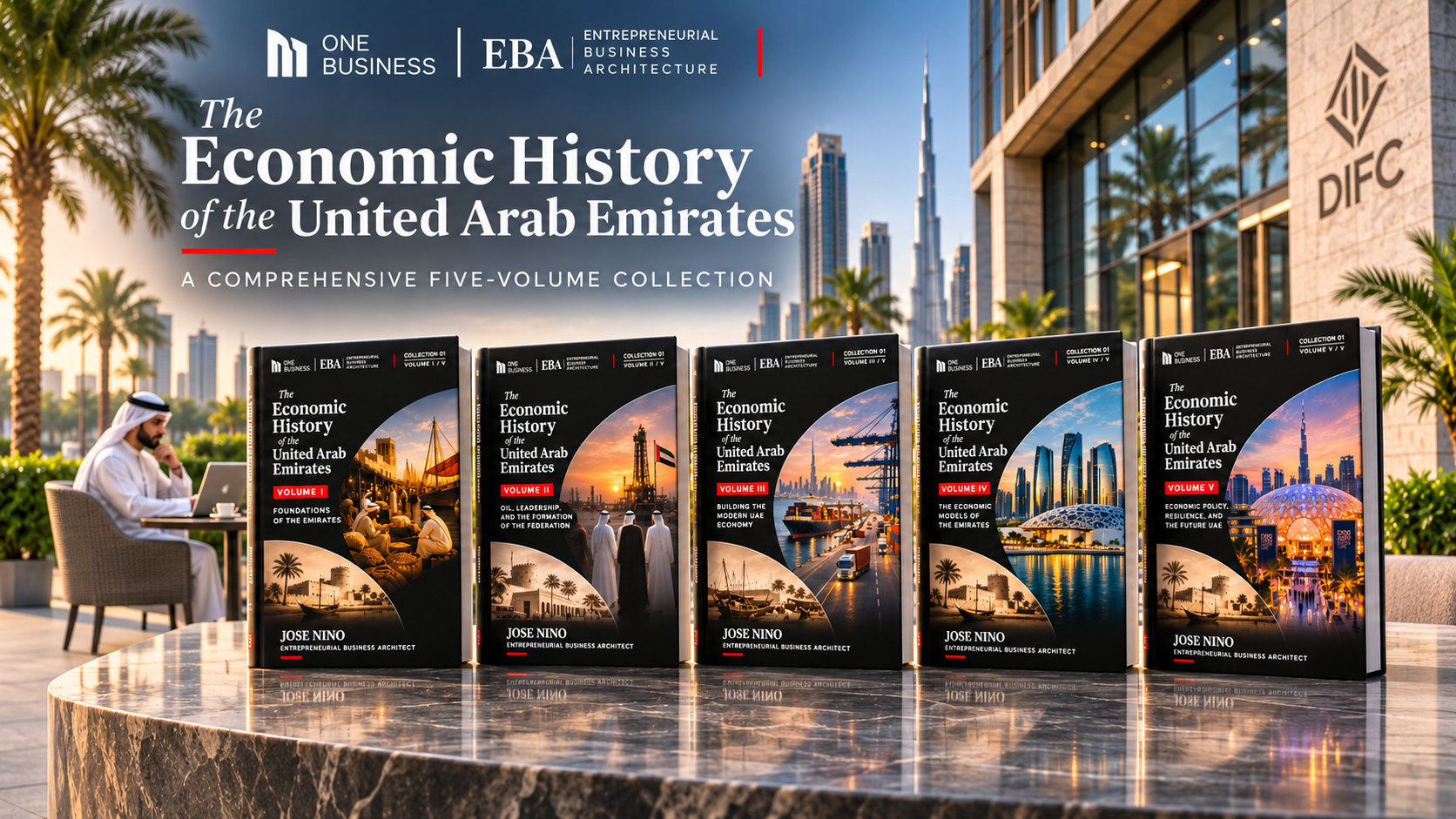
The Economic History of the United Arab Emirates — A Five-Volume Collection
The economic opportunities available in the United Arab Emirates today are the result of a remarkable historical transformation. Understanding that transformation requires examining the country's origins, the commercial relationships that preceded petroleum development, the leadership and institutional decisions that shaped federation, the enterprises that built the modern economy, and the policies that continue influencing its future.
This is the purpose of The Economic History of the United Arab Emirates, a comprehensive five-volume research work by Jose Nino, Entrepreneurial Business Architect, published through ONE Business.
The collection was developed to help entrepreneurs, business professionals, investors, researchers, and internationally oriented readers understand the historical foundations of the UAE's economic environment. Rather than treating history as a collection of disconnected events, the work examines how economic opportunities emerged, how constraints were addressed, how productive capabilities were developed, and how different decisions contributed to the transformation of the seven emirates.
For entrepreneurs considering establishing or expanding a business in the UAE, this historical perspective provides knowledge that cannot be obtained simply by comparing registration packages or reading promotional descriptions of business jurisdictions. It helps explain why particular industries developed, how infrastructure and institutions influenced commercial activity, and why different emirates offer distinct economic environments today.
The history of the UAE's free zones is examined in particular depth in Volume V — Economic Policy, Resilience, and the Future UAE, especially Chapter 32, Free Zones: Designing Specialized Systems for Investment and Enterprise. That chapter explores the origins of Jebel Ali Free Zone, the evolution of specialized business environments, the economic constraints these institutions were designed to address, and the broader lessons their development offers for understanding enterprise and economic transformation.
The complete collection provides the wider historical context necessary to understand how these developments fit into the UAE's economic journey, from its earliest commercial foundations to its contemporary ambitions.
Five volumes. Seven emirates. Forty chapters. One extraordinary economic transformation.
Complete Five-Volume Digital Collection — USD 29.99
Explore The Economic History of the United Arab Emirates — Complete Collection
Volume V — Economic Policy, Resilience, and the Future UAE — USD 6.99
Explore Volume V and the History of UAE Free Zones
Understanding the UAE's past is an investment in understanding its present and making more informed decisions about its entrepreneurial future.
Establishing Your Business in Dubai and the United Arab Emirates
Understanding the historical development of the UAE's business environment is an important foundation for entrepreneurs considering international expansion. The creation of free zones, the development of infrastructure, and the diversification of the country's economy demonstrate how commercial opportunities depend on the interaction of institutions, markets, operating capabilities, and strategic investment.
Entrepreneurs seeking to establish a company in the UAE should therefore approach business formation as part of a broader commercial strategy. The appropriate jurisdiction and licensing structure depend on the activities the company intends to undertake, the customers it expects to serve, its operational requirements, and its plans for future development.
ONE Business Dubai assists international entrepreneurs and businesses with company registration in Dubai and the United Arab Emirates, helping them navigate the establishment process and identify appropriate registration arrangements according to their proposed business activities.
UAE Company Registration + Business Bank Account Opening Assistance
Professional Service Fee: USD 1,000 + Applicable Government, Licensing, and Third-Party Costs
Eligible company registrations may be completed within 24 hours, subject to the relevant authority's procedures and approvals. Assistance with business bank account opening is subject to the financial institution's independent eligibility, compliance, and approval processes.
Explore ONE Business Dubai Company Registration Services
Understanding the Past. Building the Future.
The history of the UAE's free zones demonstrates that economic development is not simply the consequence of possessing favorable resources or attracting external investment. It emerges through the interaction of commercial knowledge, strategic decisions, infrastructure, institutions, productive capabilities, and entrepreneurial activity.
Dubai's experience illustrates how a territory facing significant economic constraints can develop new possibilities by constructing environments in which enterprises are better able to operate, connect with markets, and create value. The development of Jebel Ali Free Zone and the subsequent expansion of specialized business jurisdictions represent important chapters in that continuing transformation.
For entrepreneurs, the enduring lesson is that successful businesses are not created merely by entering attractive markets. They are developed through the disciplined identification of opportunities, the construction of appropriate capabilities, and the organization of resources and relationships into sustainable economic systems.
To understand the business opportunities of the United Arab Emirates today, begin by understanding the economic history that made those opportunities possible.
Discover the complete historical journey in The Economic History of the United Arab Emirates and use that knowledge to approach your own entrepreneurial future with greater understanding, perspective, and strategic clarity.
Discover the Complete Five-Volume Collection — USD 29.99
ONE Business Dubai | Strategic Entrepreneurial Business Architecture Advisory Firm
Historical research foundation: Jose Nino, The Economic History of the United Arab Emirates, Volume V, Chapter 32 — Free Zones: Designing Specialized Systems for Investment and Enterprise.
This article presents historical analysis and general entrepreneurial education. Company formation, regulatory, tax, and banking requirements should be verified for each proposed business and jurisdiction before making investment or registration decisions.