ONE BUSINESS / INSIGHTS / ARTICLE 08
How Abu Dhabi Transformed Its Economy: 12 Entrepreneurial Lessons from Oasis Life to National Leadership
The Entrepreneurial Lessons Behind Resource Management, Economic Transformation, Strategic Investment, Sheikh Zayed's Leadership, and the Foundations of the United Arab Emirates

Before Oil Wealth, Abu Dhabi Had Already Learned How to Survive
The modern image of Abu Dhabi is inseparable from its remarkable economic transformation. Today, the emirate is recognized for its energy resources, international investment activities, infrastructure, financial institutions, and central role in the United Arab Emirates. Its development represents one of the most significant economic transitions in the modern Arabian Gulf. Yet the foundations of this transformation cannot be understood by examining petroleum revenues alone. Long before oil exports began, Abu Dhabi possessed a distinctive economic system shaped by the desert, the sea, oasis agriculture, tribal relationships, and the constant necessity of organizing life around scarce resources.
Unlike Dubai, whose pre-oil development increasingly emphasized merchant networks and commercial exchange, Abu Dhabi historically combined several economic environments. The coastal settlements supported fishing, pearling, and maritime activity, while the inland oases of Liwa and Al Ain provided agricultural production, water resources, and connections with communities across the desert. These environments were not separate economies operating independently. They were connected through seasonal movement, family relationships, resource exchange, and political arrangements that allowed communities to manage difficult conditions.
The Bani Yas confederation played an important role in the development of this economic and political system. Its historical connections with the Liwa oasis, the establishment of settlements on Abu Dhabi Island, and the emergence of the Al Nahyan ruling family created foundations that extended across both coastal and inland territories. This geographical and institutional complexity distinguished Abu Dhabi from settlements whose commercial development was concentrated primarily around a single port.
The discovery of commercially significant petroleum resources in 1958 and the beginning of oil exports in 1962 fundamentally altered Abu Dhabi's financial possibilities. However, natural-resource wealth did not automatically create a modern economy. The transformation required decisions about how revenue should be allocated, which infrastructure should be constructed, how public institutions should operate, and how the emirate's resources could support a wider national project.
Sheikh Zayed bin Sultan Al Nahyan, who became Ruler of Abu Dhabi in 1966, played a defining role in this process. His experience administering Al Ain had already demonstrated the importance of water management, agricultural development, consultation, and practical improvements in people's living conditions. With access to expanding oil revenues, he pursued a broader transformation involving roads, schools, hospitals, housing, public administration, and cooperation among the emirates.
For contemporary entrepreneurs, Abu Dhabi's history offers an especially valuable perspective on the relationship between resources and economic capability. Capital can accelerate development, but it cannot substitute for leadership, strategic priorities, operational competence, or the ability to coordinate people around shared objectives. The following twelve entrepreneurial lessons examine how Abu Dhabi progressed from an economy organized around survival and resource scarcity toward a central role in the creation of a modern nation.
1. Entrepreneurial Lesson: Scarcity Can Become the Foundation of Economic Discipline
Abu Dhabi's early economic environment was defined by the limitations imposed by geography and climate. Water was scarce, agricultural possibilities were concentrated in particular locations, and desert transportation required specialized knowledge. Coastal communities depended on fishing, pearling, and maritime connections, while inland settlements relied on date cultivation, livestock, and access to reliable water sources. Survival required a careful understanding of what resources were available, how they could be used, and how communities could cooperate when conditions became difficult.
This environment encouraged forms of economic organization that differed substantially from those found in regions with abundant agricultural land or extensive freshwater systems. Water sources had to be maintained, agricultural production had to correspond to environmental conditions, and transportation depended on knowledge accumulated through experience. The economic challenge was not simply to produce more, but to use limited resources in ways that supported continuity.
Entrepreneurs encounter comparable constraints when beginning enterprises with limited financial resources, insufficient personnel, or restricted market access. A founder may recognize an attractive opportunity while lacking the capital required to pursue it through conventional methods. The appropriate response is not always to postpone the venture until substantial financing becomes available. It may involve designing a smaller initial operation, selecting a narrower customer segment, developing partnerships, or creating a business model that requires fewer fixed assets.
The important distinction is between scarcity and economic impossibility. Scarcity imposes limitations, but those limitations can encourage disciplined decisions concerning priorities, efficiency, and the organization of productive resources. A business that learns to operate effectively with limited capital may develop financial habits that remain valuable when its resources expand.
The first entrepreneurial lesson is that scarcity becomes an advantage when it encourages entrepreneurs to distinguish essential capabilities from unnecessary expenditure and build an economically disciplined organization.
2. Entrepreneurial Lesson: Build Complementary Economic Activities Rather Than Depending on One Resource
Abu Dhabi's historical economy operated through a combination of coastal and inland activities. Pearling and fishing supported maritime communities, while the oases provided dates, agricultural products, and opportunities for livestock-related activities. Families and communities maintained relationships across these environments, and seasonal movements helped connect different sources of livelihood.
The importance of this structure was not that every activity generated equivalent income. Pearling could create significant commercial returns, particularly when international demand was strong, while agricultural production often served more immediate subsistence and local-market needs. Nevertheless, the existence of multiple activities meant that the economy possessed different productive capabilities rather than relying exclusively on one commercial function.
The collapse of traditional pearling during the early twentieth century demonstrated the limitations of this resilience. Cultured pearls, changing international demand, and the Great Depression severely damaged an industry upon which many families depended. Alternative economic activities did not eliminate the resulting hardship. However, Abu Dhabi's inland communities, agricultural knowledge, and established social relationships remained important elements of its economic foundation.
For entrepreneurs, the relevant principle concerns complementary revenue sources and capabilities. Diversification should not mean pursuing unrelated activities simply because they appear attractive. Instead, founders should identify opportunities that use existing strengths, serve related customers, or reduce exposure to a single source of demand.
A professional services company, for example, might develop complementary offerings that serve the same client base. A trading enterprise might distribute several related product categories through established logistics arrangements. Such diversification can improve resilience without requiring the organization to abandon its core expertise.
The second entrepreneurial lesson is that sustainable diversification begins with complementary capabilities, not with the indiscriminate accumulation of unrelated businesses.
3. Entrepreneurial Lesson: Water and Infrastructure Demonstrate the Economics of Essential Resources
The oases of Al Ain and Liwa illustrate the economic importance of essential infrastructure. Agricultural activity depended on access to water, while the management of irrigation systems influenced the productivity of cultivated land. Traditional aflaj channels and other water-management arrangements required maintenance, coordination, and an understanding of local environmental conditions.
These systems demonstrate that a natural resource does not become economically productive merely because it exists. Water must reach agricultural land, irrigation must be organized, and the people responsible for cultivation must possess the knowledge and resources required to use it effectively. The productive system therefore includes both the physical resource and the organizational arrangements surrounding it.
During Sheikh Zayed's administration of the Eastern Region, improvements to irrigation and agricultural conditions became important elements of local development. His approach recognized that economic progress could begin with practical changes to the systems upon which everyday livelihoods depended. Water management was not an isolated technical activity; it influenced agricultural output, community stability, and the possibilities for further economic development.
Modern entrepreneurs can apply this principle when evaluating their own operational infrastructure. Businesses frequently depend on essential systems that receive less attention than sales or marketing. Reliable payment processing, accurate accounting, dependable suppliers, transportation arrangements, and effective information systems may not attract public attention, but their failure can disrupt the entire enterprise.
The strategic question is whether the organization has identified the resources and systems without which it cannot deliver value. Investments should prioritize these foundations before expensive expansion projects that depend on them.
The third entrepreneurial lesson is that productive growth requires entrepreneurs to identify, protect, and improve the essential systems upon which every other business activity depends.
4. Entrepreneurial Lesson: Effective Leadership Begins with Understanding Real Problems
Sheikh Zayed's experience in Al Ain provides an important example of leadership grounded in practical knowledge. Appointed Ruler's Representative in the Eastern Region in 1946, he worked within an environment where financial resources were limited and economic development depended heavily on agriculture, water management, and local cooperation.
His responsibilities required direct engagement with communities, an understanding of competing needs, and decisions concerning the use of scarce resources. This experience preceded the substantial petroleum revenues that later made large-scale development possible. Consequently, his approach to leadership was shaped by problems that could not simply be solved through expenditure.
Consultation formed an important part of his governing practice. The majlis tradition allowed members of the community to communicate concerns, discuss problems, and participate in the process through which leadership understood local conditions. Although such arrangements were not equivalent to modern democratic institutions, they provided mechanisms for gathering information and maintaining relationships between authority and society.
For entrepreneurs, the parallel is the importance of remaining close to the problems experienced by customers, employees, and business partners. Founders sometimes develop strategies based primarily on financial projections or assumptions about market demand. These tools are useful, but they cannot replace direct knowledge of the people whose decisions determine whether the enterprise succeeds.
A founder who regularly examines customer complaints, operational difficulties, supplier constraints, and employee observations may discover problems that remain invisible in high-level performance reports. Effective leadership therefore requires both strategic perspective and practical engagement.
The fourth entrepreneurial lesson is that successful leaders do not begin by imposing solutions. They begin by understanding the actual conditions in which people must work, produce, and create value.
5. Entrepreneurial Lesson: Natural Resources Create Possibilities, Not Guaranteed Prosperity
The discovery of commercially significant petroleum resources transformed Abu Dhabi's economic prospects. Offshore discoveries in 1958, followed by the development of additional fields and the beginning of exports in 1962, created access to financial resources far beyond those available through traditional pearling, fishing, and agriculture.
Nevertheless, petroleum wealth introduced a new economic problem. The emirate now possessed the possibility of financing development on a much larger scale, but decisions still had to be made about how those revenues should be used. Spending could support immediate consumption, public services, physical infrastructure, or investments intended to create capabilities extending beyond the petroleum industry.
The difference between possessing a valuable resource and building a productive economy is fundamental. Natural resources generate revenue only when extraction, transportation, commercial agreements, and supporting operations are organized successfully. Even after revenues become available, their long-term contribution depends on the quality of investment and institutional decisions.
Entrepreneurs encounter a similar challenge when their businesses receive substantial financing, achieve an unexpected increase in sales, or secure a major commercial contract. A sudden expansion in available capital can create the impression that previous limitations have disappeared. In reality, financial growth often exposes weaknesses in management, staffing, operations, and strategic planning.
The appropriate response is to distinguish temporary financial capacity from lasting organizational capability. Additional resources should strengthen the enterprise's ability to deliver value, maintain financial stability, and respond to future changes.
The fifth entrepreneurial lesson is that wealth becomes economically transformative only when it is converted into capabilities that continue generating value beyond the original source of revenue.
6. Entrepreneurial Lesson: Timing and Patience Matter in Long-Term Investment
Abu Dhabi's petroleum transformation did not occur immediately after the first interest in exploration. Geological surveys and concession arrangements developed during the 1930s, while exploration and commercial production faced technical, financial, and historical obstacles. The Second World War and the difficulties of operating in a challenging environment contributed to delays before commercially significant production became possible.
The time between early exploration and the beginning of oil exports illustrates the importance of distinguishing a promising opportunity from an operationally viable enterprise. The existence of potential reserves did not guarantee that extraction could begin immediately or that commercial revenues would become available on a predictable schedule.
Large projects require multiple conditions to align. Technical feasibility, financial commitments, infrastructure, contractual arrangements, and market access must support the proposed activity. A delay in one component can affect the viability of the entire project. Consequently, successful development depends on managing uncertainty over extended periods rather than assuming that every promising discovery will produce immediate returns.
Entrepreneurs often face comparable challenges when developing new products, entering regulated markets, or establishing international operations. The opportunity may be genuine, but its commercial realization can require extensive preparation. Founders who confuse strategic patience with inactivity may abandon viable projects prematurely, while those who ignore changing conditions may continue investing in opportunities that no longer justify their costs.
Disciplined patience requires milestones, evidence, financial controls, and periodic reassessment. It means continuing to develop an opportunity while remaining willing to modify the strategy when new information becomes available.
The sixth entrepreneurial lesson is that long-term opportunities require both persistence and disciplined evaluation. Patience becomes productive when it is supported by evidence, preparation, and clear investment priorities.
7. Entrepreneurial Lesson: Convert Financial Capital into Human and Institutional Capital
When Sheikh Zayed became Ruler of Abu Dhabi in August 1966, petroleum revenues offered the possibility of accelerating development. His administration pursued improvements in education, healthcare, housing, transportation, and public infrastructure. These investments addressed immediate social needs while also strengthening the foundations of future economic activity.
Schools could expand access to education and develop the capabilities of future generations. Hospitals improved healthcare and the conditions under which communities could work and develop. Roads connected settlements and reduced some of the difficulties associated with transportation. Public administration created mechanisms for planning, financing, and implementing increasingly complex development programs.
These investments demonstrate the difference between expenditure and capacity creation. Money spent on a temporary benefit may improve present conditions without necessarily increasing future productivity. Investment in education, healthcare, infrastructure, and institutions can generate benefits over longer periods, although the effectiveness of such investments depends on implementation and continued maintenance.
For entrepreneurs, this principle applies directly to the allocation of profits. A profitable business can distribute all available earnings or reinvest part of them in capabilities that improve future performance. Employee training, stronger management systems, improved technology, customer research, and better operational procedures may generate less immediate visibility than aggressive marketing, but they can strengthen the enterprise's long-term position.
The appropriate balance depends on the company's circumstances. Reinvestment should be evaluated according to expected benefits, financial capacity, and strategic priorities rather than treated as an automatic justification for additional spending.
The seventh entrepreneurial lesson is that financial capital becomes more valuable when it is transformed into human knowledge, organizational competence, and systems capable of producing future benefits.
8. Entrepreneurial Lesson: Strategic Planning Must Connect Vision with Execution
Abu Dhabi's development after 1966 required more than a general commitment to modernization. Roads, housing, public services, administrative institutions, and other projects had to be planned, financed, coordinated, and implemented. The establishment of the Abu Dhabi Planning Council in September 1966 reflected the importance of creating institutional mechanisms for managing this transformation.
The scale of the challenge was considerable. Abu Dhabi was moving from a relatively limited administrative and economic structure toward a system responsible for increasingly complex development activities. Expanding financial resources made larger projects possible, but they also increased the need for reliable decision-making and coordination.
This history illustrates the relationship between vision and execution. A leader may identify an attractive future, but the organization must still determine which activities should occur first, which resources are required, and who will be responsible for implementation. Without these arrangements, ambitious objectives can remain disconnected from operational reality.
Entrepreneurs frequently encounter the same problem when planning expansion. A company may intend to enter several international markets, launch new services, or increase revenue substantially. Yet these objectives become meaningful only when translated into projects, budgets, responsibilities, and measurable results.
Entrepreneurial Business Architecture provides a useful contemporary interpretation. The enterprise's strategic objectives should connect with its operating model, financial resources, organizational responsibilities, and mechanisms for evaluating performance. Each major initiative should contribute to a clearly defined commercial purpose.
The eighth entrepreneurial lesson is that strategic vision becomes economically valuable only when an organization develops the systems required to convert ambition into coordinated execution.
9. Entrepreneurial Lesson: Economic Transformation Requires Institutional Development
The emergence of Abu Dhabi as a modern economic center involved the creation and expansion of public institutions. As development activities increased, the responsibilities associated with planning, administration, infrastructure, public services, and economic management became more complex.
Institutions are important because they allow activities to continue beyond individual decisions. A large development project cannot depend indefinitely on informal instructions or the personal involvement of a single leader. It requires defined responsibilities, financial procedures, technical expertise, documentation, and mechanisms for monitoring implementation.
The development of institutional capacity also changes the relationship between available resources and economic results. A government may possess sufficient funds to construct infrastructure, but without effective administration those resources can be delayed, misallocated, or used inefficiently. Similarly, a business may possess substantial capital but lack the management capabilities necessary to operate successfully at scale.
Entrepreneurs should recognize the moment when informal management becomes an obstacle to growth. In the earliest stages of a venture, founders may personally handle sales, financial decisions, customer relationships, and service delivery. As the enterprise expands, this concentration of responsibility can create delays and operational vulnerabilities.
Institutional development within a business involves establishing repeatable procedures, assigning authority, creating reliable financial records, defining performance expectations, and developing management capabilities. These changes do not require unnecessary bureaucracy. Their purpose is to make the organization more reliable and less dependent on constant intervention by its founder.
The ninth entrepreneurial lesson is that sustainable growth requires institutions and management systems capable of supporting responsibilities that become more complex as the organization expands.
10. Entrepreneurial Lesson: Strong Partnerships Combine Complementary Capabilities
The relationship between Abu Dhabi and Dubai became especially significant during the period preceding the formation of the United Arab Emirates. The two emirates possessed different economic characteristics. Abu Dhabi's petroleum resources created substantial financial capacity, while Dubai had developed extensive commercial relationships and a distinctive trading economy.
These differences did not eliminate political and economic challenges, but they created possibilities for cooperation. The two emirates could contribute different strengths to a broader project. Their relationship illustrates how complementary resources can support objectives that individual participants may find more difficult to achieve independently.
Following the British announcement of withdrawal from the Gulf in January 1968, Sheikh Zayed and Sheikh Rashid bin Saeed Al Maktoum met on February 18, 1968, and agreed to pursue a union. Their cooperation became a decisive foundation for the wider federation-building process.
For entrepreneurs, this historical development provides an important lesson about strategic partnerships. The most valuable partner is not necessarily the organization with the greatest financial resources or the largest market presence. A strong partnership may arise when participants possess different but compatible capabilities.
A technology company may contribute specialized knowledge while a distribution business provides customer access. A professional services firm may possess technical expertise while another organization contributes local market understanding. Such relationships can expand the possibilities available to both participants.
However, complementary capabilities do not automatically guarantee successful cooperation. Partnerships require aligned objectives, clearly defined responsibilities, trust, and mechanisms for resolving disagreements.
The tenth entrepreneurial lesson is that strategic partnerships create their greatest value when participants combine complementary strengths around a shared objective that neither could pursue as effectively alone.
11. Entrepreneurial Lesson: Leadership Creates Greater Value When It Builds Beyond Immediate Interests
Abu Dhabi's transformation under Sheikh Zayed extended beyond the modernization of the emirate itself. The increasing availability of petroleum revenues created opportunities to support development in other parts of the Trucial States. Contributions to regional development initiatives reflected an understanding that economic stability and progress could benefit from cooperation beyond individual territorial boundaries.
The movement toward federation demonstrated this broader perspective. The British withdrawal announcement created urgent questions concerning security, sovereignty, and political coordination. The challenge was not merely to preserve Abu Dhabi's own position, but to determine whether cooperation could produce a more stable and capable regional system.
Sheikh Zayed's support for federation, alongside Sheikh Rashid and the other rulers, contributed to the creation of the United Arab Emirates on December 2, 1971. The process required negotiation, consensus-building, and recognition of the distinct interests of participating emirates. Ras Al Khaimah subsequently joined the federation in February 1972.
For entrepreneurs, the relevant principle is that long-term value creation frequently extends beyond immediate transactions. A business that strengthens suppliers, develops employees, improves customer capabilities, or contributes to a productive commercial ecosystem may generate benefits that support its own sustainability.
This does not mean that entrepreneurs should ignore profitability or assume responsibility for every social problem. Financial viability remains essential. The strategic opportunity lies in identifying situations where creating value for other participants also strengthens the conditions necessary for the enterprise's continued success.
The eleventh entrepreneurial lesson is that enduring leadership expands economic possibilities by building relationships, capabilities, and institutions whose value extends beyond the immediate interests of the original organization.
12. Entrepreneurial Lesson: The Greatest Transformation Is the Architecture Built Around Resources
Abu Dhabi's history demonstrates that economic transformation cannot be explained through a single discovery, leader, or investment. Its development emerged from the interaction of geography, traditional economic activities, political institutions, petroleum resources, leadership decisions, infrastructure development, and cooperation with neighboring emirates.
The discovery of oil changed the scale of available resources, but the transformation of those resources into economic and institutional capabilities required additional decisions. The development of Al Ain, the expansion of public services, the creation of planning institutions, and the commitment to federation formed different components of a larger historical process.
Entrepreneurial Business Architecture offers a contemporary framework for interpreting this experience. An enterprise requires a clear purpose, a viable economic model, productive resources, operational capabilities, financial discipline, institutional alignment, and the capacity to adapt. The existence of one strong component does not compensate indefinitely for weaknesses elsewhere.
A company may possess substantial capital but lack customers. It may attract customers but fail to deliver reliably. It may develop excellent products while depending on an unsustainable financial model. It may achieve rapid growth without establishing the management systems necessary to maintain quality. In each case, the central problem concerns the relationship between the components of the enterprise.
Abu Dhabi's transformation offers a larger historical illustration of the importance of this integration. Resources became the foundation for development when they were connected with leadership, institutions, infrastructure, and a vision extending beyond immediate financial returns.
The twelfth entrepreneurial lesson is that sustainable economic transformation depends not simply on acquiring valuable resources, but on designing the architecture through which those resources become productive capabilities, enduring institutions, and opportunities for future generations.
Explore The Economic History of the United Arab Emirates
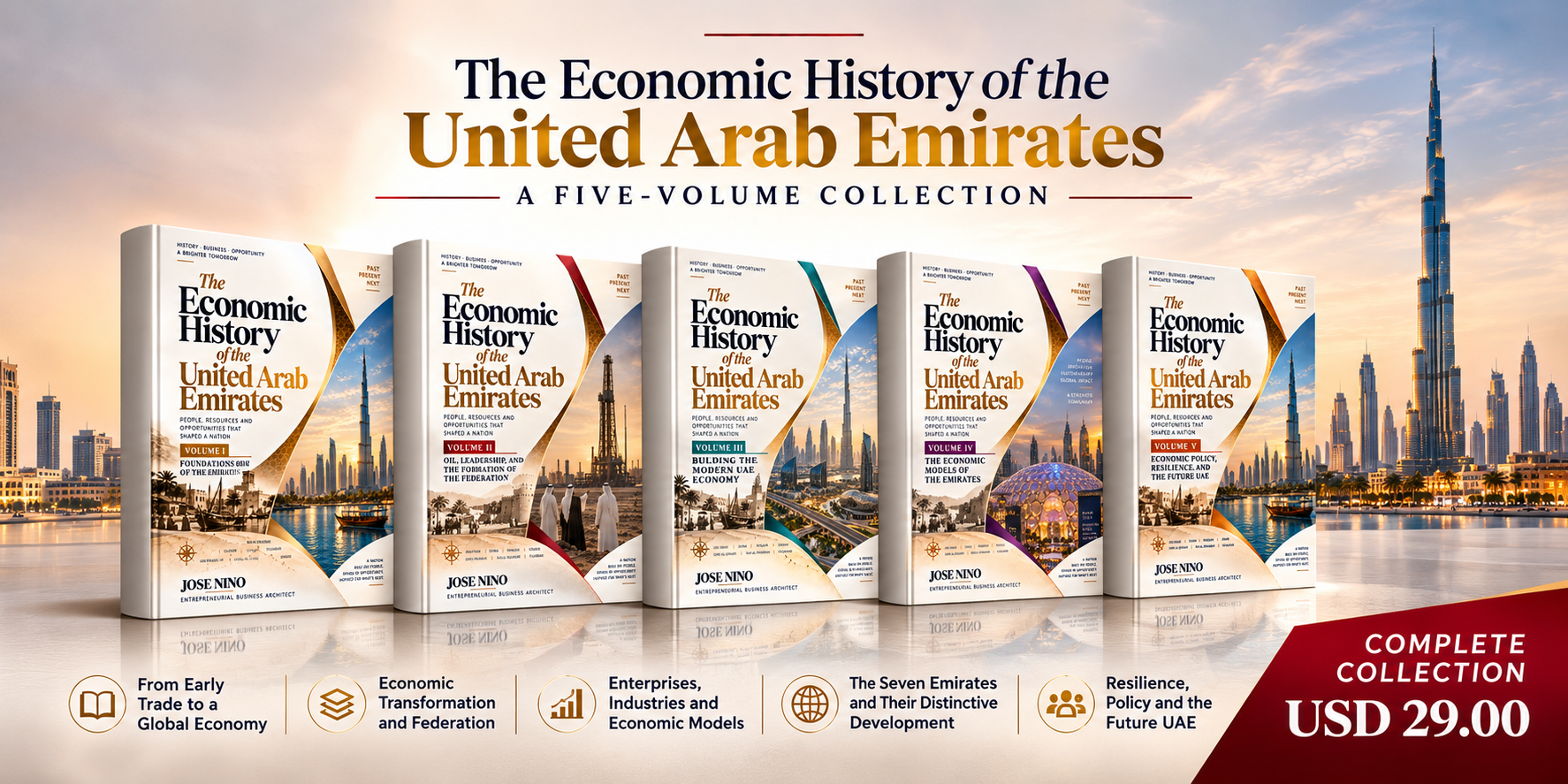
The transformation of Abu Dhabi from an economy based on oasis agriculture, maritime activity, and traditional livelihoods into a central force behind the establishment of the United Arab Emirates is one of the most important chapters in the country's economic history. It reveals how resource scarcity shaped early economic organization, how petroleum altered development possibilities, and how leadership decisions influenced the conversion of financial wealth into public institutions and national capabilities.
The Economic History of the United Arab Emirates, by Jose Nino, examines these developments through a comprehensive five-volume collection. Volume I, Foundations of the Emirates, explores the historical foundations of the seven emirates, including Abu Dhabi's dual oasis-and-coastal economy, its ruling institutions, petroleum exploration, and transformation before the establishment of the federation.
For entrepreneurs, investors, researchers, and business professionals, the collection provides more than a historical chronology. It examines how economic opportunities emerge, how leaders make decisions under uncertainty, how institutions influence development, and how resources can be organized to create lasting economic value.
Five volumes. One extraordinary economic transformation. Practical lessons for today's entrepreneurs.
Complete Five-Volume Digital PDF Collection — USD 29.99
From Abu Dhabi's Economic Transformation to Building Your Business in the UAE
Abu Dhabi's historical development demonstrates that a successful economic project requires more than financial resources or an attractive market. Entrepreneurs must understand their environment, identify viable opportunities, establish appropriate institutional arrangements, and develop the operational capabilities necessary to create sustainable value.
For international founders considering the United Arab Emirates, these principles remain relevant. Establishing a company involves decisions concerning business activities, jurisdiction, licensing requirements, ownership arrangements, operational needs, and financial commitments. The appropriate structure should correspond to the enterprise's actual commercial objectives rather than being selected solely on the basis of promotional claims or initial registration costs.
ONE Business Dubai supports entrepreneurs and international businesses seeking to establish their commercial presence in the United Arab Emirates. Our company formation and business registration services assist clients with the initial establishment process according to their proposed activities and applicable requirements.
UAE Company Formation & Business Registration — Professional Fees from USD 1,200 + Government Fees
The final scope and estimated cost depend on the proposed activity, selected jurisdiction, registration requirements, and additional services requested. Entrepreneurs considering a new company in Dubai or the wider UAE can contact our team to discuss their business objectives and request a tailored quotation.
Request UAE Company Formation & Business Registration Assistance
Build an Enterprise Designed for Long-Term Success
The economic history of Abu Dhabi offers a powerful perspective on entrepreneurship. Resources matter, but their contribution depends on how they are organized. Leadership matters, but its effectiveness depends on understanding real problems and developing the capabilities required to solve them. Financial growth matters, but lasting success requires the transformation of capital into productive systems.
For contemporary founders, these principles translate into practical responsibilities. Define a compelling value proposition, understand the market, manage financial resources carefully, build reliable operating systems, establish appropriate partnerships, and invest in capabilities that remain valuable as conditions change. These are essential foundations of Entrepreneurial Business Architecture and central requirements for building sustainable enterprises.
Abu Dhabi's greatest economic lesson is that prosperity is not created by resources alone. It is created by the decisions, institutions, partnerships, and productive capabilities built around those resources.
Discover the historical foundations of this transformation in The Economic History of the United Arab Emirates, the complete five-volume collection by Jose Nino.
Discover the Complete Five-Volume Collection — USD 29.99
Contact ONE Business Dubai for UAE Company Formation Services