ONE BUSINESS / INSIGHTS / ARTICLE 06
How British Treaties Transformed Trade and Business in the Early UAE
The Entrepreneurial Lessons Behind Maritime Security, Institutional Change, and the Foundations of a More Predictable Commercial Environment

Before Modern Dubai, the Rules of Commerce Were Being Rewritten
Long before the United Arab Emirates became a global destination for entrepreneurs, investors, and international companies, the coastal territories that would eventually form the federation experienced a profound transformation in their political and commercial environment. During the nineteenth century, a succession of agreements between Great Britain and local rulers reshaped maritime relations, established new restrictions on external political activity, and contributed to the emergence of the territories historically known as the Trucial States. These developments did not create modern Dubai or the UAE economy directly, but they altered the institutional conditions within which subsequent economic development would take place.
The transformation began in the aftermath of maritime conflict. The British campaigns against the Al Qasimi, particularly the expedition of 1819, significantly weakened established regional maritime power and prepared the ground for a new treaty relationship. The General Maritime Treaty of 1820 marked an important turning point, followed by additional maritime truces and political agreements that progressively formalized British influence along the coast. The resulting system would remain important until the British withdrawal and the establishment of the United Arab Emirates in 1971.
For entrepreneurs, this history introduces a fundamental principle: economic opportunity depends not only on resources, customers, and commercial capabilities, but also on the institutional environment in which business takes place. Rules governing security, contracts, market access, political relationships, and commercial conduct influence what enterprises can accomplish. A business may possess substantial capabilities yet find that changing regulations, political decisions, or external pressures alter the value of those capabilities.
The nineteenth-century treaty system should not be romanticized as a straightforward project of economic modernization. It emerged from military confrontation, reflected significant inequalities of power, and imposed restrictions on the external sovereignty of local rulers. Its commercial consequences were complex. Nevertheless, examining these agreements provides an opportunity to understand how political authority, institutional arrangements, security, and economic activity became interconnected in the historical development of the Emirates.
The central entrepreneurial lesson is that successful founders must learn to read the environment in which they operate. They must understand its rules, recognize its constraints, identify the actors who influence commercial conditions, and develop enterprises capable of adapting when those conditions change.
1. The First Institutional Lesson: Markets Operate Within Systems of Rules
Entrepreneurs frequently approach new markets by evaluating customer demand, expected revenue, competitive conditions, and the cost of establishing a business. These considerations are essential, but they provide only part of the picture. Every commercial transaction takes place within an institutional environment that defines permitted activities, establishes obligations, and influences the degree of uncertainty experienced by buyers, sellers, investors, and other participants.
In the early nineteenth-century Arabian Gulf, maritime commerce operated within a politically fragmented environment involving coastal rulers, merchant communities, regional powers, and expanding British imperial interests. Commercial activity existed long before the treaties, but maritime security and political authority were contested. The agreements that followed the British campaigns changed the formal relationships between participating rulers and the British government.
These changes demonstrate that markets do not exist independently of political institutions. Navigation, transportation, access to ports, the enforcement of agreements, and the protection of commercial activity are all influenced by rules and power relationships. When those conditions change, the economic opportunities available to businesses can change with them.
For contemporary entrepreneurs, the equivalent challenge is understanding the legal and institutional framework governing a proposed enterprise. Establishing a business in Dubai requires more than identifying an attractive commercial opportunity. The founder must determine which activities are permitted, which jurisdiction is appropriate, what licensing requirements apply, and which operational obligations accompany the chosen structure.
The first responsibility of an entrepreneur entering a market is to understand the environment before committing substantial resources to operating within it. A promising opportunity can become commercially impractical when its regulatory, financial, or operational conditions are misunderstood.
2. The General Maritime Treaty of 1820: A New Framework for the Gulf
The General Maritime Treaty of 1820 emerged following the British military campaign of 1819 and was concluded with participating rulers and representatives along the Gulf coast. Its provisions addressed maritime conduct and established rules intended to regulate conflict and attacks at sea. The agreement became an important foundation for the subsequent relationship between Britain and the coastal sheikhdoms.
The treaty must be understood within its historical circumstances. Britain sought to protect its maritime interests and the routes associated with its expanding position in India. Local rulers, meanwhile, faced the consequences of British military superiority and the need to operate within a changing regional balance of power. The resulting agreement was not negotiated between parties possessing equivalent political or military influence.
Nevertheless, the treaty illustrates how formal agreements can change the conditions governing economic activity. When maritime conduct becomes subject to defined obligations, participants encounter a different institutional environment from one in which disputes are managed primarily through shifting local power relationships. Formal rules do not eliminate uncertainty or guarantee compliance, but they can establish expectations that influence subsequent decisions.
For entrepreneurs, the relevant principle is that clear commercial rules can reduce certain forms of uncertainty. Contracts, defined responsibilities, documented procedures, and transparent obligations help participants understand what is expected and how commercial relationships should function.
A business becomes more reliable when its relationships are governed by clear commitments rather than depending exclusively on informal expectations. This applies to supplier agreements, customer contracts, distribution arrangements, partnerships, and the internal responsibilities of an enterprise.
3. The Maritime Truces: Why Predictability Matters to Commerce
The General Maritime Treaty did not end the evolution of British relations with the Gulf rulers. Additional agreements followed, including the maritime truce of 1835 and the Perpetual Maritime Truce of 1853. These arrangements sought to reduce hostilities at sea and contributed to the framework from which the designation Trucial States eventually developed.
The commercial significance of maritime truces lies in the relationship between security and predictability. Merchants undertaking voyages needed to evaluate the possibility of disruption, the availability of routes, and the reliability of transportation. When maritime conflict threatened commercial activity, uncertainty could increase the costs and risks associated with exchange.
More predictable conditions could make it easier to plan voyages, organize transactions, and maintain relationships across ports. However, it would be inaccurate to claim that the treaties automatically produced uninterrupted peace or equal commercial prosperity throughout the region. Their effects depended on enforcement, local circumstances, economic conditions, and the wider distribution of political power.
The modern entrepreneurial parallel concerns the importance of reducing avoidable uncertainty. Customers are more willing to enter commercial relationships when they understand delivery conditions, payment obligations, service standards, and the procedures available when problems occur. Suppliers similarly benefit from clear expectations concerning orders, payments, and contractual commitments.
Predictability is an economic capability because it allows participants to make decisions with greater confidence. Entrepreneurs can strengthen this capability by designing dependable operating procedures, communicating accurately, honoring commitments, and managing commercial risks systematically.
4. From Maritime Agreements to the Emergence of the Trucial States
The term Trucial States developed from the treaty relationships that connected Britain with the coastal sheikhdoms. It described a political framework rather than a unified sovereign country. The participating territories retained distinct rulers, local political arrangements, and economic characteristics, even as their external relationships became increasingly shaped by agreements with Britain.
This distinction is essential for understanding the history of the UAE. The nineteenth-century treaties did not establish the federation that exists today. The United Arab Emirates emerged much later, through political decisions and negotiations associated with British withdrawal and the creation of the federation in 1971.
The Trucial States framework nevertheless contributed to a historical environment in which the coastal territories were increasingly connected through shared external arrangements. Their individual economic trajectories remained different. Dubai developed commercial activities associated with trade and maritime exchange, while Abu Dhabi, Sharjah, Ras Al Khaimah, and the other emirates followed development patterns influenced by their own resources, leadership, and circumstances.
For entrepreneurs, this history offers a lesson about the difference between shared institutional conditions and individual business strategies. Companies may operate within the same jurisdiction while possessing very different commercial models, resources, customers, and competitive capabilities.
A favorable business environment creates possibilities, but it does not determine how effectively each enterprise will use them. Founders must develop strategies suited to their own market, rather than assuming that participation in a successful economic system guarantees individual success.
5. The Exclusive Agreements of 1892: Stability and the Limits of Autonomy
The Exclusive Agreements of 1892 represented another important stage in the relationship between Britain and the Trucial rulers. These agreements restricted the rulers' ability to establish certain external political relationships, including agreements with other foreign powers, without British consent. They reinforced Britain's predominant position in the external affairs of the territories.
The agreements illustrate a fundamental tension between external protection and independent decision-making. A political arrangement may provide certain forms of security while simultaneously limiting the choices available to its participants. In the Trucial States, British influence over foreign relations developed alongside the continuation of substantial local authority over internal affairs.
The resulting system cannot be evaluated solely through the language of commercial stability. Restrictions on sovereignty were significant, and British strategic interests did not necessarily coincide with the economic priorities of every local community. Any assessment of the treaty system must recognize both its institutional consequences and the unequal power relationships through which it operated.
For contemporary entrepreneurs, the analytical parallel concerns strategic partnerships and dependence. A business may obtain access to capital, technology, distribution networks, or specialized expertise through an agreement with a powerful partner. These advantages may accelerate development, but the agreement may also restrict future commercial choices.
Every strategic alliance involves an exchange of benefits, responsibilities, and degrees of independence. Founders should evaluate not only what a partnership provides immediately, but also how it affects the enterprise's future ability to make decisions, enter markets, select partners, and adapt its strategy.
6. Local Authority and External Influence: The Importance of Clear Responsibilities
The Trucial States framework developed around a division between local political authority and British influence over external affairs and security. This arrangement was not identical across every territory or historical period, and local rulers retained important responsibilities for internal governance.
From an economic perspective, the distinction between internal and external authority matters because commercial activity depends upon different levels of decision-making. Local leadership influences the administration of communities, economic relationships, and internal development. External political arrangements can affect international connections, security, and relations with other powers.
When responsibilities are clearly understood, participants may find it easier to determine where decisions are made and which authorities influence particular activities. When responsibilities overlap or remain ambiguous, uncertainty and conflict can arise. The historical treaty framework illustrates both the importance and the complexity of allocating authority.
Modern enterprises face a similar organizational problem. Founders frequently begin by controlling nearly every decision, from customer acquisition and financial management to service delivery and supplier relationships. This arrangement may be manageable during the earliest stages, but it can become inefficient as the organization expands.
Effective governance requires a clear division of responsibilities, decision-making authority, and accountability. Entrepreneurs should establish who is authorized to make commercial commitments, approve expenditure, manage operational risks, and represent the enterprise in contractual relationships. Such arrangements become especially important when companies develop multiple business units, international operations, or external partnerships.
7. Maritime Security and the Economics of Commercial Risk
Security influences economic activity because uncertainty creates costs. A merchant considering a voyage must evaluate the possibility that goods will be delayed, damaged, seized, or prevented from reaching their intended market. The greater the uncertainty, the more difficult it may become to calculate expected returns and organize reliable commercial arrangements.
The maritime agreements of the nineteenth century sought to influence these conditions in the Gulf. By establishing rules concerning maritime hostilities, the treaty framework contributed to changes in the security environment within which trade occurred. The extent of its economic effects varied, and commercial development continued to depend on many other factors.
The important entrepreneurial principle is that risk influences the economic viability of transactions. A business opportunity may appear profitable when evaluated solely through expected revenue and direct operating costs, but become unattractive when delivery uncertainty, payment exposure, regulatory obligations, or operational disruptions are properly considered.
Consider a company established in Dubai to distribute specialized products across several international markets. The founder must evaluate more than the difference between purchasing and selling prices. Shipping reliability, customs requirements, supplier performance, payment terms, insurance, and customer credit conditions can all affect the outcome.
Risk management is not separate from commercial strategy. It is part of the process through which an opportunity becomes economically viable. Entrepreneurs should identify material risks, evaluate their potential consequences, and develop controls proportionate to the scale and complexity of their operations.
8. Institutional Confidence and the Foundations of Long-Term Investment
Long-term investment requires expectations about future conditions. Entrepreneurs committing capital to facilities, equipment, employees, or distribution arrangements must consider whether their enterprise will be able to operate under sufficiently predictable circumstances to recover those investments and generate returns.
Institutional arrangements can influence these expectations. Rules governing commercial activity, security, property, obligations, and political authority affect the decisions of individuals and organizations considering long-term commitments. When such rules are understood and applied consistently, they may support greater confidence. When they are unstable or uncertain, investment decisions can become more difficult.
The Trucial States treaty system contributed to a changing institutional environment, but it should not be portrayed as having created modern investment conditions by itself. The economic development of the Emirates occurred through multiple historical processes, including local leadership, commercial specialization, infrastructure development, changing international relationships, and later petroleum revenues.
For modern entrepreneurs, the relevant lesson is that business growth should be supported by a realistic assessment of institutional conditions. Founders need to understand licensing obligations, contractual requirements, financial regulations, and the practical rules governing their proposed activities.
Investment becomes more disciplined when entrepreneurs evaluate both the commercial opportunity and the institutional conditions necessary to sustain it. This approach is particularly important for businesses making substantial commitments to physical infrastructure, regulated activities, or international operations.
9. The Economic Trade-Off Between Security, Independence, and Strategic Choice
The history of the treaties demonstrates that institutional stability and political independence do not always advance together. The agreements with Britain changed the maritime and diplomatic environment of the Trucial Coast, but they also constrained the external political choices available to local rulers.
This historical reality provides an important corrective to overly simplified interpretations of economic development. An arrangement may reduce one category of uncertainty while creating another form of dependence. It may provide access to a powerful partner while restricting alternatives. It may support certain commercial activities while favoring the strategic interests of a dominant external actor.
Entrepreneurs encounter comparable trade-offs in modern commercial arrangements, although business partnerships are not equivalent to nineteenth-century imperial treaties. A company may enter an exclusive distribution agreement that provides access to a major supplier but prevents it from representing competing products. A technology business may rely on a large platform that offers access to customers while controlling essential operating conditions.
The correct strategic decision depends on the enterprise's objectives, bargaining position, alternative options, and exposure to future change. There is no universal rule requiring founders to avoid dependence entirely. Many successful businesses rely on important partnerships. The challenge is to understand the implications before making commitments.
A strategic decision should be evaluated by examining both the capabilities it creates and the options it removes. Entrepreneurs who assess only immediate benefits may underestimate the long-term consequences of contractual or operational dependence.
10. Entrepreneurial Business Architecture: Reading the Institutional Environment
Entrepreneurial Business Architecture (EBA) provides a contemporary framework for connecting these historical lessons with the design of modern enterprises. Applied to the Trucial States experience, EBA emphasizes that the external environment is not merely background information. It is part of the system within which entrepreneurial opportunities become possible, profitable, restricted, or unsustainable.
The first architectural responsibility is to identify the environment governing the proposed business. This includes understanding the applicable jurisdiction, licensing framework, commercial regulations, customer requirements, competitive conditions, and relationships with important institutions. The entrepreneur must distinguish between conditions the enterprise can influence and those it must accept or adapt to.
The second responsibility is to evaluate how those conditions affect the business model. A particular activity may require specialized approvals, qualified personnel, additional financial resources, or a specific operating structure. The founder should determine whether these requirements can be satisfied economically and whether the resulting business remains attractive.
The third responsibility concerns governance. An enterprise must establish internal responsibilities, documented procedures, and appropriate controls so that its operations remain consistent with the environment in which it operates. Compliance should not be treated exclusively as an administrative obligation. It can also support reliability, commercial credibility, and organizational continuity.
The fourth responsibility concerns adaptation. Rules, technologies, competitive conditions, and customer expectations change. Entrepreneurs should develop mechanisms for identifying relevant changes, evaluating their consequences, and adjusting the enterprise's activities without unnecessarily disrupting its core capabilities.
The purpose of business architecture is to design an enterprise that can create value within its actual environment, rather than within an idealized market imagined by its founder. This distinction helps transform entrepreneurial ambition into a commercially and institutionally viable organization.
11. A Practical Business Lesson: Build an Institutional Environment Map
Entrepreneurs considering Dubai or another UAE jurisdiction can translate these lessons into a practical exercise before beginning company registration. The objective is to create an institutional environment map that identifies the rules, relationships, and external conditions most likely to influence the proposed enterprise.
Begin with the business activity. Define precisely what the company intends to sell, which customers it will serve, where its transactions will occur, and how products or services will be delivered. A broad description such as international trading or business services may be insufficient for evaluating actual licensing and operational requirements.
Next, identify the institutions and obligations relevant to the activity. Determine which registration authorities, licensing categories, approvals, contractual requirements, and financial arrangements may apply. The founder should distinguish verified requirements from assumptions or promotional claims and seek appropriate professional advice where necessary.
The third stage involves mapping critical dependencies. Identify essential suppliers, distribution platforms, payment arrangements, technology providers, commercial partners, and customers. Evaluate whether the business could continue operating if one of these relationships changed or became unavailable.
The fourth stage concerns the economic consequences of the environment. Estimate the financial commitments associated with establishment, ongoing compliance, staffing, delivery, and customer acquisition. Consider how regulatory or commercial changes could affect margins, cash flow, and the feasibility of expansion.
Finally, establish a monitoring process. Assign responsibility for reviewing relevant changes, maintaining accurate documentation, and ensuring that business decisions remain consistent with applicable requirements.
The objective is not merely to register a company successfully. It is to establish an enterprise whose commercial strategy, operating capabilities, and institutional obligations are aligned from the beginning.
12. The Enduring Lesson: Institutions Shape Economic Possibility
The treaties between Britain and the Gulf rulers formed part of a prolonged historical transformation that reshaped the political and maritime environment of the territories that would eventually become the United Arab Emirates. The General Maritime Treaty of 1820, the maritime truces of the nineteenth century, and the Exclusive Agreements of 1892 established successive elements of a framework that influenced regional security, external relations, and the autonomy of local rulers.
These agreements did not create the modern UAE economy, nor should their effects be interpreted without acknowledging imperial power and the limitations imposed on local sovereignty. Their historical importance lies in how they changed the conditions under which political and commercial activity developed. They demonstrate that economic environments are shaped not only by geography and natural resources, but also by institutions, agreements, power relationships, and decisions concerning governance.
For entrepreneurs, this history provides a valuable perspective on the relationship between business strategy and external conditions. A company may possess talented people, useful products, sufficient capital, and strong customer relationships, yet still encounter difficulties if its founders misunderstand the institutional environment governing its activities.
Equally, an enterprise that understands its environment can make better decisions about market entry, partnerships, investment, operational design, and risk. It can identify opportunities that are consistent with applicable rules and avoid commitments based on incomplete assumptions.
The enduring entrepreneurial lesson is that building a successful business requires more than recognizing an opportunity. It requires understanding the environment that makes the opportunity possible.
Explore The Economic History of the United Arab Emirates
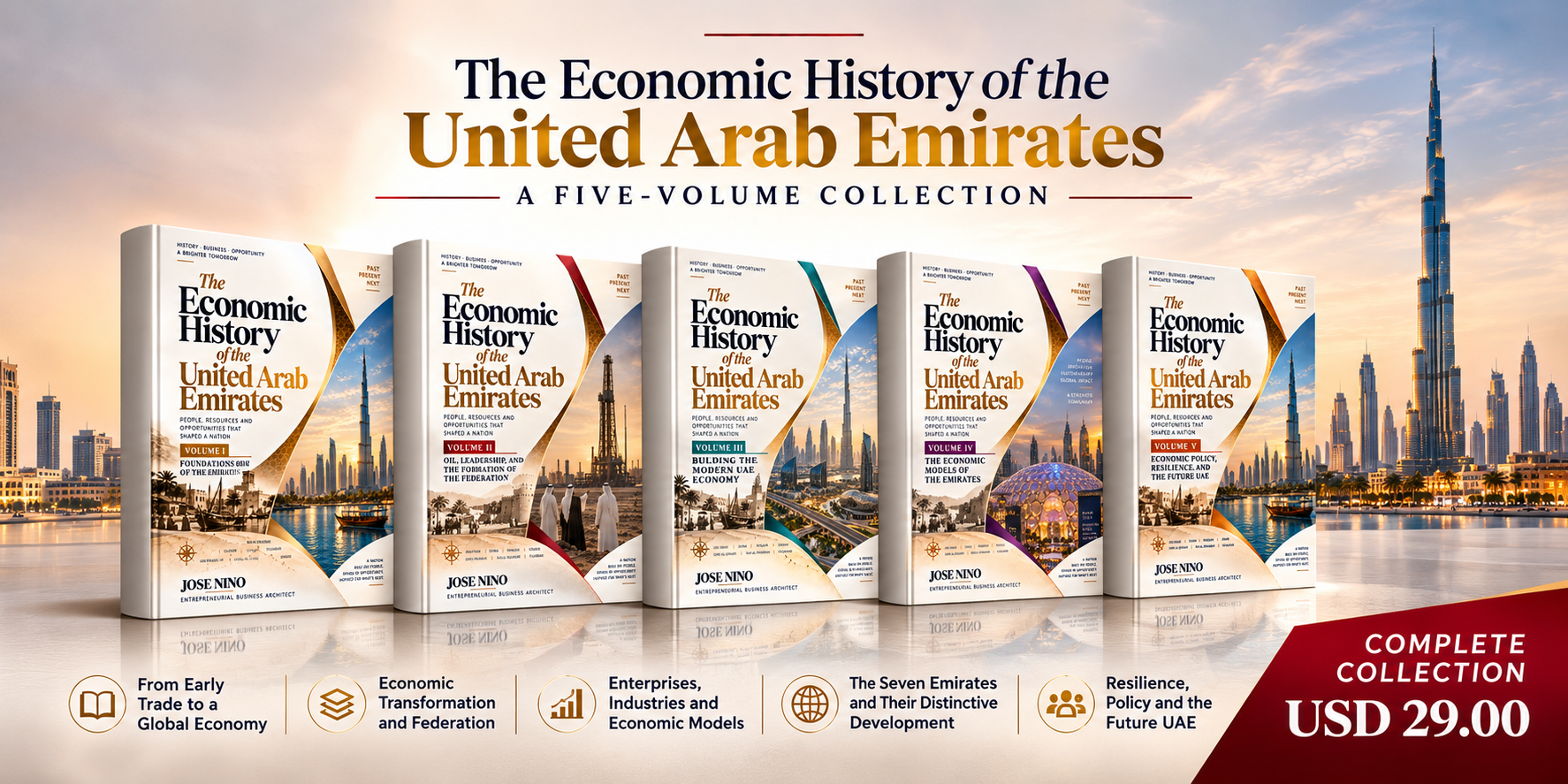
The history of the Trucial States is one part of a much larger economic transformation. Understanding how the UAE developed requires examining its early commercial foundations, ruling families, maritime networks, institutional relationships, petroleum discoveries, infrastructure investments, and entrepreneurial development.
The Economic History of the United Arab Emirates, by Jose Nino, explores this transformation across a comprehensive five-volume collection. Volume I, Foundations of the Emirates, examines the economic and institutional developments that preceded the formation of the modern federation, including the treaties with Great Britain and the emergence of the Trucial States.
For entrepreneurs, investors, researchers, and business professionals, the collection provides a historical perspective on the forces that shaped the country's development and the economic principles that remain relevant to contemporary business decisions.
Five volumes. One economic transformation. Practical lessons for today's entrepreneurs.
Complete Five-Volume Digital PDF Collection — USD 29.99
From Institutional History to Establishing Your Business in Dubai
Understanding the institutional environment is essential when entering a new market. Entrepreneurs considering Dubai or the wider UAE must evaluate the relationship between their proposed business activities, licensing requirements, jurisdiction, commercial objectives, and operating structure.
ONE Business Dubai supports entrepreneurs and international businesses seeking to establish their commercial presence in the United Arab Emirates. Our company formation and business registration services assist clients with the initial establishment process according to their proposed activities and applicable requirements.
UAE Company Formation & Business Registration — Professional Fees from USD 1,200 + Government Fees
The final scope and estimated cost depend on the proposed activity, jurisdiction, registration requirements, and services requested. Contact our team to discuss your enterprise and request a tailored quotation.
Request UAE Company Formation & Business Registration Assistance
Build Your Business on a Foundation You Understand
The transformation of the Trucial Coast demonstrates that economic opportunities are influenced by the rules, institutions, and political relationships within which commerce develops. Entrepreneurs cannot control every element of their external environment, but they can improve their ability to understand it and respond intelligently.
Before entering a market, identify its rules. Before investing, evaluate its institutional conditions. Before forming partnerships, understand the commitments and limitations they create. And before expanding, ensure that the enterprise possesses the capabilities necessary to operate reliably within its chosen environment.
A sustainable business begins with a clear understanding of both the opportunity and the conditions required to pursue it successfully.
Discover the historical foundations of the UAE economy in The Economic History of the United Arab Emirates, the complete five-volume collection by Jose Nino.
Discover the Complete Five-Volume Collection — USD 29.99
Contact ONE Business Dubai for UAE Company Formation Services