ONE BUSINESS / INSIGHTS / ARTICLE 07
How Dubai Built a Commercial Economy Before Oil: 12 Entrepreneurial Lessons
The Entrepreneurial Lessons Behind Merchant Networks, Open Trade, Commercial Trust, Economic Resilience, and Dubai's Rise as a Global Business Center

Dubai's Greatest Economic Advantage Was Built Before Oil
When entrepreneurs look at Dubai today, they see one of the world's most internationally connected business environments. The city is associated with modern infrastructure, global aviation, international finance, sophisticated logistics, and a remarkable concentration of commercial activity. Yet the foundations of this economic success were established long before petroleum revenues transformed the emirate's development possibilities. Dubai was already building a distinctive commercial economy when its principal assets were a natural creek, maritime connections, merchant relationships, and the determination of its leadership and trading communities to participate in regional commerce.
This history challenges a common misunderstanding about the development of the United Arab Emirates: that its economic success began with the discovery of oil. Petroleum undoubtedly accelerated development and provided important financial resources, but Dubai's commercial identity emerged much earlier. Its position as a trading settlement, its connections with regional markets, and its ability to attract merchants created economic capabilities that would later support a much larger transformation. The discovery of oil in Dubai in 1966 and the beginning of exports in 1969 represented a new stage in a commercial history that was already well established.
For entrepreneurs, the distinction is fundamental. Economic opportunity does not necessarily begin with abundant natural resources, advanced technology, or substantial financial capital. It can emerge when individuals and institutions discover how to organize existing resources, establish productive relationships, reduce barriers to exchange, and attract participants who contribute complementary capabilities. Dubai's development demonstrates that the economic value of a location depends not only on what it possesses, but also on what people can accomplish through it.
The following twelve entrepreneurial lessons examine the development of Dubai's pre-oil commercial economy, from the establishment of Al Maktoum rule in 1833 to the growth of merchant networks, the importance of Dubai Creek, the attraction of international traders, and the challenges created by the decline of pearling. Each lesson connects historical developments with principles relevant to contemporary entrepreneurship and Entrepreneurial Business Architecture (EBA). Together, they reveal how commercial environments become productive, how enterprises develop competitive advantages, and why economic resilience depends on the capacity to adapt.
1. Entrepreneurial Lesson: A Successful Venture Begins with a Distinct Economic Proposition
The establishment of Al Maktoum rule in Dubai in 1833 represented a decisive moment in the emirate's political development. Members of the Al Bu Falasah branch of the Bani Yas, led by Maktoum bin Butti, moved from Abu Dhabi and established a separate political center in Dubai. The settlement was not an empty territory awaiting its first inhabitants. Fishing, pearling, and maritime activities already existed along the Creek, but the establishment of new leadership created the foundations for a different political and commercial trajectory.
The importance of this development lies partly in the relationship between leadership and economic participation. A settlement seeking to attract merchants, residents, and commercial activity needed to offer conditions that participants considered worthwhile. Security, access to maritime routes, local relationships, and the treatment of traders influenced the attractiveness of competing coastal settlements. Political authority alone could not guarantee prosperity; the settlement also needed productive economic relationships.
For entrepreneurs, this experience illustrates the difference between establishing an organization and creating a compelling reason for others to participate in it. Incorporating a company, renting premises, or launching a website creates an organizational structure, but it does not automatically create customer demand. A new enterprise must explain why customers should purchase its products, why suppliers should cooperate with it, and why talented people should contribute to its development.
The practical application is to define the enterprise's value proposition before making substantial investments. Entrepreneurs should identify the problem being solved, the customers experiencing that problem, the alternatives already available, and the distinctive benefits the proposed business can deliver. The first entrepreneurial lesson is that a successful venture begins not merely with the decision to establish it, but with a credible economic proposition that attracts voluntary participation.
2. Entrepreneurial Lesson: Geography Becomes an Advantage Through Commercial Organization
Dubai Creek was one of the most important physical foundations of the emirate's early economy. Its sheltered waters provided access for vessels engaged in fishing, pearling, and regional trade. The surrounding settlement developed commercial activities that connected maritime transportation with local markets, merchants, and the movement of goods. The Creek was a natural asset, but its economic significance depended on the activities organized around it.
Other settlements along the Arabian Gulf also possessed coastal access and maritime traditions. Geography therefore cannot, by itself, explain Dubai's subsequent development. The distinction emerged through the combination of location, commercial relationships, local policies, and the accumulation of trading capabilities. As merchants established businesses and maritime operators connected the settlement with external markets, the usefulness of the Creek increased.
This illustrates a fundamental principle of economic development: resources acquire greater value when they are connected to productive systems. A harbor becomes commercially important when vessels can use it to reach customers and suppliers. A marketplace becomes valuable when it attracts sufficient buyers and sellers. A transportation network creates economic benefits when businesses can use it to move goods reliably and at commercially viable costs.
Modern entrepreneurs encounter the same distinction when choosing business locations. Establishing a company in Dubai may provide access to international infrastructure, but the location alone does not create a profitable enterprise. The founder must develop customers, distribution arrangements, operational processes, and relationships that convert geographical access into commercial value. The second lesson is that location creates potential, while business architecture determines whether that potential becomes a sustainable competitive advantage.
3. Entrepreneurial Lesson: Attracting Productive Participants Can Be More Valuable Than Owning Resources
Dubai's early economic development depended heavily on the activities of merchants. Traders brought goods, financial resources, commercial knowledge, and relationships with external markets. Their presence generated transactions and created demand for transportation, storage, services, and other activities that supported the wider settlement.
The value of these merchants extended beyond the merchandise they imported or exported. Experienced traders understood regional demand, maintained relationships with suppliers, negotiated commercial arrangements, and possessed knowledge accumulated through repeated transactions. Their participation strengthened the settlement's economic connections and increased its usefulness to other merchants.
This process illustrates the importance of attracting productive participants rather than attempting to control every economic activity directly. A commercial center can generate substantial value by creating conditions in which independent enterprises find it advantageous to operate. As more businesses participate, opportunities for specialization, cooperation, and exchange may increase.
Contemporary entrepreneurs can apply this principle when developing marketplaces, professional service networks, distribution businesses, or platforms that connect customers and suppliers. The objective is not necessarily to own every productive resource. Instead, the enterprise may create value by facilitating transactions, coordinating complementary capabilities, and making participation attractive to others. The third lesson is that an entrepreneurial organization can become economically powerful by enabling other businesses to create value within its commercial system.
4. Entrepreneurial Lesson: Commercial Openness Is a Strategic Competitive Advantage
During the late nineteenth and early twentieth centuries, Dubai increasingly developed a reputation for policies favorable to merchants and trading activity. Under Sheikh Maktoum bin Hasher Al Maktoum, the emirate pursued a free-port strategy around the beginning of the twentieth century, reducing commercial barriers and strengthening its attractiveness relative to competing ports.
These policies became especially significant as changes in taxation and administration affected the Persian port of Lingah. Merchants who faced less favorable conditions elsewhere had reasons to consider relocating their activities. Dubai benefited from the movement of trading communities that brought established networks, commercial expertise, and connections with India and other markets.
The entrepreneurial significance of this development lies in the relationship between transaction costs and market participation. Businesses and merchants evaluate the costs associated with entering a market, completing transactions, and maintaining operations. When unnecessary barriers are reduced, a commercial environment can become more attractive even without possessing superior natural resources.
Modern enterprises face similar decisions when designing their pricing, customer onboarding, purchasing procedures, and service delivery systems. Complicated documentation, unclear conditions, delayed responses, and unnecessary administrative requirements can discourage customers. Removing friction can improve participation, although appropriate legal, financial, and operational controls must remain in place. The fourth lesson is that commercial openness creates competitive advantage when it reduces unnecessary obstacles while preserving the reliability and integrity of business operations.
5. Entrepreneurial Lesson: Merchant Networks Are a Form of Economic Capital
Dubai's commercial development was closely connected to trading networks extending across the Arabian Gulf, Persia, India, and the wider Indian Ocean economy. These relationships allowed merchants to identify products, obtain supplies, access customers, arrange transportation, and exchange information across different markets.
The arrival of merchant communities from other ports strengthened these connections. Traders did not arrive solely with physical goods or financial capital. They also brought relationships, knowledge of market conditions, commercial practices, and reputations developed through previous transactions. These intangible resources could become as important as warehouses, vessels, or trading premises.
The historical experience demonstrates that economic capital takes multiple forms. Financial resources allow businesses to purchase assets and finance operations, but relationships and specialized knowledge determine how effectively those resources can be used. A merchant with access to reliable suppliers and established customers may possess opportunities unavailable to another trader with similar financial resources but weaker connections.
For entrepreneurs entering Dubai today, this lesson emphasizes the importance of developing genuine commercial relationships. Company registration may establish legal capacity to conduct business, but it does not automatically provide customers, suppliers, distribution channels, or market knowledge. These capabilities must be developed through research, professional credibility, reliable performance, and sustained engagement. The fifth lesson is that commercial networks become valuable assets when they improve access to opportunities, reduce uncertainty, and support productive cooperation.
6. Entrepreneurial Lesson: International Talent Expands the Capabilities of an Economy
Dubai's commercial identity was strengthened by the arrival of merchants and trading communities from different parts of the region. Persian and Indian commercial connections became important elements of its economic development, contributing knowledge, capital, trading relationships, and specialized business activities.
This movement of people was influenced by economic conditions, political developments, and the opportunities available in competing ports. Merchants considered whether a location offered favorable conditions for conducting business, maintaining relationships, and protecting their commercial interests. Dubai's growing attractiveness encouraged the concentration of diverse commercial capabilities within a relatively small settlement.
The resulting economic benefits extended beyond individual businesses. Merchants required services, labor, transportation, storage, and local suppliers. Their activities created opportunities for other participants and contributed to a broader commercial ecosystem. At the same time, the experiences of different communities were shaped by distinct social and legal positions, and economic participation did not necessarily imply equal political standing.
Modern entrepreneurial ecosystems benefit from a similar accumulation of capabilities. International founders, skilled professionals, investors, and established businesses can introduce new knowledge, relationships, and commercial opportunities. However, attracting talent is only the beginning. The surrounding environment must enable participants to cooperate productively and develop sustainable enterprises. The sixth lesson is that economic development accelerates when a commercial environment attracts people whose skills, relationships, and experience expand the opportunities available to others.
7. Entrepreneurial Lesson: Infrastructure Creates Value When It Enables Productive Exchange
Dubai's early commercial infrastructure was modest compared with its modern ports and logistics systems. Nevertheless, the Creek, maritime vessels, markets, storage arrangements, and supporting services formed an interconnected system that enabled trade. Each component contributed to the movement of goods and the organization of commercial transactions.
The economic importance of infrastructure depends on how effectively it serves productive activity. A harbor without merchants has limited commercial value. A warehouse without reliable transportation may become an expensive asset. A marketplace without sufficient customers cannot sustain participating businesses indefinitely. Infrastructure must therefore be evaluated in relation to the economic system it supports.
Dubai's later development reinforced this principle. The decision to improve navigability through dredging Dubai Creek in the late 1950s reflected the continuing importance of maritime commerce. Under Sheikh Rashid bin Saeed Al Maktoum, investment in commercial infrastructure became an important part of preparing the emirate for future growth, even before oil exports began.
For entrepreneurs, this lesson applies to decisions concerning offices, warehouses, software, equipment, and operational capacity. Founders sometimes invest in impressive assets before validating demand or determining whether those assets will improve productivity. A more disciplined approach evaluates infrastructure according to its contribution to customer service, transaction efficiency, reliability, and revenue generation. The seventh lesson is that infrastructure should be developed to support a clearly understood commercial purpose, rather than treated as evidence of success in itself.
8. Entrepreneurial Lesson: Trust Is the Invisible Infrastructure of Commerce
Commercial transactions frequently require participants to make commitments before receiving the full benefits of an exchange. Merchants may deliver goods before payment, extend credit to established customers, or depend on partners located in distant markets. These arrangements create uncertainty that cannot always be eliminated through immediate inspection or direct control.
In Dubai's early trading environment, reputation, family relationships, repeated transactions, and established merchant networks helped participants evaluate commercial reliability. Trust facilitated cooperation across distances and supported relationships involving different communities and markets. These practices were particularly important in an era when communication and transportation were considerably slower than today.
Trust also had economic consequences. A merchant known for fulfilling commitments could become a preferred commercial partner. Reliable relationships could reduce the time required to identify counterparties, negotiate arrangements, and organize transactions. However, personal confidence did not eliminate financial risk, and commercial relationships remained vulnerable to changing market conditions.
For modern entrepreneurs, trust continues to influence customer acquisition, supplier relationships, partnerships, and financing opportunities. It is developed through accurate communication, transparent obligations, dependable service delivery, and responsible financial conduct. Formal contracts and appropriate controls strengthen rather than replace these foundations. The eighth lesson is that trust becomes an economic asset when consistent performance reduces uncertainty and makes productive cooperation easier to sustain.
9. Entrepreneurial Lesson: A Profitable Industry Can Become a Dangerous Dependency
Pearling was one of the principal economic activities of Dubai and the wider Gulf before petroleum. The industry connected divers, vessel owners, financiers, merchants, and international buyers through a complex commercial system. It generated employment and supported households whose livelihoods depended directly or indirectly on the seasonal pearl economy.
The industry also exposed participants to considerable risk. Pearling depended on maritime conditions, labor-intensive operations, financing arrangements, and international demand. The economic returns were uncertain, while the physical dangers faced by divers were substantial. The commercial system could be profitable, but its participants remained vulnerable to circumstances beyond their control.
During the early twentieth century, the expansion of cultured pearls, changes in international luxury demand, and the economic disruption associated with the Great Depression contributed to the severe decline of traditional Gulf pearling. The consequences affected not only those directly involved in diving, but also merchants, financiers, suppliers, and communities connected to the industry.
For entrepreneurs, this history illustrates the danger of confusing current profitability with permanent economic security. A business may perform successfully for many years while remaining dependent on one product, one technology, one customer segment, or one source of demand. When external conditions change, established advantages can deteriorate rapidly. The ninth lesson is that entrepreneurs must evaluate concentration risk even when their principal business activity appears commercially successful.
10. Entrepreneurial Lesson: Economic Resilience Depends on Transferable Capabilities
The decline of pearling created substantial economic hardship across the Gulf. Dubai experienced the effects of reduced demand, declining incomes, and the disruption of commercial relationships associated with the industry. Adaptation was difficult, and the existence of alternative trading activities did not prevent considerable suffering among affected communities.
Nevertheless, Dubai possessed commercial capabilities that extended beyond pearling. Merchant networks, maritime knowledge, trading relationships, and experience in organizing transactions could support other forms of exchange. These capabilities did not guarantee immediate recovery, but they provided foundations upon which alternative activities could develop.
The distinction between an economic activity and the capabilities supporting it is important. A business may initially succeed by selling a particular product, but its deeper strengths may include supplier relationships, customer knowledge, distribution systems, financial discipline, or specialized expertise. When demand changes, some of these capabilities may remain valuable.
Entrepreneurs should therefore examine which elements of their businesses are transferable to new markets or activities. A distribution company may be able to introduce different products through established channels. A professional service firm may adapt its expertise to emerging customer requirements. A technology enterprise may apply its capabilities to new applications. The tenth lesson is that resilience comes from developing capabilities that remain useful when the original business model must change.
11. Entrepreneurial Lesson: Business Architecture Connects Opportunity with Execution
Dubai's pre-oil development illustrates how different economic elements can reinforce one another. Geographic access created possibilities for maritime trade, merchant participation expanded commercial networks, favorable trading conditions attracted additional activity, and supporting infrastructure helped organize exchange. No single element fully explains the emirate's commercial development.
Entrepreneurial Business Architecture (EBA) provides a contemporary framework for understanding these relationships. The objective is not to suggest that historical merchants applied a modern methodology, but to identify the interconnected components that entrepreneurs must consider when designing enterprises.
The first component is the value proposition: the economic benefit that attracts customers and commercial partners. The second is the operating system: the people, processes, resources, and infrastructure necessary to deliver that benefit. The third is the commercial network: the relationships connecting the enterprise with suppliers, customers, financial institutions, and other participants.
The fourth component is institutional alignment. Entrepreneurs must understand the legal, regulatory, contractual, and commercial conditions governing their activities. The fifth is financial sustainability, including the ability to generate sufficient revenue, control costs, maintain liquidity, and finance future development. The sixth is adaptability, which allows the organization to respond when markets, technologies, or customer requirements change.
These components must operate together. An attractive product cannot compensate indefinitely for unreliable delivery. Strong relationships cannot sustain an enterprise whose financial model is fundamentally unviable. Infrastructure cannot generate returns without sufficient commercial activity. The eleventh lesson is that sustainable entrepreneurship requires an integrated business architecture in which strategy, operations, relationships, institutions, and financial resources reinforce one another.
12. Entrepreneurial Lesson: Sustainable Prosperity Is Constructed Through Economic Participation
The history of pre-oil Dubai demonstrates that economic development is not determined exclusively by the natural resources available within a territory. The emirate's commercial identity emerged through the interaction of leadership, maritime access, merchant entrepreneurship, international relationships, and policies that influenced participation in its economy.
This development was neither inevitable nor uninterrupted. Dubai faced competition from other Gulf ports, changing regional political conditions, economic uncertainty, and the collapse of an industry upon which many livelihoods depended. Its subsequent growth should therefore be understood as a historical process involving adaptation, opportunity, and difficult choices rather than as the automatic result of a predetermined economic destiny.
The most important insight for entrepreneurs concerns the organization of value creation. A successful enterprise must attract customers, coordinate productive resources, establish reliable relationships, and develop capabilities that remain relevant as circumstances change. These responsibilities become more demanding as the business grows, but they remain central from the earliest stages of development.
Dubai's history also demonstrates the value of thinking beyond individual transactions. Commercial ecosystems become stronger when participants have reasons to continue exchanging goods, services, knowledge, and opportunities. Entrepreneurs who create value for customers and partners can contribute to relationships that support further growth.
The twelfth lesson is that lasting economic prosperity is constructed through the continuous creation of opportunities for productive participation. The entrepreneur's challenge is not simply to capture existing demand, but to design an organization capable of expanding the possibilities available to customers, partners, employees, and the wider market.
Explore The Economic History of the United Arab Emirates
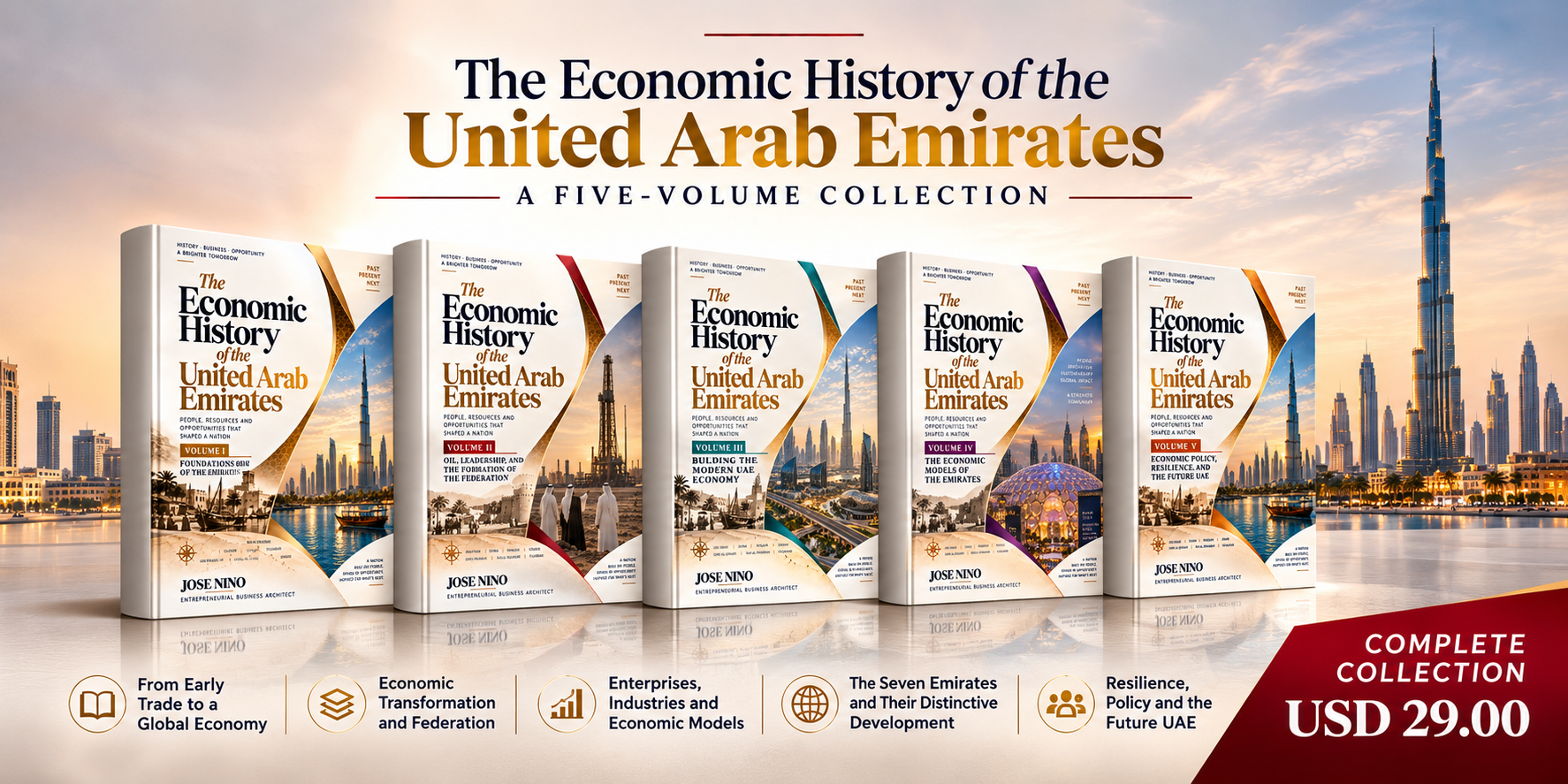
Dubai's commercial development before oil represents one chapter in the much larger economic transformation of the United Arab Emirates. Understanding this transformation requires examining the relationship between geography, merchant networks, political leadership, maritime commerce, economic institutions, petroleum development, infrastructure investment, and entrepreneurial activity. These historical processes reveal how the foundations of modern economic systems emerge and how decisions made across generations influence the opportunities available to future entrepreneurs.
The Economic History of the United Arab Emirates, by Jose Nino, examines this extraordinary journey across a comprehensive five-volume collection. Volume I, Foundations of the Emirates, explores the early economic development of the region, including the emergence of Dubai as a commercial center before petroleum. The subsequent volumes examine the discovery of oil, the formation of the federation, the construction of modern industries and infrastructure, the distinctive economic models of the seven emirates, and the policies influencing the country's future development.
The collection is intended for entrepreneurs, investors, business leaders, researchers, and readers who want to understand the economic principles behind the UAE's transformation. Rather than presenting economic history as a sequence of isolated events, it connects historical developments with questions concerning leadership, opportunity recognition, institutional development, commercial strategy, and the organization of productive resources.
Five volumes. One extraordinary economic transformation. Entrepreneurial lessons for a changing world.
Complete Five-Volume Digital PDF Collection — USD 29.99
From Dubai's Commercial History to Establishing Your Business in the UAE
Dubai's early development demonstrates that entering a market successfully requires more than recognizing an attractive location. Entrepreneurs must understand the commercial environment, identify viable opportunities, establish reliable relationships, and develop operating capabilities consistent with the requirements of their chosen activities. These principles remain relevant to international founders considering Dubai and the wider United Arab Emirates as a base for business development.
ONE Business Dubai assists entrepreneurs and international businesses seeking to establish their commercial presence in the UAE. Our company formation and business registration services support the initial establishment process, helping clients evaluate their proposed business activities and the registration arrangements relevant to their objectives. The appropriate structure depends on the nature of the business, its intended operations, applicable licensing requirements, and the jurisdiction selected.
UAE Company Formation & Business Registration — Professional Fees from USD 1,200 + Government Fees
The final scope and estimated cost depend on the proposed activity, registration requirements, jurisdiction, and additional services requested. Entrepreneurs considering a new business in Dubai are invited to contact ONE Business Dubai to discuss their proposed activities and request a tailored quotation.
Request UAE Company Formation & Business Registration Assistance
Build a Business That Creates Opportunities, Not Just Transactions
The history of Dubai before oil provides a compelling reminder that entrepreneurial development is not simply a matter of possessing capital, resources, or a favorable location. Sustainable economic success emerges when entrepreneurs organize capabilities, establish productive relationships, create value for customers, and develop the flexibility necessary to respond to changing circumstances. Dubai's commercial foundations demonstrate how these principles can influence the development of an entire economic environment.
For founders considering the United Arab Emirates, the practical challenge is to translate opportunity into a functioning enterprise. This requires more than obtaining a business license or entering an attractive market. It requires a clear value proposition, disciplined financial planning, appropriate institutional arrangements, reliable operations, and a strategy for developing commercial relationships over time. These are the foundations of Entrepreneurial Business Architecture and the principles that connect historical economic development with contemporary entrepreneurship.
Dubai's enduring entrepreneurial lesson is that economic opportunity does not have to be inherited from natural resources. It can be created through vision, commercial openness, productive relationships, institutional understanding, and the disciplined architecture of enterprise.
Discover the economic history behind Dubai's transformation in The Economic History of the United Arab Emirates, the five-volume collection by Jose Nino.
Discover the Complete Five-Volume Collection — USD 29.99
Contact ONE Business Dubai for UAE Company Formation Services