ONE BUSINESS / INSIGHTS / ARTICLE 20
How Dubai’s Digital Company Formation, Free Zones, and Global Trade Infrastructure Help Entrepreneurs Build International Businesses
Understanding how Dubai’s business environment supports international entrepreneurship, why choosing the right company structure matters, and how to turn access to a global business hub into a commercially viable enterprise.

Dubai has become one of the world's most attractive destinations for international entrepreneurs seeking to establish companies, expand commercial operations, and access new markets. Its business environment combines modern infrastructure, specialized economic jurisdictions, digital government services, international financial institutions, and commercial connections extending across the Middle East, Asia, Africa, and Europe. These capabilities have made company formation in Dubai an increasingly attractive option for founders who want to participate in international business without necessarily relocating their entire lives or operations.
However, understanding Dubai's business advantages requires more than examining the speed of its company registration procedures or the availability of free-zone licenses. Entrepreneurs must understand how the emirate developed its economic architecture, why different business jurisdictions exist, how its international infrastructure supports particular commercial activities, and which decisions determine whether a newly established company becomes a functioning enterprise.
Dubai offers entrepreneurs access to an extraordinary business environment, but entrepreneurial success depends on understanding how to use that environment effectively. A commercial license provides the legal foundation for an enterprise, while customers, suppliers, organizational capabilities, financial resources, and an appropriate business model determine its ability to create economic value.
This distinction is fundamental to the services provided by ONE Business Dubai, which assists international entrepreneurs seeking to establish companies in Dubai and the wider United Arab Emirates. For eligible business activities and jurisdictions, our company formation services support same-day UAE company registration for a professional service fee of USD 1,200, plus applicable government and licensing costs, subject to complete documentation, the requirements of the relevant authority, and necessary approvals.
Start Your Business in Dubai — Same-Day Company Formation Services for USD 1,200 + Government Fees
The business environment available to international entrepreneurs today represents the outcome of a much longer process of economic development. Dubai's ability to attract enterprises, facilitate commerce, and connect international markets did not emerge exclusively from digital technology or contemporary company registration procedures. It developed through a historical combination of maritime trade, merchant activity, strategic infrastructure investment, institutional construction, economic diversification, and the progressive development of commercial capabilities.
As explored in The Economic History of the United Arab Emirates, the country's transformation demonstrates how economic opportunities become more valuable when geography, infrastructure, institutions, capital, and enterprise are developed as interconnected components of an economic system. This historical perspective helps contemporary entrepreneurs understand why Dubai's business environment operates as it does and how its capabilities contribute to the opportunities available to companies entering the market.
The most important entrepreneurial lesson is that establishing a company and developing a business are different but interconnected processes. Digital formation procedures can reduce the administrative effort required to create a legal entity, but they do not replace the strategic analysis needed to identify customers, evaluate competition, select an appropriate operating structure, and build an enterprise capable of generating sustainable revenue.
Dubai’s Free Zones and the Economic Architecture Behind International Business
Dubai's free zones represent one of the most distinctive characteristics of its business environment. Rather than relying on a single institutional framework for every commercial activity, the emirate developed specialized jurisdictions intended to support different industries, investment requirements, and operating models. These environments form part of a wider economic strategy in which regulatory arrangements, infrastructure, administrative services, and commercial ecosystems are coordinated to facilitate particular forms of enterprise.
The historical development of this strategy helps explain why Dubai offers entrepreneurs more than a location in which to register a company. Its free zones participate in the organization of economic activity by providing institutional environments adapted to different commercial requirements. Their value does not depend exclusively on company ownership provisions or administrative convenience. It also depends on their relationships with the industries, infrastructure, professional services, and international markets surrounding them.
Jebel Ali Free Zone, commonly known as JAFZA, illustrates the importance of connecting a business jurisdiction with major productive and transportation infrastructure. Its relationship with Jebel Ali Port provides an environment relevant to international trading companies, industrial enterprises, logistics operators, and businesses requiring physical distribution capabilities. The economic significance of this arrangement extends beyond the availability of warehouses or commercial licenses. It lies in the ability to connect maritime transportation, storage, industrial operations, customs procedures, and commercial activity within a coordinated environment.
Dubai Multi Commodities Centre, or DMCC, represents another approach to specialized economic development. Its business ecosystem includes commodities trading, international commercial services, and technology-related activities. Companies considering this environment must evaluate whether its regulatory arrangements, business community, available services, and commercial positioning correspond to their particular activities. An internationally recognized jurisdiction may offer valuable opportunities, but its reputation alone does not establish that it is the most suitable option for every entrepreneur.
Other jurisdictions serve different commercial needs. Dubai International Financial Centre provides a specialized legal and regulatory environment for financial and related professional activities. Dubai South supports activities associated with aviation, logistics, and economic development around Al Maktoum International Airport. Business environments such as Dubai Internet City, Dubai Design District, Meydan Free Zone, and IFZA provide distinct combinations of licensing arrangements, facilities, sector focus, and administrative services.
The entrepreneurial lesson is that choosing a free zone should be a strategic business decision, not simply a comparison of company registration prices. Entrepreneurs need to determine what their businesses intend to do, which customers they will serve, where their activities will take place, and what resources are necessary for successful operations. The most appropriate jurisdiction is the one whose legal and commercial characteristics support those requirements.
An entrepreneur establishing an international consulting business may prioritize the availability of suitable professional activities, efficient administrative services, and an appropriate operating address. A company planning to import machinery, maintain inventory, and distribute products internationally may require physical facilities, customs arrangements, and transportation capabilities that would be irrelevant to a consulting enterprise. A business intending to provide regulated financial services must evaluate a substantially different institutional environment from one developing general commercial software.
These distinctions influence much more than initial costs. The selected jurisdiction can affect permitted activities, premises requirements, immigration arrangements, regulatory obligations, access to customers, and the ability to conduct particular operations within the UAE mainland. Entrepreneurs who choose a structure without understanding these relationships may subsequently discover that additional permissions, licenses, facilities, or operational arrangements are required.
The distinction between mainland and free-zone business activity deserves particular attention. A free-zone company does not automatically possess unrestricted authorization to conduct every type of business throughout the UAE mainland. Applicable restrictions, licensing arrangements, and additional permits depend on the activities involved and the relevant legal framework. Dubai has developed mechanisms allowing eligible free-zone businesses to undertake specified mainland activities through appropriate authorization, but these arrangements require an understanding of their scope and conditions.
This is precisely why professional assistance can be valuable during company formation. ONE Business Dubai helps international entrepreneurs navigate the establishment process and understand the arrangements relevant to their intended business activities, rather than treating every incorporation as an identical administrative transaction.
For eligible clients, the process can be completed through qualifying same-day company formation arrangements, with a professional service fee of USD 1,200 plus applicable government and licensing costs. The actual completion time depends on the jurisdiction, selected activities, supporting documents, and required approvals.
Establish Your UAE Company with ONE Business Dubai — Explore Our USD 1,200 Company Formation Service
The broader economic significance of Dubai's free-zone model becomes clearer when examined historically. In The Economic History of the United Arab Emirates, particularly the volumes examining the construction of the modern economy and the instruments of economic development, infrastructure and institutions are understood as mechanisms through which commercial possibilities can be transformed into productive capabilities.
Free zones illustrate this relationship because they are not simply geographical areas offering company registration. They are institutional environments intended to influence how enterprises establish themselves, access resources, and participate in economic activity.
For international entrepreneurs, understanding this history helps clarify why selecting the right jurisdiction matters. A business license should be considered one component of the wider enterprise architecture, designed to support the market the company intends to serve and the activities through which it expects to generate revenue.
Digital Company Formation, Remote Entrepreneurship, and the Difference Between Registration and Business Readiness
The digital transformation of government and commercial services has significantly changed how entrepreneurs interact with business registration authorities. Procedures that previously required extensive paper documentation and physical visits can, for eligible applications, be initiated or completed through electronic platforms. Online applications, digital document submission, identity verification, electronic approvals, and electronic licensing systems contribute to a more accessible environment for domestic and international investors.
Dubai's digital business formation infrastructure provides an important example of this development. The availability of online company establishment services reduces certain administrative barriers and allows entrepreneurs to organize parts of the registration process without the same physical presence requirements associated with traditional company formation procedures.
Under qualifying circumstances, some business licenses can be issued rapidly, including through instant licensing arrangements for eligible activities. However, the availability of digital services should not be interpreted as a universal guarantee that every type of company can be incorporated immediately or that every associated requirement can be completed remotely.
Business activities requiring specialized approvals, particular premises, regulated operations, additional verification, or complex ownership arrangements may involve different procedures and processing times. Even when a license can be issued electronically, other operational requirements may remain outstanding.
The principal advantage of digital company formation is not merely speed. It is the opportunity to reduce administrative friction so entrepreneurs can devote more attention and resources to developing their businesses.
For an international founder, administrative efficiency becomes economically valuable when it supports a coherent commercial strategy. A company that can establish its legal presence efficiently may begin organizing contractual arrangements, communicating with suppliers, preparing operational systems, and approaching prospective customers without unnecessary delays. Nevertheless, these activities still require preparation and appropriate resources.
Before registering a company, an entrepreneur should understand the nature of the intended business, the customers it expects to serve, its principal revenue model, and the operational arrangements required to deliver its products or services. These questions help determine which licenses, jurisdictions, and legal structures are suitable for the proposed activity.
For example, a founder developing a digital consultancy serving international clients may have relatively limited requirements for physical facilities. The same founder, however, may still need to establish suitable contractual procedures, payment arrangements, professional documentation, data-management practices, and compliance systems. Company formation provides the corporate structure within which these activities can be organized, but registration alone does not complete them.
A trading enterprise faces different conditions. Its commercial readiness may depend upon access to suppliers, inventory financing, shipping arrangements, customs procedures, product compliance, and distribution channels. Rapid registration can facilitate the legal establishment of such an enterprise, but it cannot replace the preparation required for its commercial operations.
The distinction becomes particularly important when discussing corporate banking. A newly registered company may apply to open a UAE business bank account, but the decision to approve the application rests with the financial institution and its compliance procedures. Banks may examine the company's ownership, business activities, expected transactions, source of funds, operational substance, and the identities of individuals associated with the enterprise.
Consequently, entrepreneurs should not assume that same-day incorporation means same-day activation of a fully operational bank account. Banking arrangements must be evaluated separately, and processing times can vary according to the institution, applicant profile, business model, and documentation.
ONE Business Dubai can assist clients with the business bank account opening process where appropriate, while recognizing that account approval remains the independent responsibility of the relevant financial institution.
The same distinction applies to immigration and residency. Owning a company in the UAE does not automatically establish personal residency or determine an individual's tax residence. Visas, immigration permissions, identification procedures, and tax-residency requirements are governed by their respective rules. Entrepreneurs who intend to relocate or establish a long-term physical presence must examine those requirements separately from company registration.
This is especially important for founders who plan to manage UAE companies while remaining physically located in another country. International business ownership may be legally possible without permanent relocation, depending on the structure and activities involved, but the taxation of the entrepreneur and the business may also be affected by foreign-country residence rules, corporate management arrangements, and cross-border tax obligations.
A company established in Dubai is therefore not automatically outside the tax jurisdiction of every other country in which its founders live or conduct business. Professional cross-border advice becomes important when the commercial arrangement involves multiple tax systems.
The historical relationship between infrastructure and entrepreneurship provides useful context for these developments. Earlier commercial communities required transportation routes, practical knowledge, and institutional arrangements to participate in markets. Contemporary entrepreneurs require different forms of infrastructure, including digital administrative systems, financial services, legal institutions, and information technologies.
The specific technologies have changed dramatically, but the economic principle remains relevant: infrastructure becomes valuable when entrepreneurs integrate it with capabilities, customers, and commercially productive activities.
This is the approach underlying ONE Business Dubai's company formation services. The objective is to assist international entrepreneurs in establishing an appropriate legal foundation efficiently while recognizing that the development of a successful enterprise requires a wider process of market evaluation, operational preparation, and commercial execution.
Ready to establish your company in Dubai or the UAE? ONE Business Dubai offers same-day company formation services for eligible applications, with a professional fee of USD 1,200 plus government and licensing costs.
Start Your UAE Company Registration
Global Trade Infrastructure and the Strategic Value of Dubai’s Geographic Position
Dubai's international business environment cannot be understood solely through the efficiency of its licensing procedures. One of its most important economic characteristics is the relationship between its geographical position and the infrastructure developed to connect international markets.
Situated along major trade routes between Asia, Africa, and Europe, Dubai has invested extensively in maritime transportation, aviation, logistics, commercial districts, and supporting services. These investments have contributed to an economic environment in which companies can organize trade, transportation, distribution, and international business activities from a strategically connected location.
The historical foundations of this position are especially important. The economic history of the Emirates demonstrates that maritime connections existed long before the emergence of modern container ports or international airports. Communities along the Arabian Gulf developed commercial relationships with neighboring economies and participated in wider systems of exchange. Their opportunities depended partly on geography, but geography alone did not determine commercial outcomes.
Knowledge of trading routes, maritime capabilities, transportation arrangements, commercial relationships, and political circumstances influenced the economic activities available to different communities.
As explored in The Economic History of the United Arab Emirates, the country's economic development illustrates how the strategic value of geography changes when investments and institutions expand what businesses can accomplish within a particular location.
A coastline may provide access to maritime transportation, but the development of major ports, warehousing facilities, customs systems, transportation corridors, and supporting enterprises transforms the scale and sophistication of commercial activity that can take place there.
Modern Dubai demonstrates this transformation through the development of Jebel Ali Port, JAFZA, international aviation networks, logistics facilities, and commercial services connected to regional and global trade.
Jebel Ali Port and its surrounding economic infrastructure support activities involving container transportation, storage, industrial operations, and international distribution. The development of aviation and airport-related infrastructure provides additional possibilities for businesses dependent on passenger connections, time-sensitive transportation, specialized cargo handling, and international commercial mobility.
The economic significance of these investments arises partly from their interaction. Maritime transportation becomes more valuable when connected to suitable warehouses, commercial institutions, road networks, financing arrangements, and enterprises capable of using those facilities. Aviation contributes to economic activity through relationships with tourism, trade, investment, professional services, and international business travel.
This interaction explains why Dubai should be understood as an integrated commercial environment rather than merely a collection of impressive infrastructure projects.
For entrepreneurs, the principal lesson is that access to infrastructure creates an opportunity to organize commercial activity more effectively, but the business must still determine how that infrastructure contributes to its particular value proposition.
A company importing goods through Dubai must investigate the costs and conditions associated with transportation, warehousing, customs clearance, inventory management, and final delivery. It should also evaluate the requirements of destination markets, the reliability of suppliers, and the demand for its products. The existence of substantial logistics infrastructure is valuable, but profitable operations depend on how effectively the company combines these resources with a commercially viable business model.
An international distribution company may benefit from consolidating inventory, coordinating suppliers, arranging product inspection, or serving customers across multiple markets. However, each potential activity requires careful assessment of its costs, regulatory obligations, operational complexity, and competitive conditions.
The most appropriate business structure depends on these practical considerations. A company operating substantial physical distribution activities may require facilities and authorizations different from those of an enterprise providing international consulting or software services.
This is another reason why the decision to establish a company in Dubai should be approached strategically. Entrepreneurs should determine which activities they intend to perform and which aspects of Dubai's infrastructure are relevant to those activities before selecting a jurisdiction.
The commercial importance of free zones also becomes clearer through this analysis. Some zones are particularly relevant to physical trade, manufacturing, and distribution, while others support professional services, technology, finance, and other economic activities. Their usefulness depends on how their facilities, institutional arrangements, and permitted activities correspond to the proposed enterprise.
Entrepreneurs should therefore avoid choosing a company registration arrangement solely because it appears inexpensive or can be completed quickly. The total economic value of a structure depends on whether it supports the company's operational requirements and longer-term commercial objectives.
ONE Business Dubai assists international entrepreneurs with this establishment process, helping them understand available company formation arrangements and the practical requirements associated with their intended business activities.
Establishing an international business requires more than obtaining a trade license. It requires choosing a corporate structure that supports the market, customers, and commercial operations the entrepreneur intends to develop.
Explore Same-Day UAE Company Formation — ONE Business Dubai | USD 1,200 + Government Fees
Dubai's trade infrastructure also provides an important example of how economic development can create opportunities beyond the activities directly supported by major transportation facilities. Ports, airports, and logistics centers generate demand for complementary services involving technology, equipment, maintenance, professional expertise, information management, and operational coordination.
Entrepreneurs examining these ecosystems may identify opportunities that do not require ownership of large physical assets. Instead, their businesses may create value through specialized capabilities that help other companies operate more efficiently.
This distinction is particularly relevant to international founders with limited financial resources. Participating in an established economic ecosystem does not necessarily require developing infrastructure independently. Entrepreneurs can investigate the needs of enterprises already using that infrastructure and determine whether they possess capabilities that address commercially meaningful problems.
The historical economic lesson is that major investments and established commercial systems can create additional opportunities for specialized enterprises. Understanding how these relationships develop helps entrepreneurs recognize possibilities that may otherwise remain hidden behind the most visible industries.
Building a Commercially Viable Enterprise: What Entrepreneurs Must Understand Beyond Incorporation
The attractiveness of Dubai's business environment can encourage international entrepreneurs to focus heavily on company formation as the principal objective of entering the UAE market. Yet the legal establishment of an enterprise is only one component of entrepreneurial development.
A business must possess an identifiable commercial purpose, a defined customer market, the capabilities required to deliver value, and an operating model capable of generating sufficient revenue to sustain its activities.
This distinction is important because administrative efficiency can sometimes create a misleading impression of commercial simplicity. A company may be registered rapidly, but customers do not necessarily appear immediately. Access to international markets does not eliminate competition, while modern infrastructure does not replace the need for working capital, professional management, or reliable commercial execution.
The real entrepreneurial opportunity in Dubai is not simply the ability to register a company quickly. It is the possibility of building an enterprise within an economic environment designed to facilitate different forms of commercial activity.
Entrepreneurs should therefore evaluate their proposed business model before committing substantial resources to the establishment process. The analysis must determine whether the product or service addresses a genuine need, whether potential customers are willing to purchase it, and whether the company can deliver the offering at a cost consistent with a viable commercial margin.
The selected business activity also influences regulatory responsibilities. Different sectors may require specialized approvals, professional qualifications, operational facilities, or compliance procedures. Entrepreneurs must understand these requirements before beginning activities that fall within regulated categories.
Taxation presents another significant consideration. The UAE's corporate tax framework does not provide a universal exemption for every company established within a free zone. Qualifying Free Zone Persons may benefit from a 0% corporate tax rate on qualifying income when the relevant legal conditions are satisfied, while other income and activities may be subject to different treatment.
This means that the tax consequences of a proposed business should be evaluated according to its actual activities, transactions, operating arrangements, and applicable legal requirements. Entrepreneurs should not assume that incorporation within a particular free zone automatically establishes a permanent zero-tax position.
Accounting and compliance systems are similarly important. Businesses need to maintain appropriate financial records, understand registration obligations, monitor applicable tax thresholds, and establish procedures suited to their operations. The precise responsibilities depend on the company's activities and legal circumstances, but these obligations should be considered during the planning process rather than postponed until problems arise.
For international entrepreneurs, personal and cross-border taxation may add further complexity. The tax treatment of a shareholder residing outside the UAE depends on the laws of the relevant countries and the circumstances of the business. Establishing a UAE company does not independently determine where the individual is tax resident or where corporate profits may be taxable under foreign law.
Understanding these distinctions helps entrepreneurs avoid confusing a favorable business environment with an absence of regulatory responsibilities.
Financial readiness also deserves attention. Entrepreneurs should examine the capital required to establish the company, maintain licensing and facilities, support operations, acquire customers, and meet obligations during the period before sufficient revenue is generated. The initial cost of incorporation is therefore only one component of the total investment required to launch a viable enterprise.
A low-cost or rapidly established company may become expensive if its structure requires later changes, does not permit the intended activities, or creates operational difficulties that were not considered before registration. Conversely, an appropriately selected structure can help reduce unnecessary administrative and operational complications.
The role of professional company formation assistance should be understood within this wider context. An effective provider helps entrepreneurs organize the establishment process, understand relevant requirements, and navigate the administrative arrangements associated with the selected jurisdiction.
ONE Business Dubai provides this assistance through its UAE company formation services, offering eligible entrepreneurs an efficient route to establishing their corporate presence.
Our professional service fee is USD 1,200, plus applicable government and licensing costs. Same-day registration is available for qualifying applications, subject to complete documentation and the relevant authority's procedures and approvals.
Start Your Business in Dubai with ONE Business Dubai
Entrepreneurs should also distinguish clearly between the creation of a legal entity and the development of an operating business. A company may possess a valid commercial license without yet having customers, contracts, revenue, or an established competitive position. The transition from incorporation to commercial activity requires market development, organizational preparation, and the systematic execution of the business model.
This transition can be especially challenging for founders entering a market they have not previously served. They must learn how customers make purchasing decisions, understand the competitive environment, and identify the relationships required to deliver their products or services effectively.
An entrepreneur establishing a consultancy, for example, needs more than permission to conduct consulting activities. The business must define its specialization, demonstrate its professional capabilities, communicate its value proposition, acquire clients, and deliver services that justify the prices charged.
A trading enterprise faces different challenges involving product selection, supplier verification, transportation, customs arrangements, financing, and customer acquisition. Each business model requires capabilities that must be developed deliberately.
The economic history of the United Arab Emirates provides a valuable perspective on this process. The country's transformation did not result merely from possessing resources, establishing institutions, or constructing infrastructure independently. Economic development emerged through the coordination of these elements into increasingly sophisticated systems of productive activity.
This relationship connects with Entrepreneurial Business Architecture (EBA), which examines entrepreneurship through the interaction of opportunity recognition, capability development, market understanding, enterprise organization, and business growth.
From this perspective, company formation creates an institutional foundation, but entrepreneurial development continues through the progressive construction of the capabilities required to compete within a particular market.
The UAE provides an especially valuable environment for examining this relationship because its development history demonstrates how resources, infrastructure, institutions, and enterprises contribute to economic transformation when they become interconnected.
The historical research presented in The Economic History of the United Arab Emirates helps entrepreneurs understand these relationships and develop a more informed perspective on the economic environment in which they intend to establish their companies.
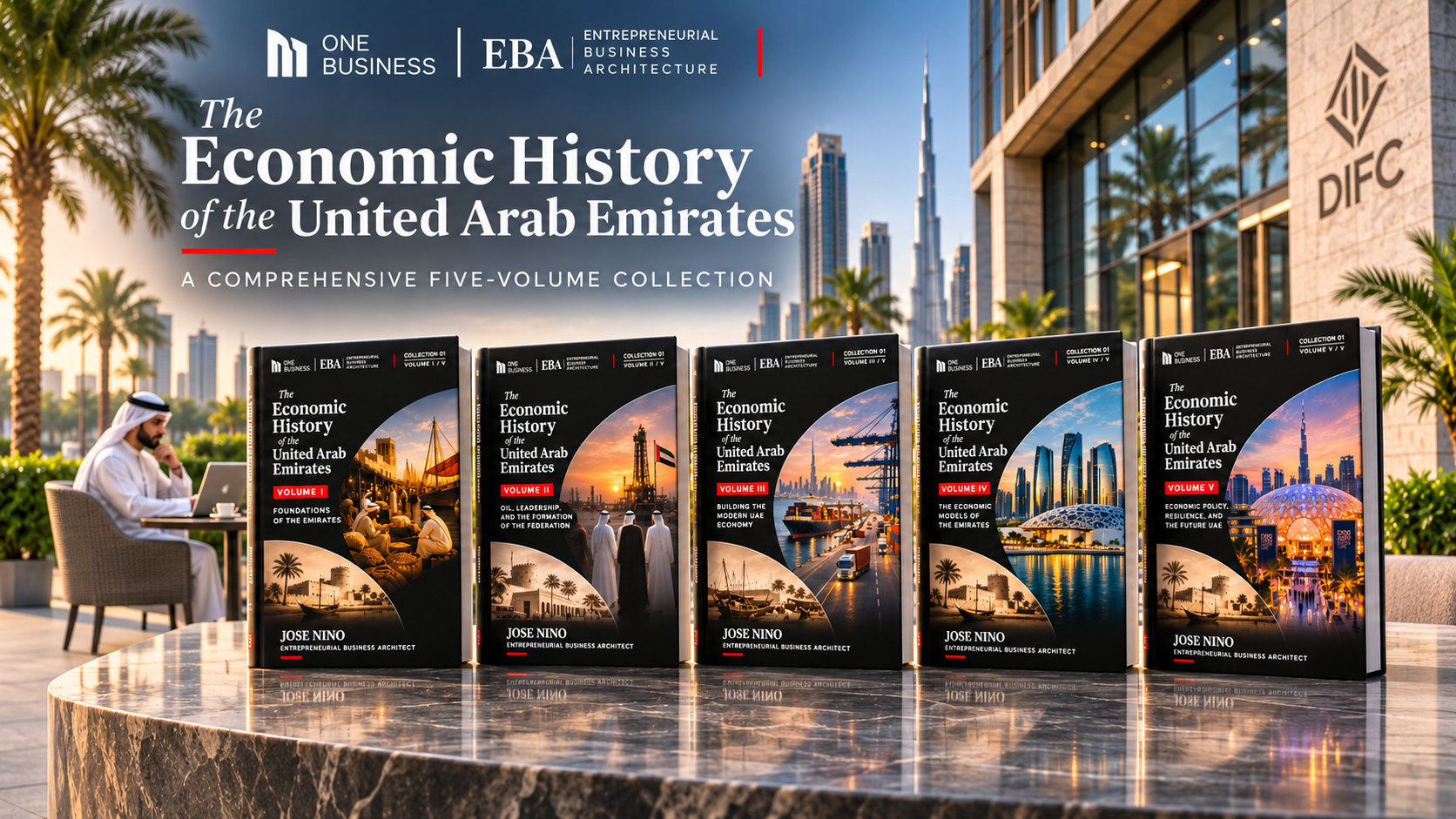
Explore The Economic History of the United Arab Emirates — Complete Collection
The five-volume collection examines the country's development from its early commercial foundations through the discovery of oil, the formation of the federation, the development of modern infrastructure and enterprises, the distinct economic models of the seven emirates, and the strategies shaping the country's future.
Understanding this history helps entrepreneurs appreciate why Dubai's contemporary business environment offers particular opportunities and why those opportunities must be evaluated within the wider economic system.
For entrepreneurs preparing to establish a company in the UAE, combining historical understanding with practical company formation assistance offers a more complete approach to business development. Historical knowledge strengthens the capacity to interpret the economic environment, while professional establishment services help organize the administrative process required to create the enterprise.
Dubai's economic transformation demonstrates that commercial development requires more than recognizing favorable circumstances. It involves turning opportunities into functioning organizations through informed decisions, productive capabilities, suitable institutions, and sustained economic activity.
That principle should guide entrepreneurs entering the UAE today. The availability of digital registration, specialized free zones, financial services, and global transportation infrastructure provides an attractive starting point, but the success of the enterprise depends on how effectively these capabilities are combined with its actual business objectives.
ONE Business Dubai helps international entrepreneurs establish the legal foundation for participating in this economic environment through professional UAE company formation services.
For eligible applications, our service supports same-day company registration, allowing founders to begin establishing their corporate presence through an efficient process suited to the relevant jurisdiction and business activity.
Same-Day UAE Company Formation
Professional Service Fee: USD 1,200 + Applicable Government and Licensing Costs
Company formation timelines depend on the selected jurisdiction, proposed activities, documentation, and required approvals. Banking, residency, and other associated procedures are separate processes subject to their respective requirements.
Establish Your Company in Dubai — Explore ONE Business Dubai Company Formation Services
Entrepreneurs who want to build successful international businesses should approach Dubai as more than a location offering convenient registration procedures. It is an economic environment whose commercial capabilities have developed through a long history of trade, investment, strategic infrastructure, institutional development, and entrepreneurial activity.
Understanding that environment helps founders make better decisions about the markets they intend to serve, the capabilities they need to develop, and the corporate structures best suited to their commercial objectives.
Study the economy. Understand the opportunities. Establish the right company. Build a stronger business future in Dubai.
ONE Business Dubai — Strategic Entrepreneurial Business Architecture Advisory Firm.
This article provides general entrepreneurial education and business establishment information. Company registration, licensing, taxation, banking, and immigration requirements must be verified according to the relevant authority, jurisdiction, business activity, and applicant circumstances.