ONE BUSINESS / INSIGHTS / ARTICLE 03
How Entrepreneurs Built Wealth Through Trade Before the UAE Had Oil
The Business Lessons Behind the Emirates' Early Commercial Success

The Business Opportunity That Existed Before Modern Dubai
Long before Dubai became an international business destination, before the construction of its modern skyline, and before the discovery of oil transformed the economies of the Arabian Gulf, merchants were already creating commercial opportunities through exchange, relationships, and access to distant markets. The territories that would eventually form the United Arab Emirates were not wealthy industrial economies, nor did they possess the infrastructure, financial institutions, or technological capabilities associated with modern international commerce. Nevertheless, commercial activity developed because individuals and communities recognized something fundamental about business: prosperity does not depend exclusively on the resources available within a particular territory. It also depends on the ability to connect resources, producers, buyers, and markets.
This principle helps explain an important part of the Emirates' economic development. The early inhabitants of the region faced substantial environmental limitations, including scarce freshwater, difficult agricultural conditions, and considerable uncertainty surrounding production and transportation. Yet these constraints did not eliminate the possibility of economic activity. Coastal settlements, inland communities, and commercial intermediaries participated in systems of production and exchange that connected the Arabian Peninsula with surrounding regions. Over time, these relationships contributed to the development of commercial knowledge, specialized activities, and networks through which goods and opportunities could circulate.
For contemporary entrepreneurs interested in establishing a business in Dubai or elsewhere in the UAE, this historical experience offers a valuable starting point. Many founders approach international markets by asking what resources they need to own, how much capital they must invest, or which products they should manufacture. Those questions are important, but they do not describe every possible entrepreneurial model. A business can also create value by improving access, reducing commercial friction, identifying unmet demand, organizing distribution, or connecting parties that would otherwise struggle to transact. These capabilities were relevant to historical commerce, and they remain central to numerous businesses operating in today's international economy.
The central lesson of this article is therefore not simply that trade existed before oil. It is that commercial opportunity can be constructed through networks, trust, specialization, and coordinated activity, even when the entrepreneur does not control substantial natural resources. Understanding this principle can help modern business founders think more strategically about where value originates, how commercial relationships become productive assets, and why the ability to participate effectively in a market can sometimes matter more than the ownership of physical goods.
1. The First Business Lesson: Wealth Begins with Recognizing Exchange Opportunities
The foundations of commerce in the region long predate the modern state. Archaeological evidence from the territory of the present-day UAE points to communities engaged in fishing, agriculture, craft production, metallurgy, and exchange. During the Bronze Age, the wider southeastern Arabian region participated in commercial relationships involving neighboring economic centers, including Mesopotamia and the Indus Valley. The historical geography associated with Magan is particularly relevant to understanding how the region became connected to broader systems of production and trade. These exchanges demonstrate that economic activity was not confined to isolated settlements; it developed through relationships between communities possessing different resources, capabilities, and requirements.
The economic importance of these relationships becomes clearer when we consider why exchange occurs. A community may produce a good that is valuable locally but even more valuable elsewhere. Another community may require materials, tools, food products, or specialized services that it cannot produce efficiently on its own. Trade creates an opportunity when someone recognizes these differences and develops a practical way to connect supply with demand. The resulting value does not necessarily arise from manufacturing a new product. It can emerge from discovering a market, organizing transportation, coordinating transactions, or making an existing product available to customers who previously had limited access to it.
This is one of the most transferable lessons for entrepreneurs entering Dubai today. A founder does not necessarily need to begin with an entirely new invention. There may be significant opportunities in understanding how established products, professional services, technologies, or specialized capabilities can serve customers in the UAE or reach international markets through the country. The commercial challenge is to identify a genuine mismatch between available supply and customer demand, determine why that mismatch exists, and design an economically viable business capable of addressing it.
However, identifying a difference between two markets is only the beginning. An entrepreneur must also determine whether customers are willing to pay, whether the product can be delivered reliably, whether the applicable regulations permit the proposed activity, and whether the transaction can generate sufficient revenue after accounting for its costs. An opportunity becomes a business only when the entrepreneur develops a repeatable mechanism for creating and capturing value. The historical existence of trade illustrates the importance of exchange, but modern business success requires disciplined commercial validation rather than assuming that every apparent market gap is profitable.
2. Merchants Created Value Without Producing Everything They Sold
An important characteristic of merchant activity is that commercial value can be created through coordination rather than direct production. Producers possess goods, buyers possess purchasing requirements, and merchants may possess information, relationships, transportation arrangements, and the ability to negotiate transactions. By bringing these elements together, merchants can facilitate exchanges that would otherwise be difficult, expensive, or uncertain. This does not mean that all merchants automatically become prosperous, nor that intermediation is always profitable. It means that the organization of exchange is itself an economic activity with the potential to create value.
In the historical commercial environment of the Arabian Gulf, maritime connections made it possible for merchants and trading communities to participate in economic relationships extending beyond their immediate settlements. Goods, people, knowledge, and commercial practices moved through networks connecting different parts of Arabia with the wider Indian Ocean world. The importance of these relationships was not limited to the physical movement of merchandise. Repeated exchanges could also generate familiarity with foreign markets, knowledge of commercial practices, and relationships that helped participants identify future opportunities.
For modern entrepreneurs, this distinction between producing and coordinating value is especially useful. Consider a business founder who understands the requirements of companies entering the UAE and the capabilities of specialized international suppliers. The founder may create a business that helps those companies identify suitable suppliers, compare commercial alternatives, organize procurement, and coordinate delivery. The enterprise does not need to manufacture every product involved in the transaction. Its value may reside in expertise, reliability, market access, and the ability to reduce the customer's operational burden.
The same logic can apply to professional services, international distribution, business development, technology implementation, and specialized consulting. Yet a sustainable intermediary must contribute something more than an introduction that customers could easily arrange themselves. The stronger business model is one in which the intermediary reduces uncertainty, improves execution, provides useful information, or solves a recurring commercial problem. Entrepreneurs should therefore evaluate not only what they intend to sell, but also which specific transaction costs or market difficulties their business will reduce.
3. Commercial Trust Became an Economic Asset
Trade between distant parties creates a fundamental problem: buyers and sellers do not always possess complete information about one another. A buyer may be uncertain whether goods will arrive in the agreed condition, while a seller may be concerned about receiving payment. Differences in location, commercial practices, language, and available information can increase the difficulty of reaching and completing agreements. These problems are particularly significant when formal mechanisms for verification and enforcement are limited or expensive.
Historical merchant communities developed commercial relationships in environments where personal reputation, repeated dealings, and community connections could play important roles in reducing uncertainty. Such arrangements should not be romanticized as universally fair or entirely reliable. Commercial disputes, unequal bargaining power, and failures of trust remained possible. Nevertheless, the broader economic principle is clear: when participants can develop reasonable confidence in one another's conduct, transactions may become easier to organize and commercial relationships may become more durable.
This principle remains highly relevant in Dubai's contemporary international business environment. Entrepreneurs may encounter customers, suppliers, investors, and professional partners from different jurisdictions and commercial traditions. Establishing confidence requires more than making attractive promises or presenting a professional website. It requires consistent performance, transparent communication, accurate documentation, responsible handling of commitments, and a willingness to address problems when they arise. A company that repeatedly demonstrates these capabilities may reduce the perceived risk associated with doing business with it.
Trust is not simply a desirable personal quality; it can become a productive business capability. Customers who believe that a company understands their needs and fulfills its commitments may be more willing to continue purchasing its services, recommend it to others, or enter longer-term arrangements. Nevertheless, trust should complement rather than replace appropriate contracts, due diligence, compliance procedures, and commercial controls. The practical lesson for entrepreneurs is to design reliability into their business operations so that confidence is supported by evidence and repeatable performance.
4. Business Networks Expanded the Range of Possible Opportunities
A merchant with access to only one local market faces a limited range of customers, suppliers, and commercial alternatives. As relationships extend across regions, the number of potential transactions can increase, and the merchant may gain access to information that is unavailable within a single community. This is one reason commercial networks have played such an important role in economic development. They connect otherwise separated economic activities and allow participants to recognize possibilities that would remain invisible within isolated markets.
The Arabian Gulf's connections with neighboring regions illustrate this process across different historical periods. Trade relationships developed and changed over time, linking coastal communities with markets and commercial routes associated with Arabia, Persia, India, and the wider Indian Ocean. These connections were neither identical across all periods nor equally accessible to every participant. Their significance lies in the broader pattern: commercial connectivity expanded the economic possibilities available to communities that participated in exchange.
For entrepreneurs establishing businesses in the UAE, network development should therefore be understood as a deliberate business function rather than an occasional social activity. Relationships with customers, distributors, industry specialists, logistics providers, financial institutions, and professional advisers can improve access to market information and commercial opportunities. However, the value of a network depends on its relevance, quality, and the ability of participants to create mutually beneficial outcomes. A large contact list is not necessarily a productive commercial network.
A practical approach begins with identifying the relationships that are essential to the proposed business model. An import and distribution enterprise may need dependable suppliers, logistics arrangements, regulatory expertise, and access to buyers. A professional services firm may depend more heavily on specialized knowledge, referral relationships, and recurring client requirements. A technology company may need implementation partners, industry access, and organizations willing to test its solutions. The entrepreneur's task is not merely to meet people, but to construct a network that improves the company's capacity to serve a defined market.
5. Specialization Made Commercial Cooperation More Productive
Economic exchange becomes particularly important when different individuals and communities develop specialized capabilities. One group may possess knowledge of production, another may understand transportation, and another may have relationships with buyers in distant markets. Cooperation allows these capabilities to be combined without requiring every participant to perform every activity independently. Specialization can therefore improve efficiency, expand productive possibilities, and create opportunities for businesses that serve one another.
The early economies of the region included different activities associated with coastal, oasis, and inland environments. Fishing, agricultural production, craft activities, and trade were shaped by local conditions and available knowledge. Over time, the development of specialized capabilities contributed to relationships through which communities could obtain goods and services beyond those available through their own production. The historical details varied across places and periods, but the underlying economic principle is that productive differences can support mutually beneficial exchange.
Modern Dubai provides a setting in which entrepreneurs can apply this principle through carefully designed business models. A new enterprise does not necessarily need to manage every function internally. Depending on its activity and regulatory obligations, it may be more effective to concentrate on customer acquisition, product development, specialized expertise, or another capability while obtaining supporting services from qualified external providers. This approach can reduce certain fixed commitments and allow the company to access capabilities that would be costly to develop independently.
Specialization also creates risks. A business that depends excessively on a single supplier, customer, service provider, or distribution channel may become vulnerable to disruption. The entrepreneurial challenge is therefore to determine which capabilities are strategically important enough to control directly and which can be obtained through contractual relationships. Successful specialization requires a clear understanding of the company's distinctive value, its critical dependencies, and the arrangements needed to maintain reliable operations.
6. Information Was as Important as the Movement of Goods
Commercial decisions depend on information. Merchants need to understand what customers want, which products are available, how prices differ between markets, what transportation arrangements are possible, and which commercial partners can be relied upon. Without adequate information, even an apparently attractive opportunity can become a costly mistake. Market knowledge therefore represents an important economic resource, particularly when transactions involve unfamiliar territories or substantial uncertainty.
Historical trade networks transmitted more than merchandise. Commercial relationships could also facilitate the movement of knowledge concerning markets, navigation, production, and business practices. The extent and accuracy of that information varied, and merchants operated under constraints that differ greatly from those facing modern businesses. Nevertheless, the economic mechanism remains recognizable: participants with useful commercial knowledge could make better-informed decisions about where, when, and how to exchange goods.
Entrepreneurs considering Dubai often encounter abundant promotional information about company formation, international trade, investment opportunities, and the advantages of particular business locations. This information can be useful, but it should not substitute for independent market analysis. A founder needs to understand the actual customer segment, purchasing behavior, competitive environment, operating costs, licensing requirements, and practical conditions under which the business will generate revenue. The existence of a large and internationally connected market does not establish that a particular business idea will succeed within it.
A disciplined entrepreneur therefore treats market intelligence as an ongoing operational capability. Customer interviews, supplier comparisons, small commercial tests, competitor analysis, and careful financial assumptions can help distinguish a promising opportunity from an attractive but unsupported expectation. The objective is not to eliminate uncertainty completely, which is rarely possible, but to improve the quality of decisions before committing substantial resources.
7. Managing Risk Was Essential to Commercial Expansion
The possibility of commercial profit has always been accompanied by the possibility of loss. Historical merchants faced uncertainties involving transportation, weather, changing demand, commercial disputes, and the availability of goods. Longer trading relationships could create opportunities for greater exchange, but they also introduced additional dependencies and difficulties. The development of commerce therefore required more than an appetite for opportunity; it required ways of operating under uncertain conditions.
The historical record supports the general importance of adaptation and cooperation in commercial activity, although specific risk-management practices should not be assumed to have been identical across different communities or periods. For contemporary entrepreneurs, the relevant lesson is that growth and risk management must be developed together. A business that expands sales without considering payment collection, delivery reliability, customer concentration, or operational capacity may become more exposed even while its revenue appears to increase.
Consider an entrepreneur establishing a trading company in Dubai to distribute specialized products. The opportunity may appear attractive because of access to international suppliers and regional customers. However, the business must also consider the timing of supplier payments, customer credit terms, shipping costs, inventory commitments, import requirements, and possible changes in demand. A profitable transaction on paper can become financially difficult if cash is committed long before payment is received or if unexpected costs eliminate the expected margin.
Entrepreneurial resilience depends on understanding which risks accompany the business model and developing proportionate controls before those risks become crises. This may involve testing demand with limited initial commitments, diversifying relationships where commercially sensible, negotiating clear payment conditions, maintaining adequate financial reserves, and using appropriate professional advice. The objective is not to avoid every uncertain opportunity, but to ensure that commercial ambition is supported by operational and financial discipline.
8. The Most Valuable Commercial Asset Was Often a Capability
When people think about business wealth, they frequently focus on visible assets such as buildings, inventory, equipment, or financial capital. These resources can be essential, but they do not fully explain why some enterprises are able to identify and exploit opportunities more effectively than others. Knowledge of customers, reliable commercial relationships, organizational experience, and the ability to coordinate transactions can also contribute substantially to an enterprise's productive capacity.
The history of commerce in the Emirates illustrates why capabilities matter. Participating in regional exchange required practical knowledge and the coordination of different activities. Over time, commercial experience and relationships could provide advantages that were not reducible to the possession of a particular physical resource. This does not imply that historical merchants possessed the same organizational structures as contemporary companies. It demonstrates that economic activity has long depended on combinations of tangible resources and less visible forms of commercial competence.
For modern entrepreneurs, the practical question is which capabilities their business must develop to become more competitive. A company may begin by offering a service that competitors can easily imitate, but gradually improve its position through better customer understanding, more dependable delivery, specialized expertise, or stronger distribution arrangements. These improvements may help the business differentiate itself and reduce the difficulty customers experience when purchasing its products or services.
The distinction between owning an asset and possessing a capability is fundamental to business development. An asset may provide access to a particular resource, while a capability determines how effectively the enterprise can use resources to produce results. Entrepreneurs should therefore evaluate investments not only by their immediate financial cost, but also by whether they strengthen the company's ability to identify opportunities, satisfy customers, adapt to change, and operate consistently.
9. What These Commercial Foundations Teach Entrepreneurs Entering Dubai Today
The historical experience of the Emirates should not be treated as a formula that guarantees success in a modern business environment. Ancient and pre-oil trading communities operated under institutions, technologies, market conditions, and social arrangements that differ substantially from those of contemporary Dubai. Nevertheless, their experience provides a useful basis for examining recurring economic mechanisms. Exchange requires a reason for buyers and sellers to transact. Commercial relationships require some means of managing uncertainty. Specialization creates opportunities for cooperation. Networks expand access, while information and organizational capabilities influence the quality of business decisions.
An entrepreneur entering Dubai can apply these principles by beginning with a clearly defined commercial problem rather than with the assumption that establishing a company automatically creates a market. The founder should identify who the intended customers are, what they need, how they currently satisfy that need, and why they would choose a new provider. This analysis establishes whether the proposed business creates value that customers can recognize and are willing to purchase.
The next step is to design the commercial relationships required to deliver that value. A company may need suppliers, qualified service providers, distributors, technical specialists, or professional partners. These relationships should be evaluated according to reliability, economic contribution, and strategic importance rather than simply their availability. The entrepreneur should also determine which activities the company can perform competitively and which are better supported through external arrangements.
Finally, the business must convert its proposed value into an operational model. This includes appropriate licensing, financial planning, pricing, customer acquisition, payment collection, service delivery, and performance measurement. A promising commercial idea becomes an enterprise when its activities can be coordinated repeatedly and economically to serve customers. This is where entrepreneurial imagination must be translated into organizational capability.
10. Entrepreneurial Business Architecture: Turning Networks into a Business Model
Entrepreneurial Business Architecture (EBA) provides a contemporary framework for examining how an opportunity can be transformed into an organized enterprise. Applied to the commercial principles discussed in this article, the framework begins with the recognition of a market need and proceeds through the identification of resources, the development of capabilities, the organization of commercial relationships, and the design of activities that allow a business to create and capture value. EBA is a modern analytical approach; it should not be projected backward as a formal system used by historical merchants.
The first architectural decision concerns the opportunity itself. The entrepreneur must determine whether a genuine customer problem exists and whether addressing it can support an economically viable transaction. The second decision concerns resources and capabilities: what knowledge, people, relationships, capital, and operating arrangements are necessary to deliver the proposed solution? The third concerns the market: how will customers discover the business, evaluate its offering, complete purchases, and receive the promised value? The fourth concerns adaptation: how will the enterprise learn from actual commercial results and modify its activities when conditions change?
Consider a hypothetical entrepreneur who identifies demand among UAE companies for a specialized product supplied by manufacturers abroad. An initial idea might be to establish an importing company. EBA encourages a more complete analysis. The founder must understand the customers' requirements, determine the reliability of suppliers, evaluate logistics and regulatory conditions, calculate margins and working-capital needs, and design a dependable process for fulfilling orders. The business opportunity is not simply the existence of a foreign product and a potential local buyer. It is the ability to organize the complete commercial system connecting them.
This perspective also explains why networks are valuable but insufficient on their own. Relationships create access, yet the enterprise still needs processes, accountability, financial discipline, and the capacity to fulfill its commitments. The purpose of business architecture is to transform an opportunity that depends heavily on individual initiative into an enterprise capable of producing consistent commercial results. That transition is particularly important for founders who want to build organizations that can grow beyond their personal involvement in every transaction.
11. A Practical Business Lesson: Build a Commercial Opportunity Map
Entrepreneurs can translate the historical lessons of trade into a practical opportunity-development exercise. Begin by selecting a specific industry or customer group in Dubai or another UAE market. Instead of immediately deciding which company to register or which product to sell, examine the relationships between customers, suppliers, existing service providers, and the activities required to complete a transaction. The objective is to understand how value currently moves through the market and where customers encounter delays, uncertainty, excessive costs, or unmet requirements.
Next, identify the commercial function that a new enterprise could perform better or differently. It might provide access to a specialized supplier, improve the quality of market information, coordinate a complex service, reduce delivery uncertainty, or serve a customer segment that existing providers do not adequately address. Each possibility should be evaluated against observable customer needs rather than relying exclusively on assumptions. The entrepreneur should seek evidence that the proposed improvement matters enough for customers to change their purchasing behavior.
The third stage involves evaluating the relationships and capabilities required to execute the opportunity. Determine which suppliers or partners would be essential, what commitments would be necessary, and how the business would maintain control over service quality. Assess whether the enterprise can generate sufficient margin after accounting for customer acquisition, operating expenses, regulatory obligations, and the cost of fulfilling transactions. An opportunity that appears commercially attractive may prove unsuitable if the company cannot deliver it consistently or profitably.
Finally, test the business model at a scale appropriate to its risks. A founder may begin with customer conversations, a limited service offering, a pilot transaction, or another lawful and commercially appropriate validation method. Results should be used to refine the value proposition and operating arrangements before committing to substantial expansion. The goal is to build a business from demonstrated market relationships and capabilities, not from assumptions about the attractiveness of a particular location. This approach captures the most useful entrepreneurial lesson of historical commerce: prosperity develops through productive exchange that is deliberately organized and continuously improved.
12. The Deeper Lesson: Dubai's Commercial Success Was Built on More Than Resources
Dubai's emergence as a major international business center cannot be explained by any single historical factor. Its modern development reflects decisions and processes involving leadership, institutions, infrastructure, trade, investment, enterprise development, and international connectivity. The earlier commercial history of the region does not by itself explain the scale or complexity of the contemporary economy, but it establishes an important foundation: commercial activity and relationships existed long before the oil era and the construction of the modern city.
For entrepreneurs, the most valuable insight is that a location's economic potential depends partly on what people and organizations are capable of doing with the opportunities available to them. Commercial relationships can connect distant markets. Specialized knowledge can make transactions possible. Reliable organizations can reduce uncertainty. Infrastructure and institutions can expand the range of economic activities that businesses are able to undertake. These elements operate at different levels, but together they help explain why entrepreneurship is more than the possession of money or physical resources.
This distinction matters for anyone planning to build a business in Dubai. The city offers an internationally connected commercial environment, but access to that environment does not remove the need for sound entrepreneurial judgment. Founders must still understand customers, establish credible relationships, develop useful capabilities, comply with applicable requirements, and manage financial and operational risks. The history of the Emirates provides lessons about how commercial opportunities can emerge and develop; the entrepreneur's responsibility is to determine how those lessons apply to a specific contemporary market.
The enduring business lesson is that wealth creation begins with the ability to recognize and organize valuable economic relationships. Entrepreneurs who understand how markets connect, how trust influences transactions, and how specialized capabilities generate value are better equipped to evaluate opportunities and design enterprises around real customer needs. That is the practical significance of studying the commercial foundations of the UAE: not simply to understand what happened in the past, but to improve the quality of business decisions made in the present.
Explore The Economic History of the United Arab Emirates
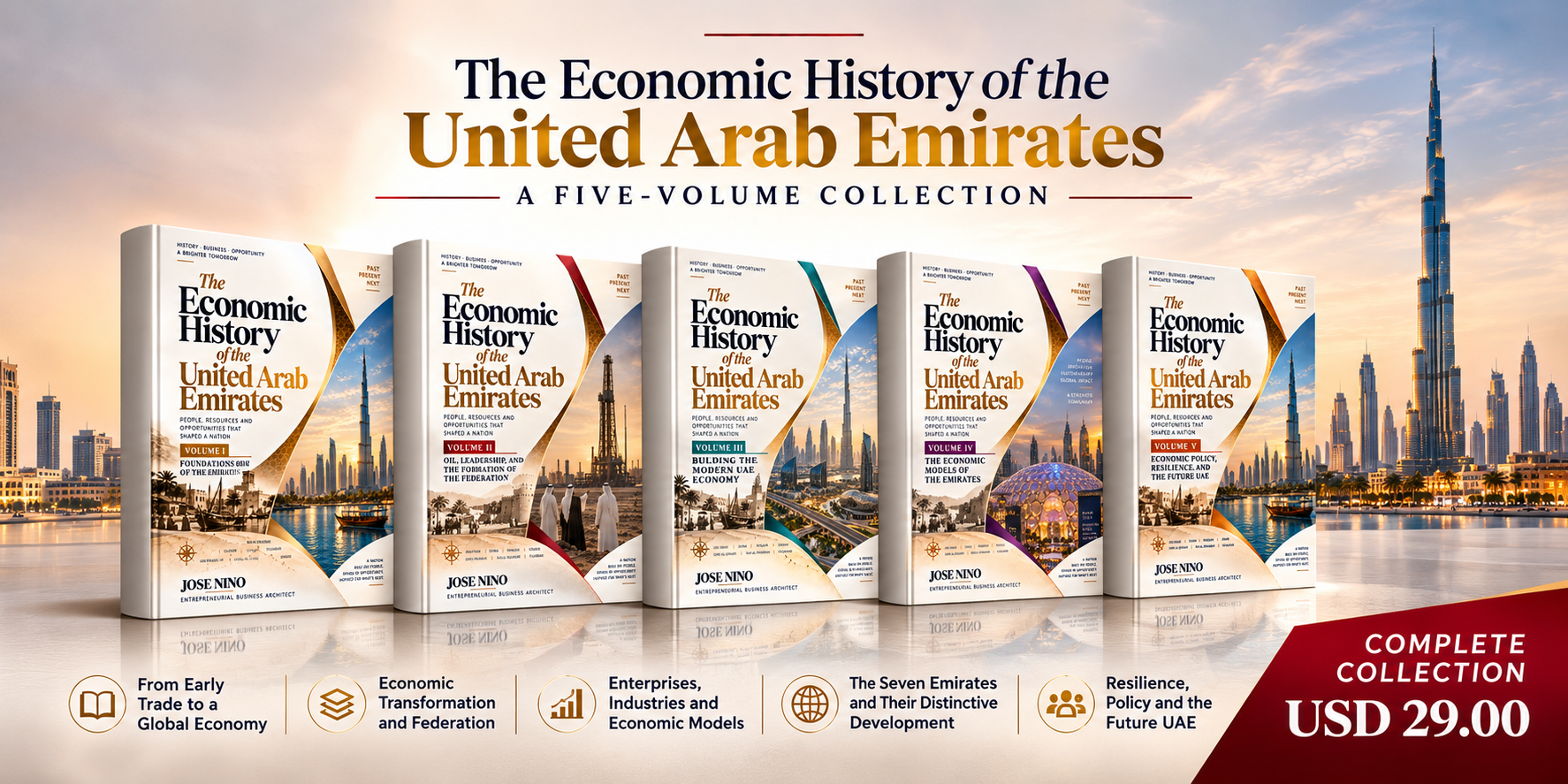
Discover the business lessons behind the rise of one of the world's most internationally connected economies. The Economic History of the United Arab Emirates examines the economic foundations, commercial development, leadership decisions, industries, institutions, and entrepreneurial capabilities that contributed to the country's transformation. Across five volumes, readers can explore how opportunities emerged, how economic activities evolved, and how business environments were developed over time.
For entrepreneurs, founders, investors, and business professionals interested in Dubai and the wider UAE, the collection offers a deeper perspective on the relationships between economic development, enterprise creation, commercial strategy, and long-term prosperity. The objective is not merely to understand the past, but to discover lessons that can inform better entrepreneurial reasoning and more disciplined business decisions.
Five volumes. One economic transformation. Practical lessons for today's entrepreneurs.
Complete Five-Volume Digital PDF Collection — USD 29.99
Turn Business Knowledge into Your Next Opportunity in Dubai
Understanding how commercial opportunities develop is valuable. Translating that knowledge into a properly structured enterprise requires additional decisions involving business activities, licensing, jurisdiction selection, operational arrangements, and market entry. Entrepreneurs considering Dubai or the wider UAE should approach these decisions as part of a coherent business strategy rather than treating company registration as an isolated administrative procedure.
ONE Business Dubai supports entrepreneurs and international businesses seeking to establish and develop their commercial presence in the United Arab Emirates. Our company formation services help clients navigate the initial structuring and registration process according to their proposed activities and business requirements.
Company Formation & Business Registration — Professional Fees from USD 1,200 + Government Fees
The final scope of services and total estimated cost depend upon the jurisdiction, business activity, registration requirements, and services requested. Contact our team to discuss your proposed enterprise and request a tailored quotation.
Request UAE Company Formation & Business Registration Assistance
Conclusion: The Business Lesson Behind the Emirates' Early Commerce
The commercial foundations of the Emirates demonstrate that economic opportunities can emerge through the organization of exchange, the development of productive relationships, and the accumulation of specialized capabilities. Long before the modern economy existed, communities participated in commercial activities that connected different producers, markets, and regions. Their experience illustrates why market access, information, reliability, and cooperation can become economically valuable even when natural resources and physical infrastructure are limited.
For today's entrepreneurs, the lesson is to look beyond the visible attractiveness of a market and understand the commercial mechanisms that make a business viable. Identify a genuine customer requirement, determine how value can be created, establish reliable relationships, and develop the organizational capabilities needed to deliver consistently. Dubai's history offers inspiration, but entrepreneurial success depends on applying sound commercial principles to real opportunities, with disciplined execution and an understanding of risk.
The question for the modern founder is not simply whether Dubai offers business opportunities. It is which opportunity the entrepreneur can serve effectively, what distinctive value the enterprise can provide, and how that value can become a sustainable business.
Discover the Complete Five-Volume Collection — USD 29.99
Contact ONE Business Dubai for UAE Company Formation Services