ONE BUSINESS / INSIGHTS / ARTICLE 18
How Geography and Scarcity Shaped the UAE’s First Economic Opportunities
Explore how the UAE’s early geography, scarce resources, maritime trade, pearling, oases, and practical capabilities shaped economic opportunities before oil.
Long before the United Arab Emirates became associated with international finance, modern infrastructure, global trade, and entrepreneurial opportunity, the communities inhabiting its territory faced a very different economic reality. Their opportunities were shaped by an environment in which freshwater was limited, agricultural land was unevenly distributed, transportation was demanding, and survival required an intimate understanding of the surrounding geography.
The Arabian Gulf, the desert, the mountains, and the scattered oases were not simply geographical features. They influenced where people settled, how communities organized economic activities, which resources could be exchanged, and how individuals developed the knowledge necessary to sustain their livelihoods.
Yet these environmental conditions did not prevent economic activity from emerging. They encouraged the development of distinctive forms of adaptation, cooperation, specialization, and trade.
The early economic history of the Emirates demonstrates that economic opportunity does not emerge exclusively from the abundance of resources. It can also develop through the ability of individuals and communities to recognize possibilities within environments characterized by scarcity and uncertainty.
Understanding this historical relationship provides valuable insight into the economic foundations that preceded the discovery of oil and the formation of the modern United Arab Emirates.
It also helps explain why trade, maritime activity, resource management, and commercial relationships became important components of the region's economic development.
For entrepreneurs and business professionals examining the UAE today, these foundations offer an essential perspective: the country's contemporary economic identity emerged through a long historical process in which geography, human capabilities, commercial relationships, and changing opportunities interacted.
Geography as the Foundation of Early Economic Activity
The territory that now constitutes the United Arab Emirates contains several distinct geographical environments. Extensive desert landscapes occupy much of the interior, while coastal settlements developed along the Arabian Gulf and the Gulf of Oman. Mountainous regions, particularly toward the northeast, created different ecological conditions, while oases offered opportunities for settlement and cultivation wherever reliable water resources could be maintained.
Each environment presented particular constraints and possibilities.
The desert limited conventional agricultural production across much of the territory. High temperatures, low rainfall, and the uneven availability of freshwater made sustained cultivation difficult outside suitable locations. Consequently, communities developed forms of economic activity adapted to mobility, pastoral resources, seasonal conditions, and access to established settlements.
The coast provided another set of opportunities. Fishing, pearling, boatbuilding, navigation, and maritime commerce connected coastal communities with resources and commercial networks that were unavailable across much of the interior.
Oases supported agriculture, particularly date cultivation, and helped sustain communities whose economic activities combined farming, exchange, and connections with surrounding settlements.
Mountainous areas offered their own resources and routes, contributing to patterns of settlement, agriculture, movement, and regional interaction.
The geographical diversity of the Emirates created different economic possibilities rather than a single uniform economy.
Understanding these differences is important because the development of the region cannot be explained through one industry, one settlement, or one historical experience.
Coastal merchants, pearl divers, agricultural communities, craftspeople, and pastoral populations participated in economic activities shaped by different environments. Their circumstances were not identical, but exchanges among them contributed to regional economic relationships.
This diversity also helps explain why the economic histories of the individual emirates followed different trajectories before federation.
Scarcity and the Development of Practical Capabilities
Scarcity is often discussed as a limitation on economic development. A shortage of water, productive land, infrastructure, or financial resources can restrict available opportunities and increase the difficulty of sustaining economic activity.
However, scarcity can also influence which capabilities become particularly valuable.
In the historical Emirates, successful participation in economic life often required practical knowledge of environmental conditions, seasonal patterns, available resources, transportation routes, and commercial relationships.
Communities depended on experience accumulated across generations to understand where resources could be found, how they could be managed, and which activities were appropriate under particular conditions.
This knowledge was not always acquired through formal education or institutional training. It frequently emerged through family experience, occupational specialization, observation, and participation in established economic practices.
A person involved in maritime activity needed to understand navigation, weather conditions, vessels, and the risks associated with the sea. Someone engaged in oasis agriculture needed knowledge of irrigation, cultivation, and water management. A merchant required familiarity with exchange relationships, prices, transportation, and the reliability of trading partners.
These capabilities were economically meaningful because they helped individuals operate within the conditions of their environment.
Nevertheless, adaptation should not be confused with unlimited opportunity. Scarcity could produce hardship, dependence, indebtedness, and vulnerability. Individuals and communities did not necessarily possess equal access to resources or the same freedom to choose their occupations.
The historical significance of capability development lies in understanding how people acquired practical knowledge and exercised judgment within real limitations.
From the perspective of Entrepreneurial Business Architecture (EBA), this relationship illustrates an important principle: individual capabilities influence how people recognize and pursue opportunities, but those capabilities operate within economic, social, and institutional circumstances.
Personal development can strengthen an individual's preparation to participate in economic activity. It cannot, by itself, eliminate every environmental or structural limitation.
The Arabian Gulf as a Source of Economic Possibility
The sea occupied a central position in the economic life of many communities across the territories that would eventually form the UAE.
Where agricultural production was constrained by environmental conditions, maritime resources provided alternative sources of food, employment, exchange, and income.
Fishing supported local consumption and commercial activity. Boatbuilding and maintenance created specialized occupations. Navigation connected settlements with neighboring markets. Pearling became particularly significant because pearls could be exchanged through regional and international commercial networks.
The Arabian Gulf was therefore more than a geographical boundary. It was a source of resources and a means of connection.
Coastal settlements participated in commercial relationships extending beyond their immediate surroundings, linking local economic activity to merchants and markets across the wider Gulf and the Indian Ocean.
These connections became important because local production did not necessarily provide everything communities required. Trade offered access to goods, materials, and resources that could not be produced or obtained easily within particular settlements.
However, maritime commerce was not without considerable risks.
Seafaring activities depended on weather conditions, navigational knowledge, the availability of vessels, political circumstances, and commercial demand. Fishing and pearling involved physical dangers, while trading activities could be affected by disruptions in transportation and changing external conditions.
Despite these difficulties, maritime knowledge became an important economic capability.
The ability to construct vessels, organize voyages, navigate trading routes, and establish relationships with commercial partners contributed to the development of a regional economy in which exchange occupied a prominent position.
The sea did not eliminate the limitations of the surrounding environment. It expanded the range of economic possibilities available to communities capable of participating in maritime activity.
This distinction is important when interpreting the commercial history of Dubai and other coastal centers.
Their later economic development did not emerge from a complete absence of previous commercial experience. It built upon histories of exchange, maritime activity, settlement, and interaction with external markets.
Pearling and the Formation of an Early Commercial Economy
Among the most significant economic activities of the pre-oil Gulf was the natural pearl industry.
Pearling provided income and employment to substantial numbers of people, particularly during the nineteenth and early twentieth centuries. Its economic influence extended beyond pearl divers to include vessel owners, merchants, financiers, craftsmen, suppliers, and the families and communities connected with the industry.
Pearls were valuable because they could be sold in markets extending far beyond the Gulf. International demand created opportunities for commercial exchange and connected local production to broader networks of consumption and trade.
The industry's organization required coordination among different participants.
Pearl diving involved maritime expeditions, specialized knowledge, substantial physical effort, and considerable risk. Boats required construction and maintenance. Voyages needed equipment and supplies. Commercial transactions depended on relationships among divers, captains, financiers, and merchants.
This economic system illustrates how a natural resource could support multiple related activities.
The pearl itself was the commercial product, but its extraction and sale depended upon an interconnected set of occupations and arrangements.
From an economic perspective, this demonstrates an important relationship between resources and organized activity.
A resource becomes economically significant not merely because it exists, but because people possess the capabilities, relationships, and means necessary to extract, transport, exchange, and distribute its value.
Nevertheless, pearling was also characterized by considerable inequalities and vulnerabilities.
Divers frequently faced difficult working conditions and financial dependence. The distribution of income and commercial power was uneven, and the industry remained exposed to changes in global demand.
The expansion of cultured pearls and the severe economic disruptions associated with the global depression contributed to the industry's decline during the early twentieth century.
This decline affected communities whose livelihoods had become closely connected to pearling and its supporting activities.
It also revealed a fundamental vulnerability of economic specialization: dependence on one commercially important activity can expose an entire network of workers, businesses, and households to changes they cannot independently control.
The historical experience of pearling therefore provides more than an example of early commercial opportunity. It demonstrates the economic consequences of market dependence and the importance of understanding the conditions that sustain a commercial activity.
Oases, Water Management, and the Economic Importance of Agriculture
While maritime activity shaped many coastal communities, oases played a different but equally important role in the economic geography of the Emirates.
In environments where water was scarce, access to reliable water sources could determine whether agricultural settlement was possible.
Oasis communities developed practices for managing water, cultivating crops, and sustaining productive activities under difficult environmental conditions.
Date palms were especially significant because they provided food and supported agricultural systems adapted to the region's climate. In appropriate locations, other forms of cultivation also contributed to local livelihoods.
Traditional irrigation systems, including forms of falaj water distribution, reflected accumulated knowledge about managing scarce resources.
These systems were not simply technical arrangements. They were connected to settlement patterns, social relationships, obligations, and the organization of agricultural activity.
Water management required coordination, maintenance, and an understanding of the conditions under which cultivation could continue.
The economic significance of oases extended beyond the crops they produced.
Agricultural settlements interacted with surrounding communities through trade, movement, and the exchange of goods and services. Their production could complement the economic activities of coastal and desert populations.
Such relationships demonstrate the importance of economic interdependence in a geographically diverse region.
A coastal community might possess maritime resources but require agricultural products. An oasis settlement might support cultivation but depend on exchange for other goods. Pastoral communities could contribute products and services associated with their own environments.
These relationships were not necessarily equal or free from conflict. Access to water, land, and commercial connections could influence the distribution of opportunities and power.
Nevertheless, they help explain how distinct economic activities contributed to wider regional networks.
The history of oasis agriculture demonstrates that the management of essential resources can become an important foundation for economic organization, cooperation, and the development of specialized capabilities.
Desert Mobility and the Economic Value of Connectivity
The desert is frequently represented as a barrier to economic development. Its climate, distances, and limited water resources undoubtedly made transportation and settlement difficult.
Yet desert environments also shaped forms of mobility and economic interaction that were important to regional life.
Pastoral activities, seasonal movement, knowledge of routes, and relationships among communities contributed to the circulation of people, goods, and information.
Camels played an important role in transportation and pastoral economies because of their suitability for particular desert conditions.
Knowledge of routes and access to water were essential for movement across difficult terrain.
These capabilities allowed communities to connect areas that might otherwise have remained economically isolated.
Such movement could support trade between inland settlements, oases, and coastal markets.
However, desert mobility depended on social and political circumstances as well as environmental knowledge. Security, access rights, relationships among groups, and the availability of resources influenced which routes and activities were possible.
Understanding these conditions helps avoid an overly simplified interpretation of desert life.
Mobility was not merely a romantic expression of freedom. It was often an economic necessity shaped by environmental constraints and the need to access resources.
It could provide opportunities for exchange while also exposing individuals and communities to uncertainty.
From a broader historical perspective, these patterns demonstrate that connectivity is not exclusively a modern achievement associated with highways, airports, telecommunications, or digital infrastructure.
Earlier societies developed forms of connectivity appropriate to their technologies and circumstances.
Their systems were different in scale and capacity from contemporary networks, but they responded to a similar economic requirement: the need to connect people, resources, and places.
Why Trade Became Central to the Region's Economic Identity
Geographical conditions and the uneven availability of resources encouraged forms of specialization and exchange.
No single settlement or environment provided every good and service required by its inhabitants.
Coastal communities participated in fishing, pearling, and maritime commerce. Oasis settlements produced agricultural goods. Other communities contributed pastoral products, crafts, transportation, and specialized services.
These activities created reasons for economic interaction.
Trade allowed communities to exchange goods they possessed for resources and products they required.
Over time, commercial relationships could extend beyond the immediate region, connecting local activities to markets across the Gulf and the Indian Ocean.
The development of maritime commerce also created opportunities for merchants who understood transportation, demand, commercial relationships, and the organization of exchange.
This historical context is particularly relevant to understanding Dubai's later emergence as a commercial center.
Dubai did not develop its trading identity solely as a result of modern skyscrapers, contemporary financial services, or oil-era infrastructure.
Its commercial development drew upon earlier relationships involving regional exchange, maritime activity, merchants, and the geographical opportunities associated with its location.
Those foundations evolved significantly as political arrangements, commercial practices, technologies, and infrastructure changed.
Historical continuity should not be mistaken for an inevitable progression toward modern prosperity. Economic development involved decisions, disruptions, investments, institutional changes, and external influences.
Nevertheless, the importance of trade before the oil era demonstrates that commercial capabilities and economic relationships were already part of the region's history.
The economic foundations of the Emirates were shaped not only by what communities produced, but also by their ability to connect production, resources, transportation, and demand.
This relationship remains relevant to understanding business activity, although contemporary markets operate under substantially different institutional and technological conditions.
The Commercial Meaning of a Resource-Constrained Economy
An economy characterized by limited resources can develop activities that generate value, but its opportunities are often shaped by the costs and difficulties associated with scarcity.
The early Emirates provide a valuable historical example of this relationship.
Limited freshwater constrained agricultural possibilities. Dependence on particular maritime industries created exposure to international demand. Transportation required specialized knowledge and infrastructure appropriate to local conditions. Communities needed to coordinate activities across environments that offered different resources.
These circumstances made resource allocation especially important.
Decisions about where to settle, which activities to pursue, how to organize transportation, and which commercial relationships to maintain could have significant consequences.
At the same time, the historical record shows that scarcity did not affect all individuals equally.
Economic participation depended partly on occupation, household circumstances, access to resources, social relationships, and prevailing political and commercial arrangements.
Some individuals occupied positions that allowed them to organize trade or control resources. Others participated as workers under demanding conditions and with limited bargaining power.
A responsible interpretation of economic history must recognize these differences.
The existence of commercial opportunity does not imply that every participant enjoyed comparable benefits.
Similarly, the ability of communities to adapt does not mean that environmental limitations were unimportant or easily overcome.
Economic opportunity emerged within a complex relationship among resources, human capabilities, institutions, and market conditions.
This relationship provides an important analytical foundation for understanding the region's subsequent transformations.
When oil revenues later altered the economic possibilities of particular emirates, they entered societies that already possessed established commercial practices, economic relationships, and forms of social organization.
The scale and characteristics of economic activity would change dramatically, but the earlier history remains essential to understanding the conditions from which those changes emerged.
What the Early Emirates Reveal About Entrepreneurship
The history of pre-oil economic activity provides several insights relevant to entrepreneurship, although historical occupations should not automatically be equated with the organization of contemporary businesses.
Many people involved in fishing, cultivation, trade, transportation, or pearling participated in economic systems very different from those of modern entrepreneurs.
Their activities were shaped by the technologies, institutions, resource constraints, and commercial relationships of their time.
Nevertheless, examining how opportunities emerged can help contemporary readers understand the relationship between capabilities and economic participation.
The first important insight concerns the recognition of needs.
Economic exchange develops partly because individuals and communities require resources, products, or services that they cannot readily produce themselves.
The second concerns the application of capabilities.
People need knowledge, practical skills, judgment, and access to appropriate resources to participate in productive activity.
The third concerns coordination.
Commercial value often depends on connections among different participants rather than on isolated individual effort.
The fourth concerns uncertainty.
An activity may appear economically promising while remaining exposed to changes in demand, competition, environmental conditions, or other external factors.
These relationships are relevant to modern entrepreneurship without implying that historical and contemporary business conditions are identical.
Within Entrepreneurial Business Architecture (EBA), entrepreneurship is understood as a pathway through which developed personal capabilities can contribute to discovering opportunities, creating economic value, and pursuing greater independence.
The historical experience of the Emirates illustrates why the starting point for economic activity deserves careful examination.
Entrepreneurs need to understand the environment in which opportunities exist, the capabilities required to pursue them, and the constraints that may influence their viability.
Recognizing a resource or identifying a need does not, by itself, establish a commercially viable business.
Additional investigation is necessary to understand customers, demand, competition, costs, available resources, and institutional requirements.
The most valuable lesson from this historical perspective is not that scarcity automatically produces entrepreneurship. It is that meaningful economic opportunities emerge through the interaction of real needs, human capabilities, available resources, and suitable conditions for exchange.
From Traditional Economic Foundations to a Changing Regional Economy
The economic structures of the Emirates did not remain unchanged.
During the nineteenth and twentieth centuries, developments in international commerce, maritime politics, technology, and regional markets influenced the opportunities available to coastal and inland communities.
The pearling industry experienced periods of commercial importance followed by severe decline.
Traditional economic activities continued under changing circumstances, while new forms of employment and commercial participation gradually appeared.
The eventual discovery and commercial development of oil transformed the scale of economic resources available to particular emirates.
However, the transition from traditional economic structures toward the modern economy did not occur simultaneously or uniformly across the entire region.
The emirates had different resource endowments, political circumstances, commercial histories, and development priorities.
These differences help explain why understanding the formation of the UAE requires attention to the individual histories of its constituent emirates as well as the broader process of federation.
Oil would become a major turning point, but it was not the beginning of economic life in the region.
Before petroleum transformed development possibilities, communities had already developed networks of maritime commerce, agricultural production, transportation, specialized occupations, and regional exchange.
Their experiences formed part of the economic and social foundations upon which later transformation would occur.
This is one reason why an examination of the modern UAE should not begin exclusively with the discovery of oil or the construction of contemporary infrastructure.
Such an approach risks overlooking the historical processes through which people organized economic activity long before the creation of the federation.
Why This History Matters to Entrepreneurs Exploring the UAE Today
Modern Dubai and the wider United Arab Emirates operate within a business environment that differs profoundly from the economies of the pre-oil period.
International transportation, financial institutions, business regulation, digital infrastructure, global investment, and diversified commercial activities have transformed the possibilities available to entrepreneurs and enterprises.
However, understanding the earlier economy provides a more complete appreciation of the country's historical development.
It reveals the importance of geographical location, commercial relationships, access to resources, and the capabilities required to participate in economic activity.
It also demonstrates why economic transformation should be examined as a historical process rather than as the automatic consequence of discovering a valuable natural resource.
For entrepreneurs, this perspective can encourage more disciplined thinking about contemporary opportunities.
An attractive business environment does not mean that every proposed enterprise will become successful.
The presence of infrastructure and commercial networks may create opportunities, but entrepreneurs still need to examine actual market demand, business costs, competition, legal requirements, and the capabilities necessary to operate effectively.
Historical understanding can enrich these evaluations by encouraging attention to the broader economic environment in which businesses function.
It can also help prospective investors and entrepreneurs appreciate that a country's commercial identity reflects accumulated experiences and institutional developments.
The UAE's modern economy cannot be reduced to its geographical location, its natural resources, or the decisions of a single historical period.
It represents the interaction of numerous developments across time.
For those interested in studying business opportunities in Dubai, understanding these foundations provides context for examining the country's contemporary position within regional and international commerce.
Discover the Economic History Behind the Modern Emirates
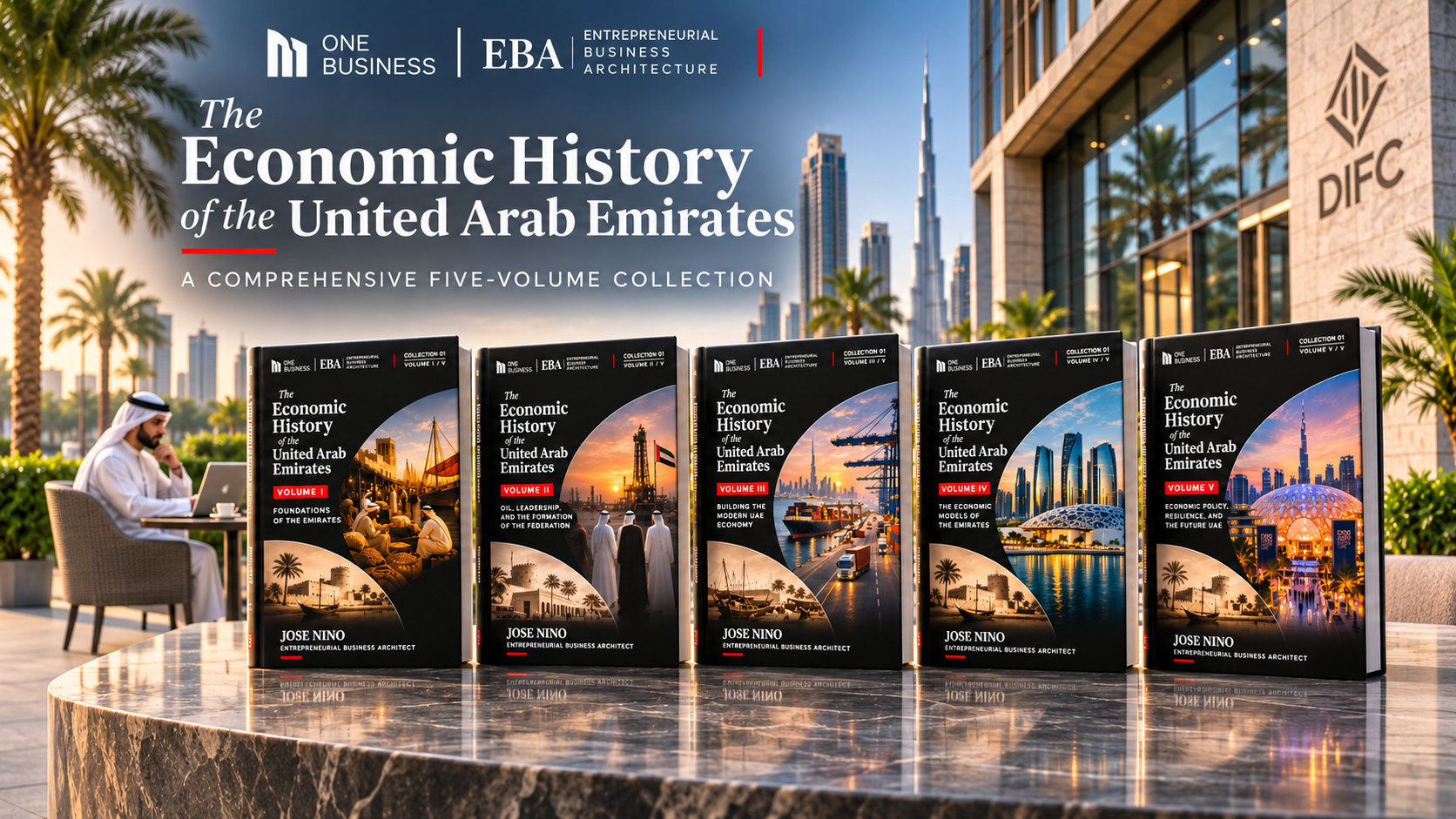
The Economic History of the United Arab Emirates is a five-volume collection examining the people, resources, commercial activities, institutions, and economic transformations that contributed to the development of the modern UAE.
Its first volume, Foundations of the Emirates, explores the geographical, social, and economic conditions that shaped the region before the emergence of the modern federation.
The volume provides historical context for understanding the significance of environmental adaptation, maritime commerce, pearling, traditional production, commercial relationships, and the economic activities that preceded the oil era.
The subsequent volumes examine the transformation associated with petroleum, leadership, federation, modern economic development, the economic models of the individual emirates, and the country's evolving development strategies.
Together, the collection offers readers a structured historical perspective on one of the most significant economic transformations of the modern era.
For entrepreneurs, business professionals, researchers, and readers interested in the UAE, this historical approach provides a deeper foundation for understanding the relationship between economic environments and the opportunities available within them.
Explore The Economic History of the United Arab Emirates — Complete Five-Volume Collection.
Explore the Complete Collection
Collection price: USD 29.99
Explore Business Opportunities in Dubai
Understanding the economic history of the Emirates can provide valuable context for entrepreneurs examining opportunities within the modern UAE.
ONE Business Dubai supports international entrepreneurs and businesses interested in establishing a commercial presence in Dubai and exploring the practical requirements of company formation.
Its business formation services are designed to help clients navigate the incorporation process, understand applicable licensing and government requirements, and obtain assistance with business banking arrangements, subject to the relevant providers' approval.
UAE Company Registration + Business Bank Account Opening Assistance — Professional Service Fee: USD 1,000, plus applicable government, licensing, and third-party costs.
Explore ONE Business Dubai Company Registration Services
The historical development of the Emirates demonstrates that economic transformation involves more than access to resources. It depends on people, knowledge, institutions, commercial relationships, and the capacity to recognize and pursue opportunities responsibly.
Before exploring the businesses that may shape the UAE's future, it is worth understanding the economic foundations that helped shape its past.
Entrepreneurial Business Architecture (EBA)
Transform Your Life. Build Your Business. Create Your Future.