ONE BUSINESS / INSIGHTS / ARTICLE 05
How Maritime Trade and Strategic Positioning Shaped the UAE's Early Economy
The Entrepreneurial Lessons Behind Maritime Networks, Regional Competition, and Building a Sustainable Commercial Advantage

Maritime Power Was Once One of the Gulf's Most Valuable Economic Assets
Long before the United Arab Emirates became a center of international aviation, financial services, logistics, and global investment, the sea was one of the most important foundations of economic activity along its coastline. Maritime connections enabled communities to exchange goods, reach distant markets, develop specialized skills, and participate in commercial relationships that extended beyond the limitations of their immediate territory. For coastal settlements, access to the sea was not simply a geographical characteristic. It represented an opportunity to develop productive capabilities, establish commercial relationships, and influence the movement of economic activity across an interconnected region.
The history of the Al Qasimi family offers an especially revealing example of this relationship between maritime capabilities and economic power. Associated historically with Sharjah and Ras Al Khaimah, the Al Qasimi developed a substantial maritime presence that connected political authority, commercial exchange, territorial positioning, and naval organization. By the beginning of the nineteenth century, their influence had become significant enough to attract the growing attention of British commercial and imperial interests operating in the Gulf. The resulting confrontation would transform not only the family's maritime position but also the wider institutional environment of the coast.
This history is particularly relevant to entrepreneurs because it demonstrates that a competitive advantage is rarely created by one asset alone. Ships were important to maritime activity, but vessels could not produce a successful commercial network without experienced crews, navigational knowledge, ports, trading relationships, operational coordination, and access to markets. These elements reinforced one another, creating a system whose economic value was greater than the contribution of any individual component.
The Al Qasimi experience also reveals the vulnerability of such systems. An organization may develop considerable capabilities within its existing environment, yet encounter powerful external forces capable of changing the conditions under which those capabilities remain effective. The ability to build an advantage is therefore only part of the strategic challenge. Entrepreneurs must also understand how their advantages can be threatened, how dependencies create exposure, and how organizations can preserve essential capabilities when established commercial arrangements are disrupted.
For contemporary founders establishing businesses in Dubai or elsewhere in the UAE, this history offers an opportunity to examine strategic positioning more deeply. Rather than asking only which products to sell or which markets to enter, entrepreneurs can consider how commercial networks are constructed, which capabilities support their competitive position, and what would happen if a critical element of their business model became unavailable.
1. The First Maritime Lesson: Geography Creates Possibilities, Not Competitive Advantages
The Arabian Gulf occupies a strategically important position between the Arabian Peninsula, Persia, and the wider Indian Ocean trading world. Coastal settlements could participate in commercial relationships that connected producers and consumers across different territories. However, proximity to maritime routes did not automatically guarantee prosperity. Communities needed the knowledge, infrastructure, vessels, and relationships necessary to participate effectively in exchange.
The Al Qasimi developed their maritime influence through sustained engagement with this environment. Their historical position involved coastal territories and connections on both sides of the Gulf, allowing their activities to extend beyond a single settlement. The economic importance of this positioning arose not merely from geography but from the ability to organize maritime activity around it.
A similar distinction applies to entrepreneurs entering Dubai today. The city's international connectivity creates possibilities for companies involved in trade, professional services, technology, distribution, and business development. Yet registering a company within an internationally connected economy does not automatically provide access to customers or establish a competitive position.
Geographical access becomes a business advantage only when an enterprise possesses the capabilities required to use that access productively. A founder must understand the customers, suppliers, regulations, distribution arrangements, and economic conditions relevant to the proposed business. Without these capabilities, an attractive location may offer little more than an operating address.
2. The Al Qasimi Built a Maritime System, Not Simply a Fleet
The maritime strength of the Al Qasimi was supported by a combination of vessels, experienced crews, coastal positions, commercial relationships, and accumulated knowledge. These capabilities developed over time and contributed to the family's ability to participate in trade, project regional influence, and maintain connections across the Gulf.
The significance of this combination becomes clearer when its individual elements are considered. A vessel requires navigation, maintenance, financing, personnel, and commercial purpose. A port becomes more economically useful when merchants, suppliers, and transportation arrangements connect it to markets. Trading relationships become more valuable when participants possess the operational capacity to fulfill transactions.
These interdependencies illustrate a fundamental principle of business architecture. A collection of valuable assets does not necessarily constitute a functioning enterprise. The assets must be coordinated through a productive operating system.
Modern entrepreneurs encounter this challenge when they invest in technology, facilities, employees, or marketing without adequately designing the relationships between those resources. A business may possess sophisticated software but lack effective customer service. It may attract substantial demand but have insufficient delivery capacity. It may establish international supplier relationships without developing reliable payment and logistics procedures.
The lesson from the Al Qasimi maritime system is that competitive capability emerges through coordination. Entrepreneurs should therefore examine whether their resources reinforce one another and whether the organization can transform them into consistent commercial results.
3. Commercial Networks Extended Economic Influence Beyond Local Markets
Maritime networks allowed economic activity to extend beyond the boundaries of individual settlements. The Al Qasimi participated in commercial relationships linking the Arabian Gulf with Persian coastal markets and the wider Indian Ocean trading system, including connections toward India. Such networks created opportunities for exchange, information sharing, and the development of specialized commercial capabilities.
A commercial network is more than a collection of contacts. Its economic value depends on whether relationships enable transactions, improve market access, reduce uncertainty, or provide capabilities that participants could not efficiently develop independently. Merchants and maritime operators benefited when established connections made it possible to coordinate trade across different locations.
For modern entrepreneurs, this principle is especially relevant to international business development. A company established in Dubai may seek customers in the UAE while sourcing products or expertise from other countries. Another enterprise may use its knowledge of regional requirements to help international suppliers serve customers in Gulf markets. In both cases, the value of the network depends upon its ability to support a defined commercial activity.
The objective of networking is not simply to increase the number of relationships an entrepreneur possesses. It is to develop relationships that strengthen the enterprise's capacity to create value. This requires selecting partners carefully, understanding mutual commercial interests, establishing clear expectations, and maintaining the operational capabilities necessary to fulfill commitments.
4. Strategic Positioning Depends on Controlling Critical Capabilities
The Al Qasimi maritime position was connected to coastal access, vessels, navigational expertise, and the ability to operate within important trading corridors. These capabilities contributed to their regional influence, but they also created strategic exposure when other powerful participants sought access to the same maritime environment.
The modern business equivalent is the distinction between participating in a market and controlling a capability that makes participation more valuable. A company may sell products through an established distribution channel, but if competitors can use the same channel under similar conditions, that access alone may provide little differentiation.
A stronger strategic position may arise from specialized knowledge, proprietary technology, established customer relationships, dependable delivery systems, or expertise in navigating complex commercial requirements. Such capabilities can improve the enterprise's ability to serve customers and may be difficult for competitors to reproduce immediately.
However, strategic control can also create conflict when other market participants depend upon access to the same infrastructure or relationships. Entrepreneurs must therefore consider how their competitive advantages affect customers, suppliers, regulators, and commercial partners.
A sustainable competitive position requires both distinctive capabilities and an understanding of the wider economic environment in which those capabilities operate.
5. Operational Discipline Turned Maritime Knowledge into Economic Capability
Maritime trade required careful coordination. Voyages were influenced by seasonal wind patterns, navigational conditions, established routes, vessel readiness, and the availability of experienced crews. The commercial usefulness of maritime knowledge depended on applying it consistently rather than treating every voyage as an entirely new undertaking.
The Al Qasimi maritime network operated within a broader trading environment in which accumulated navigational experience helped connect ports and markets. This knowledge represented an important organizational resource because it contributed to the predictability and effectiveness of commercial operations.
Modern companies face comparable challenges in logistics, service delivery, manufacturing, technology, and professional services. An enterprise that repeatedly improvises its operating procedures may experience unnecessary delays, inconsistent quality, and higher costs. As experience accumulates, founders have an opportunity to transform successful practices into repeatable processes.
This is particularly important when a business begins to grow. Activities that can be managed informally with a small number of customers may become difficult to coordinate when transaction volumes increase. Documented procedures, trained personnel, appropriate technology, and performance monitoring can improve consistency.
Operational excellence develops when accumulated knowledge becomes an organizational capability rather than remaining exclusively within the experience of individual employees or founders.
6. Maritime Prosperity Created Economic Dependencies
Commercial networks generate benefits because different participants depend on one another's capabilities. Merchants require transportation, shipbuilders require demand for vessels, crews depend on maritime activity, and coastal settlements benefit from the movement of goods and people. As these relationships become more developed, the economic consequences of disruption can extend well beyond the organization at the center of the network.
The Al Qasimi maritime system supported activities involving vessels, ports, trading communities, and maritime labor. Its economic significance therefore cannot be understood exclusively through the political authority of the ruling family. The wider commercial ecosystem depended upon the infrastructure and relationships that sustained maritime activity.
This interdependence provides an important lesson for entrepreneurs designing business models around external platforms, distribution channels, suppliers, or logistics networks. Such relationships can make expansion possible, but they can also create vulnerabilities when an enterprise becomes excessively dependent upon one critical provider.
A company may generate substantial revenue through a single digital marketplace while possessing limited direct access to its customers. Another may rely on one overseas manufacturer for its most important product. A third may depend upon a particular payment provider or regulatory arrangement to complete transactions.
The more important a dependency becomes to the business model, the more carefully its potential disruption should be evaluated. Entrepreneurs should understand which relationships are essential, whether alternatives exist, and what operational or financial consequences would follow if access were interrupted.
7. The British East India Company and the Challenge of Competing Strategic Interests
By the late eighteenth and early nineteenth centuries, British commercial and imperial interests had become increasingly concerned with maritime security and access to the Gulf's trading routes. The British East India Company operated within an expanding commercial and political system centered on India, while the Al Qasimi possessed established maritime capabilities within waters important to British shipping.
The resulting conflict involved overlapping strategic interests, competing claims concerning maritime conduct, and substantial differences in political and military power. British accounts frequently characterized Al Qasimi maritime activity through accusations of piracy, but the interpretation of these accusations remains contested in historical scholarship. The region's history cannot be adequately understood by accepting every contemporary imperial description as an uncontested account of events.
For entrepreneurs, the broader economic lesson concerns structural conflict between organizations whose strategies depend upon the same market, infrastructure, or distribution system. Such conflicts can arise even when participants possess legitimate commercial objectives, particularly when one organization controls access that another considers essential.
Modern examples can be found in disagreements between digital platforms and software developers, distribution networks and suppliers, or established market participants and new entrants. These comparisons are analytical rather than historical equivalents, but they demonstrate how strategic dependence can create commercial friction.
Entrepreneurs should evaluate not only their direct competitors, but also the interests and influence of organizations that control critical parts of their commercial environment. A business model that depends on access controlled by a substantially more powerful participant may require careful contractual, regulatory, and strategic planning.
8. The Campaigns of 1809 and 1819: When External Forces Transform a Business Environment
The conflict between British forces and the Al Qasimi maritime system escalated into major military operations. In 1809, a British expedition attacked Ras Al Khaimah and other coastal positions, damaging vessels and maritime infrastructure. The campaign caused substantial disruption, but it did not permanently eliminate the capabilities through which Al Qasimi maritime activity could be rebuilt.
A decade later, the British campaign of 1819 produced a more decisive transformation. Military operations against Ras Al Khaimah and associated maritime positions severely damaged the infrastructure supporting the family's regional power. The consequences extended beyond the immediate destruction of vessels, affecting the wider commercial system connected to maritime activity.
These events belong to a historical context involving imperial expansion and military coercion, not ordinary commercial competition. They should not be presented as a simple example of one business defeating another. Nevertheless, they reveal a broader economic principle: an organization may possess substantial capabilities while remaining vulnerable to changes in the external environment that exceed its ability to control.
Contemporary businesses can experience different forms of structural disruption through technological change, regulatory decisions, geopolitical restrictions, financial crises, or the loss of access to essential infrastructure. The mechanisms differ greatly from historical military conflict, but the strategic question remains relevant.
An enterprise must understand which external developments could undermine the conditions upon which its business model depends. This requires scenario planning, financial resilience, alternative operating arrangements, and a willingness to adapt when established assumptions no longer hold.
9. The General Treaty of 1820 and the Transformation of the Commercial Environment
The British campaign of 1819 was followed by the General Maritime Treaty of 1820, which established a new formal framework governing maritime relations between Britain and participating coastal rulers. The treaty emerged under conditions of substantial military pressure and became an important stage in the development of the political relationships that would eventually characterize the Trucial States.
This transformation affected more than the Al Qasimi family. It contributed to a wider reorganization of the region's maritime and political environment, changing the conditions under which coastal rulers and commercial participants operated. The economic significance of the treaty therefore extended beyond the resolution of one particular conflict.
For entrepreneurs, the relevant lesson concerns the influence of institutional and regulatory frameworks on commercial possibilities. A company may develop its strategy under one set of rules, only to encounter changes that affect licensing, distribution, ownership, taxation, trade, or access to customers.
Such changes may create opportunities for some enterprises while imposing additional costs or restrictions on others. Businesses that understand their regulatory environment and maintain appropriate compliance capabilities are generally better positioned to respond than those that treat legal requirements as secondary administrative matters.
Institutions and regulations are not external details that can be separated from business strategy. They form part of the environment within which an enterprise creates and captures value. Entrepreneurs entering the UAE should therefore consider regulatory requirements from the beginning of their business design rather than addressing them only after commercial commitments have been made.
10. Resilience Means Preserving Capabilities When an Advantage Disappears
One of the most important dimensions of the Al Qasimi story is that the loss of their earlier maritime dominance did not mean the disappearance of the ruling family or the communities associated with it. Political and economic conditions changed substantially, but institutional continuity and adaptation remained possible.
This distinction is important because organizations frequently confuse a particular competitive advantage with their entire identity. A company may become successful through one product, distribution channel, technology, or commercial arrangement. Over time, the organization may become so closely associated with that advantage that it struggles to imagine operating differently.
However, an enterprise may possess deeper capabilities that remain useful after its original business model becomes less effective. These can include customer knowledge, specialized expertise, trusted relationships, operational discipline, and the capacity to coordinate resources.
The entrepreneurial challenge is to distinguish between capabilities that are valuable only under specific conditions and capabilities that can be adapted to new opportunities. A company whose competitive position depends entirely upon one external arrangement may be fragile. An organization that develops transferable knowledge and strong operating systems may possess more alternatives when circumstances change.
Resilience is not simply the ability to endure a setback. It is the capacity to preserve and reorganize productive capabilities so that the enterprise can continue creating value under different conditions.
11. Entrepreneurial Business Architecture: Designing a Defensible Commercial Position
Entrepreneurial Business Architecture (EBA) provides a contemporary framework for applying these historical lessons to the design of modern enterprises. The objective is not to suggest that the Al Qasimi operated according to a formal modern business methodology, but to use their historical experience to examine the relationships between strategic positioning, organizational capabilities, commercial networks, dependencies, and resilience.
The first architectural question concerns the enterprise's value proposition. What specific problem does the business solve, and why should customers choose its products or services rather than those of competitors? This question establishes whether the proposed business possesses a meaningful commercial purpose.
The second concerns the capabilities required to deliver that value. Entrepreneurs must identify the knowledge, people, technology, relationships, financial resources, and operational systems necessary to fulfill customer requirements. These capabilities should reinforce one another rather than exist as disconnected investments.
The third concerns strategic dependencies. Which suppliers, platforms, customers, distribution arrangements, or regulatory conditions are essential to the enterprise? What would happen if one became unavailable? The founder should determine whether alternative arrangements are feasible and how much financial exposure the business could absorb.
The fourth concerns adaptation. How will the organization monitor changes in customer demand, competitive conditions, technology, and regulation? Which capabilities can be transferred into new opportunities if the existing business model becomes less attractive?
Consider a hypothetical entrepreneur establishing an international distribution company in Dubai. The founder may identify demand for specialized products manufactured abroad. A basic business plan might focus on company registration, supplier agreements, and expected sales. An EBA approach requires a more complete design involving customer validation, logistics, pricing, working capital, regulatory obligations, alternative suppliers, operational responsibilities, and the development of capabilities that distinguish the enterprise from competing distributors.
A defensible commercial position is created when an enterprise combines valuable market access with capabilities, relationships, and operating systems that allow it to serve customers reliably and adapt when conditions change.
12. The Enduring Lesson: Protecting an Advantage Is as Important as Building It
The maritime history of the Al Qasimi reveals the relationship between opportunity, capability, strategic positioning, external power, and institutional continuity. Their development demonstrates how sustained investment in maritime knowledge, vessels, coastal relationships, and commercial networks could generate substantial regional influence. Their confrontation with British interests demonstrates how a powerful external actor could transform the conditions under which that influence operated.
For entrepreneurs, the lesson is not that every business should seek control over critical infrastructure or imitate historical struggles for regional power. It is that competitive advantages exist within larger economic systems. Customers, suppliers, institutions, technologies, regulations, and powerful market participants all influence whether a particular business model remains viable.
The history also challenges the assumption that growth alone establishes organizational strength. A company can become larger while simultaneously increasing its dependence on fragile arrangements. It can expand into new markets while exposing itself to risks it does not fully understand. It can accumulate assets without developing the capabilities required to adapt when those assets lose their original economic usefulness.
Sustainable entrepreneurship requires building competitive advantages, understanding the conditions that support them, protecting essential capabilities, and preparing the organization for change. These responsibilities are especially important for founders entering internationally connected markets such as Dubai, where opportunities can be substantial but competition, regulation, and commercial interdependence also demand disciplined judgment.
The most valuable insight from the Al Qasimi maritime experience is therefore not simply the scale of their historical influence. It is the distinction between possessing an advantage at a particular moment and developing an organization capable of surviving beyond that advantage. Entrepreneurs who understand this distinction can approach business development with a more complete perspective on strategy, resilience, and long-term value creation.
Explore The Economic History of the United Arab Emirates
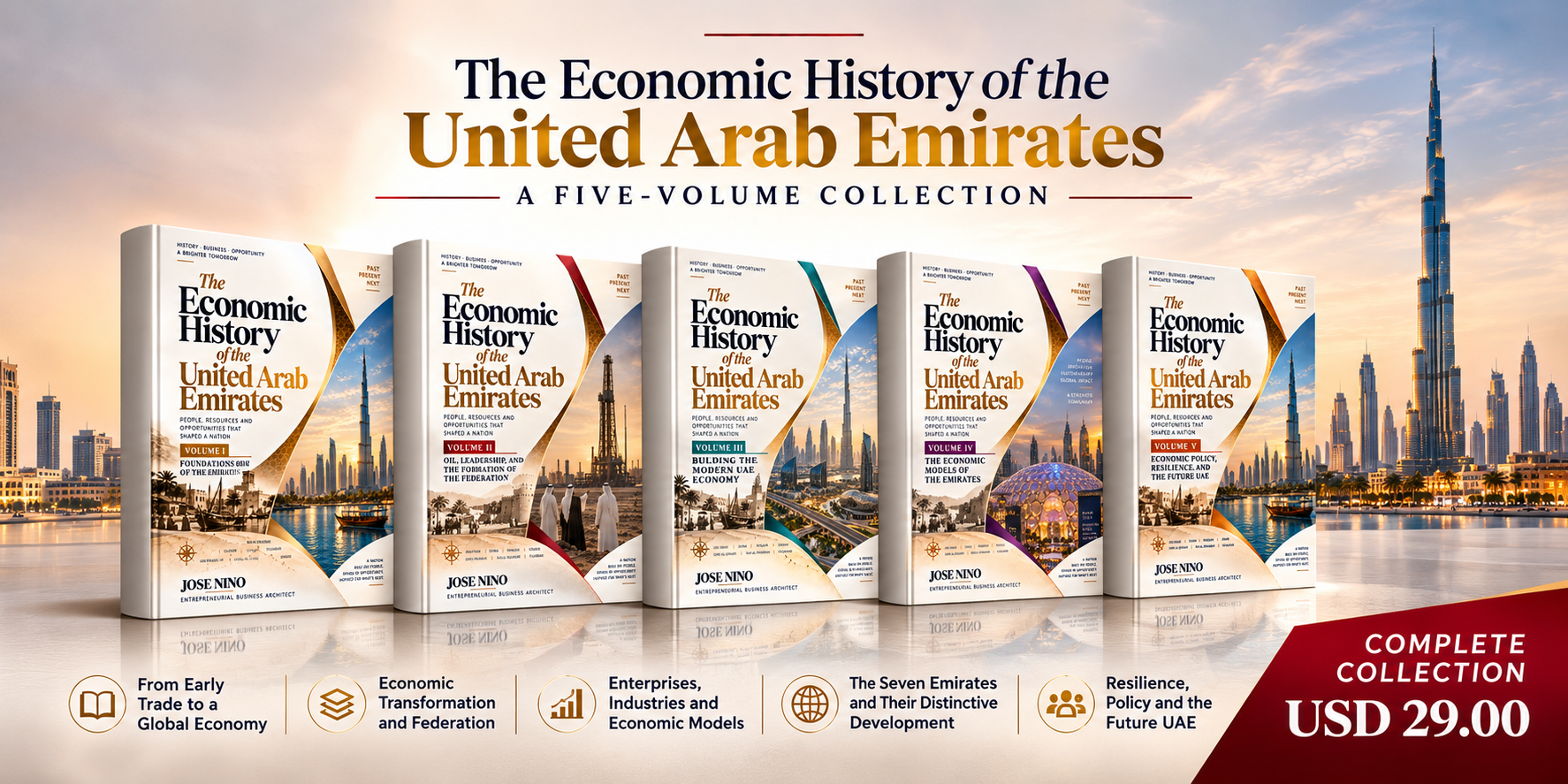
The economic transformation of the UAE cannot be understood without examining the maritime networks, political relationships, commercial institutions, and strategic decisions that shaped the region before the modern federation existed. These historical foundations help explain how economic opportunities developed, how commercial capabilities accumulated, and how external forces influenced the emergence of the institutions that would later support national development.
The Economic History of the United Arab Emirates, by Jose Nino, explores these developments across a comprehensive five-volume collection. Volume I, Foundations of the Emirates, examines the region's early economic foundations, including the maritime power of the Al Qasimi, the development of the ruling families, and the changing relationships between coastal communities and external powers.
The collection continues through the petroleum era, the formation of the federation, the construction of the modern UAE economy, the distinct economic development models of the seven emirates, and the policies and challenges shaping the country's future.
Five volumes. One economic transformation. Valuable lessons for today's entrepreneurs.
Complete Five-Volume Digital PDF Collection — USD 29.99
From Maritime Strategy to Building Your Business in Dubai
Understanding how commercial networks, strategic positioning, and institutional environments influence economic development can help entrepreneurs make better decisions when establishing businesses in the United Arab Emirates. However, turning a commercial opportunity into an operating enterprise requires practical choices concerning business activities, jurisdiction, licensing, organizational structure, and the capabilities needed to serve customers.
ONE Business Dubai supports entrepreneurs and international businesses seeking to establish their commercial presence in Dubai and across the UAE. Our company formation and business registration services assist clients with the initial establishment process according to their proposed activities and applicable registration requirements.
UAE Company Formation & Business Registration — Professional Fees from USD 1,200 + Government Fees
The final scope and total estimated cost depend upon the proposed business activity, jurisdiction, registration requirements, and services requested. Entrepreneurs can contact ONE Business Dubai to discuss their proposed enterprise and request a tailored quotation.
Request UAE Company Formation & Business Registration Assistance
Build Your Competitive Advantage Before You Expand
The Al Qasimi maritime experience demonstrates that commercial strength is constructed through capabilities, relationships, strategic positioning, and sustained organizational development. It also demonstrates that no competitive advantage should be treated as permanent or independent of the wider environment in which it operates.
For entrepreneurs entering Dubai, the practical objective should therefore extend beyond obtaining a license or identifying a promising market. The founder must understand how the enterprise will create value, which capabilities support that value, what dependencies could threaten its operations, and how the organization can adapt as commercial conditions change.
The strongest business is not necessarily the one with the greatest initial advantage. It is the one capable of developing, protecting, and renewing its ability to create value over time.
Discover more of the historical lessons behind the UAE's economic development in The Economic History of the United Arab Emirates, the complete five-volume collection by Jose Nino.
Discover the Complete Five-Volume Collection — USD 29.99
Contact ONE Business Dubai for UAE Company Formation Services