ONE BUSINESS / INSIGHTS / ARTICLE 09
How Sharjah Reinvented Its Economy: 12 Entrepreneurial Lessons from Maritime Trade to Industry and Culture
The Entrepreneurial Lessons Behind Strategic Geography, International Aviation, Industrial Diversification, Competitive Reinvention, Cultural Investment, and Sharjah's Economic Transformation

Sharjah's Greatest Economic Advantage Was Its Ability to Reinvent Itself
When international entrepreneurs examine the United Arab Emirates, their attention often turns immediately to Dubai's commercial infrastructure or Abu Dhabi's substantial financial resources. Yet the economic history of Sharjah offers a different and equally valuable perspective on how prosperity develops. Sharjah's transformation demonstrates that an economy does not need to possess the largest natural-resource reserves or dominate every commercial sector to establish a meaningful and sustainable competitive position. It can create economic value by recognizing its distinctive advantages, investing in productive capabilities, and repeatedly adapting its development model as markets and technologies change.
Sharjah occupies a remarkable geographical position within the United Arab Emirates. Its territory includes a coastline on the Arabian Gulf and eastern territories with access to the Gulf of Oman. This combination historically connected the emirate with maritime networks extending toward Persia, India, East Africa, and the wider Indian Ocean. Its geography created opportunities, but those opportunities became economically significant only when merchants, rulers, and later public institutions developed the infrastructure and relationships necessary to use them.
Before petroleum transformed the region, Sharjah was an important maritime trading center. Pearling, fishing, dhow construction, and regional commerce supported economic activity, while the Al Qasimi ruling family played a significant role in the political and maritime history of the lower Gulf. These activities established commercial knowledge and international relationships that remained valuable even as the economic environment changed.
One of Sharjah's most remarkable historical achievements came in 1932, when it became an important stopping point for Imperial Airways services connecting Britain and India. The establishment of the Al Mahatta airfield represented a transformation in the economic significance of geographical position. A location that had previously benefited from maritime routes became relevant to a new international transportation system.
However, Sharjah's economic development was not a story of uninterrupted commercial leadership. Dubai's increasingly competitive port infrastructure and expanding merchant economy challenged Sharjah's historical position. Rather than depending indefinitely on its former maritime advantages, Sharjah gradually developed alternative economic capabilities through industrial infrastructure, specialized ports, manufacturing, logistics, and cultural and educational institutions.
For entrepreneurs, this history raises an essential question: what happens when the original competitive advantage of a successful enterprise is no longer sufficient?
The following twelve entrepreneurial lessons examine Sharjah's transformation from a maritime gateway into an industrial, logistical, educational, and cultural center. Each lesson connects historical developments with contemporary business principles and Entrepreneurial Business Architecture (EBA), offering practical insights into competitive positioning, infrastructure investment, diversification, organizational resilience, and the construction of long-term economic value.
1. Entrepreneurial Lesson: Geography Creates Opportunity, but Strategy Creates Competitive Advantage
Sharjah's geographical position provided an important foundation for its historical economic development. Its principal settlement faced the Arabian Gulf, while territories such as Khor Fakkan and Kalba provided access to the Gulf of Oman. This unusual territorial arrangement connected the emirate with two maritime environments and created possibilities for commercial activity across different regional transportation networks.
The economic significance of this position depended on how it was used. Access to the Arabian Gulf supported trade with nearby coastal settlements, while connections through the Gulf of Oman opened additional routes toward the Indian Ocean. Merchants could participate in commercial relationships involving Persia, India, and East Africa, developing networks that extended beyond the immediate territory of Sharjah.
Nevertheless, geography alone could not guarantee prosperity. A favorable location becomes economically valuable only when it is supported by transportation, commercial relationships, security, reliable services, and the capacity to meet market requirements. A natural harbor without commercial activity remains an underutilized resource. Similarly, a strategically located territory cannot maintain its position if competing locations develop superior infrastructure and operating conditions.
Entrepreneurs face comparable challenges when selecting locations for their enterprises. Establishing a company in a recognized commercial center may provide access to customers, suppliers, and transportation infrastructure, but those advantages do not automatically generate revenue. The entrepreneur must determine how the location supports a specific business model and whether the organization possesses the capabilities necessary to benefit from it.
A company serving international markets might prioritize access to logistics infrastructure, while a professional services enterprise may benefit more from proximity to customers and specialized talent. The appropriate decision depends on the relationship between geographical advantages and the enterprise's actual economic activities.
The first entrepreneurial lesson is that location provides possibilities, but competitive advantage emerges only when entrepreneurs develop a strategy capable of converting those possibilities into productive commercial activity.
2. Entrepreneurial Lesson: Commercial Knowledge Can Survive the Loss of Physical Infrastructure
Sharjah's early maritime economy depended on capabilities accumulated across generations. Merchants understood regional markets, sailors possessed knowledge of maritime routes, dhow builders maintained specialized technical skills, and trading families developed relationships with commercial partners in distant locations. These capabilities supported economic activity even when political conditions and physical infrastructure changed.
The maritime conflicts of the early nineteenth century disrupted commercial life along the lower Gulf. Sharjah's historical experience illustrates that physical assets can be damaged or destroyed while important elements of economic knowledge remain available. A port may require reconstruction, but the knowledge of experienced merchants, vessel builders, and maritime operators can survive the disruption.
This distinction between physical capital and accumulated commercial capability is particularly important for entrepreneurs. Buildings, equipment, and inventory represent visible business assets, but an enterprise also possesses less tangible resources. Customer relationships, operational expertise, supplier knowledge, employee experience, and institutional reputation can determine how effectively the organization responds to unexpected challenges.
A business that loses a major customer or experiences the failure of an important distribution channel may still possess capabilities that can be redirected toward alternative opportunities. Its sales team may understand the market, its employees may possess valuable technical expertise, and its relationships may provide access to new commercial arrangements.
Entrepreneurs should therefore identify the capabilities that would remain valuable if their existing business model became less profitable. This requires investing in employee knowledge, documenting operating procedures, maintaining commercial relationships, and understanding which organizational strengths can be transferred to new activities.
The second entrepreneurial lesson is that lasting business resilience depends not only on protecting physical assets, but also on developing knowledge, relationships, and capabilities that remain productive when circumstances change.
3. Entrepreneurial Lesson: The Greatest Opportunities Often Emerge When Technology Changes the Value of Existing Assets
Sharjah's role in the development of international aviation illustrates how technological change can transform the economic significance of an established location. During the maritime era, the emirate's position was valuable because of its connections with regional shipping routes. With the expansion of commercial aviation, that same geographical position acquired a different potential function.
In 1932, Sharjah became an important stopping point for Imperial Airways operations between Britain and India. Aircraft of the period required intermediate landing facilities, refueling arrangements, maintenance support, and accommodation for passengers and crews. Sharjah's position made it suitable for participation in this emerging transportation network.
The establishment of Al Mahatta represented more than the construction of an airfield. It introduced new economic activities associated with aviation operations, ground services, transportation coordination, and international connectivity. A territory whose economic identity had previously been associated with maritime commerce became part of a new technological system.
For entrepreneurs, this development illustrates that the value of an existing asset can change dramatically when technology creates new applications. A company may possess specialized knowledge, a customer network, or a physical location that becomes more valuable when new technologies alter the way products and services are delivered.
However, technological opportunity must be recognized and acted upon. Organizations that assume their existing commercial advantages will remain unchanged risk losing relevance when customers adopt alternative technologies or distribution systems. Successful adaptation requires understanding how technological developments affect customer needs, operating costs, and market access.
Entrepreneurs should regularly examine whether emerging technologies create new uses for capabilities they already possess. The objective is not necessarily to abandon the existing business, but to identify opportunities for extending its value into changing economic environments.
The third entrepreneurial lesson is that technological transformation rewards entrepreneurs who recognize how new systems can create additional economic value from capabilities and assets they already possess.
4. Entrepreneurial Lesson: Infrastructure Investments Must Connect with a Real Commercial Opportunity
The development of Sharjah's early aviation infrastructure demonstrates the relationship between strategic opportunity and physical investment. An international air route required more than a favorable geographical location. Aircraft needed suitable landing facilities, dependable operational arrangements, and supporting services that allowed scheduled flights to function reliably.
The establishment of Al Mahatta required cooperation between Sharjah's leadership and international aviation interests. The commercial opportunity existed because aircraft operating between distant destinations needed intermediate facilities. Infrastructure investment therefore responded to a recognizable operational requirement rather than an abstract ambition to construct an impressive project.
This distinction remains essential in contemporary entrepreneurship. Businesses sometimes invest heavily in offices, warehouses, equipment, or technology before establishing whether those assets will improve their ability to serve customers. Such investments may create financial obligations without generating corresponding commercial benefits.
A more disciplined approach begins by identifying the economic activity that the proposed infrastructure will support. Entrepreneurs should evaluate expected demand, operational requirements, implementation costs, maintenance obligations, and the consequences of delays. The investment should have a clear relationship with the organization's revenue model and strategic objectives.
Sharjah's aviation experience also illustrates the importance of phased development. Early infrastructure can establish an initial capability, while subsequent investment may expand capacity as demand and operational experience increase. This approach can reduce the risk associated with committing excessive resources before the commercial opportunity is sufficiently understood.
For founders establishing businesses in the UAE, the principle applies to decisions concerning office facilities, industrial premises, technology systems, and logistics arrangements. The most expensive infrastructure is not necessarily the most appropriate. The correct investment is the one that supports the actual operating requirements of the enterprise.
The fourth entrepreneurial lesson is that infrastructure becomes an economic asset when it responds to a clearly identified commercial need and is developed according to the enterprise's operational and financial capacity.
5. Entrepreneurial Lesson: Integration Creates Greater Value Than Isolated Business Capabilities
Sharjah's historical development involved the interaction of maritime commerce and aviation infrastructure. The presence of a port and an airfield created opportunities for connecting different transportation systems, allowing merchants and service providers to organize commercial activities that extended beyond the capabilities of either facility operating independently.
The economic significance of integration lies in the coordination of complementary activities. Maritime transportation can move substantial quantities of goods between ports, while aviation provides access to destinations and delivery times that maritime routes cannot always match. Warehousing, financing, documentation, and distribution services connect these activities into a functioning commercial system.
An enterprise may possess several valuable resources without using them effectively together. A company might have an established customer base, a modern website, qualified employees, and reliable suppliers, yet still experience poor performance because its systems do not coordinate. Customers may receive inconsistent information, employees may duplicate work, and financial decisions may remain disconnected from operational realities.
Entrepreneurial Business Architecture provides a contemporary framework for addressing this problem. The enterprise should be understood as an integrated system connecting its value proposition, customer relationships, operational processes, financial resources, institutional arrangements, and growth strategy.
The objective is not simply to improve each component independently. Entrepreneurs must also examine the relationships between components. A marketing campaign that increases customer demand can damage the business if delivery capacity is insufficient. Similarly, investments in production may fail to generate returns if distribution channels remain underdeveloped.
Sharjah's experience demonstrates that the value of infrastructure can increase when complementary systems are deliberately connected. For modern founders, this means designing processes that allow commercial capabilities to reinforce one another rather than operate as isolated departments or activities.
The fifth entrepreneurial lesson is that sustainable business performance depends on the quality of the connections between organizational capabilities, not merely on the strength of each capability considered separately.
6. Entrepreneurial Lesson: Competitive Leadership Is Never Permanent
Sharjah's historical importance as a maritime trading center did not guarantee that it would retain its relative commercial position indefinitely. During the twentieth century, Dubai increasingly developed the infrastructure and commercial policies necessary to attract regional trade. Improvements to Dubai Creek, expanding merchant networks, and investment in transportation facilities strengthened Dubai's competitiveness.
Sharjah faced the consequences of changing commercial conditions, including limitations associated with its traditional harbor. As Dubai improved its infrastructure and expanded its commercial capacity, merchants and transportation operators had reasons to reconsider where they conducted business. Historical reputation alone could not eliminate the advantages created by a competitor's sustained investment.
This experience demonstrates that competitive advantage is dynamic. A business may become successful because it offers better access, lower costs, stronger relationships, or superior service. Yet competitors can improve their own capabilities, technologies can change customer expectations, and markets can reward different characteristics over time.
Entrepreneurs who interpret past success as evidence of permanent superiority risk becoming complacent. Their organizations may continue investing in an established model while customers gradually discover more attractive alternatives. By the time declining performance becomes visible, the competitor may have developed advantages that are expensive or impossible to replicate quickly.
A disciplined business strategy therefore requires continuous competitive analysis. Entrepreneurs should evaluate how competitors are investing, which customer needs are changing, and whether the organization's original value proposition remains sufficiently distinctive.
Sharjah's history also demonstrates that losing leadership in one market does not necessarily mean losing the capacity to create value. The more important strategic question is whether the organization can identify new opportunities before its existing position deteriorates beyond recovery.
The sixth entrepreneurial lesson is that competitive advantage must be renewed continuously, because the success of yesterday's business model does not guarantee its relevance in tomorrow's market.
7. Entrepreneurial Lesson: Reinvention Is Often More Valuable Than Defending an Outdated Position
When Dubai's commercial expansion challenged Sharjah's traditional advantages, attempting to reproduce Dubai's development model was not the only possible response. Sharjah possessed different geographical characteristics, industrial opportunities, and institutional priorities that could support an alternative economic strategy.
Its subsequent development increasingly emphasized manufacturing, industrial zones, specialized port facilities, and logistics. These activities represented a shift from depending primarily on historical maritime trade toward constructing new sources of economic value. Reinvention did not require abandoning every existing capability; it involved applying accumulated knowledge and infrastructure to different economic opportunities.
For entrepreneurs, the distinction between improvement and reinvention is important. Improvement involves making an existing business model more efficient or competitive. Reinvention requires reconsidering the value proposition, target customers, revenue sources, or operating system when the existing model no longer provides sufficient opportunities.
A company facing declining demand may initially respond by reducing prices, increasing advertising, or cutting operating costs. These measures can be appropriate when the underlying market remains attractive. However, they may be insufficient when technology, customer behavior, or competitive conditions have fundamentally changed.
Strategic reinvention begins by identifying the capabilities that remain valuable and determining how they can support a different economic proposition. An established distributor may develop specialized logistics services. A manufacturing company may expand into higher-value products. A professional services enterprise may reorganize its expertise around emerging customer requirements.
The process requires disciplined experimentation, financial planning, and a willingness to reconsider assumptions that previously guided the organization. Reinvention should not become an excuse for abandoning profitable activities prematurely, but neither should loyalty to the original business prevent necessary change.
The seventh entrepreneurial lesson is that long-term survival sometimes requires entrepreneurs to stop defending an increasingly weak competitive position and begin constructing a new one around capabilities that can generate future value.
8. Entrepreneurial Lesson: Specialization Creates Advantages That Larger Competitors Cannot Easily Replicate
Sharjah's later port development illustrates the importance of specialization. Rather than depending exclusively on a single maritime facility, the emirate developed different port capabilities serving distinct commercial purposes. Port Khalid supported commercial maritime activity, Hamriyah developed an important industrial function, and Khor Fakkan offered access to deep-water facilities on the Gulf of Oman.
Khor Fakkan's geographical position provides a particularly distinctive advantage. Its location outside the Strait of Hormuz allows vessels approaching from the Indian Ocean to access port facilities without entering the Arabian Gulf. This characteristic cannot be reproduced simply by expanding a competing port located inside the Gulf.
The entrepreneurial significance of this distinction concerns defensible competitive advantages. Some business characteristics, such as lower prices or larger advertising budgets, can be imitated by competitors with sufficient resources. Other advantages arise from specialized expertise, established relationships, unique access, proprietary capabilities, or operating arrangements that are difficult to reproduce.
Smaller enterprises frequently make the mistake of competing against larger organizations across every dimension. They attempt to offer comparable product ranges, marketing reach, and service coverage despite possessing fewer resources. This approach can create unsustainable financial pressure.
A more effective strategy may involve identifying a specific market segment whose requirements are not adequately served by larger competitors. Specialization allows the enterprise to concentrate resources, develop deeper expertise, and create a value proposition that customers recognize as distinctive.
For international entrepreneurs considering the UAE, the lesson is especially relevant. The objective should not necessarily be to compete directly with the largest established businesses. Founders may achieve stronger results by identifying specialized customer needs, underserved commercial activities, or differentiated service models.
The eighth entrepreneurial lesson is that smaller organizations can develop powerful competitive advantages by specializing in capabilities or market positions that larger competitors cannot easily reproduce.
9. Entrepreneurial Lesson: Industrial Ecosystems Are More Valuable Than Individual Factories
Sharjah's industrial transformation involved more than establishing manufacturing facilities. The development of industrial zones, port infrastructure, transportation arrangements, and supporting services created conditions in which different manufacturers could operate within a coordinated economic environment.
The establishment of Hamriyah Free Zone Authority in 1995 represented an important element of this development. Its industrial environment provided a framework for attracting enterprises requiring land, infrastructure, logistics access, and administrative arrangements appropriate to manufacturing and related activities.
Industrial development becomes more productive when firms can benefit from proximity to suppliers, transportation providers, technical specialists, and complementary manufacturers. A factory operating in isolation may face higher costs associated with obtaining materials, maintaining equipment, transporting goods, and recruiting specialized personnel.
An industrial cluster can reduce some of these difficulties by concentrating related capabilities within a defined area. Logistics providers can serve multiple clients, suppliers can develop relationships with several manufacturers, and workers can acquire skills relevant to the surrounding industries. These relationships may improve productivity and attract further investment.
Entrepreneurs can apply the same principle when developing businesses within specialized commercial ecosystems. An enterprise does not necessarily need to internalize every function. It may achieve better results by operating in an environment where reliable suppliers, service providers, customers, and complementary organizations are accessible.
However, the benefits of clustering depend on the quality of the surrounding institutions and infrastructure. Proximity alone does not guarantee cooperation, and an industrial zone cannot substitute for a viable product, effective management, or sufficient market demand.
The ninth entrepreneurial lesson is that economic ecosystems create additional value when infrastructure, institutions, suppliers, and enterprises operate together to reduce costs and expand productive opportunities.
10. Entrepreneurial Lesson: Diversification Should Create a Portfolio of Complementary Economic Strengths
Sharjah's industrial development expanded across multiple manufacturing activities, including building materials, metals, plastics, and other industrial products. This diversification helped establish an economic base that was not dependent exclusively on maritime commerce or a single manufacturing sector.
The significance of diversification extends beyond the number of industries represented. Different activities may respond differently to changes in international demand, construction cycles, commodity prices, and regional investment. An economy with multiple productive sectors can possess greater flexibility than one dependent on a single source of commercial activity.
Nevertheless, diversification introduces management challenges. Each industry has different operating requirements, financing needs, technical standards, and competitive conditions. Expanding into too many unrelated activities without sufficient expertise can weaken rather than strengthen an organization.
Entrepreneurs should therefore distinguish strategic diversification from uncontrolled expansion. The most valuable new activities often share capabilities with the existing enterprise. A manufacturer may introduce related products using established equipment or supplier relationships. A logistics company may expand into warehousing or distribution services that complement its transportation activities.
Financial discipline remains essential. Each new activity should be evaluated according to market demand, expected profitability, capital requirements, operational complexity, and its contribution to the enterprise's overall risk profile.
Entrepreneurial Business Architecture helps founders examine whether diversification strengthens the organization as a system. A new business line should contribute to the enterprise's long-term economic purpose rather than simply increase the number of activities under management.
The tenth entrepreneurial lesson is that effective diversification creates resilience by developing complementary sources of value while preserving operational coherence and financial discipline.
11. Entrepreneurial Lesson: Education and Culture Can Become Long-Term Economic Assets
One of the most distinctive characteristics of Sharjah's modern development is its sustained emphasis on education and culture. Under the leadership of Sheikh Sultan bin Muhammad Al Qasimi, who became Ruler in 1972, the emirate developed institutions and initiatives that strengthened its identity as an educational and cultural center.
The establishment of the University of Sharjah and the American University of Sharjah in 1997 contributed to the expansion of higher education. Cultural institutions, museums, publishing activities, and heritage initiatives further strengthened the emirate's distinctive position. Sharjah's designation as the Cultural Capital of the Arab World by UNESCO in 1998 and its recognition as the Capital of Islamic Culture for 2014 reflected the importance of this development.
These investments represent an economic strategy that extends beyond conventional industrial production. Universities can contribute to human capital, professional development, research, and the attraction of students and educators. Cultural institutions can support tourism, creative industries, publishing, and international recognition while preserving historical knowledge and identity.
For entrepreneurs, this history demonstrates that intangible assets can influence long-term competitive positioning. Knowledge, reputation, organizational culture, and professional expertise may be difficult to measure through immediate revenue, yet they can determine whether an enterprise attracts customers, talented employees, and valuable partnerships.
A business that invests consistently in employee development may strengthen its operational capabilities. An organization that builds a reputation for reliability and specialized knowledge may attract customers who value expertise over price. An educational enterprise may create economic opportunities by developing capabilities that individuals and organizations can apply throughout their careers.
These benefits require sustained commitment. Educational quality and institutional reputation cannot be established through promotional campaigns alone. They depend on credible programs, competent leadership, effective administration, and consistent delivery over time.
The eleventh entrepreneurial lesson is that investment in knowledge, culture, and institutional reputation can create durable economic advantages whose value extends beyond immediate financial transactions.
12. Entrepreneurial Lesson: Sustainable Success Requires the Continuous Reinvention of Business Architecture
Sharjah's economic history reveals a recurring pattern of transformation. Maritime commerce created an early commercial foundation. International aviation introduced a new technological opportunity. Competition from Dubai challenged established advantages. Industrial infrastructure and specialized ports supported alternative economic activities, while education and culture contributed additional dimensions to the emirate's development.
These transitions were neither automatic nor free from difficulty. Each required decisions concerning resources, infrastructure, partnerships, and institutional priorities. The importance of Sharjah's experience lies not in the assumption that every strategy succeeded equally, but in the repeated effort to construct new economic capabilities as circumstances changed.
Entrepreneurial Business Architecture provides a contemporary framework for understanding this process. An enterprise should be designed around a viable economic proposition, but its architecture must also accommodate changing technologies, customer requirements, competitive conditions, and opportunities for growth.
The value proposition defines why customers participate. The operating model determines how the organization delivers that value. Financial architecture supports sustainability, while commercial relationships connect the enterprise with customers, suppliers, and partners. Institutional arrangements establish responsibilities and operating conditions, and strategic capabilities allow the business to adapt when its original assumptions no longer hold.
These components must evolve together. A company cannot successfully enter a new market without examining whether its operations, financing, and commercial relationships can support the expansion. Similarly, a business cannot maintain its competitiveness indefinitely if its products remain unchanged while customer expectations and technology advance.
Sharjah's transformation demonstrates that economic development is an ongoing process rather than a permanent destination. A competitive advantage that creates prosperity during one historical period may become insufficient during another. Sustainable organizations must therefore develop the ability to recognize change, preserve valuable capabilities, and construct new sources of economic relevance.
The twelfth entrepreneurial lesson is that lasting success depends on the continuous reinvention of business architecture: the disciplined process of adapting resources, capabilities, relationships, and institutions to create value in changing economic environments.
Explore The Economic History of the United Arab Emirates
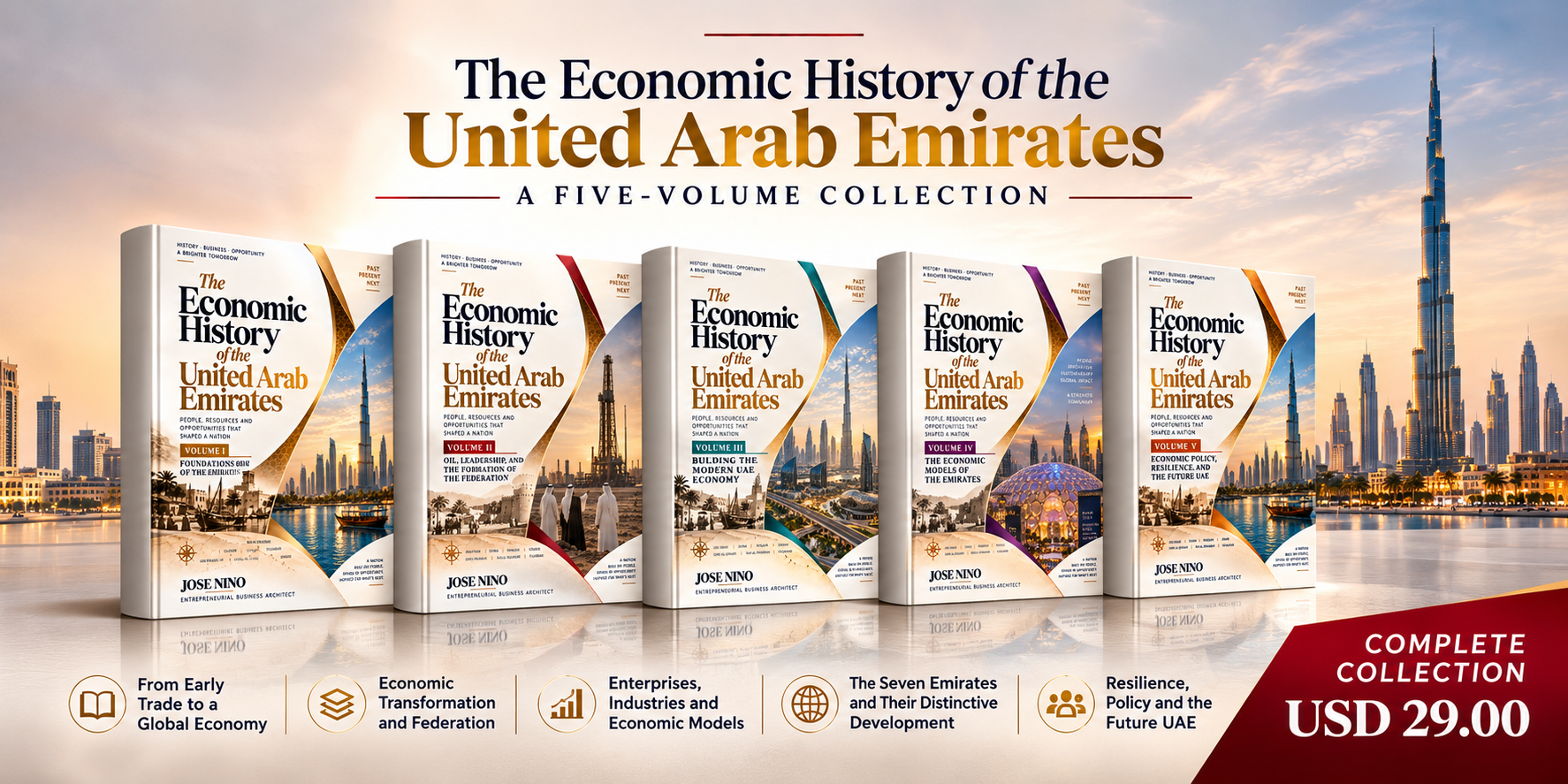
Sharjah's transformation from a maritime gateway into an industrial, logistical, educational, and cultural center represents one chapter in the broader economic history of the United Arab Emirates. Its experience demonstrates how geographical positioning, commercial relationships, technological change, competition, institutional development, and strategic diversification influence the evolution of economic systems.
The Economic History of the United Arab Emirates, by Jose Nino, examines this transformation through a comprehensive five-volume collection. Volume I, Foundations of the Emirates, explores the historical development of the region before the formation of the federation, including the commercial evolution of Dubai, the economic transformation of Abu Dhabi, and Sharjah's distinctive experience of repeated reinvention.
The subsequent volumes examine petroleum development, national leadership, the establishment of federal institutions, the construction of modern economic sectors, the distinctive economic models of the seven emirates, and the strategic questions influencing the UAE's future development.
The collection is designed for entrepreneurs, investors, business leaders, researchers, and readers seeking to understand the historical foundations of one of the world's most remarkable economic transformations. It connects economic history with contemporary questions concerning entrepreneurship, competitive strategy, institutional development, resource management, and the organization of sustainable enterprises.
Five volumes. Seven emirates. One extraordinary economic transformation.
Complete Five-Volume Digital PDF Collection — USD 29.99
From Sharjah's Economic Reinvention to Establishing Your Business in the UAE
Sharjah's historical experience demonstrates that successful market participation requires more than identifying an attractive commercial location. Entrepreneurs must understand the economic environment, evaluate available infrastructure, recognize their competitive advantages, and develop an operating model consistent with their business objectives.
These principles remain relevant for international founders considering the United Arab Emirates. The UAE offers different jurisdictions, business environments, and commercial structures, each with distinct regulatory and operational considerations. The appropriate establishment strategy depends on the proposed activity, target market, licensing requirements, infrastructure needs, and long-term business objectives.
ONE Business Dubai assists entrepreneurs and international businesses seeking to establish their commercial presence in the United Arab Emirates. Our company formation and business registration services support the initial establishment process, helping clients evaluate the registration arrangements relevant to their proposed activities.
UAE Company Formation & Business Registration — Professional Fees from USD 1,200 + Government Fees
The final scope and estimated cost depend on the proposed business activity, jurisdiction, licensing requirements, and additional services requested. Entrepreneurs considering business establishment in Dubai, Sharjah, or the wider UAE can contact ONE Business Dubai to discuss their objectives and request a tailored quotation.
Request UAE Company Formation & Business Registration Assistance
Build a Business Capable of Reinventing Its Own Future
Sharjah's economic history offers a powerful reminder that competitive success is not permanent. A favorable location, an established commercial network, or an important technological advantage can create substantial opportunities, but those advantages must be continually evaluated against changing market conditions.
For contemporary entrepreneurs, the challenge is to build enterprises that combine strategic focus with adaptability. This requires a clear value proposition, disciplined financial management, effective operating systems, productive commercial relationships, and the capacity to identify new opportunities before existing advantages deteriorate.
The most resilient enterprises do not treat their original business model as an unchangeable structure. They preserve the capabilities that remain valuable while developing new ways to serve customers, participate in markets, and create economic value. This principle connects Sharjah's historical transformation with the central purpose of Entrepreneurial Business Architecture.
Sharjah's enduring entrepreneurial lesson is that economic prosperity does not depend on maintaining the same competitive advantage forever. It depends on developing the vision, capabilities, and institutional discipline required to create the next advantage.
Discover the broader economic history behind this transformation in The Economic History of the United Arab Emirates, the five-volume collection by Jose Nino.
Discover the Complete Five-Volume Collection — USD 29.99
Contact ONE Business Dubai for UAE Company Formation Services