ONE BUSINESS / INSIGHTS / ARTICLE 13
How Sheikh Rashid Built Dubai's Economic Architecture: 12 Entrepreneurial Lessons in Trade, Infrastructure, and Strategic Development
From the Transformation of Dubai Creek to the Construction of Ports, Airports, Commercial Institutions, and the Foundations of a Global Business Hub
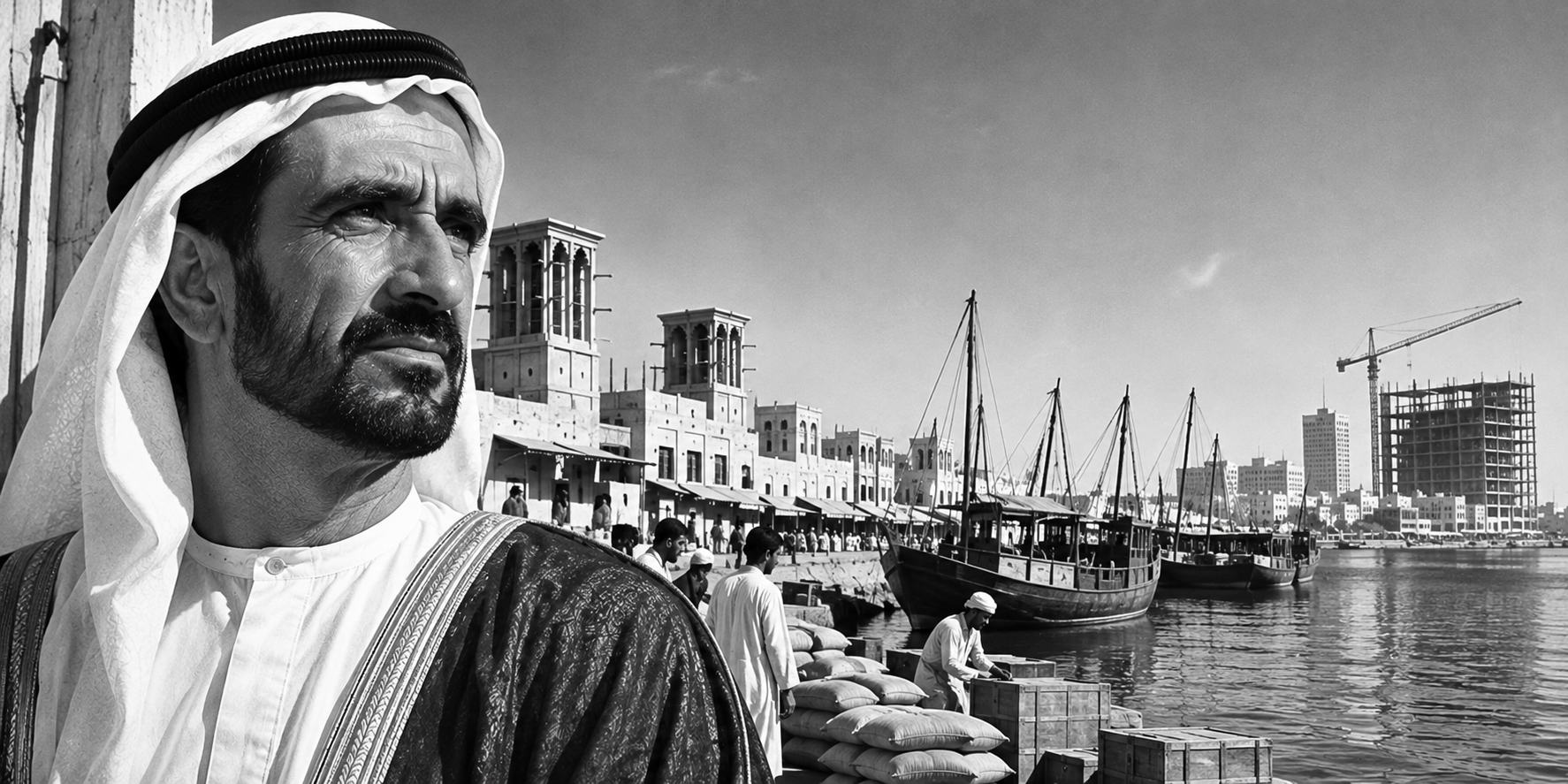
How Sheikh Rashid Built Dubai's Economic Architecture: 12 Entrepreneurial Lessons in Trade, Infrastructure, and Strategic Development
For international entrepreneurs, investors, and professionals arriving in Dubai, understanding the historical foundations of the emirate's commercial economy provides an important perspective on the business environment they encounter today. Dubai's international connectivity, extensive infrastructure, trading institutions, and reputation as a global commercial center did not emerge automatically from geographical location or petroleum revenues. They developed through successive decisions concerning trade, investment, infrastructure, commercial relationships, and the organization of economic activity.
Among the historical figures associated with this transformation, Sheikh Rashid bin Saeed Al Maktoum occupies a central position. As Ruler of Dubai from 1958 to 1990, he directed a period of development during which the emirate expanded its maritime infrastructure, improved transportation and communications, strengthened its commercial institutions, and established important foundations for subsequent economic growth. His approach demonstrated the significance of identifying economic constraints and investing in capabilities that could expand commercial possibilities.
Dubai's historical economy was closely connected to maritime trade, pearling, regional commerce, and the activities of merchant communities. Its location along the Arabian Gulf provided access to international trading routes, but geography alone did not guarantee commercial success. Trade required navigable waterways, facilities for handling goods, reliable commercial relationships, and an environment in which merchants could conduct business with reasonable confidence.
During the first half of the twentieth century, the decline of the pearling economy created serious difficulties across the Gulf. Dubai nevertheless continued developing its commercial role through trading relationships and the movement of goods between regional markets. The expansion of these activities created new requirements for maritime infrastructure, particularly because the limitations of Dubai Creek constrained the movement of larger vessels and the handling of commercial cargo.
Sheikh Rashid recognized that the Creek represented more than a geographical feature. It was a productive economic asset whose capacity influenced the commercial opportunities available to the emirate. The dredging and improvement of Dubai Creek, completed in 1961, therefore represented an important strategic investment. By improving maritime access before substantial petroleum revenues became available, Dubai strengthened an existing economic capability rather than waiting for a new source of wealth to determine its future.
This sequence is particularly significant because Dubai's Fateh oil field was discovered in 1966, and petroleum exports began in 1969. The decision to improve the Creek preceded these developments. It illustrates an approach to economic development based on the productive potential of trade, infrastructure, and commercial activity rather than exclusive dependence on natural-resource revenues.
The subsequent construction of Port Rashid, which opened in 1972, expanded Dubai's capacity to accommodate international shipping. The development of Dubai International Airport, transportation networks, electricity, telecommunications, and other facilities further strengthened the connections between the emirate and international markets. These projects were not economically isolated. Together, they supported the emergence of a more integrated commercial environment.
Sheikh Rashid's development approach also depended on relationships with Dubai's merchant community. Commercial knowledge, international trading connections, investment decisions, and confidence in the emirate's economic direction were important complements to public infrastructure. Government investment could improve the physical conditions for trade, while private merchants and businesses supplied commercial activity, market relationships, and entrepreneurial initiative.
For contemporary entrepreneurs, this history demonstrates that a favorable business environment is constructed through the interaction of physical infrastructure, commercial institutions, financial decisions, market access, and productive relationships. Establishing a company in Dubai today involves operating within an economic system whose historical development reflects decades of investment in these interconnected capabilities.
Through the contemporary perspective of Entrepreneurial Business Architecture (EBA), Sheikh Rashid's historical experience offers twelve lessons concerning strategic vision, economic constraints, productive investment, commercial openness, infrastructure development, institutional capacity, and sustainable business growth. These lessons are modern entrepreneurial interpretations of historical developments, not claims that Sheikh Rashid consciously applied a contemporary business framework.
1. Entrepreneurial Lesson: A Clear Economic Vision Must Precede Major Investment
Dubai's economic development under Sheikh Rashid was shaped by an understanding of the emirate's commercial potential. Its established trading relationships and maritime location provided a foundation for expansion, but the existing infrastructure imposed practical limitations on that potential. A development strategy therefore needed to address the conditions that prevented commercial activity from growing.
The decision to improve Dubai Creek reflected a clear relationship between economic purpose and investment. The objective was not simply to undertake a major construction project. It was to improve maritime accessibility, facilitate commercial movement, and strengthen Dubai's position as a trading center. The investment was connected to an existing economic activity whose development could generate broader benefits.
This distinction is important because major expenditure does not automatically constitute strategic investment. A project becomes strategically meaningful when its purpose is connected to identifiable economic opportunities and when its expected contribution can be evaluated in relation to broader development objectives.
Sheikh Rashid's emphasis on trade and connectivity provided a direction that could guide successive infrastructure decisions. Improvements to maritime facilities, aviation, transportation, and communications were relevant because they supported the movement of goods, people, capital, and commercial information.
Entrepreneurs encounter similar challenges when deciding how to allocate capital. A company may invest in technology, facilities, equipment, or marketing without defining the commercial objective that the investment is intended to achieve. Such expenditure can increase operating complexity without necessarily strengthening the enterprise.
Strategic vision requires entrepreneurs to identify the markets they intend to serve, the value they expect to create, and the capabilities necessary to deliver that value. Investment decisions should follow from this understanding rather than determine the organization's direction after resources have already been committed.
The first entrepreneurial lesson is that major investment should follow a clearly defined economic vision, because capital becomes strategically productive when it strengthens capabilities connected to identifiable commercial opportunities.
2. Entrepreneurial Lesson: Identify and Remove the Constraint Limiting Economic Growth
Dubai Creek was central to the emirate's commercial activity, but its physical characteristics limited maritime accessibility. As trade developed, the capacity of the waterway became increasingly important to the movement of vessels and goods. The constraint was not a lack of geographical access to international markets, but the limited capacity of the infrastructure connecting those markets with Dubai's commercial activities.
The dredging of the Creek addressed this limitation directly. By improving navigability, the project expanded the ability of maritime traffic to support commercial activity. Its economic significance lay in removing a practical obstacle that affected an existing network of merchants, shipping operators, and trading relationships.
This illustrates a general principle of economic development: increasing resources does not necessarily increase productive capacity when a critical constraint remains unresolved. Additional commercial demand cannot be served effectively if transportation, operating systems, or other essential capabilities are insufficient.
The identification of a constraint requires an understanding of how economic activity actually functions. In Dubai's case, the relationship between shipping access and commercial trade made the Creek an important development priority. Improving less consequential facilities would not necessarily have produced the same effect on the emirate's trading capacity.
Entrepreneurs should examine their organizations with similar attention to operational limitations. A business experiencing weak growth may assume that it needs additional marketing expenditure when the actual constraint involves delivery capacity, product quality, customer retention, or an ineffective sales process.
Effective diagnosis involves examining the relationship between demand, resources, operations, and results. Once the principal constraint is identified, investment can be directed toward the capability whose improvement is most likely to strengthen overall performance.
The second entrepreneurial lesson is that sustainable growth often begins by identifying and removing the constraint that prevents existing resources, demand, and commercial opportunities from producing their full economic value.
3. Entrepreneurial Lesson: Build Productive Capacity Before Demand Fully Materializes
The improvement of Dubai Creek demonstrates the importance of investing in economic capacity before future demand becomes fully visible. Commercial activity already existed, but the decision to expand maritime accessibility reflected an expectation that improved infrastructure could support additional trade.
Such investment involves uncertainty because the scale and timing of future demand cannot be known precisely. Infrastructure requires substantial expenditure before its full economic benefits become available, and its productive value depends on subsequent commercial use.
Nevertheless, waiting until demand exceeds existing capacity can create a different problem. Inadequate infrastructure may discourage commercial activity, increase costs, and prevent potential customers or trading partners from using a location or service. Capacity limitations can therefore suppress the very demand that an investor is waiting to observe.
Dubai's development demonstrates how investment can influence the future conditions of a market. Improvements to maritime access, port facilities, and transportation connectivity expanded the possibilities available to commercial participants. These investments supported the emirate's capacity to attract and accommodate additional activity.
Entrepreneurs face comparable decisions when preparing for expansion. A company may need to develop production systems, distribution capacity, technology infrastructure, or management capabilities before customer demand reaches its anticipated level. The appropriate timing depends on financial capacity, market evidence, implementation requirements, and the risks associated with insufficient or excessive investment.
Anticipatory investment should not be confused with speculative expenditure unsupported by economic reasoning. Entrepreneurs must evaluate whether the proposed capacity addresses a credible market opportunity and whether the enterprise can sustain the financial commitments involved.
The third entrepreneurial lesson is that productive capacity sometimes must be developed ahead of demand, provided the investment is supported by a credible understanding of future markets, operating requirements, and financial risk.
4. Entrepreneurial Lesson: Strategic Borrowing Can Finance Economic Transformation
The development of Dubai Creek required financial resources at a time when the emirate did not yet possess substantial petroleum income. Financing infrastructure under these circumstances demanded a willingness to consider arrangements through which future economic benefits could justify present financial commitments.
Sheikh Rashid's infrastructure program included borrowing and external financial support, with Kuwait playing a role in Dubai's early development financing. These arrangements illustrate the importance of distinguishing borrowing for productive investment from borrowing that merely supports expenditure without strengthening future economic capacity.
Debt creates obligations that must be fulfilled regardless of whether the anticipated benefits of an investment materialize. Its economic value therefore depends on the relationship between financing costs, project implementation, expected productive benefits, and the capacity to meet repayment commitments.
Infrastructure financing is particularly challenging because benefits may develop gradually and may extend across many commercial participants. The improvement of a port or waterway can support merchants, transport operators, suppliers, and customers without generating all of its economic benefits through a single direct revenue stream.
Entrepreneurs face similar financing decisions when purchasing equipment, expanding facilities, entering markets, or developing technology. Borrowed capital may accelerate growth when it finances capabilities that improve the enterprise's future earning potential. It can also weaken the organization when repayment obligations exceed the cash flows generated by the investment.
Financial discipline requires evaluating the purpose of borrowing, realistic revenue assumptions, repayment schedules, liquidity requirements, and alternative financing arrangements. The strategic question is not whether debt is inherently desirable or undesirable, but whether it supports an economically justified development objective.
The fourth entrepreneurial lesson is that borrowing can support transformation when it finances productive capabilities whose expected economic benefits justify the financial obligations and risks involved.
5. Entrepreneurial Lesson: Infrastructure Investment Can Create Markets Rather Than Merely Serve Them
Infrastructure is often understood as a response to existing demand. Roads are constructed because people need transportation, ports are expanded because shipping activity increases, and communications systems are developed because organizations require connectivity. Dubai's historical development demonstrates that infrastructure can also influence the scale and character of future demand.
By improving maritime accessibility and subsequently expanding port capacity, Dubai strengthened its ability to participate in regional and international trade. These improvements could make commercial activities more practical and encourage merchants and transport operators to consider opportunities that had previously been constrained by inadequate facilities.
The construction of Port Rashid represented an important extension of this approach. Its opening in 1972 expanded Dubai's maritime capabilities and supported the development of a commercial environment increasingly connected to international shipping and logistics.
Infrastructure can create economic opportunities by reducing transaction costs, improving reliability, expanding accessibility, and connecting participants who previously faced substantial obstacles to cooperation. Its influence extends beyond the direct users of the infrastructure because suppliers, service providers, and related enterprises may develop around the capabilities it creates.
Entrepreneurs can apply this principle when developing business platforms, distribution networks, digital systems, or other capabilities that improve market participation. A company may create value not only by responding to established demand, but also by making previously difficult transactions or services commercially feasible.
However, market-creating investment requires careful analysis. New infrastructure does not guarantee that customers will adopt the opportunities it makes possible. Entrepreneurs must evaluate the underlying economic need, the barriers to adoption, and the complementary activities required for a market to develop.
The fifth entrepreneurial lesson is that strategically designed infrastructure can expand markets by reducing barriers to participation and creating productive opportunities that existing market conditions could not adequately support.
6. Entrepreneurial Lesson: Commercial Openness Is a Strategic Economic Asset
Dubai's commercial history reflects the importance of international trading relationships and the participation of merchants connected to different regional markets. The emirate's economic opportunities depended partly on its capacity to attract commercial activity and maintain relationships extending beyond its immediate territory.
Commercial openness contributed to this process by supporting the movement of goods, capital, and entrepreneurial knowledge. A trading center benefits when merchants perceive that they can conduct transactions, maintain business relationships, and access markets under conditions that make commercial participation worthwhile.
Sheikh Rashid's development approach built upon Dubai's established trading orientation. Infrastructure improvements strengthened the practical conditions for commerce, while the emirate's commercial environment continued to support the activities of merchants and international business participants.
Openness is economically significant because it increases the range of resources and opportunities available to a market. International relationships can provide access to customers, suppliers, financing, specialized knowledge, and commercial practices that may not be available within a smaller local economy.
Entrepreneurs establishing businesses in Dubai today should recognize that international connectivity creates opportunities but also increases competition. Access to global markets does not eliminate the need for differentiation, reliable operations, regulatory compliance, and an appropriate understanding of customer requirements.
A commercially open environment becomes most valuable to an enterprise when the organization develops the capabilities necessary to participate effectively. Entrepreneurs must connect international opportunities with a viable business model, suitable partnerships, and the ability to deliver consistent value.
The sixth entrepreneurial lesson is that commercial openness strengthens economic opportunity by expanding access to markets, knowledge, capital, and relationships, but enterprises must possess the capabilities necessary to convert that access into productive results.
7. Entrepreneurial Lesson: Trust Between Leadership and Business Communities Supports Investment
Dubai's merchant community played an important role in the emirate's historical economy. Merchants possessed commercial experience, regional and international relationships, and knowledge of the practical requirements of trade. Their activities contributed to the economic foundations upon which subsequent infrastructure development could build.
The relationship between Sheikh Rashid's administration and commercial participants was therefore economically significant. Public infrastructure investment could improve the conditions for trade, but the resulting facilities required private commercial activity to generate their broader economic value.
Trust supports economic cooperation because investment decisions involve uncertainty about future conditions and the behavior of other participants. Merchants considering commercial commitments need confidence that infrastructure, administrative arrangements, and business relationships will remain sufficiently reliable to support their activities.
Confidence does not arise exclusively from declarations of support for business. It develops through consistent decisions, observable improvements, credible commitments, and practical cooperation. Infrastructure projects can contribute to confidence when they demonstrate a continuing commitment to improving the conditions under which commercial activity takes place.
Entrepreneurs face comparable requirements when building relationships with customers, suppliers, investors, employees, and commercial partners. Each participant must assess whether the enterprise can fulfill its commitments and whether cooperation is likely to generate continuing benefits.
Trust must also be supported by appropriate contractual arrangements, clear responsibilities, and reliable operating procedures. Personal relationships can facilitate cooperation, but sustainable commercial systems require structures capable of maintaining confidence as organizations expand.
The seventh entrepreneurial lesson is that durable economic relationships depend on trust supported by credible commitments, reliable performance, and institutional arrangements that allow commercial participants to cooperate with confidence.
8. Entrepreneurial Lesson: Complementary Infrastructure Creates Greater Value Than Isolated Assets
Dubai's transformation involved more than the development of a single port or transportation facility. Improvements to Dubai Creek, the construction of Port Rashid, the expansion of aviation facilities, and the development of roads, electricity, and telecommunications contributed to a broader commercial system.
The economic value of these investments increased through their relationships with one another. Maritime facilities supported the movement of goods, while roads improved connections between ports and commercial areas. Aviation strengthened international accessibility, and communications infrastructure supported the coordination of commercial transactions.
An isolated asset may possess limited value when the surrounding capabilities necessary for its effective use are absent. A port cannot operate efficiently without appropriate cargo handling, transportation connections, administrative procedures, and commercial demand. Its productive contribution depends on the performance of the wider system.
Complementarity also affects the sequence of investment. Improvements in one capability may create additional requirements elsewhere. Expanding shipping capacity can increase the need for storage, customs administration, inland transportation, and commercial services.
Entrepreneurs should evaluate their organizations through the same systemic perspective. A company may invest heavily in customer acquisition while neglecting service delivery, or introduce advanced technology without developing the employee capabilities required to use it effectively. Such imbalances limit the value of individual investments.
Entrepreneurial Business Architecture emphasizes the importance of aligning strategy, operations, finance, market relationships, and organizational capabilities. Investment decisions should therefore be evaluated not only according to their individual benefits, but also according to their contribution to the performance of the enterprise as a whole.
The eighth entrepreneurial lesson is that complementary investments generate greater economic value when they are designed as parts of an integrated productive system rather than as disconnected assets or projects.
9. Entrepreneurial Lesson: Strategic Risk-Taking Must Be Supported by Economic Reasoning
Major infrastructure decisions involve uncertainty because they require present commitments in anticipation of future economic benefits. Dubai's early development projects were undertaken in an environment where financial resources, commercial demand, and regional economic conditions could change substantially.
The improvement of Dubai Creek before the discovery and commercialization of petroleum demonstrates the significance of evaluating opportunities beyond immediate financial circumstances. The project involved a commitment to strengthening an established economic activity despite the limitations of the emirate's available resources.
Strategic risk-taking differs from unrestricted speculation. It requires an understanding of the economic opportunity, the constraints that investment is intended to remove, and the potential consequences if anticipated benefits develop more slowly than expected.
Risk cannot be eliminated from entrepreneurial development. Avoiding every uncertain investment may protect existing resources in the short term while preventing the organization from developing capabilities necessary for future competitiveness.
Entrepreneurs must therefore distinguish between risks that are justified by credible economic opportunities and risks that arise from inadequate planning, excessive borrowing, or unrealistic expectations. Financial projections, market evidence, implementation capacity, and contingency arrangements are essential elements of responsible decision-making.
The objective of strategic risk management is not to guarantee success, but to improve the quality of decisions and maintain sufficient flexibility to respond when circumstances differ from expectations.
The ninth entrepreneurial lesson is that strategic risk-taking becomes economically defensible when investment decisions are grounded in credible opportunities, disciplined financial analysis, operational preparation, and an understanding of potential adverse outcomes.
10. Entrepreneurial Lesson: Economic Growth Requires Institutions Capable of Managing Complexity
The expansion of Dubai's commercial infrastructure increased the complexity of the activities that public authorities and businesses needed to coordinate. Larger maritime facilities, international shipping, transportation systems, and growing commercial relationships created requirements extending beyond the construction of physical assets.
Ports require administrative arrangements for vessel movements, cargo handling, customs procedures, and commercial coordination. Airports require operating systems, technical capabilities, and relationships with international aviation participants. Infrastructure becomes economically productive through the institutions and procedures responsible for its operation.
Dubai's development therefore involved the gradual strengthening of administrative and commercial capabilities alongside physical infrastructure. The effectiveness of the emirate's investments depended on its ability to manage increasingly complex economic activities.
Institutions contribute to economic development by establishing responsibilities, coordinating decisions, preserving organizational knowledge, and improving the reliability of transactions. As economic activity expands, informal arrangements alone may become insufficient to manage the number of participants and the complexity of their relationships.
Entrepreneurs encounter comparable challenges when companies grow beyond their initial operating scale. Founders may personally supervise most activities during the earliest stages, but expansion requires financial controls, defined responsibilities, contractual procedures, customer management systems, and reliable information.
Institutional development should remain proportional to the organization's needs. Excessive administrative complexity can create unnecessary costs, while inadequate governance can weaken execution and expose the enterprise to avoidable risks. Effective business architecture requires systems that support growth without undermining operational flexibility.
The tenth entrepreneurial lesson is that sustainable growth requires institutions and operating systems capable of coordinating increasingly complex activities, maintaining accountability, and supporting reliable commercial performance.
11. Entrepreneurial Lesson: A Business Ecosystem Becomes Stronger Through Public-Private Cooperation
Dubai's commercial transformation depended on the interaction between public development initiatives and private entrepreneurial activity. Government investment improved infrastructure and commercial accessibility, while merchants and businesses used those capabilities to establish transactions, develop markets, and maintain international relationships.
This relationship illustrates why economic development cannot be understood exclusively through public expenditure or private investment. Infrastructure may create opportunities, but entrepreneurs must identify commercially viable uses for those opportunities. Private initiative can generate economic activity, but its effectiveness may depend on transportation, utilities, administrative institutions, and other shared capabilities.
Dubai's historical merchant networks supplied knowledge of customers, suppliers, trading routes, and commercial requirements. Such information was valuable because it connected infrastructure development with the practical conditions of economic activity.
Cooperation between public and private participants can improve the effectiveness of investment when responsibilities are appropriately distributed. Public authorities may provide infrastructure and administrative arrangements, while businesses contribute market knowledge, commercial investment, innovation, and operational expertise.
Entrepreneurs should understand their businesses as participants in wider ecosystems rather than isolated organizations. Suppliers, customers, financial institutions, professional service providers, logistics operators, technology partners, and regulators all influence the conditions under which enterprises operate.
Strong ecosystems depend on productive relationships, credible institutions, and the ability of participants to coordinate complementary capabilities. Entrepreneurs can strengthen their position by identifying the relationships essential to their business model and developing arrangements that support mutual value creation.
The eleventh entrepreneurial lesson is that sustainable business ecosystems emerge when public infrastructure, private initiative, commercial knowledge, and institutional cooperation reinforce one another to expand productive economic opportunities.
12. Entrepreneurial Lesson: Sustainable Growth Requires an Integrated Architecture of Vision, Capital, Infrastructure, Institutions, and Markets
The economic development of Dubai under Sheikh Rashid cannot be explained by a single project, financial resource, or commercial policy. It emerged through the interaction of strategic vision, infrastructure investment, financial arrangements, merchant relationships, commercial openness, and institutional development.
Each component influenced the effectiveness of the others. Improved maritime access strengthened the possibilities for trade, while commercial activity increased the productive value of infrastructure. Financing arrangements made major projects possible, while transportation and communications investments expanded the connections among economic participants.
Institutional capacity supported the management of increasingly complex activities, and commercial relationships helped translate physical infrastructure into actual economic transactions. The significance of Dubai's transformation therefore lies partly in the relationships among these capabilities rather than exclusively in the scale of individual investments.
This historical experience can be interpreted through the contemporary framework of Entrepreneurial Business Architecture (EBA), which examines how the essential components of an enterprise can be organized into a coherent and sustainable economic system.
A business may possess capital without an appropriate market, infrastructure without sufficient demand, commercial opportunities without operational capacity, or partnerships without reliable governance. Each weakness can limit the productive value of otherwise valuable resources.
Entrepreneurs establishing companies in Dubai should therefore evaluate the architecture of their proposed enterprises before committing substantial resources. Market selection, value proposition, financial structure, regulatory requirements, operating capabilities, commercial partnerships, and growth strategy must be considered as interconnected decisions.
The historical development of Dubai offers a particularly relevant perspective because the emirate's commercial success was supported by the gradual construction of complementary economic capabilities. Its transformation demonstrates the importance of organizing resources and institutions around productive opportunities rather than relying on isolated investments.
The twelfth entrepreneurial lesson is that enduring economic growth depends on an integrated architecture in which vision, capital, infrastructure, institutions, commercial relationships, and market opportunities reinforce one another over time.
From a Trading Port to the Foundations of a Global Commercial Economy
Sheikh Rashid's contribution to Dubai's economic development illustrates how strategic infrastructure decisions can influence the long-term possibilities of a commercial economy. The improvement of Dubai Creek, the development of maritime and aviation facilities, and the expansion of supporting infrastructure strengthened the conditions under which merchants and businesses could participate in regional and international trade.
The historical sequence is especially important. The improvement of Dubai Creek preceded the discovery of petroleum in the emirate, demonstrating that Dubai's commercial development was not initially dependent on oil wealth. Petroleum revenues subsequently expanded financial possibilities, but the emirate's trading relationships and infrastructure investments had already established important foundations for growth.
Port Rashid, Dubai International Airport, transportation networks, and supporting commercial institutions contributed to a development process in which economic capabilities became increasingly interconnected. These investments expanded the practical opportunities available to businesses and strengthened Dubai's participation in international markets.
For entrepreneurs, the historical experience provides a perspective on the difference between possessing resources and developing a productive economic system. Capital, technology, infrastructure, and commercial relationships create lasting value when they are connected through a coherent strategy and supported by effective operating capabilities.
The central principle of Entrepreneurial Business Architecture illustrated by Dubai's development is that sustainable commercial success emerges when economic opportunities are connected with the infrastructure, institutions, financial resources, and organizational capabilities necessary to realize them.
Explore The Economic History of the United Arab Emirates
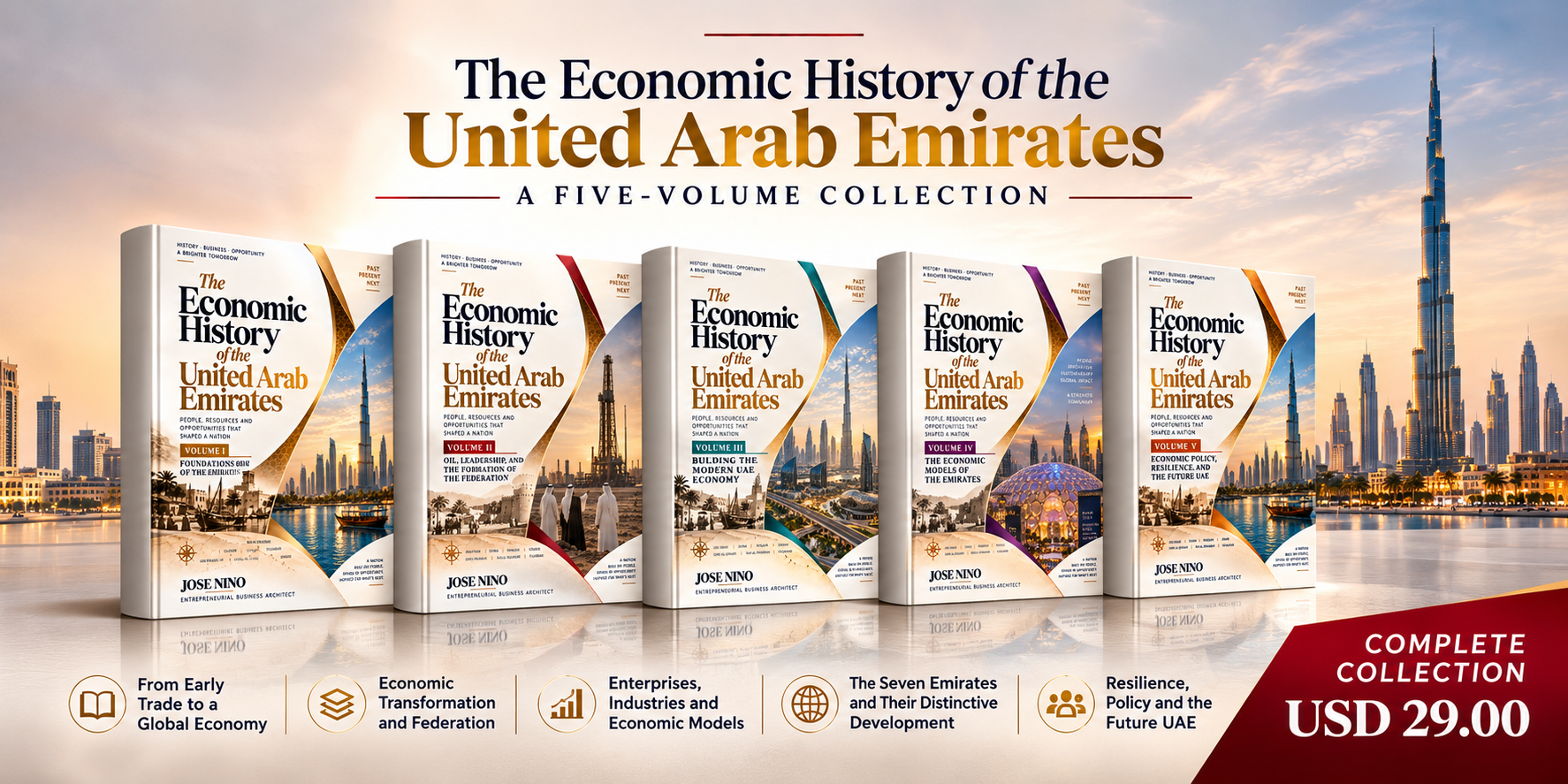
The historical developments examined in this article are explored in greater depth in The Economic History of the United Arab Emirates, a comprehensive five-volume collection by Jose Nino, published through ONE Business.
Volume II, Oil, Leadership, and the Formation of the Federation, examines the economic transformation of the Emirates during the petroleum era, including Sheikh Rashid's commercial vision, the improvement of Dubai Creek, the development of maritime and aviation infrastructure, the growth of Dubai's commercial economy, and the political and institutional processes surrounding the establishment of the United Arab Emirates.
The collection connects the economic history of the Emirates with broader questions of entrepreneurship, strategic investment, infrastructure development, institutional capacity, commercial openness, and Entrepreneurial Business Architecture. For international entrepreneurs and investors, it provides a historical perspective on the economic environment in which they may establish and develop their enterprises.
Five volumes. Seven emirates. One extraordinary economic transformation. Practical lessons for today's entrepreneurs.
Complete Five-Volume Digital PDF Collection — USD 29.99
Establishing Your Business in the United Arab Emirates
Understanding Dubai's economic history provides entrepreneurs with a broader perspective on the commercial environment in which they intend to operate. The emirate's development demonstrates the importance of international connectivity, infrastructure, commercial institutions, and strategic investment in creating opportunities for enterprise formation.
Entrepreneurs considering establishing a company in Dubai or another emirate should evaluate their proposed business activities, target markets, operational requirements, and long-term objectives before selecting a registration structure. Different jurisdictions and licensing arrangements offer distinct conditions, and the appropriate choice depends on the characteristics of the proposed enterprise.
ONE Business Dubai provides UAE company formation and business registration services, assisting entrepreneurs and international businesses with the establishment process according to their proposed activities and applicable requirements.
UAE Company Formation & Business Registration — Professional Fees from USD 1,200 + Government Fees
The final scope and cost depend on the selected jurisdiction, business activity, registration requirements, and additional services requested. Entrepreneurs planning to establish a commercial presence in the UAE can contact ONE Business Dubai to discuss their objectives and request information about the applicable registration process.
Request UAE Company Formation & Business Registration Assistance
The Entrepreneurial Legacy of Sheikh Rashid's Economic Vision
The transformation of Dubai under Sheikh Rashid bin Saeed Al Maktoum demonstrates that economic development depends on more than favorable geographical conditions or the availability of financial resources. Commercial opportunities become more valuable when infrastructure, institutions, and productive relationships are developed to support their expansion.
Sheikh Rashid's historical contribution is closely associated with the recognition of trade as a foundation for economic development and with investments that strengthened Dubai's ability to participate in international commerce. The improvement of Dubai Creek, the development of port and aviation infrastructure, and the expansion of supporting facilities helped establish capabilities that influenced the emirate's subsequent growth.
For international entrepreneurs arriving in Dubai today, this history provides an important perspective on the foundations of the commercial environment they intend to enter. It demonstrates that business opportunities must be supported by appropriate investment, reliable operations, institutional understanding, and the capacity to coordinate resources toward a sustainable economic objective.
These principles are central to Entrepreneurial Business Architecture (EBA), which examines the development of sustainable enterprises through the integration of strategy, financial resources, market relationships, operating systems, organizational capabilities, and governance. Dubai's historical experience provides a valuable illustration of how complementary capabilities can support economic transformation.
The central entrepreneurial lesson from Sheikh Rashid's economic vision is that lasting commercial success is built by identifying economic opportunities, removing constraints, investing in productive capabilities, and connecting infrastructure, institutions, and markets within a coherent development strategy.
Discover the historical foundations of these transformations in The Economic History of the United Arab Emirates, the complete five-volume collection by Jose Nino.
Discover the Complete Five-Volume Collection — USD 29.99
Contact ONE Business Dubai for UAE Company Formation Services