ONE BUSINESS / INSIGHTS / ARTICLE 12
How Sheikh Zayed Transformed Abu Dhabi: 12 Entrepreneurial Lessons in Leadership, Strategic Investment, and Economic Development
From the Governance of Al Ain to the Transformation of Oil Revenues into Infrastructure, Institutions, and the Foundations of a Modern Nation
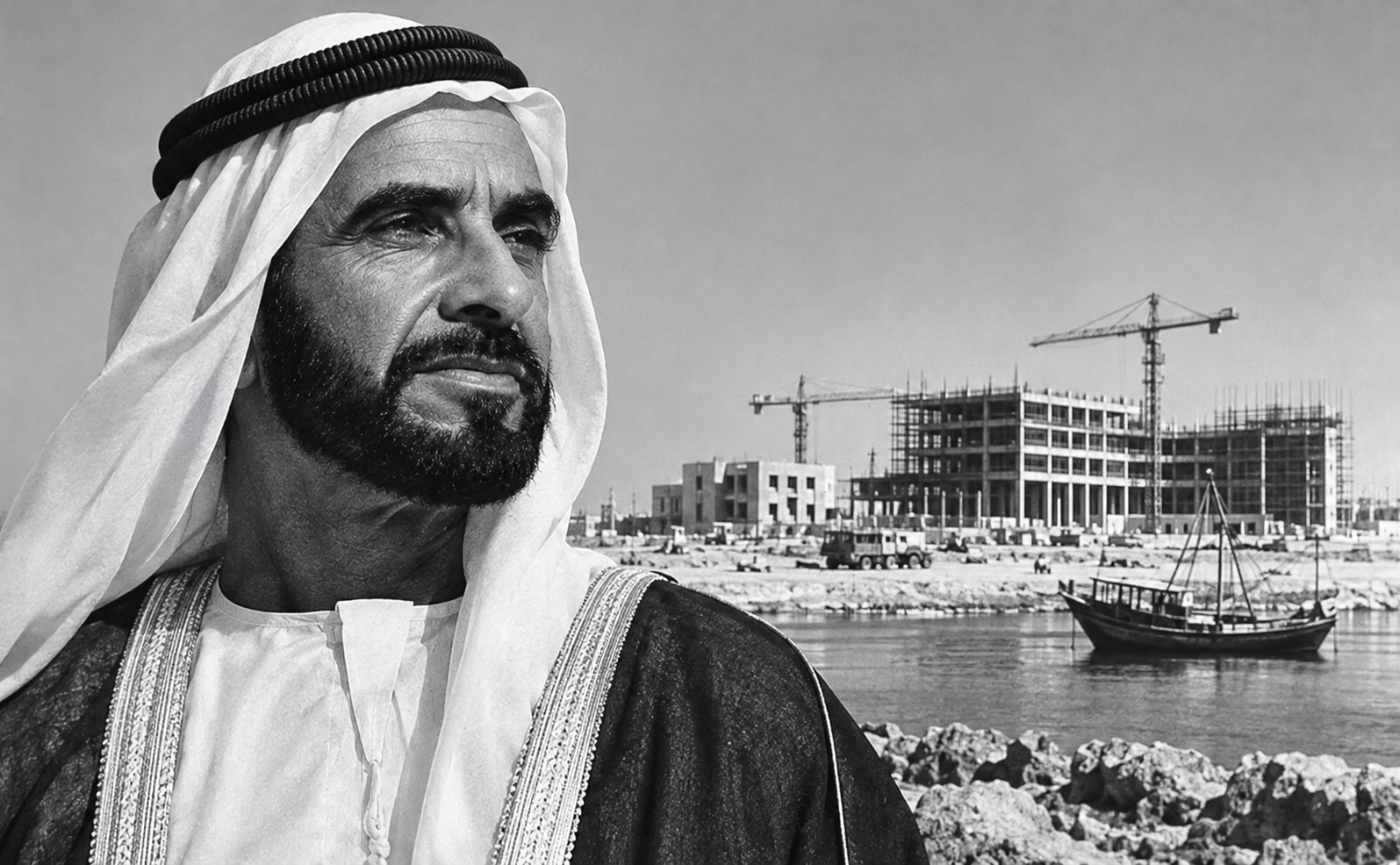
How Sheikh Zayed Transformed Abu Dhabi: 12 Entrepreneurial Lessons in Leadership, Strategic Investment, and Economic Development
For international entrepreneurs, investors, and professionals arriving in Dubai and the United Arab Emirates, understanding the country's economic history provides an important foundation for making informed business decisions. The modern commercial environment they encounter today, characterized by extensive infrastructure, international connectivity, established institutions, and opportunities for enterprise creation, did not emerge spontaneously. It developed through decades of political leadership, strategic investment, economic cooperation, and the gradual construction of institutions capable of supporting a modern economy.
Among the historical figures who shaped this transformation, Sheikh Zayed bin Sultan Al Nahyan occupies a central position. His leadership of Abu Dhabi from 1966 and his contribution to the establishment of the United Arab Emirates in 1971 helped create the institutional and economic foundations upon which the country's subsequent development would unfold. His historical experience demonstrates that natural-resource wealth becomes economically transformative when it is connected to effective leadership, productive investment, public institutions, and long-term development priorities.
For entrepreneurs considering business opportunities in Dubai, Abu Dhabi, or elsewhere in the UAE, this history offers more than an account of national development. It provides a perspective on how economic environments are created, how financial resources become productive capabilities, and why sustainable enterprises depend on the relationship between leadership, strategy, investment, infrastructure, and institutions. Understanding the foundations of the UAE economy can help international entrepreneurs appreciate the economic structures and development decisions that contributed to the commercial environment in which they intend to operate.
The transformation of Abu Dhabi from a territory with limited infrastructure and an economy historically connected to maritime activities, oasis agriculture, and regional relationships into the political and financial center of the UAE represents one of the most consequential developments in the modern economic history of the Arabian Gulf. Petroleum revenues provided the financial resources necessary to accelerate development, but the existence of oil wealth alone cannot explain the scale, direction, or durability of the transformation. The decisive economic question concerns how those revenues were governed, invested, and converted into productive capabilities.
When Abu Dhabi began exporting petroleum in 1962, its financial possibilities changed fundamentally. Nevertheless, the availability of substantial revenue did not immediately resolve the challenges associated with transportation, public administration, education, healthcare, housing, and territorial development. Financial capacity and development capacity were not identical. The emirate needed leadership capable of connecting newly available resources with a coherent program of economic and social transformation.
Sheikh Zayed's accession as Ruler of Abu Dhabi in 1966 marked an important change in the government's development priorities. His predecessor, Sheikh Shakhbut bin Sultan Al Nahyan, had governed through decades of economic uncertainty, when the collapse of the pearling industry and the prolonged search for petroleum encouraged financial caution. The arrival of substantial oil income created different economic possibilities, and Sheikh Zayed's administration placed greater emphasis on converting those possibilities into public infrastructure, institutional capacity, and improvements in living conditions.
Sheikh Zayed brought to this transition approximately two decades of administrative experience in Al Ain, where he had served as the ruler's representative from 1946. His responsibilities included managing community relationships, addressing disputes, supporting agricultural development, and working within an economy where water management and cooperation were essential. This experience provided practical knowledge of the people, productive activities, and territorial relationships that would be affected by Abu Dhabi's subsequent development.
The transformation that followed extended beyond the construction of roads, buildings, and public facilities. It involved the development of administrative institutions, the integration of coastal and inland communities, and the formation of relationships among the emirates that eventually supported the establishment of the United Arab Emirates. The partnership between Sheikh Zayed and Sheikh Rashid bin Saeed Al Maktoum was especially important because Abu Dhabi's financial resources and Dubai's commercial capabilities offered complementary foundations for national development.
Through the perspective of Entrepreneurial Business Architecture (EBA), this historical experience offers twelve lessons concerning leadership preparation, strategic investment, institutional development, productive infrastructure, human capabilities, stakeholder cooperation, and the organization of resources into sustainable economic systems. These lessons are contemporary interpretations of the historical record rather than claims that Sheikh Zayed or his contemporaries consciously followed a modern entrepreneurial methodology.
1. Entrepreneurial Lesson: Leadership Capability Must Be Developed Before Major Opportunities Emerge
Sheikh Zayed's administrative experience in Al Ain began in 1946, well before petroleum revenues provided Abu Dhabi with the financial capacity to undertake large-scale development. Al Ain's oasis economy depended on irrigation systems, agricultural production, community relationships, and the management of limited resources. Effective administration required familiarity with local conditions and the ability to coordinate decisions among communities possessing different interests and responsibilities.
The management of water resources was especially significant because agricultural productivity and community stability depended on reliable access to irrigation. Decisions concerning shared infrastructure had immediate economic consequences, while the resolution of disputes required judgment and an understanding of the relationships connecting the region's communities. These responsibilities developed administrative capabilities through repeated practical experience rather than through the sudden availability of financial resources.
When Sheikh Zayed became Ruler of Abu Dhabi in 1966, this accumulated experience became relevant on a much larger scale. Petroleum income expanded the government's possibilities, but it did not automatically create the judgment necessary to establish priorities or implement projects. His earlier experience provided knowledge of the territory, its population, and the practical relationship between public decisions and economic conditions.
Entrepreneurs encounter comparable circumstances when a business receives substantial investment, experiences unexpected demand, or gains access to a new market. These opportunities may expand financial possibilities faster than organizational capabilities can develop. Companies that lack adequate management systems, operational knowledge, or decision-making discipline may struggle to convert growth into sustainable performance.
Leadership preparation therefore involves more than acquiring theoretical knowledge. Entrepreneurs need experience in allocating resources, coordinating people, resolving operational difficulties, and evaluating the consequences of their decisions. Such capabilities become particularly valuable when an enterprise enters a period of rapid expansion and the financial consequences of management errors increase substantially.
The first entrepreneurial lesson is that leadership capabilities should be developed before major opportunities emerge, because new financial resources tend to magnify the strengths and weaknesses of the organization receiving them.
2. Entrepreneurial Lesson: Economic Transformation Begins with a Clear Development Purpose
The leadership transition of 1966 changed the relationship between Abu Dhabi's petroleum revenues and its development priorities. The emirate already possessed substantial financial potential, but the question of how those resources should be used had become increasingly important. Sheikh Zayed's administration placed greater emphasis on directing public resources toward infrastructure, services, and improvements in the economic conditions of the population.
This change illustrates the importance of distinguishing financial accumulation from economic development. Financial reserves may provide security and flexibility, but they do not necessarily create productive capabilities unless they are connected to appropriate investment decisions. The economic value of petroleum revenue therefore depended on the objectives guiding its allocation and the institutions responsible for implementing those objectives.
The development program pursued under Sheikh Zayed addressed practical needs involving transportation, utilities, housing, education, and healthcare. These investments were connected by a broader purpose: improving the conditions under which communities could participate in economic and social life. Their significance extended beyond individual projects because they contributed to the emergence of a more integrated and productive economy.
A development purpose becomes economically meaningful when it guides decisions about the allocation of scarce resources. Even when substantial financial capital is available, organizations face constraints involving time, managerial attention, technical expertise, and implementation capacity. Establishing a clear direction helps determine which activities deserve priority and which expenditures contribute most directly to long-term objectives.
Entrepreneurs must establish a similarly coherent understanding of the economic purpose of their organizations. A business may possess capital, technical expertise, and access to potential customers without defining the value it intends to create or the capabilities necessary to deliver that value. When objectives remain unclear, investment decisions can become fragmented and resources may be distributed among activities that do not reinforce one another.
The second entrepreneurial lesson is that sustainable transformation requires a clearly defined development purpose capable of connecting available resources with strategic priorities, productive capabilities, and measurable economic results.
3. Entrepreneurial Lesson: Financial Resources Must Be Converted into Productive Capital
The commencement of petroleum exports in 1962 fundamentally changed Abu Dhabi's financial circumstances. However, petroleum revenues represented an economic opportunity rather than a complete development strategy. The long-term significance of those revenues depended on whether they would support temporary expenditure or contribute to capabilities that could improve economic conditions over time.
Under Sheikh Zayed's leadership, substantial public resources were directed toward transportation networks, utilities, public facilities, housing, and services. These investments helped address constraints that had limited the emirate's development during earlier decades. Roads facilitated movement between communities, utilities supported new forms of settlement and enterprise, and public institutions improved the government's ability to coordinate economic activity.
The distinction between financial resources and productive capital is fundamental to understanding this process. Money provides the capacity to acquire assets and finance activities, but the resulting economic value depends on how those resources are organized. A road becomes economically significant when it improves transportation and market access. A school contributes to development when it expands human capabilities. An administrative institution becomes productive when it improves the coordination and reliability of decisions.
Productive capital should therefore be evaluated according to its contribution to future economic activity rather than simply according to the amount invested. The acquisition of an asset may represent a substantial financial commitment without necessarily improving productivity. Its economic significance emerges from the services, capabilities, and opportunities that the asset makes available over time.
For entrepreneurs, the same principle applies to commercial revenue and investment capital. A company may generate substantial income while failing to strengthen its productive capacity. Expenditure that does not improve operations, market access, customer relationships, or organizational capabilities may provide short-term benefits without establishing a stronger enterprise.
The third entrepreneurial lesson is that financial resources create lasting economic value when they are deliberately transformed into productive assets, human capabilities, operating systems, and commercial opportunities.
4. Entrepreneurial Lesson: Strategic Investment Requires Priorities and Sequencing
The transformation of Abu Dhabi involved an extensive range of development requirements. Transportation infrastructure, electricity, water systems, housing, schools, hospitals, and administrative institutions were all necessary, but the availability of petroleum revenue did not eliminate the practical limitations associated with implementing them.
Large-scale construction required contractors, equipment, technical specialists, imported materials, administrative coordination, and the capacity to manage complex projects. These capabilities could not all be established immediately. Development therefore required decisions about priorities, the order in which investments should occur, and the relationships among different projects.
Transportation infrastructure was particularly important because the movement of workers, materials, and equipment influenced the feasibility of subsequent development. Improving connectivity could facilitate construction and expand access to services, creating conditions in which additional investments became more effective. The sequence of development therefore mattered as much as the amount of expenditure.
The historical process was not a flawless execution of a predetermined plan. Abu Dhabi's administration faced incomplete information, limited institutional capacity, and changing economic circumstances. Decisions had to be implemented while the systems necessary to support them were still developing. Practical experience consequently became an important source of information for subsequent planning.
Entrepreneurs face comparable challenges when expanding their organizations. A company may need improved financial controls before increasing its operations, reliable logistics before entering new markets, or additional management capacity before introducing new services. Attempting to pursue every opportunity simultaneously can weaken execution and create unnecessary financial exposure.
The fourth entrepreneurial lesson is that strategic investment requires disciplined priorities and an appropriate sequence of development, allowing each completed investment to strengthen the capabilities required for subsequent growth.
5. Entrepreneurial Lesson: Infrastructure Creates the Foundations for Economic Opportunity
The construction of infrastructure became one of the most visible expressions of Abu Dhabi's economic transformation. Roads, utilities, public facilities, and transportation networks changed the practical conditions under which people, businesses, and institutions could operate. These investments reduced constraints associated with geographical distance, limited mobility, and inadequate public services.
Infrastructure contributes to economic development because it makes activities possible that would otherwise be difficult, expensive, or commercially impractical. Reliable transportation improves the movement of goods and workers. Utilities support industrial and commercial operations. Communications infrastructure facilitates coordination among organizations, customers, and public institutions.
In Abu Dhabi, the expansion of infrastructure helped create conditions for economic activities extending beyond the direct production and export of petroleum. Construction generated demand for materials, equipment, labor, and professional services, while improved public facilities supported population growth and the development of new administrative and commercial functions.
Infrastructure nevertheless derives its economic value from its productive use rather than its physical appearance. Buildings, roads, and equipment are not inherently productive simply because they require substantial expenditure. Their value depends on whether they reduce constraints, improve efficiency, or enable activities that contribute to broader economic objectives.
Entrepreneurs should apply the same reasoning to the infrastructure of their businesses. Warehousing, technology platforms, production equipment, distribution systems, and digital operations should be evaluated according to the capabilities they create and the commercial requirements they satisfy. Investment in infrastructure should support a coherent business model rather than become an objective independent of productive demand.
The fifth entrepreneurial lesson is that infrastructure creates sustainable economic opportunity when it removes operational constraints, improves efficiency, and enables productive activities that could not otherwise develop effectively.
6. Entrepreneurial Lesson: Human Development Is an Essential Economic Investment
The transformation of Abu Dhabi under Sheikh Zayed included substantial attention to education, healthcare, housing, and improvements in living conditions. These investments reflected the relationship between economic development and the capabilities of the people expected to participate in a modernizing society.
A modern economy requires more than financial capital and physical infrastructure. It depends on individuals possessing the knowledge, health, skills, and opportunities necessary to perform productive activities. The expansion of education supports the development of professional and technical capabilities, while healthcare contributes to the population's ability to participate consistently in economic and social life.
These investments also influence the effectiveness of other development initiatives. Infrastructure requires engineers, administrators, technicians, and workers capable of constructing, operating, and maintaining it. Institutions require qualified personnel and appropriate professional knowledge. Economic diversification becomes more feasible when the population possesses capabilities that can support activities beyond the original source of national revenue.
Human development is also a long-term investment because its benefits accumulate through education, professional experience, and the transfer of knowledge between generations. Unlike many physical assets, human capabilities can contribute to multiple economic activities and adapt to technological and organizational change. Their development strengthens the ability of an economy to respond to opportunities that were not necessarily anticipated when the original investments were made.
For entrepreneurs, human development is similarly connected to organizational performance. Companies may acquire advanced equipment or introduce new technologies without obtaining the expected benefits if employees lack appropriate training or operating knowledge. Sustainable growth requires attention to the people responsible for delivering products, managing operations, maintaining customer relationships, and implementing strategic decisions.
Human-capital investment should therefore be understood as part of business architecture rather than an isolated administrative expense. Recruitment, training, professional development, knowledge transfer, and management succession influence the enterprise's capacity to adapt to changing market conditions.
The sixth entrepreneurial lesson is that sustainable economic development requires the coordinated development of human capabilities, because financial resources and technology become productive only when people possess the knowledge and organizational support necessary to use them effectively.
7. Entrepreneurial Lesson: Institutional Capacity Must Grow Alongside Financial Resources
The expansion of Abu Dhabi's development program created administrative requirements that were substantially more complex than those associated with the emirate's earlier economy. Public expenditure, construction projects, service delivery, and territorial development required institutions capable of coordinating decisions, managing resources, and maintaining continuity.
The development of administrative institutions was therefore an essential component of economic transformation. Financial resources could support individual projects, but sustained development required systems through which decisions could be implemented repeatedly and responsibilities could be distributed among appropriate organizations.
Institutions also preserve knowledge and provide continuity beyond the individuals responsible for initiating particular programs. Their importance increases as the scale of activity expands and the number of participants grows. Without appropriate institutional capacity, rapid financial growth can create administrative difficulties, inconsistent decisions, and weaknesses in accountability.
The historical development of Abu Dhabi illustrates the relationship between leadership and institution-building. Leadership established development priorities, while administrative systems increasingly supported their implementation. The two functions were complementary: strategic direction required operational capacity, and institutions required coherent objectives.
Institutional development also changes the way an organization manages complexity. As responsibilities become more specialized, effective coordination depends on clear procedures, reliable information, and the ability to evaluate performance across different activities. Institutions can improve continuity and accountability, although their design must remain appropriate to the objectives they are intended to serve.
Entrepreneurs encounter similar challenges as businesses expand. Informal arrangements may be sufficient during the earliest stages of an enterprise, when founders personally supervise most activities. As the company grows, however, financial management, contractual procedures, customer operations, employee responsibilities, and information systems require more formal coordination.
The seventh entrepreneurial lesson is that financial growth must be accompanied by institutional development, because durable economic performance depends on systems capable of organizing resources, implementing decisions, and maintaining accountability over time.
8. Entrepreneurial Lesson: Effective Leadership Combines Long-Term Vision with Practical Execution
The development of Abu Dhabi required an ambitious understanding of future economic possibilities, but it also demanded attention to immediate practical challenges. Roads had to be constructed, utilities established, services organized, and administrative institutions developed while the emirate was experiencing rapid change.
Sheikh Zayed's earlier experience in Al Ain had involved decisions whose consequences could be observed directly in agricultural production, water management, and community relationships. This background provided practical familiarity with the relationship between administrative decisions and their implementation.
The subsequent transformation of Abu Dhabi involved substantially greater financial resources and organizational complexity. Nevertheless, the underlying requirement remained similar: development objectives had to be translated into concrete activities capable of producing observable improvements.
The historical record also indicates that development occurred under conditions of uncertainty. The government could not fully anticipate population growth, construction requirements, or every administrative challenge. Effective leadership therefore required the ability to establish direction while adapting implementation to new information and changing circumstances.
Entrepreneurs face comparable tensions between strategic ambition and operational execution. A founder may develop a compelling vision without establishing the processes necessary to deliver it. Conversely, an organization may become highly efficient in its existing activities while neglecting the strategic changes required for future competitiveness.
Within Entrepreneurial Business Architecture, leadership and execution should be treated as connected responsibilities. Strategic objectives must influence operational priorities, resource allocation, and performance evaluation, while operational experience should provide information that helps refine strategic decisions. This relationship allows the enterprise to preserve direction without becoming incapable of adaptation.
The eighth entrepreneurial lesson is that effective leadership connects long-term strategic objectives with disciplined execution, practical judgment, and the capacity to revise decisions as experience reveals new information.
9. Entrepreneurial Lesson: Territorial Integration Expands Economic Possibilities
Abu Dhabi's economic transformation extended beyond its coastal capital. The integration of Al Ain into a wider territorial development program represented an important dimension of Sheikh Zayed's leadership because the emirate contained communities with different economic characteristics and development requirements.
Al Ain's oasis economy had historically depended on agriculture, water management, and inland relationships, while Abu Dhabi city possessed a coastal orientation shaped by maritime activities and, subsequently, petroleum administration. Geographical distance and limited transportation infrastructure constrained the connections between these environments.
Sheikh Zayed's knowledge of Al Ain contributed to an approach that recognized the inland territory as an essential component of the emirate's development. Improved transportation, public services, and administrative coordination helped establish stronger relationships between coastal and inland communities.
The economic significance of territorial integration lies in the opportunities created when previously separated productive environments become better connected. Transportation networks facilitate the movement of goods and people, while administrative integration can improve the allocation of resources and coordination of services.
Integration does not require the elimination of regional differences. The productive characteristics of an agricultural oasis and a coastal administrative center are not identical, and their economic contributions depend partly on those differences. A coherent development strategy can preserve local capabilities while improving access to the wider infrastructure and institutions of the territory.
Entrepreneurs encounter comparable opportunities when connecting different business locations, distribution networks, customer markets, or organizational departments. A company may possess valuable resources across multiple activities without obtaining their full economic benefit because those resources remain poorly coordinated.
The ninth entrepreneurial lesson is that economic value can increase when separate resources, markets, and productive capabilities are connected through effective infrastructure, coordinated management, and a shared strategic direction.
10. Entrepreneurial Lesson: Public Trust and Stakeholder Cooperation Strengthen Development
Sheikh Zayed's experience in Al Ain required sustained interaction with communities whose cooperation was essential to effective administration. Irrigation systems, agricultural activity, and local relationships depended on arrangements that recognized shared interests and responsibilities.
These experiences demonstrate that economic development involves relationships as well as financial resources. Public projects may provide physical assets, but their effectiveness also depends on whether the people affected understand their purpose, participate in their operation, and recognize their practical benefits.
The development of Abu Dhabi after 1966 created visible improvements in infrastructure and public services. Such improvements helped connect government expenditure with the everyday conditions of the population, providing a practical foundation for confidence in the development process.
Trust should not be confused with the absence of accountability or formal institutions. Its economic significance arises when commitments are supported by reliable decisions, consistent performance, and arrangements capable of managing disagreements.
Stakeholder cooperation becomes especially important when development involves several organizations or communities whose interests are not identical. Shared objectives may provide an initial basis for collaboration, but durable relationships require mechanisms for resolving differences and distributing responsibilities. The effectiveness of cooperation depends on whether participants recognize continuing benefits from their involvement.
Entrepreneurs must likewise coordinate relationships among customers, employees, suppliers, investors, regulators, and commercial partners. These participants may possess different objectives, and the enterprise's long-term performance depends partly on establishing arrangements that make cooperation productive and sustainable.
The tenth entrepreneurial lesson is that lasting economic development requires stakeholder confidence supported by credible commitments, observable benefits, reliable performance, and effective mechanisms for cooperation.
11. Entrepreneurial Lesson: Complementary Partnerships Can Create Greater Collective Value
The establishment of the United Arab Emirates required cooperation among territories possessing different economic resources, political interests, and historical experiences. Abu Dhabi's petroleum wealth provided substantial financial capacity, while Dubai had developed commercial relationships, trading networks, and infrastructure associated with its role as a regional commercial center.
The partnership between Sheikh Zayed and Sheikh Rashid bin Saeed Al Maktoum became especially important following Britain's January 1968 announcement of its intention to withdraw from treaty relationships in the Gulf. The emirates faced significant questions concerning security, political organization, and their future relationships with one another.
The process of federation required negotiation because the participating emirates retained distinct identities and interests. Cooperation could not be reduced to financial transfers or a single agreement. It required arrangements through which separate political communities could participate in a shared national structure.
The establishment of the UAE in December 1971 reflected the development of a common institutional framework. Abu Dhabi's financial resources and Dubai's commercial capabilities provided different contributions to the emerging federation, demonstrating the potential value of coordinating complementary strengths.
The significance of this partnership extends beyond the differences in financial resources. Abu Dhabi and Dubai had developed distinct economic capabilities through different historical experiences. Their cooperation illustrates how the combination of complementary strengths can expand the possibilities available to each participant without requiring them to possess identical resources or pursue identical economic activities.
For entrepreneurs, this history illustrates the importance of evaluating partnerships according to the capabilities each participant contributes. An enterprise possessing capital may benefit from cooperation with a company possessing technical knowledge, distribution networks, or established market relationships. Such arrangements can create opportunities that neither organization could develop as effectively independently.
Successful partnerships nevertheless require more than the identification of complementary resources. They need clear responsibilities, realistic expectations, appropriate governance arrangements, and mechanisms for managing disagreements. Without these elements, differences that initially appear advantageous can become sources of conflict.
The eleventh entrepreneurial lesson is that strategic partnerships can generate greater collective value when complementary capabilities are coordinated through shared objectives, appropriate governance arrangements, and durable commitments.
12. Entrepreneurial Lesson: Sustainable Transformation Requires an Integrated Architecture of Leadership, Resources, Institutions, and Strategy
The transformation of Abu Dhabi under Sheikh Zayed demonstrates that lasting economic development cannot be explained by a single resource, investment, or decision. It emerged through the interaction of leadership, petroleum revenues, infrastructure, institutions, human development, territorial integration, and cooperation among the emirates.
Each component contributed to the effectiveness of the others. Financial resources supported infrastructure, while infrastructure expanded economic possibilities. Administrative institutions improved the capacity to organize development, while education and healthcare strengthened human capabilities. Territorial integration connected communities, and federal cooperation extended the scale of economic and institutional coordination.
These relationships explain why the transformation should be understood as a process of capability development rather than simply an increase in expenditure. Petroleum revenues provided the means to accelerate change, but the durability of that change depended on the productive and institutional systems created through investment.
Entrepreneurial Business Architecture offers a contemporary framework for interpreting these historical relationships. It examines how leadership, resources, organizational structures, operating capabilities, market relationships, and strategy can be designed as interconnected elements of a sustainable enterprise.
A company may possess substantial financial resources without developing a viable business model. It may establish advanced operating systems without identifying an appropriate market. It may secure valuable partnerships without developing the governance arrangements necessary to maintain them. Sustainable performance requires coherence among the different components of the organization.
This perspective is particularly relevant to entrepreneurs establishing businesses in the United Arab Emirates. Access to a sophisticated commercial environment, international infrastructure, and potential business opportunities does not independently guarantee enterprise success. Founders must still develop an appropriate value proposition, understand their customers, manage financial resources, establish operating capabilities, and create a coherent strategy for long-term development.
The twelfth entrepreneurial lesson is that enduring economic transformation depends on an integrated architecture in which leadership, capital, productive capabilities, institutions, relationships, and strategy reinforce one another over time.
From Petroleum Wealth to the Foundations of a Modern Nation
The transformation of Abu Dhabi under Sheikh Zayed illustrates the difference between possessing financial resources and developing the capabilities necessary for lasting economic progress. Petroleum revenues created extraordinary possibilities, but their broader significance depended on decisions concerning infrastructure, institutions, public services, territorial integration, and cooperation among the emirates.
The historical sequence is essential to understanding the transformation. Sheikh Zayed's administrative experience in Al Ain preceded his accession as Ruler of Abu Dhabi. Petroleum revenues had already begun to expand the emirate's financial capacity, but the subsequent development program connected those resources more directly with improvements in infrastructure and public services. The development of administrative institutions supported increasingly complex responsibilities, while cooperation with Dubai and the other emirates contributed to the creation of a federal political framework.
This process was not simply the result of financial expenditure. It required the organization of people, resources, institutions, and relationships around development objectives. Its significance therefore extends beyond the particular historical circumstances of Abu Dhabi and provides a broader perspective on the economic mechanisms through which resources can be converted into productive capabilities.
For entrepreneurs, the experience demonstrates why access to capital should not be confused with the establishment of a successful enterprise. A viable business requires leadership, strategy, market understanding, operating systems, financial discipline, and the capacity to coordinate different resources toward a common economic purpose.
The historical transformation of Abu Dhabi therefore offers a central principle of Entrepreneurial Business Architecture: sustainable economic value emerges when leadership, resources, institutions, and productive capabilities are deliberately organized into a coherent system.
Explore The Economic History of the United Arab Emirates
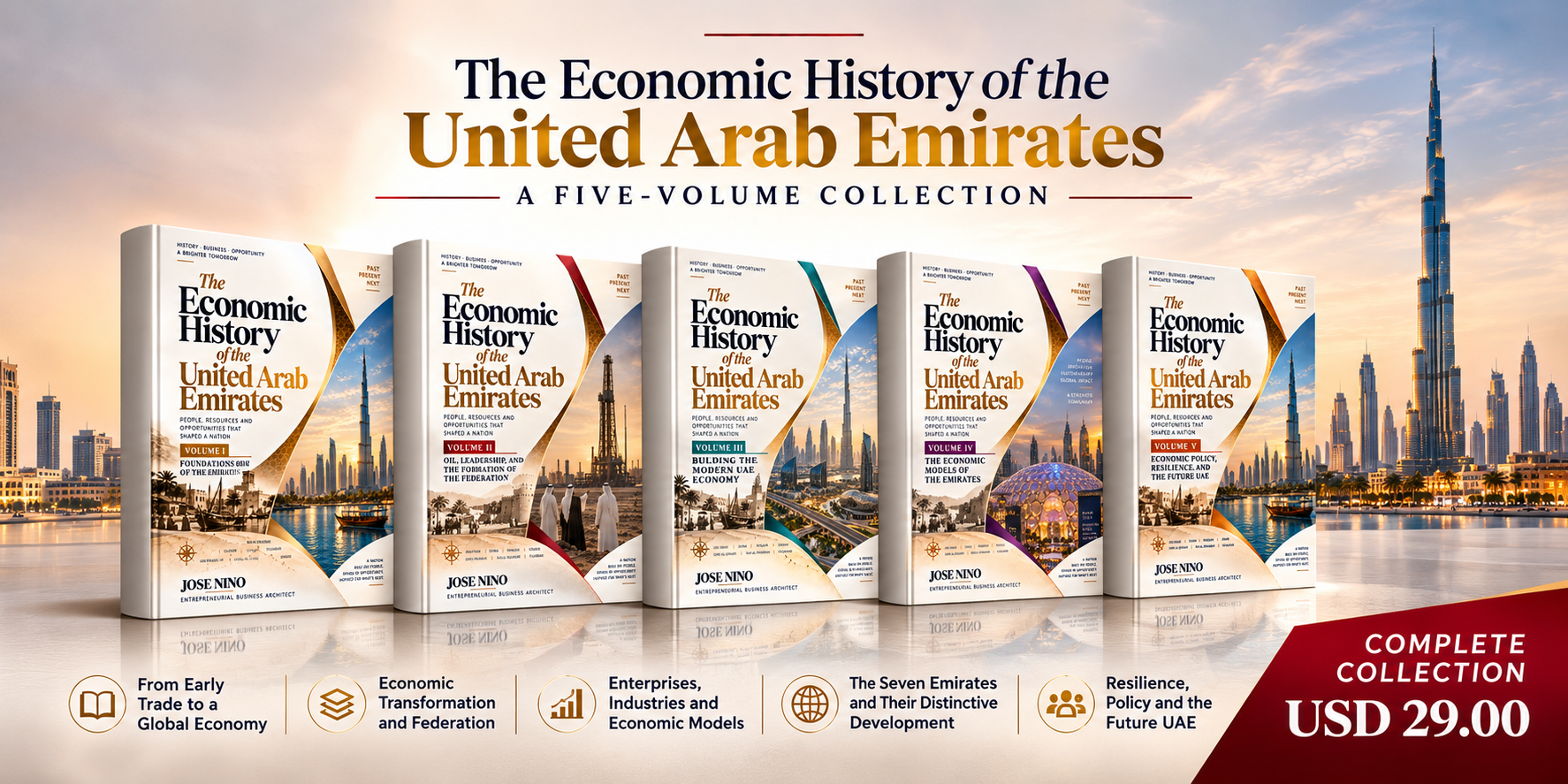
The historical developments examined in this article are explored in greater depth in The Economic History of the United Arab Emirates, a comprehensive five-volume collection by Jose Nino, published through ONE Business.
Volume II, Oil, Leadership, and the Formation of the Federation, examines the discovery and commercialization of petroleum, the economic transformation of Abu Dhabi under Sheikh Zayed, the economic architecture developed under Sheikh Rashid in Dubai, and the political and institutional processes leading to the creation of the United Arab Emirates.
The collection connects the economic history of the Emirates with broader questions of entrepreneurship, strategic development, institutional capacity, economic resilience, and Entrepreneurial Business Architecture. For international entrepreneurs and investors, it provides a historical perspective on the development of the commercial environment in which they may establish and develop their enterprises.
Five volumes. Seven emirates. One extraordinary economic transformation. Practical lessons for today's entrepreneurs.
Complete Five-Volume Digital PDF Collection — USD 29.99
Establishing Your Business in the United Arab Emirates
Understanding the economic history of the United Arab Emirates can provide entrepreneurs with a broader perspective on the commercial environment in which they intend to operate. The country's development demonstrates the importance of infrastructure, institutions, strategic investment, and international economic relationships in creating opportunities for enterprise formation.
Entrepreneurs considering establishing a company in Dubai, Abu Dhabi, or another emirate should evaluate their proposed business activities, target markets, operating requirements, and long-term objectives before selecting a registration structure. Different jurisdictions and licensing arrangements offer distinct conditions, and the appropriate choice depends on the characteristics of the proposed enterprise.
ONE Business Dubai provides UAE company formation and business registration services, assisting entrepreneurs and international businesses with the establishment process according to their proposed activities and applicable requirements.
UAE Company Formation & Business Registration — Professional Fees from USD 1,200 + Government Fees
The final scope and cost depend on the selected jurisdiction, business activity, registration requirements, and additional services requested. Entrepreneurs planning to establish a commercial presence in the UAE can contact ONE Business Dubai to discuss their objectives and request information about the applicable registration process.
Request UAE Company Formation & Business Registration Assistance
The Entrepreneurial Legacy of Sheikh Zayed's Economic Transformation
The transformation of Abu Dhabi under Sheikh Zayed bin Sultan Al Nahyan demonstrates that the long-term significance of economic resources depends on the decisions and institutions through which they are used. Petroleum revenues created exceptional financial opportunities, but those opportunities became foundations for broader development through investment in infrastructure, public services, administrative capacity, and the relationships necessary for economic cooperation.
Sheikh Zayed's contribution cannot be reduced to the availability of petroleum wealth. His administrative experience in Al Ain, the development priorities established after 1966, the expansion of infrastructure and public services, and his role in building the federation formed part of a broader historical process through which financial capacity was connected to economic and institutional development.
For international entrepreneurs arriving in Dubai and the United Arab Emirates, this history provides an important perspective on the foundations of the country's commercial environment. It demonstrates that sustainable economic success depends on more than identifying opportunities or obtaining capital. Entrepreneurs must organize resources, develop capabilities, coordinate relationships, and implement strategies capable of converting commercial potential into continuing economic value.
These principles lie at the center of Entrepreneurial Business Architecture (EBA), which examines the development of sustainable enterprises through the integration of leadership, strategy, resources, operations, institutions, and market relationships. The historical experience of Abu Dhabi offers a valuable illustration of how these elements can interact to support economic transformation over time.
The central entrepreneurial lesson from Sheikh Zayed's transformation of Abu Dhabi is that the enduring value of wealth is determined not merely by its possession, but by the productive capabilities, institutions, and opportunities created through its responsible and strategic use.
Discover the historical foundations of these transformations in The Economic History of the United Arab Emirates, the complete five-volume collection by Jose Nino.
Discover the Complete Five-Volume Collection — USD 29.99
Contact ONE Business Dubai for UAE Company Formation Services