ONE BUSINESS / INSIGHTS / ARTICLE 16
How the UAE Built Global Enterprises That Transformed Its Economy: Entrepreneurial Lessons from Emirates, DP World, and ADNOC
Discover how the United Arab Emirates transformed strategic enterprises into engines of economic development — and what their history teaches entrepreneurs about building companies, developing markets, creating business ecosystems, and achieving sustainable growth.
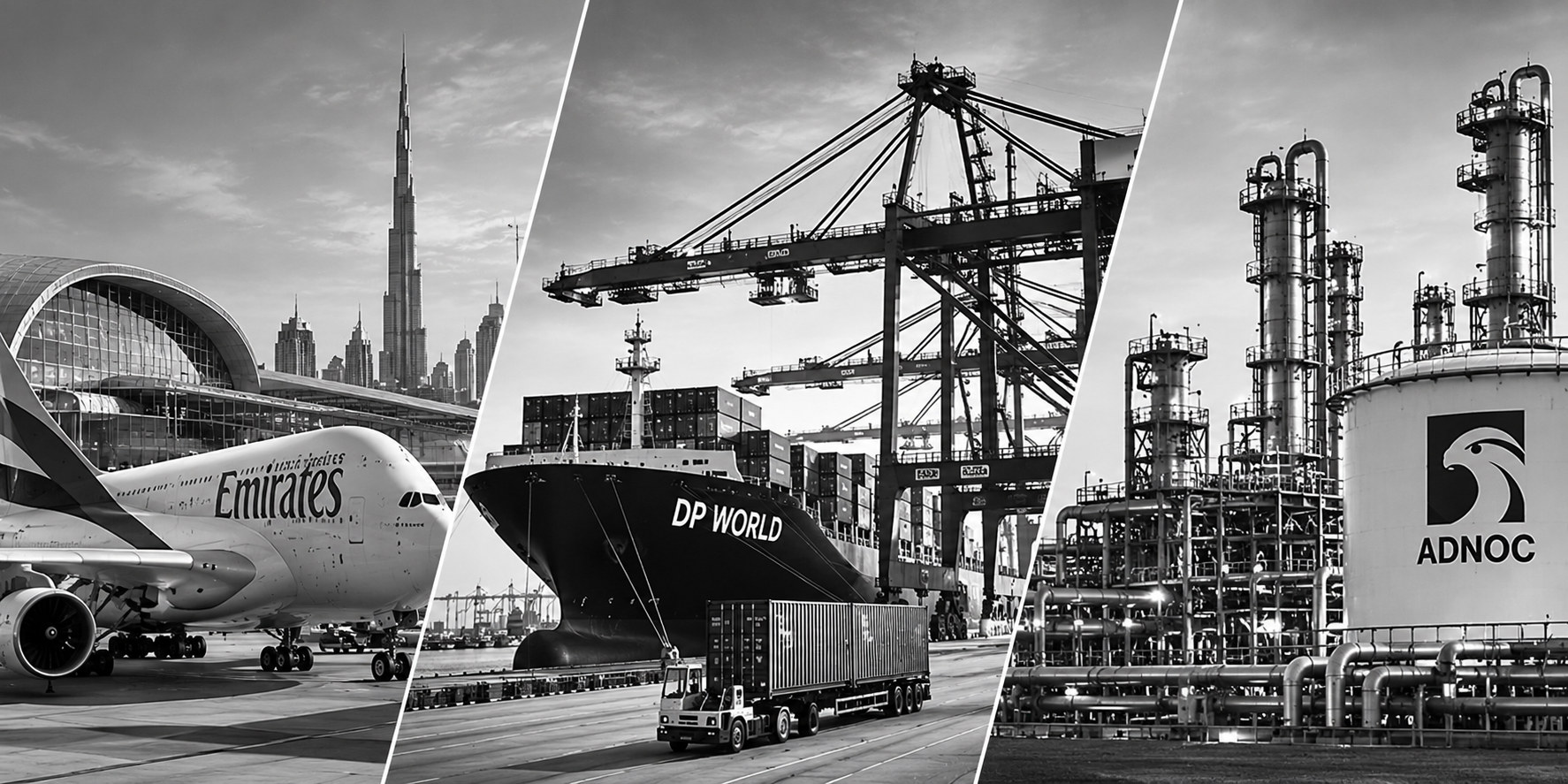
The economic transformation of the United Arab Emirates cannot be explained solely through its natural resources, infrastructure investments, geographic advantages, or government policies. Behind many of the country's most important achievements stand enterprises that converted these foundations into productive economic activity. Companies such as Emirates Airline, DP World, and Abu Dhabi National Oil Company (ADNOC) became more than significant organizations within their respective industries. They contributed to the development of entire economic sectors, strengthened international commercial relationships, expanded productive capabilities, and helped establish the UAE's position within the global economy.
For entrepreneurs seeking to establish or develop businesses in Dubai and the wider United Arab Emirates, understanding the historical development of these enterprises offers insights that extend far beyond their individual commercial achievements. Their histories reveal how organizations can create economic value not only through the products and services they sell, but also through the capabilities, relationships, institutions, and markets that develop around their activities.
One of the most important entrepreneurial lessons from the UAE's economic history is that successful enterprises can become platforms for the development of other enterprises. A company that strengthens transportation networks, improves industrial capabilities, develops specialized expertise, or connects previously separated markets can create opportunities extending well beyond its own immediate customers and revenues.
This perspective is especially relevant to contemporary entrepreneurs. Many approach business creation primarily through the relationship between a product and its customers. They seek to identify demand, establish a company, deliver a service, and generate revenue. These activities are essential, but the UAE's historical experience demonstrates that business development can involve a much broader process: constructing organizations whose capabilities generate additional opportunities for suppliers, partners, investors, professionals, and other businesses.
Understanding how this process unfolded is particularly important in a country where the relationship between government, enterprise, infrastructure, and economic development has played such a significant historical role. The UAE's state-owned and government-linked enterprises developed within particular institutional and financial circumstances, but many of the underlying strategic principles are relevant to entrepreneurs operating at much smaller scales.
To understand the opportunities available in the UAE today, entrepreneurs must examine not only the economic environment they encounter, but also the enterprises that helped create that environment. Their histories explain important aspects of where the country came from, how its economy became internationally connected, and which productive capabilities may continue influencing its future.
From Government Investment to Productive Enterprise
The discovery and commercialization of petroleum transformed the financial possibilities available to the emirates during the second half of the twentieth century. Abu Dhabi acquired substantial financial resources through hydrocarbon production, while Dubai pursued a development trajectory increasingly centered on trade, transportation, international connectivity, and commercial infrastructure. The formation of the United Arab Emirates in 1971 provided a federal framework within which these different economic models could develop and interact.
However, access to financial resources did not automatically create a diversified economy. Capital could finance roads, ports, airports, public services, and industrial facilities, but the economic value of these investments depended partly on whether enterprises could use them to produce goods, deliver services, develop markets, and establish commercial relationships.
The distinction between infrastructure and enterprise became increasingly important as the country developed. A port provides the physical capacity to accommodate maritime trade, but logistics companies, shipping operators, distributors, and commercial enterprises are required to transform that capacity into economic activity. An airport enables aviation operations, but airlines, ground-handling organizations, cargo companies, tourism businesses, and supporting services contribute to the development of a functioning aviation economy.
Similarly, petroleum reserves represent natural resources, but their conversion into sustained economic value requires exploration, production, processing, transportation, investment, technical expertise, and commercial organization. These activities depend on enterprises capable of coordinating substantial resources and operating within complex international markets.
The UAE's historical response involved the development of enterprises with different ownership structures and strategic mandates. Some were wholly state-owned, while others developed through government shareholdings, corporate structures, partnerships, or public-market participation. Their institutional arrangements were not identical, and their commercial objectives differed. Nevertheless, many became important instruments through which financial resources, infrastructure, and economic priorities were translated into productive capabilities.
The entrepreneurial significance of this process lies in the distinction between possessing resources and organizing those resources into an enterprise capable of creating value.
An individual entrepreneur may possess financial capital, technical knowledge, professional experience, or access to a promising market. Yet these advantages do not automatically constitute a functioning business. They must be organized through an appropriate business model, operating structure, management capabilities, customer relationships, and financial systems.
The history of the UAE's major enterprises demonstrates how the organization of resources can be as important as the resources themselves. Economic transformation required not merely investment, but institutions and companies capable of converting investment into sustained commercial activity.
Emirates Airline: Building an Enterprise That Helped Create Its Own Market
The establishment of Emirates Airline in 1985 provides one of the clearest examples of how an enterprise can contribute to the transformation of the economic environment in which it operates.
Dubai already possessed important geographic advantages and had invested in aviation infrastructure. Its location provided opportunities to connect major international regions, while its commercial traditions encouraged the development of relationships extending beyond the local market. Nevertheless, geographic position and airport facilities alone were insufficient to create a major international aviation hub.
The establishment of Emirates introduced an enterprise capable of converting these advantages into a commercial proposition. Beginning operations with two leased aircraft, the airline developed an international network that progressively strengthened Dubai's position as a connecting point between destinations across Europe, Asia, Africa, and other regions.
Its development depended on more than adding aircraft and routes. The airline required operational expertise, commercial partnerships, service capabilities, airport coordination, international market knowledge, and the capacity to compete within a demanding global industry. As its network expanded, the value of Dubai's aviation infrastructure increased, while improvements to airport capacity and supporting services contributed to the airline's ability to develop further.
This relationship illustrates an important characteristic of economic development: enterprises and their surrounding environments can strengthen one another. Emirates benefited from Dubai's infrastructure and international orientation, but the airline also contributed to the commercial significance of those assets by generating passenger flows, strengthening connectivity, and supporting related activities.
The effects extended into tourism, hospitality, logistics, professional services, international business travel, and the wider development of Dubai as a commercial destination. Improved air connectivity made it easier for people and businesses to reach the emirate, while the growth of economic activity increased the potential demand for aviation services.
This process did not eliminate competition or commercial risk. International aviation remains exposed to fuel costs, economic cycles, geopolitical developments, regulatory conditions, and changes in travel demand. The historical significance of Emirates lies not in the absence of these challenges, but in the development of an enterprise whose capabilities contributed to a much broader economic system.
The Entrepreneurial Power of Creating Complementary Demand
Entrepreneurs can learn from Emirates that the value of a business may extend beyond the immediate transaction between the company and its customers. A well-developed enterprise can strengthen complementary activities that subsequently increase demand for its own products or services.
Consider a technology company that develops software for a specialized professional industry. Its commercial opportunity may initially involve selling subscriptions to individual customers. However, if the company also supports training, integration services, professional partnerships, and complementary applications, it may contribute to the development of an ecosystem that makes its software more valuable.
A logistics enterprise may generate similar effects by improving delivery reliability and enabling customers to serve markets that were previously difficult to reach. A professional services company may develop educational resources and institutional relationships that strengthen the capabilities of its clients and create additional demand for specialized services.
The essential principle is that a business can increase its long-term economic value by developing capabilities that make the activities of its customers, suppliers, and partners more productive.
For entrepreneurs considering Dubai, this lesson is particularly relevant because the country's economy contains numerous interconnected sectors. Opportunities may emerge not only from serving final consumers, but also from supporting the enterprises, industries, and commercial relationships that contribute to the wider economy.
DP World: From Port Operations to an Integrated Global Business System
The historical development of Dubai's ports provides another example of how enterprise organization can transform infrastructure into international commercial capabilities.
The improvement of Dubai Creek, the development of Port Rashid, and the construction of Jebel Ali Port expanded the emirate's maritime infrastructure over successive decades. These investments increased Dubai's capacity to accommodate commercial shipping and participate in international trade. However, the economic value of the infrastructure depended on effective port operations, logistics capabilities, commercial relationships, and the development of supporting business activities.
The creation of Jebel Ali Free Zone strengthened the relationship between maritime infrastructure and international enterprise by providing an environment in which foreign businesses could establish trading, distribution, industrial, and related operations. The integration of port infrastructure with commercial and institutional arrangements expanded the activities that companies could undertake from Dubai.
The later development of DP World represented an additional stage in this evolution. Established in 2005 through the consolidation of Dubai's principal port-operating businesses, DP World subsequently expanded its international presence and developed capabilities across port operations, terminals, logistics, and related supply-chain services.
Its history illustrates the transition from operating important physical assets to developing an integrated international enterprise. Managing a port requires operational efficiency, technical expertise, infrastructure investment, commercial relationships, and coordination among numerous participants. Operating across multiple international locations introduces additional challenges involving different markets, regulations, transportation networks, customers, and institutional environments.
The economic significance of this development extends beyond the ownership or management of individual terminals. International trade depends on the movement of goods through connected systems. Ports, warehouses, inland transportation, customs arrangements, digital information, and distribution networks influence the speed, reliability, and cost of commercial activity.
An enterprise capable of improving coordination among these components can create value by reducing friction across the movement of goods. Its competitive advantage may therefore depend not only on the performance of individual assets, but also on the quality of the connections between them.
Why Business Integration Matters More Than Isolated Expansion
For entrepreneurs, the development of DP World offers a lesson about the difference between expanding a company and strengthening its business architecture.
An enterprise can increase its size by opening additional locations, introducing more products, hiring employees, or acquiring other businesses. However, these actions do not necessarily improve its competitiveness or profitability. Expansion can create complexity when new activities operate independently, duplicate resources, or fail to strengthen the organization's existing capabilities.
Integrated development follows a different logic. New activities are evaluated according to their contribution to the wider enterprise. A new location may improve access to customers already served by the company. An additional service may strengthen customer relationships by addressing needs that complement the original offering. A technology investment may improve several operating functions simultaneously.
The entrepreneurial objective is not simply to build a larger company, but to develop an organization in which its capabilities become more valuable through their relationships with one another.
This principle is relevant to businesses of every size. A small consulting company may improve its competitiveness by integrating research, education, digital services, and specialized professional capabilities. A distribution business may strengthen its position by coordinating supplier relationships, inventory management, transportation, and customer service. A digital enterprise may create additional value by connecting its products through shared information, customer relationships, and operating systems.
The historical development of Dubai's logistics sector demonstrates why such integration can become a source of competitive advantage. Infrastructure creates possibilities, but enterprises must organize the relationships through which those possibilities become productive.
ADNOC: Transforming Natural Resources into Industrial Capabilities
Abu Dhabi's economic development followed a different historical trajectory from Dubai's. The discovery and commercialization of substantial hydrocarbon resources created financial possibilities that transformed the emirate's economy and contributed significantly to the development of the federation.
Yet the economic significance of petroleum depended on more than the existence of reserves. Extracting, processing, transporting, and commercializing hydrocarbons required technical expertise, infrastructure, financial resources, institutional organization, and access to international markets.
The establishment of Abu Dhabi National Oil Company in 1971 represented an important development in the organization of these activities. ADNOC became a central institution in Abu Dhabi's energy economy, coordinating and developing capabilities associated with hydrocarbon production and related operations.
Over subsequent decades, the development of the energy sector contributed to the expansion of industrial activities, infrastructure, specialized employment, technical expertise, and commercial relationships. The economic value of the sector extended beyond the sale of crude oil through activities associated with processing, refining, petrochemicals, logistics, and industrial development.
This historical process demonstrates the difference between extracting economic value from a resource and developing capabilities around that resource. A territory may possess commercially valuable natural assets without developing the industries, technologies, and institutions necessary to capture a wider range of economic benefits.
The development of ADNOC and associated industrial activities contributed to Abu Dhabi's ability to participate in more complex segments of the energy value chain. It also created relationships with suppliers, contractors, technology providers, professional services firms, and international commercial partners.
The enterprise's economic importance therefore includes both its direct commercial activities and its role within a wider industrial system. Its operations create demand for capabilities that other businesses may provide, while the development of specialized suppliers and supporting services can strengthen the performance of the energy sector itself.
The Entrepreneurial Lesson of Moving Beyond the Original Product
For entrepreneurs, the historical development of ADNOC illustrates the strategic importance of understanding the broader value chain associated with a product, service, or resource.
A business may initially operate within a relatively narrow commercial activity. A manufacturer produces a particular product, a distributor sells goods obtained from suppliers, or a professional services firm delivers specialized expertise. These activities can generate revenue, but their long-term potential may also depend on opportunities available elsewhere within the value chain.
A manufacturer may identify opportunities in product design, maintenance, distribution, or specialized components. A professional services enterprise may develop complementary educational resources, technology systems, or market-development capabilities. A digital company may strengthen its position by providing integrations, data services, or specialized applications that support its principal product.
These possibilities should not be confused with indiscriminate diversification. Expanding into unrelated activities can weaken an enterprise by dispersing capital, management attention, and operational capabilities. The more valuable approach involves identifying adjacent opportunities that correspond to the organization's existing knowledge, customer relationships, infrastructure, and strategic position.
Entrepreneurial growth becomes more sustainable when expansion builds upon capabilities the enterprise already possesses while developing additional sources of economic value.
The UAE's energy history demonstrates that a resource can become the foundation for a wider productive system when capital, technical knowledge, infrastructure, and institutions are developed around it. Entrepreneurs can apply the underlying principle by examining how their existing capabilities might support carefully selected opportunities beyond their original commercial offering.
The Role of Anchor Enterprises in Developing Business Ecosystems
The histories of Emirates Airline, DP World, and ADNOC reveal a common economic mechanism despite their different industries, ownership arrangements, and institutional circumstances. Each became an important enterprise around which additional commercial activities could develop.
In aviation, airline operations generated demand for airport services, ground handling, logistics, tourism, hospitality, maintenance, and other specialized capabilities. In maritime trade, port operations supported logistics providers, distribution businesses, industrial enterprises, transportation companies, and international commercial relationships. In energy, hydrocarbon operations contributed to the development of industrial suppliers, technical services, engineering capabilities, and related manufacturing activities.
These relationships illustrate the concept of an anchor enterprise: an organization whose scale, capabilities, or market position contributes to the development of a wider business ecosystem.
An anchor enterprise does not necessarily create every surrounding business directly. Its activities can generate demand, establish technical standards, strengthen market credibility, or provide commercial opportunities that other entrepreneurs identify and pursue independently.
The economic effects may become particularly significant when the anchor enterprise operates in an industry requiring extensive networks of specialized suppliers and supporting services. Its presence can influence investment decisions, professional development, technological capabilities, and the emergence of complementary businesses.
However, the relationship is not automatically beneficial to every participant. Smaller suppliers may become excessively dependent on a dominant customer. Commercial conditions may change, procurement requirements may be demanding, and competition for contracts can be intense. Entrepreneurs must therefore evaluate the opportunities associated with major enterprises without assuming that their presence guarantees business success.
How Entrepreneurs Can Identify Opportunities Around Major Enterprises
For entrepreneurs considering the UAE, the existence of major national and international enterprises provides a useful starting point for opportunity discovery.
Instead of examining only broad consumer markets, entrepreneurs can investigate the operational needs of established industries. Aviation requires specialized services, technologies, logistics, professional expertise, and customer-support capabilities. Maritime trade depends on transportation, distribution, documentation, digital systems, and commercial coordination. Energy and manufacturing require technical services, equipment, industrial capabilities, and specialized professional support.
These industries can create opportunities for businesses that solve specific problems within their operating environments. However, identifying a large industry is not sufficient to establish the existence of a viable market. Entrepreneurs must investigate actual customer requirements, purchasing processes, regulatory conditions, competitive alternatives, and their own ability to deliver a commercially attractive solution.
This distinction is important because the economic scale of a major enterprise can create an impression of opportunity that may not translate into accessible demand for a particular startup. Some activities require substantial technical qualifications, financial resources, certifications, or established operating experience. Others may be accessible to smaller companies that possess specialized knowledge or offer solutions to clearly defined needs.
The entrepreneurial opportunity is not simply to operate near a successful enterprise. It is to identify a genuine requirement within the ecosystem and develop the capabilities necessary to satisfy it competitively.
The history of the UAE's major enterprises therefore provides a foundation for market research rather than a substitute for it. Understanding how industries developed helps entrepreneurs recognize their economic structure, but successful business creation still requires investigation, validation, and disciplined execution.
Commercial Discipline and the Responsibilities of Enterprise Leadership
The development of state-owned and government-linked enterprises raises an important question about the relationship between strategic objectives and commercial performance.
An enterprise may be established partly to support broader economic development, but its ability to contribute sustainably depends on how effectively it operates. Infrastructure, capital, institutional support, and favorable strategic positioning do not eliminate the need for competent management, operational efficiency, financial discipline, and responsiveness to market conditions.
The histories of the UAE's major enterprises illustrate different approaches to combining commercial activity with wider development objectives. Airlines must compete for passengers and manage complex operating costs. Port operators must maintain reliability, efficiency, and customer relationships. Energy enterprises must manage substantial capital investments, technical requirements, international markets, and long-term operational risks.
The existence of government ownership or support does not make these challenges disappear. Nor should all state-owned enterprises be treated as though they operate under identical financial or institutional conditions. Their mandates, ownership arrangements, commercial responsibilities, and relationships with public policy can differ substantially.
For entrepreneurs, the transferable lesson concerns organizational discipline. A company cannot rely indefinitely on the enthusiasm of its founders, the availability of initial capital, or the attractiveness of its market. As it develops, it must establish management systems capable of coordinating activities, allocating resources, evaluating performance, and responding to changing conditions.
Entrepreneurial leadership therefore involves more than identifying opportunities. It requires transforming strategic intentions into operating capabilities that can function consistently over time.
A business may possess a strong commercial proposition but fail because its financial controls are inadequate. It may attract customers but struggle to deliver reliable services. It may expand rapidly without developing the management capacity necessary to sustain growth.
The strength of an enterprise is ultimately demonstrated by its ability to convert strategy into repeated, reliable, economically sustainable performance.
This principle is especially important for entrepreneurs establishing companies in international markets. Business formation creates a legal and administrative foundation, but organizational development determines whether the enterprise can deliver value, maintain customer relationships, and pursue future opportunities.
Entrepreneurial Business Architecture: Designing Enterprises That Create Wider Economic Value
The historical development of the UAE's major enterprises can be examined through Entrepreneurial Business Architecture (EBA), a contemporary discipline concerned with the systematic development of entrepreneurial capabilities and the creation, development, and growth of enterprises.
EBA provides a useful framework for interpreting the relationships among opportunity discovery, business creation, market development, organizational capabilities, and sustainable growth. It should not be understood as a framework consciously applied by the historical actors responsible for establishing Emirates Airline, DP World, or ADNOC. Rather, it offers a contemporary analytical perspective through which selected entrepreneurial mechanisms visible in their histories can be examined.
From this perspective, the development of these enterprises illustrates how business opportunities become productive through the coordination of multiple capabilities. Emirates required an operating airline, international routes, commercial relationships, service systems, and connections with airport infrastructure. DP World developed through the organization of port operations, logistics capabilities, and international commercial networks. ADNOC's development involved the integration of natural resources, technical expertise, industrial infrastructure, and market relationships.
Although these enterprises operated at scales and under institutional conditions very different from those of most startups, their histories reveal a principle relevant to entrepreneurs: a viable enterprise must be designed around the relationship between the opportunity it pursues and the capabilities necessary to deliver value.
EBA's MasterUP framework emphasizes the development of personal, intellectual, behavioral, and professional capabilities that enable individuals to pursue entrepreneurial activities. ExploreUP focuses on the discovery, investigation, evaluation, and validation of opportunities. StartUP addresses the transformation of validated opportunities into structured, operational, and commercially viable businesses.
PresenceUP concerns the strategic development and management of an enterprise's online business presence, while MarketUP focuses on market development, customer relationships, commercial activity, and revenue generation. ScaleUP addresses organizational strengthening and sustainable business growth.
These frameworks describe different but interconnected dimensions of entrepreneurial development. Their relevance to the UAE's enterprise history lies in the broader relationship between capabilities, opportunities, business structures, markets, and growth.
A company cannot rely exclusively on a promising opportunity if its founders lack the capabilities necessary to pursue it. A legally registered business cannot become commercially viable without an operating model and access to customers. Market development becomes difficult when the organization lacks the capacity to deliver reliably. Growth can create financial and operational vulnerabilities when the enterprise expands faster than its supporting systems.
The histories of major UAE enterprises demonstrate the importance of developing these dimensions in a coordinated manner. They also illustrate that enterprise development can generate benefits extending beyond the organization itself when its capabilities strengthen surrounding markets and business relationships.
For entrepreneurs, the practical challenge is to build companies whose resources, operations, market relationships, and growth strategies form a coherent business architecture.
Understanding the UAE's Economic Ecosystems Before Establishing a Business
The United Arab Emirates offers international entrepreneurs access to an economy containing established industries, specialized business environments, major enterprises, international transportation networks, financial institutions, and diverse commercial communities.
However, the opportunities available within this environment differ considerably according to the proposed business activity, the emirate, the target customers, and the capabilities required for commercial operation.
An entrepreneur considering an aviation-related service may need to understand the operating requirements and procurement structures of the relevant industry. A logistics business must evaluate transportation networks, customer demand, competition, and regulatory requirements. An enterprise seeking to supply industrial or energy-related services may encounter specialized technical, compliance, and qualification conditions.
These differences demonstrate why business formation should follow a clear understanding of the proposed commercial activity. The selection of a mainland or free-zone structure, the identification of appropriate licensed activities, and the evaluation of operating requirements should be connected to the enterprise's intended market.
Entrepreneurs should also distinguish between the general attractiveness of the UAE economy and the commercial feasibility of their specific business propositions. A country can possess sophisticated infrastructure and internationally competitive enterprises without every proposed startup being viable. Successful market entry depends on understanding customer requirements, competition, pricing, financial commitments, and the organization's ability to deliver value.
The economic history of the UAE provides context for this investigation. It explains why particular sectors developed, how major enterprises contributed to the formation of industrial and commercial ecosystems, and why different emirates possess distinct economic strengths.
For international entrepreneurs, such knowledge can improve the quality of market research and strategic decision-making. It can also help them identify the relationships between established industries and emerging opportunities rather than treating the UAE as a single market defined primarily by company registration procedures.
Understanding the enterprises that built the UAE economy helps entrepreneurs understand the business environment in which they intend to operate.
From Historical Enterprise Development to the UAE's Economic Future
The contemporary UAE economy continues evolving through technological development, advanced industry, international investment, digital transformation, artificial intelligence, energy transition initiatives, and the expansion of knowledge-intensive activities.
Major enterprises remain important participants in these developments because they possess accumulated capabilities, financial resources, operating experience, commercial relationships, and institutional connections. Their activities may contribute to new industries, technological applications, professional capabilities, and opportunities for other businesses.
Nevertheless, the country's future cannot be understood solely through the expansion of its established enterprises. Economic development also depends on private entrepreneurship, competition, innovation, new business formation, human capital, and the capacity of smaller organizations to identify and pursue emerging opportunities.
The relationship between established enterprises and new entrepreneurial activity is therefore particularly important. Large organizations can generate demand for specialized services, develop infrastructure, introduce technologies, and create commercial networks. Smaller enterprises may contribute flexibility, specialized expertise, innovative solutions, and the ability to address market needs that larger organizations do not serve directly.
The resulting economic environment contains both opportunities and constraints. Established industries may provide access to substantial markets, but they can also involve demanding procurement requirements and strong competition. Emerging sectors may offer possibilities for innovation, but their commercial prospects can remain uncertain.
Entrepreneurs should therefore approach the UAE's future with informed curiosity rather than assuming that every announced development will produce accessible business opportunities.
The historical record provides a valuable foundation for evaluating these possibilities. It demonstrates how earlier investments and enterprises contributed to the creation of productive capabilities, while also showing that economic transformation depends on adaptation, coordination, and sustained execution.
To understand where the UAE economy is going, entrepreneurs must understand the enterprises, institutions, and capabilities that brought it to its present position.
The Enduring Entrepreneurial Lesson: Build an Enterprise That Creates Opportunities Beyond Itself
The development of Emirates Airline, DP World, and ADNOC illustrates how enterprises can contribute to economic transformation when their activities are connected to broader systems of infrastructure, markets, institutions, and productive capabilities.
Their histories differ substantially. Emirates developed international aviation connectivity and contributed to the expansion of related commercial activities. DP World evolved through port operations and logistics integration, strengthening the systems through which international trade takes place. ADNOC organized energy resources and industrial capabilities that became important components of Abu Dhabi's economic development.
These enterprises should not be treated as identical models, nor should their achievements be reduced to a universal formula for business success. Their development occurred within particular historical circumstances involving government investment, institutional arrangements, geography, resources, international markets, and strategic decisions.
Nevertheless, their experiences reveal an important entrepreneurial principle. An enterprise can create economic value beyond its immediate transactions when it develops capabilities that strengthen the activities of customers, suppliers, partners, and other participants in its commercial environment.
For entrepreneurs, this principle encourages a broader understanding of business strategy. The objective is not simply to establish a company, generate initial revenue, or expand its organizational size. It is to develop a commercially viable enterprise whose capabilities create meaningful value and support sustained relationships within the markets it serves.
A small business does not need the financial resources or institutional position of a major national enterprise to apply this reasoning. It can begin by identifying a genuine customer problem, developing a reliable solution, strengthening complementary capabilities, and building relationships that improve the economic activities of its customers and partners.
Over time, such decisions can create a business that is valuable not only because of what it sells, but also because of what its presence makes possible.
The enduring entrepreneurial lesson from the UAE's major enterprises is that sustainable business success emerges when strategic vision, productive capabilities, commercial discipline, and market relationships are developed into a coherent organization capable of creating value beyond itself.
For entrepreneurs seeking opportunities in Dubai and the wider UAE, understanding this history offers a deeper perspective on the country's business environment and the possibilities available within its evolving economic ecosystems.
Understanding the UAE's Past to Build Your Business Future
Discover The Economic History of the United Arab Emirates
The United Arab Emirates did not become an internationally connected and diversified economy through a single discovery, investment, or government decision. Its transformation emerged through decades of economic adaptation, infrastructure development, institutional construction, enterprise creation, and the development of productive capabilities across seven distinct emirates.
Understanding this history is essential for entrepreneurs who want to look beyond the immediate procedures of company registration and develop a deeper appreciation of the economic environment in which they intend to operate.
The Economic History of the United Arab Emirates, a comprehensive five-volume research collection by Jose Nino, Entrepreneurial Business Architect, examines the historical foundations of this transformation and the economic mechanisms that contributed to the development of the modern UAE.
The collection explores the region's early commercial foundations, the discovery of oil, the formation of the federation, the construction of modern institutions, the development of major enterprises, the distinctive economic models of the seven emirates, and the policies and strategies shaping the country's economic future.
For entrepreneurs, investors, researchers, and business professionals, its purpose extends beyond documenting historical events. The work provides a foundation for understanding how economic opportunities emerged, how constraints were addressed, how enterprises developed, and how productive capabilities contributed to the transformation of the country.
The historical analysis presented in this article is developed in greater depth in Volume V — Economic Policy, Resilience, and the Future UAE, particularly Chapter 34, State-Owned Enterprises as Instruments of Economic Policy.
Readers interested in the individual development of major enterprises can also explore Volume III — Building the Modern UAE Economy, which examines the industries and organizations that contributed to the country's economic transformation.
Together, these volumes help explain why understanding the history of the UAE is valuable for entrepreneurs seeking to identify opportunities, establish businesses, and participate in the country's continuing development.
Five volumes. Seven emirates. Forty chapters. One extraordinary economic transformation.
Complete Five-Volume Digital Collection — USD 29.99
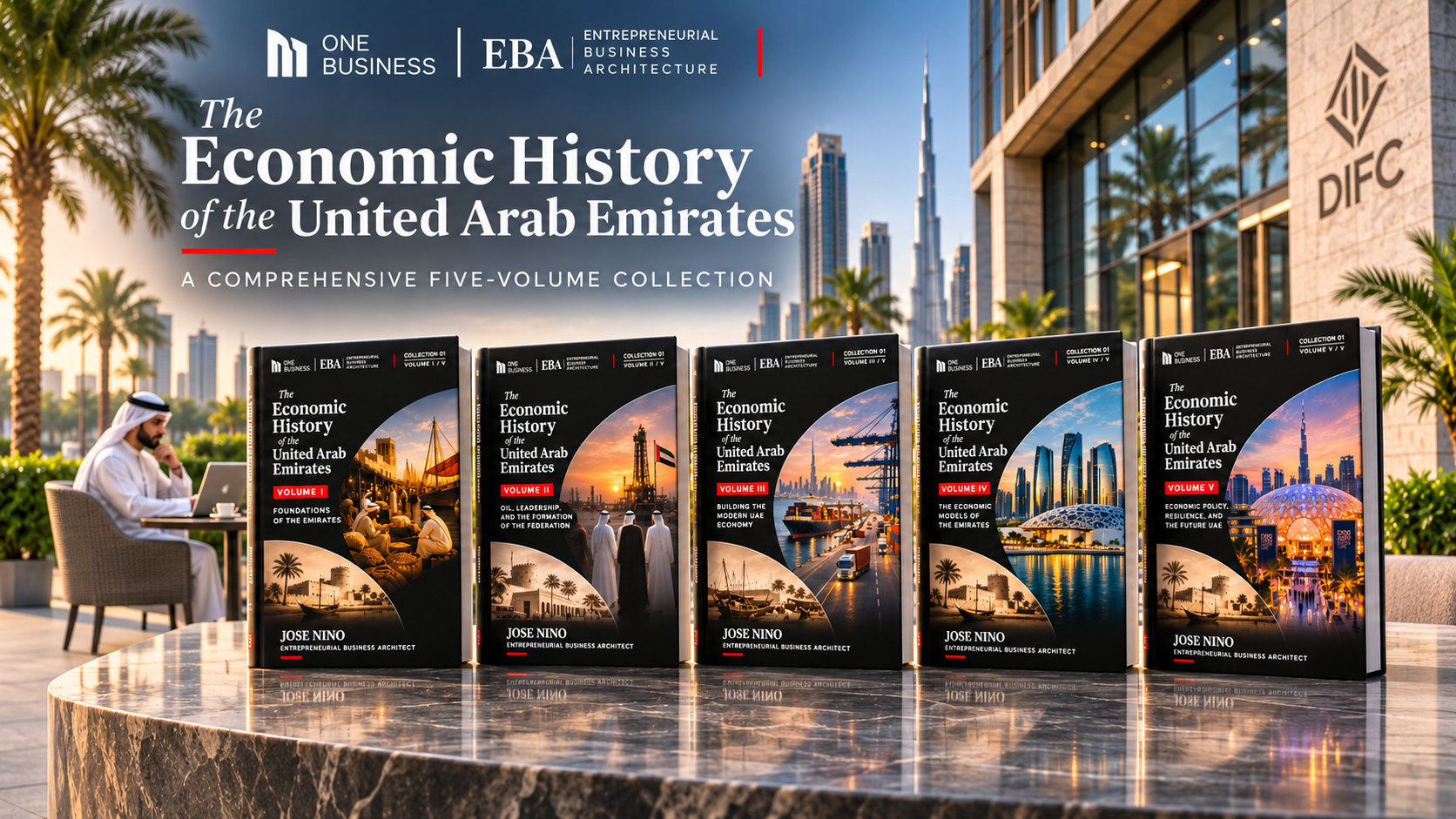
Explore The Economic History of the United Arab Emirates — Complete Collection
Volume V — Economic Policy, Resilience, and the Future UAE — USD 6.99
Volume III — Building the Modern UAE Economy — USD 6.99
Understanding the UAE's economic history is an investment in understanding the opportunities, institutions, enterprises, and capabilities shaping its entrepreneurial future.
Establish Your Business in Dubai and the United Arab Emirates
The historical development of the UAE's major enterprises demonstrates that successful business creation requires more than access to an attractive market. Entrepreneurs must understand the economic environment, identify viable opportunities, develop appropriate capabilities, and establish operating structures that support their commercial activities.
For international entrepreneurs considering Dubai or another emirate, company formation should be connected to the business model, intended customers, licensing requirements, operational needs, and longer-term development objectives of the enterprise.
ONE Business Dubai assists international entrepreneurs and companies seeking to establish businesses in Dubai and the United Arab Emirates, providing company registration services and assistance with the business bank account opening process.
UAE Company Registration + Business Bank Account Opening Assistance
Professional Service Fee: USD 1,000 + Applicable Government, Licensing, and Third-Party Costs
Eligible company registrations may be completed within 24 hours, subject to the relevant authority's documentation requirements, procedures, and approvals. Business bank account opening assistance is provided separately and remains subject to the financial institution's independent eligibility, compliance, and approval processes.
Explore ONE Business Dubai Company Registration Services
ONE Business Dubai | Strategic Entrepreneurial Business Architecture Advisory Firm
Historical research foundation: Jose Nino, The Economic History of the United Arab Emirates, Volume V, Chapter 34 — State-Owned Enterprises as Instruments of Economic Policy. Complementary historical analysis: Volume III — Building the Modern UAE Economy.
This article provides historical analysis and general entrepreneurial education. Business formation, regulatory, tax, and banking requirements should be verified for each proposed business and jurisdiction before making commercial or investment decisions.