ONE BUSINESS / INSIGHTS / ARTICLE 25
Impact Investing in Dubai: How Entrepreneurs Can Attract Capital and Build Profitable Businesses with Purpose
Discover how the United Arab Emirates’ evolving investment landscape is creating new opportunities for entrepreneurs who combine financial performance, sustainable innovation, and meaningful social impact.

The next generation of successful entrepreneurs in Dubai may not simply be those who identify the most profitable markets, develop the most advanced technologies, or secure the largest investment rounds. It may be those who understand how to transform significant economic, environmental, and social challenges into commercially viable business opportunities. As the United Arab Emirates continues to diversify its economy and strengthen its position as an international center for entrepreneurship, innovation, and investment, a powerful opportunity is emerging for founders capable of combining financial ambition with a deeper understanding of the value their businesses can create for society.
For decades, entrepreneurs have been encouraged to focus on profitability, competitive advantage, market penetration, and shareholder returns. These objectives remain essential. However, the evolution of international financial markets is introducing additional dimensions into the way investors evaluate businesses. Environmental sustainability, human development, responsible governance, resource efficiency, and measurable social outcomes are increasingly relevant to investment decisions, particularly among institutions pursuing long-term value creation and dedicated impact investment strategies.
The strategic discussions surrounding initiatives such as the Majra Impact Summit in Dubai offer entrepreneurs an opportunity to examine this changing relationship between capital, business development, and national prosperity. Rather than treating corporate responsibility as an activity separate from commercial operations, founders can begin to understand positive impact as an integral component of business architecture. This perspective opens the possibility of developing enterprises that generate sustainable financial returns precisely because they address meaningful problems.
At ONE Business Dubai, we believe that entrepreneurship represents one of the most powerful instruments for the economic and social transformation of individuals, communities, and nations. The emerging relationship between investment and measurable impact reinforces this philosophy. Entrepreneurs who develop the capabilities necessary to identify opportunities, design commercially viable solutions, establish strong organizations, and generate meaningful value can participate actively in the next chapter of economic development in the United Arab Emirates.
Understanding the Changing Investment Landscape in the United Arab Emirates
The economic transformation of the United Arab Emirates provides an extraordinary example of how a nation can use strategic vision, institutional development, international connectivity, and entrepreneurial activity to expand its productive capabilities. What was once an economy heavily dependent on traditional activities and hydrocarbon resources has progressively developed into a diversified international business environment encompassing financial services, logistics, tourism, technology, advanced manufacturing, renewable energy, healthcare, education, and numerous other industries.
This transformation has not eliminated the importance of financial capital. On the contrary, capital remains fundamental to the development of new industries, the construction of infrastructure, and the expansion of entrepreneurial enterprises. What is evolving is the relationship between financial investment and the broader objectives that investment can help achieve.
The UAE's national development ambitions, including those articulated through We the UAE 2031, provide a strategic context within which entrepreneurs can examine opportunities associated with economic competitiveness, innovation, human development, and sustainable prosperity. These priorities create potential areas of convergence between public development objectives and private entrepreneurial initiatives.
For an international entrepreneur considering Dubai as a destination for business development, understanding this convergence can be extremely valuable. Instead of approaching the UAE exclusively as a jurisdiction offering favorable business conditions, founders can examine the structural challenges, emerging industries, institutional priorities, and evolving consumer needs that are shaping its future economy.
An entrepreneur who identifies a commercially viable solution to a significant regional challenge may be able to develop a business that appeals to customers while also attracting the attention of strategic partners and investors. The opportunity is not simply to establish a company in Dubai. It is to participate in the economic transformation taking place throughout the United Arab Emirates.
What Is Impact Investing and Why Should Entrepreneurs Understand It?
Impact investing refers to investment activity undertaken with the intention of generating positive, measurable social or environmental outcomes alongside financial returns. Unlike traditional philanthropy, impact investing generally seeks to preserve or grow invested capital according to the objectives and risk profile of the investment. Unlike conventional investment strategies focused primarily on financial performance, impact investing explicitly incorporates intended positive outcomes into the investment thesis.
This distinction is particularly important for entrepreneurs. A business does not become an impact investment opportunity merely because its founders express concern about climate change, education, inequality, or community development. Investors need to understand how the enterprise intends to generate revenue, manage its costs, achieve commercial sustainability, and produce measurable outcomes through its activities.
Consider an entrepreneur developing technology that helps commercial buildings reduce unnecessary energy consumption. The business may generate recurring revenue through software subscriptions, installation services, or performance-based contracts. Its customers may benefit from lower operating expenses, while the wider economy may benefit from improved energy efficiency and reduced environmental pressure.
In this example, commercial success and positive impact are connected through the underlying business model. As the company acquires additional customers and expands its operations, its revenue potential increases alongside the potential environmental benefits associated with its technology.
This relationship illustrates one of the most important principles of impact-oriented entrepreneurship: positive impact should not necessarily be treated as an expense that a business can afford only after becoming profitable. In many cases, it can be designed into the commercial mechanism through which the business generates value.
For entrepreneurs in Dubai, this perspective creates an opportunity to examine business ideas through a broader strategic lens. Instead of asking exclusively whether a product can generate revenue, founders can investigate whether the product addresses a meaningful challenge, whether customers are willing to pay for the solution, and whether the resulting outcomes can be measured and communicated credibly.
Moving Beyond Traditional Corporate Social Responsibility
Corporate social responsibility has historically been associated with charitable donations, community initiatives, employee volunteering, environmental campaigns, and other activities undertaken by businesses to contribute positively to society. These initiatives can generate considerable value, particularly when they respond to genuine community needs and are implemented responsibly.
However, entrepreneurs building new companies have an opportunity to move beyond the traditional separation between commercial operations and corporate responsibility. Rather than developing a conventional business and subsequently allocating a portion of its profits to social initiatives, founders can investigate how their products, services, operating processes, and organizational structures can generate positive outcomes directly.
A healthcare technology company, for example, may improve access to medical services through more efficient appointment management, remote consultations, or diagnostic support. An educational enterprise may create affordable professional development opportunities for individuals who would otherwise struggle to access traditional business education. A logistics company may develop routing technologies that reduce transportation costs and unnecessary fuel consumption.
In each of these cases, the enterprise has the potential to generate financial value through activities that simultaneously address economic, social, or environmental challenges.
The growing institutional attention given to corporate responsibility and sustainable development in the UAE, including initiatives associated with Majra, provides entrepreneurs with additional reasons to examine how responsible business practices can be incorporated into their organizations from the beginning.
Nevertheless, founders should avoid assuming that participation in a corporate responsibility initiative automatically guarantees access to investment, government contracts, regulatory advantages, or preferential financing. Each opportunity must be evaluated according to its specific eligibility requirements, commercial conditions, and institutional objectives.
The strategic advantage comes from building a stronger enterprise, not simply from acquiring a sustainability label.
The Business Architecture Behind an Investable Impact Enterprise
One of the most common mistakes entrepreneurs make when seeking investment is concentrating excessively on the attractiveness of their ideas while neglecting the architecture necessary to transform those ideas into successful businesses. Investors may appreciate innovation, technological sophistication, and ambitious social objectives, but they also need confidence in the organization's ability to execute its strategy.
Entrepreneurial Business Architecture provides an integrated perspective through which founders can examine the relationship between personal development, entrepreneurial capabilities, opportunity discovery, business creation, market development, and organizational growth. From this perspective, an impact-oriented business must be understood as a connected system rather than a collection of isolated initiatives.
The entrepreneur represents the starting point of this system. Before an enterprise can attract investment and create meaningful outcomes, its founders must develop the knowledge, judgment, discipline, leadership capabilities, and financial understanding necessary to manage increasingly complex responsibilities.
An entrepreneur who lacks financial literacy may struggle to evaluate investment proposals or understand the implications of equity dilution. A founder who lacks leadership capabilities may find it difficult to build a competent management team. An individual who has not developed the discipline necessary to evaluate evidence objectively may become excessively attached to a business idea that has limited commercial potential.
These personal and professional capabilities directly influence the quality of the business architecture.
The next challenge involves discovering a genuine opportunity. Entrepreneurs must investigate the problems experienced by potential customers, identify existing alternatives, understand purchasing behavior, and determine whether their proposed solutions can create sufficient value to support sustainable revenue.
Once an opportunity has been validated, the founder must establish the legal, financial, operational, and commercial foundations of the enterprise. These foundations should support both the intended financial performance and the positive outcomes that the business seeks to generate.
A well-designed impact enterprise is therefore not simply an organization with a socially attractive mission. It is a commercially disciplined business whose architecture connects entrepreneurial capabilities, market demand, operational execution, financial sustainability, and measurable value creation.
Discovering Impact Business Opportunities in Dubai
Dubai's position as an international commercial center creates opportunities for entrepreneurs to examine challenges extending across multiple industries. The city's international population, sophisticated infrastructure, expanding technology ecosystem, and connections with regional and global markets provide an environment in which founders can investigate business models with both commercial and developmental potential.
One particularly relevant area involves energy efficiency and sustainable buildings. Commercial property owners, hospitality businesses, industrial facilities, and residential developments all have economic reasons to manage energy consumption effectively. Entrepreneurs capable of developing solutions that reduce operating expenses while maintaining performance may discover opportunities that combine customer value with environmental benefits.
Water efficiency represents another important area of investigation. The climatic conditions of the Arabian Peninsula make water management strategically significant. Businesses developing technologies for efficient irrigation, water monitoring, industrial water reuse, or consumption management may be able to address genuine operational challenges experienced by organizations throughout the region.
Food security and agricultural technology also offer opportunities for entrepreneurs willing to examine the economics of local production, controlled-environment agriculture, food distribution, and waste reduction. However, the existence of a significant national challenge does not automatically make every technological solution commercially viable. Founders must carefully investigate production costs, energy requirements, distribution economics, and customer willingness to pay.
Human development represents an equally important dimension of impact entrepreneurship. The UAE's diverse and internationally connected economy requires individuals capable of adapting to technological change, developing professional competencies, and participating productively in increasingly sophisticated industries. Entrepreneurs can investigate opportunities in vocational education, professional training, entrepreneurial development, digital learning, and workforce transition.
Healthcare accessibility, financial inclusion, responsible artificial intelligence, circular manufacturing, sustainable logistics, and technologies supporting more efficient public and private services represent additional areas in which founders may discover opportunities.
The essential principle is that entrepreneurs should begin with a detailed understanding of the problem rather than with an assumption that a fashionable industry will automatically produce a successful business. The most promising opportunities emerge when significant needs intersect with commercially viable solutions, capable entrepreneurs, and accessible markets.
Building a Business Model That Connects Profitability with Purpose
An impact-oriented enterprise must be capable of explaining how its commercial activities produce both financial returns and intended positive outcomes. This requires a clear understanding of the relationship between the customer, the product or service, the revenue model, the cost structure, and the impact generated through the business.
Imagine a Dubai-based entrepreneur developing an artificial intelligence solution that helps small manufacturing companies reduce material waste. The founder may initially describe the enterprise as a sustainable technology company. However, investors will need considerably more information before they can evaluate the opportunity.
They will want to understand how much material waste the target customers currently experience, how expensive that waste is, whether the proposed technology can reduce it reliably, and how much customers would be willing to pay for the solution. They will also examine the cost of developing, implementing, maintaining, and supporting the technology.
If the company can demonstrate that its customers achieve meaningful cost savings, that its revenue model supports attractive margins, and that its technology produces measurable reductions in material waste, the founder can present a more credible investment opportunity.
The financial performance of the enterprise would not depend exclusively on investors appreciating its environmental mission. It would depend on customers recognizing the economic value of its solution. The environmental outcomes would emerge through the same commercial activities responsible for generating revenue.
This relationship is particularly attractive when it remains intact as the company expands. An enterprise whose positive outcomes increase alongside customer acquisition and revenue growth may be better positioned to communicate the connection between profitability and purpose.
Entrepreneurs should nevertheless recognize that not every impact-oriented business will produce superior financial returns. Some models involve significant development costs, lengthy commercialization periods, complex regulatory requirements, or customers with limited purchasing power. These realities must be incorporated into the financial architecture rather than concealed behind ambitious sustainability claims.
Measuring Impact: Turning Entrepreneurial Ambition into Credible Evidence
One of the defining characteristics of impact investing is the importance of measurable outcomes. Entrepreneurs cannot expect investors to accept broad claims about sustainability, inclusion, or community development without examining the evidence supporting those claims.
A company that describes itself as environmentally responsible should be capable of identifying the specific environmental outcomes associated with its activities. An educational enterprise should consider how its services influence learning, professional capabilities, or employment-related outcomes. A healthcare business should investigate whether its solution improves accessibility, efficiency, affordability, or other relevant dimensions of service delivery.
Effective measurement begins with establishing a baseline. Before an entrepreneur can demonstrate that a technology reduces energy consumption, the company must understand how much energy was being consumed before implementation. Before an educational business can demonstrate improvements in professional capabilities, it must establish an appropriate understanding of participants' initial competencies.
Founders must also distinguish between outputs and outcomes. The number of individuals attending a training program is an output. The improvement in their professional capabilities, employment prospects, or entrepreneurial performance represents a potential outcome. Similarly, the installation of water-saving equipment is an output, while the actual reduction in water consumption represents an outcome.
Entrepreneurs should select indicators that are relevant to their specific business models and proportionate to their organizational capabilities. Early-stage companies may begin with a limited number of meaningful indicators rather than attempting to implement sophisticated reporting systems that consume resources without improving decision-making.
As the enterprise grows, measurement practices can become more advanced through standardized reporting, independent verification, improved data collection, and appropriate governance procedures. Recognized sustainability reporting and impact management frameworks may provide useful guidance, depending on the company's size, industry, investment objectives, and applicable obligations.
The objective is not to create impressive reports filled with complicated terminology. It is to establish a credible connection between what the business claims to achieve and what it actually delivers.
Understanding the Different Sources of Impact Capital
Entrepreneurs seeking financing in Dubai must understand that capital is not a homogeneous resource. Different investors have different objectives, investment horizons, risk tolerances, financial return expectations, and approaches to evaluating positive impact.
Venture capital investors may seek companies capable of achieving rapid growth and significant increases in enterprise value. These investors typically examine the size of the addressable market, the capabilities of the founding team, competitive differentiation, scalability, and potential exit opportunities.
Family offices may pursue a wider variety of investment objectives. Some prioritize long-term capital preservation, while others seek entrepreneurial growth opportunities, strategic industry exposure, or investments reflecting the values and priorities of the families whose wealth they manage.
Corporate investors may be interested in businesses that complement their existing operations, accelerate technological development, improve resource efficiency, or provide access to emerging markets. For an impact-oriented startup, a strategic corporate relationship may provide commercial opportunities in addition to financial capital.
Development finance institutions and specialized lenders may support eligible enterprises operating in strategically important industries. Institutions such as Emirates Development Bank illustrate the relevance of development-oriented financing within the broader UAE business ecosystem, although entrepreneurs must examine the specific eligibility criteria and financing conditions applicable to their businesses.
Islamic finance also represents an important component of the regional financial environment. Certain principles associated with ethical investment, responsible financing, and the connection between financial transactions and economic activity may create areas of alignment with impact-oriented business models. However, entrepreneurs must understand that Sharia compliance involves specific requirements that cannot be assumed simply because a business generates positive social or environmental outcomes.
The most effective financing strategy begins by identifying the investors whose objectives genuinely align with the enterprise. Approaching every available source of capital with the same presentation can consume significant time and resources while producing disappointing results.
Preparing an Investment Proposal That Investors Can Take Seriously
A compelling investment proposal must communicate considerably more than the entrepreneur's passion for solving a problem. It must demonstrate that the founding team understands the market, has developed a credible commercial strategy, and possesses the capabilities necessary to transform investment into measurable progress.
The proposal should begin by explaining the problem the enterprise addresses and why that problem represents a meaningful business opportunity. Founders must establish who experiences the problem, how existing solutions perform, what economic consequences arise from the problem, and why customers would consider purchasing a new solution.
The next component involves explaining the product or service and its commercial advantages. Investors should be able to understand how the solution works, why it offers value to customers, and what differentiates it from competing alternatives.
The financial architecture must demonstrate how the business expects to generate revenue, manage operating expenses, allocate capital, and progress toward financial sustainability. Projections should be based on transparent assumptions rather than unrealistic growth expectations designed exclusively to impress potential investors.
An impact-oriented investment proposal must also explain how the enterprise intends to generate positive outcomes and how those outcomes will be measured. Rather than placing sustainability or social responsibility on an isolated presentation slide, founders should integrate these dimensions throughout the investment narrative wherever they influence the business model.
Finally, entrepreneurs must communicate how the requested investment will be used. Investors need to understand whether capital will finance product development, regulatory approvals, market entry, recruitment, operational infrastructure, customer acquisition, or expansion into additional markets.
A credible investment proposal connects entrepreneurial ambition with evidence, commercial logic, financial discipline, and a realistic execution strategy. Its purpose is not simply to obtain attention. It is to establish the foundations of a productive relationship between entrepreneurs and capital providers.
Establishing the Right Corporate Structure in the UAE
The legal architecture of a business can influence its ability to attract investment, establish commercial relationships, protect intellectual property, manage shareholder rights, and expand internationally. Entrepreneurs considering Dubai should therefore evaluate company formation as a strategic business decision rather than merely an administrative requirement.
The United Arab Emirates offers multiple business establishment options, including mainland companies and companies established within specialized free zones. Different jurisdictions may offer different legal frameworks, licensing arrangements, operational conditions, and costs.
Entrepreneurs developing investment-oriented businesses should examine whether their proposed corporate structure supports their intended activities, ownership arrangements, fundraising strategy, contractual relationships, and future expansion plans.
Financial centers such as the Dubai International Financial Centre and Abu Dhabi Global Market may be relevant to certain businesses and investment structures. Nevertheless, these jurisdictions are not automatically the most appropriate choice for every startup. The nature of the proposed activities, applicable regulations, licensing costs, investor requirements, and operational needs should guide the decision.
Founders should also consider the importance of maintaining accurate corporate records, establishing clear agreements among shareholders, documenting intellectual property ownership, and implementing appropriate governance procedures.
At ONE Business Dubai, we help international entrepreneurs establish the corporate foundations necessary to begin developing their businesses in the United Arab Emirates. Our company formation and business registration services are designed to support founders as they navigate the process of selecting an appropriate business structure and establishing their enterprises.
Our professional fee for eligible UAE company formation services is USD 1,200, plus applicable government, licensing, and third-party costs. Explore ONE Business Dubai Company Formation Services. We also provide assistance with the business bank account opening process, subject to the requirements and independent approval procedures of the relevant financial institutions.
Eligible company registrations may be completed in as little as 24 hours, depending on the selected jurisdiction, business activities, documentation, and applicable approvals.
Establishing the company is not the conclusion of the entrepreneurial journey. It is the creation of the legal foundation upon which entrepreneurs can begin building their commercial, operational, and financial architecture.
Developing the Entrepreneurial Capabilities Required to Attract Investment
Access to capital can accelerate the development of a business, but it cannot substitute for the capabilities required to build and manage a successful enterprise. Entrepreneurs who receive financing without developing appropriate leadership, financial management, commercial, and operational competencies may struggle to convert that investment into sustainable growth.
This is why personal development occupies such an important position within Entrepreneurial Business Architecture. The entrepreneur must progressively develop the ability to make decisions under uncertainty, manage resources responsibly, communicate effectively, negotiate commercial agreements, lead teams, and learn from experience.
Impact-oriented entrepreneurs face additional responsibilities because their organizations may need to balance financial objectives with measurable social or environmental commitments. Managing these responsibilities requires judgment, transparency, and the willingness to examine evidence even when that evidence challenges the founder's original assumptions.
An entrepreneur may discover that a technology produces less environmental benefit than initially anticipated. A training company may find that its educational outcomes vary considerably among participants. A sustainable manufacturing enterprise may identify unexpected costs associated with its production processes.
These discoveries should not necessarily be interpreted as failures. They represent information that can help founders improve their products, refine their strategies, and strengthen their business models.
The ability to learn, adapt, and develop increasingly sophisticated capabilities is fundamental to entrepreneurial growth. Capital can provide the resources necessary to pursue opportunities, but the entrepreneur's development influences how effectively those resources are transformed into lasting value.
Understanding the UAE's Economic Transformation Through Our Book Collection
Entrepreneurs seeking to participate in the future economy of Dubai can benefit enormously from understanding the historical processes that contributed to the development of the United Arab Emirates.
The country's economic transformation did not occur through isolated investments or individual business opportunities alone. It emerged through the interaction of leadership, institutional development, infrastructure, international trade, entrepreneurial activity, human capabilities, and long-term strategic decisions.
At ONE Business Dubai, we are developing a specialized collection of publications designed to help international entrepreneurs understand these processes and extract practical lessons for their own entrepreneurial journeys.
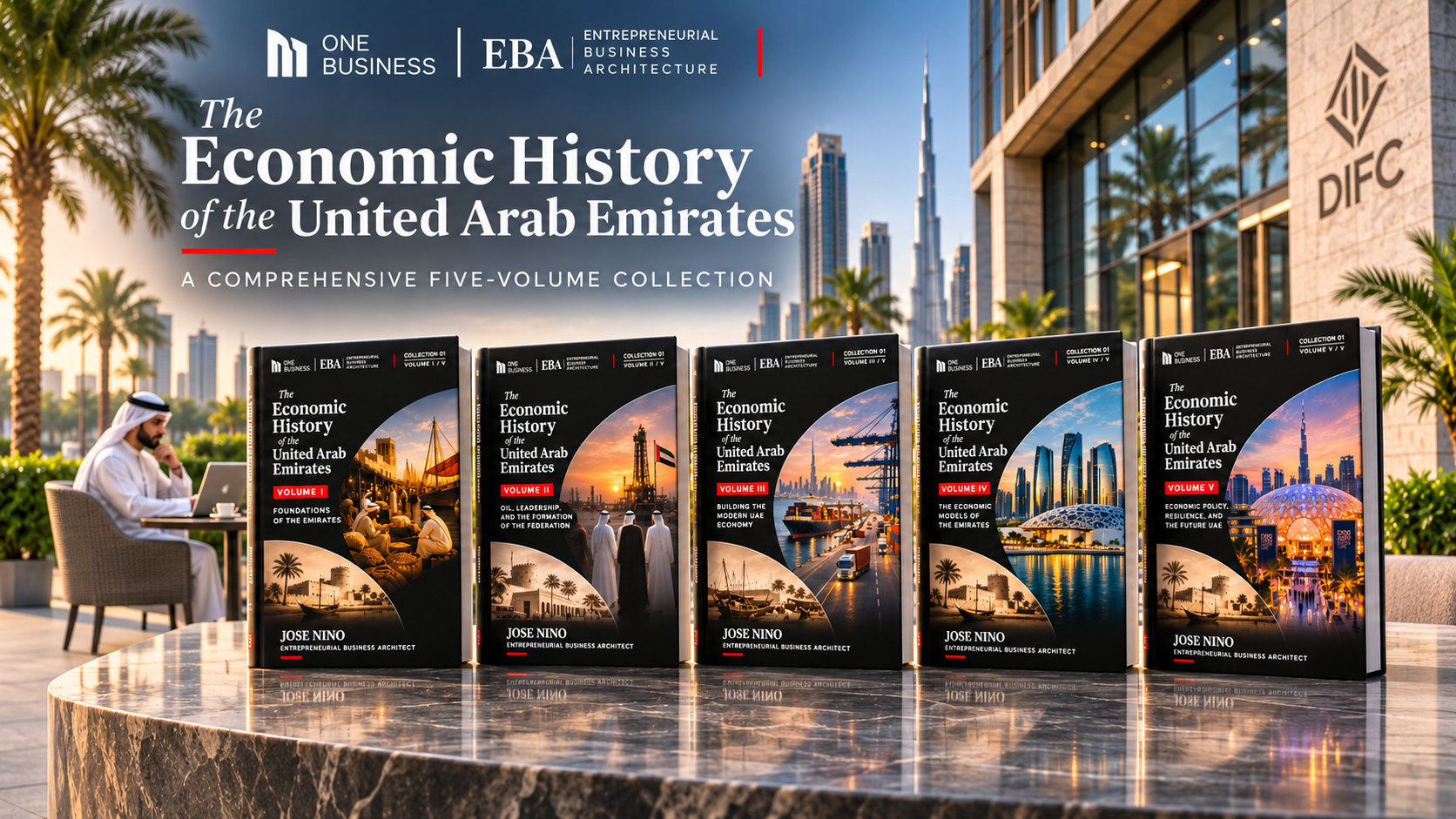
The Economic History of the United Arab Emirates for Entrepreneurs
Our five-volume collection examines the historical development of the UAE economy through the perspective of entrepreneurship and Entrepreneurial Business Architecture.
The collection explores how economic opportunities emerge, how productive capabilities develop, how institutions influence entrepreneurial activity, and how strategic decisions contribute to long-term economic transformation.
For entrepreneurs considering opportunities in sustainable industries, impact investing, technology, and human development, understanding this historical evolution provides valuable context for interpreting the country's emerging economic priorities.
The complete five-volume digital collection is available for USD 29.99. Explore The Economic History of the United Arab Emirates — Complete Collection.
The Entrepreneurial History of the United Arab Emirates
This book examines the role of entrepreneurs, business leaders, commercial networks, and entrepreneurial initiatives in the development of the United Arab Emirates.
It offers a complementary perspective on the relationship between individual ambition, opportunity discovery, business creation, and national economic development. Entrepreneurs can use this perspective to understand how businesses contribute to the transformation of markets and communities.
The Contemporary Entrepreneurial History of the United Arab Emirates
This publication explores the contemporary entrepreneurial environment of the UAE, including the evolving relationship between innovation, technology, international investment, emerging industries, and business development.
Together, these three publications are designed to help entrepreneurs move beyond a superficial understanding of Dubai as a business destination and develop a deeper appreciation of the economic and entrepreneurial architecture shaping its future.
Build Your Business in Dubai and Become Part of the UAE's Next Economic Transformation
The United Arab Emirates offers entrepreneurs an opportunity to participate in an evolving economy where innovation, commercial ambition, human development, and responsible value creation can increasingly intersect.
However, opportunities alone do not create successful businesses. Entrepreneurs must develop the capabilities necessary to recognize those opportunities, evaluate their commercial potential, establish appropriate corporate structures, build effective organizations, and deliver solutions that customers genuinely value.
Impact investing reinforces the importance of this integrated entrepreneurial approach. Businesses capable of demonstrating credible financial models, measurable outcomes, strong governance, and disciplined execution may be better positioned to engage with investors whose objectives extend beyond conventional financial performance.
The challenge for entrepreneurs is not simply to obtain capital. It is to become capable of building enterprises worthy of investment.
At ONE Business Dubai, we believe that the combination of personal development and entrepreneurship can transform individual lives while contributing to the economic and social development of entire communities. Dubai provides an extraordinary environment in which entrepreneurs can pursue this transformation, develop international businesses, and participate in the creation of new economic opportunities.
If you are ready to transform your entrepreneurial ambitions into a legally established business in the United Arab Emirates, ONE Business Dubai can help you take that essential first step.
Establish your company in Dubai or the United Arab Emirates for a professional fee of USD 1,200, plus applicable government, licensing, and third-party costs.
Our company formation services include guidance throughout the registration process and assistance with business bank account opening, subject to applicable requirements and independent bank approval.
Discover new opportunities. Develop your entrepreneurial capabilities. Build a business that creates economic value, generates meaningful impact, and contributes to the future of the United Arab Emirates.
Start your entrepreneurial journey with ONE Business Dubai today.
Email: [email protected]
ONE Business Dubai — Discover Opportunities. Build Businesses. Transform Your Future.