ONE BUSINESS / INSIGHTS / ARTICLE 28
The Power of Strategic Connections and Partnerships in Dubai: How Entrepreneurs Build Relationships, Grow Businesses, and Scale Across the UAE
Discover why professional networking, trusted business relationships, and strategic partnerships are essential for entrepreneurs seeking to establish companies, access new markets, attract customers, and build successful enterprises in Dubai and the United Arab Emirates.

Dubai has established itself as one of the world's most internationally connected commercial environments, attracting entrepreneurs who aspire to establish businesses, develop international relationships, discover new markets, and participate in the economic opportunities emerging throughout the United Arab Emirates. Its sophisticated infrastructure, internationally connected airports and ports, specialized business jurisdictions, financial institutions, and diverse business communities have created conditions in which individuals from different countries and professional backgrounds can pursue ambitious entrepreneurial projects. However, one of the most important lessons that international founders discover when entering this market is that access to infrastructure and a favorable business environment does not automatically translate into commercial success. Establishing a company provides the legal foundation for conducting business, but transforming that company into a successful enterprise requires the development of customer relationships, professional credibility, market knowledge, and strategic partnerships capable of generating meaningful economic opportunities.
For entrepreneurs operating in Dubai, the importance of relationships extends far beyond traditional networking activities or the exchange of business cards at professional events. Commercial relationships can influence how founders identify opportunities, understand customer needs, discover reliable suppliers, evaluate market conditions, establish distribution arrangements, and access specialized knowledge that would otherwise be difficult to obtain. A productive relationship with an experienced industry professional may help an entrepreneur recognize a market opportunity that was previously invisible. A trusted customer may become the source of referrals that allow a young business to acquire additional clients. A strategic partnership with a company possessing complementary capabilities may enable an enterprise to provide services or enter markets that would have been inaccessible through its existing resources alone.
These possibilities reveal an important principle of entrepreneurship: business growth is not determined exclusively by the financial capital an entrepreneur possesses, but also by the quality of the relationships and partnerships through which knowledge, resources, capabilities, and opportunities are connected. Entrepreneurs who understand how to develop meaningful professional relationships can strengthen their capacity to navigate unfamiliar markets, identify potential customers, establish credibility, and expand the productive capabilities of their enterprises. However, these benefits do not arise simply because an individual knows many people. They emerge when relationships are built through mutual trust, professional competence, reliable performance, and a clear understanding of the value that each participating party can contribute.
This perspective connects directly with Entrepreneurial Business Architecture (EBA), which understands business creation and development as an integrated process beginning with the entrepreneur's personal development and progressing through entrepreneurial capability formation, opportunity discovery, business creation, market development, and organizational growth. Within this discipline, professional relationships and strategic partnerships represent important elements of the architecture through which entrepreneurs convert opportunities into operating businesses. The entrepreneur must develop the communication skills, judgment, confidence, leadership capabilities, commercial understanding, and professional discipline necessary to establish productive relationships. These personal capabilities influence the ability to identify suitable partners, negotiate agreements, acquire customers, organize collaborations, and develop the networks necessary for business expansion.
The importance of strategic relationships in the United Arab Emirates is also deeply connected to the country's economic history. Long before the development of its modern infrastructure and international business districts, commercial activity in the region depended on merchant relationships, maritime trade, regional distribution networks, financial arrangements, and connections among trading communities extending across the Arabian Peninsula, the Indian Ocean, and other international markets. The economic transformation of the Emirates involved not only the development of physical infrastructure and institutions but also the expansion of commercial relationships that connected producers, merchants, investors, and international customers. These historical relationships are examined in The Economic History of the United Arab Emirates, the five-volume collection presented by ONE Business Dubai, which provides entrepreneurs with a deeper understanding of the economic foundations that contributed to the development of the country's contemporary business environment.
For international entrepreneurs planning to establish their commercial presence, ONE Business Dubai provides professional company formation and business registration services in the United Arab Emirates for USD 1,200 plus applicable government, licensing, and third-party costs. Our services help founders navigate the establishment process, evaluate suitable registration arrangements, and organize the legal foundation necessary to begin developing their businesses. Eligible company registrations may be completed within 24 hours when documentation, the selected jurisdiction, proposed business activities, and relevant authority approvals permit. Entrepreneurs can explore ONE Business Dubai's company formation and business registration services to begin the process of creating their enterprise. Once the company is established, the next challenge is developing the commercial relationships and strategic partnerships that can transform that legal entity into a productive and growing organization.
Why Strategic Connections Are Essential to Entrepreneurial Success in Dubai
Entrepreneurs frequently begin their business journeys with a particular combination of professional knowledge, experience, financial resources, and personal ambition. These elements influence the opportunities they recognize and the companies they aspire to establish, but they rarely provide every capability required to build a successful enterprise. A founder may possess excellent technical knowledge while lacking direct access to customers. Another entrepreneur may understand a market but lack the distribution channels necessary to reach it. A professional consultant may possess valuable expertise but need relationships with other specialists to deliver comprehensive solutions. Strategic connections help entrepreneurs address these limitations by providing access to complementary knowledge, resources, capabilities, and commercial opportunities through relationships with other individuals and organizations.
The concept of relational capital describes the potential economic value associated with professional relationships established by entrepreneurs and businesses. Unlike financial capital, relational capital cannot be measured simply through the amount of money available in a bank account. Its value depends on the trust, knowledge, credibility, experience, and willingness to cooperate that exist among the participating parties. An entrepreneur may maintain hundreds of professional contacts without obtaining meaningful commercial opportunities, while another founder may possess a smaller network of reliable customers, experienced advisers, suppliers, and commercial partners that contributes significantly to the development of the business. The distinction lies in the quality and productive potential of the relationships rather than the total number of individuals within the entrepreneur's contact list.
Dubai's international business environment creates valuable opportunities for developing this relational capital because companies and professionals from numerous countries participate in its commercial activities. Entrepreneurs can encounter individuals involved in logistics, international trade, real estate, hospitality, financial services, manufacturing, technology, professional consulting, and many other industries. These interactions may reveal customer needs, market gaps, and potential collaborations that are difficult to identify through isolated research. However, entrepreneurs must approach these opportunities strategically. Attending professional gatherings without a clear understanding of the business being developed can consume significant time while producing limited commercial value. Effective networking requires founders to identify relevant communities, understand the needs of potential partners, and communicate the value their organizations can contribute.
Consider an international entrepreneur establishing a professional consulting company in Dubai. The founder may possess considerable expertise but initially lack relationships with local businesses or international companies operating in the UAE. Participation in industry gatherings and professional communities can help the entrepreneur understand the concerns of potential customers, discover which services are in demand, and establish contact with individuals who may require specialized assistance. However, the commercial value of those connections will depend on whether the founder can demonstrate competence, propose relevant solutions, and deliver reliable services. An introduction creates an opportunity for communication, but credibility must be developed through professional behavior and actual performance.
Trust is particularly important because commercial relationships frequently involve uncertainty. A customer evaluating a new service provider must determine whether the company possesses the capabilities necessary to fulfill its promises. A business considering a distribution partner must investigate whether the organization can deliver products reliably, maintain appropriate standards, and respect contractual responsibilities. An entrepreneur contemplating a joint venture must examine the financial resources, experience, governance arrangements, and commercial objectives of the prospective partner. Personal relationships can facilitate these evaluations by providing access to information and professional references, but they should never replace independent due diligence or clear contractual arrangements.
The development of trust requires consistency over time. Entrepreneurs who communicate accurately, respect professional commitments, provide realistic expectations, and fulfill agreements establish a foundation for relationships that may generate opportunities beyond the original transaction. A satisfied customer may introduce the business to another organization, while a reliable supplier may inform the entrepreneur about developments in the market. A professional adviser may identify opportunities for collaboration with other specialists whose capabilities complement those of the enterprise. These relationships can create expanding networks of commercial opportunity, provided that the entrepreneur continues to demonstrate reliability and professional competence.
Strategic connections also contribute to entrepreneurial learning. Founders entering unfamiliar markets may possess incomplete information concerning customer expectations, commercial conditions, procurement procedures, or industry-specific requirements. Conversations with experienced business professionals can provide perspectives that help entrepreneurs challenge assumptions and improve decisions. Nevertheless, the information obtained through personal relationships should be evaluated carefully because individual experiences may not represent the entire market. Effective entrepreneurs combine professional relationships with independent research, commercial analysis, and practical validation before committing substantial resources to a new opportunity.
The central lesson is that networking should not be treated as a temporary activity undertaken only when a business needs customers. Strategic relationship development is a continuing entrepreneurial capability that contributes to opportunity discovery, market development, commercial credibility, and organizational growth. Entrepreneurs who cultivate this capability deliberately can strengthen the resources available to their enterprises while creating opportunities for productive cooperation with other individuals and organizations.
From Networking to Business Development: Turning Professional Relationships into Customers and Revenue
One of the most common challenges entrepreneurs face is converting professional contacts into meaningful commercial relationships. A founder may attend conferences, participate in business gatherings, exchange contact information, and maintain an active presence within professional communities without generating the revenue required to sustain the enterprise. This situation does not necessarily demonstrate that networking lacks value. It may indicate that the entrepreneur has not developed a structured process connecting professional relationships with market opportunities, customer needs, commercial proposals, and the delivery of products or services. Effective business development requires founders to understand how relationships progress from initial contact toward productive commercial cooperation.
The process begins with identifying the customers the enterprise intends to serve. Entrepreneurs who approach networking without a clear market focus may encounter numerous individuals whose professional interests have little connection to the products or services being offered. A consulting business specializing in international company expansion, for example, may benefit from relationships with entrepreneurs, professional advisers, corporate executives, and organizations considering entry into new markets. A logistics enterprise may prioritize connections with manufacturers, trading companies, distributors, and businesses requiring reliable transportation services. A company developing hospitality products may concentrate on relationships with hotel operators, restaurant groups, procurement specialists, and other participants within the industry. Understanding the intended market helps entrepreneurs select professional communities and networking activities that correspond to genuine commercial opportunities.
Once a potentially relevant relationship has been established, the entrepreneur must concentrate on understanding the other party's needs. Successful business development depends on discovering whether the prospective customer experiences a problem that the enterprise can solve and whether the proposed solution creates sufficient value to justify a commercial transaction. Entrepreneurs who begin every conversation by delivering an extensive sales presentation may overlook important information about the customer's actual circumstances. A more effective approach involves asking relevant questions, listening carefully, examining existing alternatives, and determining whether the company's capabilities correspond to the problem being discussed. The objective is not merely to create interest but to identify a commercially viable opportunity.
Professional follow-up is another essential component of this process. Initial meetings may create a positive impression, but business relationships develop through subsequent communication and demonstrated reliability. An entrepreneur who promises to provide information, arrange an introduction, prepare a proposal, or investigate a particular issue should fulfill that commitment within an appropriate period. Failure to follow through can weaken the credibility established during the original interaction. Conversely, consistent communication helps potential customers understand how the entrepreneur operates and whether the organization is likely to manage commercial responsibilities effectively.
The development of proposals requires particular care because a promising conversation does not automatically establish a customer's willingness or capacity to purchase. Entrepreneurs should investigate the objectives of the organization, the individuals responsible for decisions, the resources available, and the conditions governing procurement or contracting. A founder may discover that a potential customer appreciates the proposed solution but cannot proceed because the company has not allocated a budget or because the problem is not considered sufficiently urgent. Understanding these circumstances allows entrepreneurs to allocate their time and commercial resources more effectively rather than pursuing opportunities with little realistic probability of becoming transactions.
Strategic networking can also contribute to the development of referrals. Customers and professional contacts who have experienced reliable performance may recommend a business to other individuals or organizations with similar needs. Such introductions can reduce certain difficulties associated with establishing initial contact because the prospective customer receives information through an existing relationship. However, a referral does not guarantee a sale. The entrepreneur must still demonstrate that the product or service is appropriate, commercially competitive, and capable of satisfying the customer's requirements. Maintaining the confidence of the referring party also creates an additional responsibility to communicate professionally and fulfill commitments.
In Dubai, where international entrepreneurs and established companies frequently interact across industries, referrals and professional introductions can provide valuable starting points for commercial discussions. Their effectiveness depends on the quality of the relationships involved and the relevance of the proposed business opportunity. Entrepreneurs should therefore concentrate on developing the reputation and operational capabilities that make others comfortable recommending their services. A company that consistently disappoints customers will struggle to sustain productive referral relationships, regardless of how extensively its founder participates in networking activities.
Entrepreneurs should also evaluate networking through commercial indicators that reflect actual business development. The number of events attended or contacts collected may provide information about activity, but those figures do not establish whether the business is becoming more successful. More meaningful measures can include qualified commercial conversations, proposals requested, customer relationships established, referral opportunities, signed agreements, and revenue generated from relevant business-development activities. These indicators help founders determine which professional communities and relationship-development practices contribute most effectively to the enterprise's objectives.
The value of networking ultimately depends on the entrepreneur's ability to create genuine commercial value. Relationships may open doors, provide information, and facilitate introductions, but customers purchase products and services because they expect a benefit. Strategic connections accelerate business development when they help entrepreneurs reach the right customers, understand their needs, establish credibility, and deliver solutions that justify lasting commercial relationships. This connection between relational capital and market performance is essential to Entrepreneurial Business Architecture because successful market development requires more than visibility. It requires the creation of sustainable exchanges of value.
Strategic Partnerships: How Entrepreneurs Combine Resources and Capabilities to Build Stronger Businesses
Strategic partnerships represent a more structured form of commercial cooperation through which two or more organizations combine complementary resources, knowledge, capabilities, or market relationships to pursue defined objectives. Unlike ordinary networking relationships, which may involve informal professional communication, strategic partnerships generally require a clearer understanding of the responsibilities, contributions, expected benefits, and risks associated with collaboration. For entrepreneurs developing businesses in Dubai, these arrangements can create opportunities to expand service capabilities, access new customers, strengthen distribution, and pursue projects that would be difficult to undertake independently.
A young enterprise frequently encounters limitations involving capital, specialized expertise, personnel, infrastructure, or market access. These constraints can slow business development even when the entrepreneur has identified a genuine opportunity. A strategic partnership may provide a means of addressing selected limitations without requiring the company to develop every capability internally. For example, an international consulting firm entering Dubai may possess expertise in business strategy but require assistance from qualified legal, accounting, or industry specialists when serving customers with more complex requirements. Appropriate professional partnerships may allow the enterprise to coordinate complementary services while maintaining clear responsibilities and respecting the regulatory conditions applicable to each profession.
Distribution partnerships provide another example of how collaboration can contribute to market development. An entrepreneur introducing a product to the UAE may understand manufacturing, product quality, and the commercial advantages of the offering but lack relationships with local buyers or the infrastructure necessary for distribution. A suitable distribution partner may possess customer relationships, market knowledge, logistical capabilities, or sales resources that complement those of the original business. When the arrangement is structured appropriately, both organizations may benefit from combining their strengths. However, the entrepreneur must evaluate the distributor's experience, financial capacity, operational performance, contractual obligations, and ability to represent the product effectively.
Partnerships can also support innovation and product development. A business with strong knowledge of customer problems may collaborate with another enterprise possessing specialized technical or operational expertise. Such arrangements can reduce the need to build every capability internally, but they also introduce questions concerning intellectual property, confidentiality, commercial responsibilities, and ownership of the results. Entrepreneurs should establish clear agreements before committing substantial resources to collaborative projects, particularly when the work involves the development of proprietary products or services.
Joint ventures represent a more complex form of cooperation and may be appropriate when two or more parties intend to undertake commercial activities through a defined organizational or contractual structure. These arrangements can involve shared investment, operational responsibilities, governance mechanisms, and financial risks. A joint venture may offer access to complementary resources or markets, but it can also create difficulties when the partners possess conflicting objectives or inadequate procedures for resolving disagreements. Founders must understand the legal and commercial implications of the proposed structure and should obtain appropriate professional advice when necessary.
One of the most important responsibilities in strategic partnership development is selecting suitable partners. Entrepreneurs may encounter individuals who appear enthusiastic about collaborating but whose organizations lack the resources, experience, or commitment required to fulfill the proposed arrangement. Others may present attractive opportunities while expecting the entrepreneur to assume disproportionate financial or operational risks. Effective evaluation requires investigating professional history, relevant capabilities, financial circumstances, reputation, commercial interests, and the actual contribution each party will make. Founders should distinguish a promising relationship from a commercially justified partnership, because the existence of personal goodwill cannot compensate for fundamental weaknesses in the proposed business arrangement.
Strategic alignment is essential because partnerships require organizations to coordinate decisions and responsibilities over time. A business seeking rapid expansion may encounter difficulties when its partner prioritizes conservative operations or possesses insufficient capacity to meet increasing demand. Differences involving quality standards, customer service, pricing, financial management, or investment priorities can undermine cooperation even when the original commercial opportunity appears attractive. Entrepreneurs should therefore clarify objectives before entering formal arrangements and establish procedures through which performance can be monitored and disagreements addressed.
Well-structured partnerships can contribute to enterprise growth by extending the productive capabilities available to the participating organizations. However, partnerships are not inherently superior to internal development, ordinary supplier relationships, or direct commercial transactions. The entrepreneur should compare alternatives and determine whether collaboration produces sufficient value to justify its complexity, costs, and risks. The objective of strategic partnership development is not to accumulate alliances but to create relationships through which complementary capabilities generate commercial outcomes that the participating businesses could not achieve as effectively alone.
Dubai's Business Communities and Entrepreneurial Ecosystems as Sources of Strategic Partnerships
Dubai's economic environment contains specialized business districts, professional communities, chambers of commerce, industry associations, entrepreneurship initiatives, and commercial gatherings that can provide opportunities for relationship development. These environments are significant because they bring together individuals and organizations possessing different capabilities, objectives, and resources. Entrepreneurs seeking to establish and grow businesses can use appropriate communities to investigate market conditions, identify potential customers, obtain professional guidance, and discover organizations whose capabilities may complement their own. Nevertheless, the value of participation depends on the relevance of the community and the entrepreneur's ability to translate professional interaction into meaningful business activity.
The Dubai International Financial Centre (DIFC) represents an important environment for businesses and professionals involved in finance, professional services, international commerce, and related activities. Entrepreneurs whose businesses correspond to these industries may benefit from understanding the professional communities and commercial relationships associated with the district. A founder seeking to develop services for financial institutions, corporate clients, or professional advisory firms may encounter relevant opportunities through appropriate industry events and professional engagement. However, the commercial advantages of a particular location or business community depend on the nature of the enterprise. Establishing a company within a recognized district does not automatically create demand for its products or provide access to every institution operating there.
Dubai Internet City and Dubai Silicon Oasis provide other examples of specialized environments associated with technology, professional expertise, and knowledge-intensive commercial activity. Their relevance to entrepreneurs lies partly in the concentration of organizations whose activities may create opportunities for cooperation, professional learning, and business development. A founder developing specialized services may encounter companies requiring complementary capabilities, while an enterprise entering the UAE market may discover potential customers or suppliers through engagement with relevant professional communities. The practical benefit depends on whether these relationships correspond to the company's commercial objectives and whether the founder possesses the capabilities necessary to pursue them.
Dubai's institutional efforts to strengthen entrepreneurship also include initiatives such as Dubai Founders HQ, launched in 2025 to support connections among entrepreneurs, mentors, investors, and organizations involved in business development. The importance of such initiatives is that they recognize entrepreneurship as a process requiring knowledge, relationships, and access to relevant expertise rather than merely the completion of administrative company formation procedures. Founders can investigate whether available activities correspond to their development needs, although participation conditions and commercial opportunities must be evaluated individually.
Business communities associated with free zones and specialized establishment environments can also contribute to relationship development. Entrepreneurs considering a particular jurisdiction should investigate not only licensing costs and facilities but also the commercial characteristics of the surrounding business environment. A professional services enterprise may value access to potential corporate customers, while a trading business may prioritize logistics connections and relationships with distributors. A manufacturing company may require proximity to industrial suppliers or suitable facilities, whereas a consultancy may place greater importance on professional networks and the accessibility of its intended customers.
Chambers of commerce and industry associations offer additional opportunities for entrepreneurs to learn about business conditions and establish professional relationships. Their activities may include industry discussions, trade-related events, business delegations, and opportunities for interaction among organizations. Participation can provide useful information about commercial developments and help founders discover individuals with relevant experience. However, entrepreneurs should assess whether the activities offered correspond to their own market objectives and should avoid treating attendance itself as evidence of commercial progress.
Conferences and exhibitions represent another important dimension of Dubai's business environment. International events can bring together manufacturers, distributors, technology providers, professional advisers, investors, and other commercial participants. Entrepreneurs who prepare appropriately may use such events to identify potential suppliers, investigate competing products, understand customer needs, and explore partnership opportunities. The value of these gatherings often depends less on the number of presentations attended than on the quality of the commercial conversations developed and the actions undertaken afterward.
Effective preparation begins by understanding which organizations and professionals are relevant to the enterprise. Entrepreneurs should investigate the event's industry focus, identify potential participants whose activities correspond to their objectives, and prepare a clear explanation of the value their companies provide. During the event, attention should be directed toward understanding the needs and capabilities of potential partners rather than delivering identical promotional messages to every participant. Afterward, meaningful follow-up is necessary to determine whether the conversations justify additional meetings, proposals, or collaborative activities.
Dubai's diverse business communities create valuable opportunities for entrepreneurs, but they do not eliminate the responsibilities associated with commercial decision-making. The presence of an institutional initiative, recognized business district, or established professional association does not guarantee that every participant is a suitable business partner. Founders must continue evaluating competence, reliability, contractual obligations, and potential conflicts of interest. Entrepreneurial communities can help individuals discover opportunities, but the development of commercially productive relationships depends on the entrepreneur's judgment and execution.
Within Entrepreneurial Business Architecture, these communities contribute to the wider environment in which opportunities are discovered and enterprises are developed. Their value is strongest when entrepreneurs understand how to combine institutional resources, professional relationships, industry knowledge, and their own organizational capabilities. Dubai's entrepreneurial environment provides opportunities to connect, but successful founders must learn how to convert those connections into the commercial relationships and productive partnerships required for business development.
Strategic Partnerships for Market Expansion Across the United Arab Emirates and the Gulf
Entrepreneurs who establish successful businesses in Dubai may eventually investigate opportunities for expansion into additional emirates or international markets. This process can involve new customer segments, unfamiliar commercial practices, additional regulatory requirements, distribution challenges, and the need to develop organizational capabilities beyond those used during the company's initial development. Strategic partnerships may contribute to expansion by providing access to specialized knowledge, established relationships, or operational resources that the enterprise does not possess internally. However, expansion should be based on verified commercial opportunities rather than the assumption that success in one market will automatically translate into success elsewhere.
The seven emirates of the UAE possess different economic characteristics influenced by geography, resources, infrastructure, institutions, and historical development. An entrepreneur establishing a company in Dubai may discover opportunities involving industrial enterprises in Sharjah, manufacturing and logistics activities in Ras Al Khaimah, or commercial and institutional customers in Abu Dhabi. The relevance of these opportunities depends on the enterprise's business model and the specific conditions of each market. Understanding regional differences is important because partnerships that are commercially valuable in one environment may be less appropriate in another.
A distribution partnership may help a product-based enterprise investigate opportunities beyond its original customer base. A professional services business may collaborate with qualified specialists possessing experience in another emirate or industry. A manufacturing enterprise may establish relationships with suppliers or commercial partners that support access to additional customers. In each case, the entrepreneur must investigate whether the collaboration creates sufficient value, whether the partner possesses suitable capabilities, and whether the proposed activities comply with applicable licensing and commercial requirements.
Expansion beyond the UAE into other Gulf Cooperation Council markets introduces further complexity. Each country has its own legal, regulatory, commercial, and operational conditions, which may affect company registration, contracting, taxation, employment, and permitted business activities. An enterprise registered in Dubai should not assume that its UAE license automatically authorizes it to undertake regulated commercial activities in another country. Founders considering regional expansion must investigate the applicable requirements and determine whether direct establishment, distribution, licensing, professional cooperation, or another arrangement is appropriate to their business model.
Strategic partners can provide valuable market knowledge during this process. An organization with established commercial experience in a target country may understand customer purchasing practices, distribution arrangements, or industry-specific requirements that differ from those encountered in Dubai. However, the entrepreneur should independently evaluate the information provided and avoid transferring excessive responsibility to a partner whose interests may not correspond fully to those of the enterprise. Effective expansion requires an appropriate balance between using complementary external capabilities and maintaining adequate control over commercial decisions.
The selection of regional partners should therefore involve careful consideration of financial arrangements, operational capacity, customer relationships, performance expectations, and contractual protections. Entrepreneurs should establish clear responsibilities concerning pricing, customer communication, service quality, delivery obligations, intellectual property, and the conditions governing termination or modification of the relationship. These matters become increasingly important as a company's activities extend across multiple jurisdictions and depend on organizations outside the founder's direct control.
Organizational development must accompany geographic expansion. A founder may initially manage customer relationships personally, but a growing enterprise requires additional people and systems capable of maintaining consistent commercial performance. Sales managers, operational leaders, customer-service personnel, and professional advisers may assume responsibilities that were previously concentrated in the entrepreneur. Developing the capabilities of these individuals helps the organization maintain relationships and coordinate partnerships without depending entirely on the founder's personal involvement.
The long-term value of strategic relationships becomes particularly apparent when an enterprise has established a reputation for reliable performance. Customers, partners, and professional contacts who have experienced the company's capabilities may facilitate introductions in additional markets. These opportunities can contribute to growth, but they remain subject to commercial evaluation. A referral to a prospective regional partner does not guarantee that the proposed relationship is suitable, and the entrepreneur must continue applying disciplined judgment to every important expansion decision.
Strategic partnerships support business scaling when they extend organizational capabilities, provide access to commercially relevant markets, and strengthen the enterprise's capacity to deliver value without undermining its financial stability or operational reliability. This relationship is central to ScaleUP within Entrepreneurial Business Architecture because expansion requires more than increasing sales. It requires the development of an organizational architecture capable of supporting greater commercial complexity.
Developing the Entrepreneurial Capabilities Required to Build Trust and Successful Partnerships
The ability to establish productive commercial relationships begins with the individual entrepreneur. Although professional communities, events, institutions, and commercial opportunities create circumstances in which people can connect, the quality of the resulting relationships depends substantially on the founder's knowledge, behavior, judgment, and interpersonal capabilities. Entrepreneurs must learn how to communicate their ideas clearly, listen to the needs of other individuals, evaluate commercial proposals, negotiate agreements, and maintain the professional discipline required to fulfill commitments. These capabilities are not automatic consequences of establishing a company. They develop through personal development, professional experience, deliberate learning, and the willingness to improve after encountering difficulties.
Confidence is particularly important because entrepreneurs frequently need to introduce themselves and their businesses to unfamiliar people. A founder who lacks confidence may hesitate to approach potential customers, explain a commercial proposition, or negotiate with experienced business professionals. However, effective confidence should be distinguished from exaggerated self-presentation. Entrepreneurs who communicate claims that they cannot substantiate may initially attract attention but subsequently damage their credibility. Sustainable confidence develops through preparation, knowledge of the business, understanding of customer needs, and the ability to communicate genuine capabilities without relying on unrealistic promises.
Communication requires more than persuasive speaking. Entrepreneurs must also develop the ability to listen, interpret information, ask relevant questions, and understand the objectives of other participants. A founder who concentrates exclusively on presenting a product may overlook information that reveals a more valuable business opportunity. Another entrepreneur who listens carefully may discover that the prospective partner possesses capabilities or challenges that justify a different form of collaboration. These differences influence how relationships develop and whether commercial opportunities are recognized.
Negotiation is another essential capability because partnerships involve decisions about responsibilities, financial arrangements, ownership, performance expectations, and the distribution of risks. Effective entrepreneurs seek agreements that correspond to the legitimate interests of the participating parties while protecting the viability of their own businesses. This does not mean that every agreement must provide identical benefits to all participants. Contributions, risks, and commercial objectives may differ, but the arrangement should be sufficiently clear and sustainable to support productive cooperation. Founders who avoid difficult conversations about expectations or contractual responsibilities may create conditions for misunderstandings that become more serious as the partnership develops.
Professional judgment is equally important when evaluating the credibility of potential partners. Entrepreneurs may encounter individuals presenting attractive opportunities, ambitious expansion plans, or promises of access to influential commercial networks. The founder must determine whether the proposed arrangement possesses realistic commercial foundations and whether the prospective partner has demonstrated the capabilities necessary to fulfill its commitments. This evaluation may require professional references, financial information, relevant documentation, and independent legal or commercial advice. Personal enthusiasm should not replace systematic assessment of risks and responsibilities.
Integrity and reliability contribute to long-term relational capital because professional relationships depend on the expectation that commitments will be respected. Entrepreneurs who communicate honestly, acknowledge limitations, manage confidential information appropriately, and fulfill agreed responsibilities create conditions for trust to develop. When difficulties arise, transparent communication and constructive problem-solving can help preserve relationships even when the original expectations cannot be achieved. These practices influence how customers and partners perceive the enterprise and whether they are willing to engage in additional commercial activity.
Personal development also strengthens the entrepreneur's capacity to operate within diverse professional environments. Dubai brings together people from different nationalities, industries, and business traditions, creating opportunities for learning and collaboration. Entrepreneurs should approach these differences through curiosity, respect, and an understanding that effective commercial communication requires attention to the circumstances of the individuals involved. Cultural awareness does not require accepting stereotypes about how particular groups conduct business. It involves developing the flexibility to understand different expectations and communicate appropriately while maintaining clear professional standards.
Within EBA, the development of these capabilities precedes and supports the creation of successful enterprises. An entrepreneur cannot establish productive relationships simply by obtaining a business license or attending professional events. The individual must develop the competencies necessary to recognize opportunities, establish credibility, evaluate alternatives, and manage relationships responsibly. Personal development therefore becomes a foundation for relational capital, and relational capital becomes an important resource through which entrepreneurs can discover opportunities, create businesses, develop markets, and pursue sustainable growth.
Establishing Your Company in Dubai: Creating the Legal Foundation for Commercial Relationships and Partnerships
International entrepreneurs who identify opportunities in Dubai must eventually establish the corporate structure through which they intend to conduct commercial activity. Although relationships and strategic partnerships can contribute significantly to business development, many commercial arrangements require an appropriately registered enterprise capable of entering contracts, issuing invoices, maintaining corporate records, and fulfilling applicable legal obligations. Company formation therefore represents an important stage in transforming entrepreneurial ambitions into an operational business. However, founders should understand that the incorporation process must correspond to the actual activities and relationships the enterprise intends to develop.
The United Arab Emirates offers multiple establishment arrangements, including mainland companies and specialized free-zone structures. Different jurisdictions may impose distinct requirements concerning permitted activities, government fees, facilities, licensing, ownership arrangements, and commercial operations. A professional consulting enterprise may require a different establishment arrangement from a manufacturing company, international trading business, or organization undertaking specialized regulated activities. Entrepreneurs should evaluate these differences according to their intended market, customer relationships, operational needs, and long-term business objectives rather than assuming that every company can operate effectively under the same registration structure.
Strategic partnerships can influence these decisions because the nature of the proposed commercial arrangements may affect the activities the enterprise needs to conduct. A founder planning to work with distributors, provide professional services to corporate customers, or participate in projects involving specialized industries should investigate whether the selected license supports the intended operations. Similarly, a business considering a joint venture or other formal collaboration must understand the legal and commercial implications of the proposed arrangement. These issues should be evaluated before substantial contractual obligations are undertaken, particularly when the enterprise intends to operate across multiple jurisdictions.
ONE Business Dubai assists international entrepreneurs with professional company formation and business registration in the UAE for a service fee of USD 1,200 plus applicable government, licensing, and third-party costs. Our services support founders as they evaluate establishment arrangements and prepare the legal foundation for their commercial activities. Eligible registrations may be completed within 24 hours where the selected jurisdiction, proposed activities, complete documentation, and authority approvals permit. We also provide assistance with the business bank account application process, subject to the independent evaluation and approval procedures of the financial institution concerned. Incorporation does not automatically guarantee banking approval, financing, residency, government contracts, or authorization to undertake regulated activities.
Entrepreneurs interested in establishing their businesses can explore ONE Business Dubai's company formation and registration services and begin evaluating the corporate structure appropriate to their commercial objectives. The value of professional formation assistance lies in helping founders organize the initial establishment process so that they can concentrate on developing their products, understanding customers, and building the relationships necessary for business growth.
Once the company has been registered, the founder must begin developing its commercial architecture. This involves identifying target customers, communicating the enterprise's value proposition, establishing appropriate contracts, maintaining reliable financial and corporate records, and building productive relationships with suppliers and partners. These activities require continuing attention because a registered company does not become commercially successful merely by possessing legal existence. The entrepreneur must convert the corporate foundation into an organization capable of generating revenue and fulfilling its obligations consistently.
Relationships and partnerships can contribute to this process by connecting the enterprise with customers, professional expertise, and opportunities for collaboration. However, each significant arrangement must be evaluated according to its commercial relevance and the resources required to implement it. A founder may discover that a potential partner offers valuable market knowledge but lacks the capacity to deliver the proposed services. Another relationship may provide access to customers but involve contractual conditions that create excessive financial risk. Effective entrepreneurs distinguish attractive possibilities from commercially sustainable opportunities and make decisions that protect the long-term development of their businesses.
The broader purpose of company formation within Entrepreneurial Business Architecture is to establish the legal and organizational foundation through which the entrepreneur can transform an identified opportunity into productive economic activity. Strategic connections and partnerships strengthen this foundation when they contribute to customer acquisition, capability development, market expansion, and organizational growth. The opportunity for founders in Dubai is therefore not simply to register a company in an internationally recognized business environment but to establish an enterprise capable of participating actively in the commercial relationships that support economic development.
Understanding the Historical Importance of Commercial Networks Through The Economic History of the United Arab Emirates
The importance of commercial relationships in contemporary Dubai becomes clearer when examined through the economic history of the United Arab Emirates. Before the emergence of the country's modern infrastructure and institutional arrangements, regional economic activity depended heavily on trade, maritime transportation, merchant relationships, and the movement of goods among commercial communities. Merchants required access to information, financial arrangements, transportation capabilities, suppliers, and customers operating across different markets. These activities demonstrate that the development of commercial networks has long influenced the economic opportunities available to entrepreneurs in the region.
The historical growth of Dubai as a commercial center involved the development of relationships connecting local merchants with international trading communities. Maritime commerce and regional distribution activities contributed to the emergence of a trading environment in which commercial knowledge and the ability to maintain reliable relationships were essential. Over time, these foundations interacted with investments in ports, transportation infrastructure, financial services, and institutional development, allowing the emirate to strengthen its international commercial position. The economic value of infrastructure emerged partly through its capacity to support relationships and transactions among people and organizations.
The formation of the United Arab Emirates and the subsequent development of national economic capabilities created additional opportunities for business activity. Infrastructure investment, industrial development, specialized economic zones, and international commercial relationships contributed to the expansion of productive activities across the seven emirates. These changes required cooperation among institutions, enterprises, investors, professional specialists, and international partners. The country's transformation illustrates how economic development depends on the organization of resources and capabilities through relationships capable of supporting productive activity.
At ONE Business Dubai, we believe that entrepreneurs can strengthen their understanding of contemporary opportunities by studying these historical processes. The economic environment of the UAE did not emerge independently from the decisions, relationships, institutions, and commercial activities that preceded it. Understanding how those elements contributed to the country's development helps founders recognize why infrastructure, institutions, networks, and entrepreneurial capabilities continue to influence business opportunities today.
These historical foundations are explored in The Economic History of the United Arab Emirates, the comprehensive five-volume research collection presented by ONE Business Dubai. The collection examines the foundations of the Emirates, the development of the oil economy and federation, the construction of modern infrastructure, the distinct economic models of the seven emirates, and the strategic decisions influencing economic resilience and future development. Entrepreneurs can use this research to understand how the country's commercial environment evolved and why international connectivity, institutional capabilities, and productive relationships remain important to enterprise development.
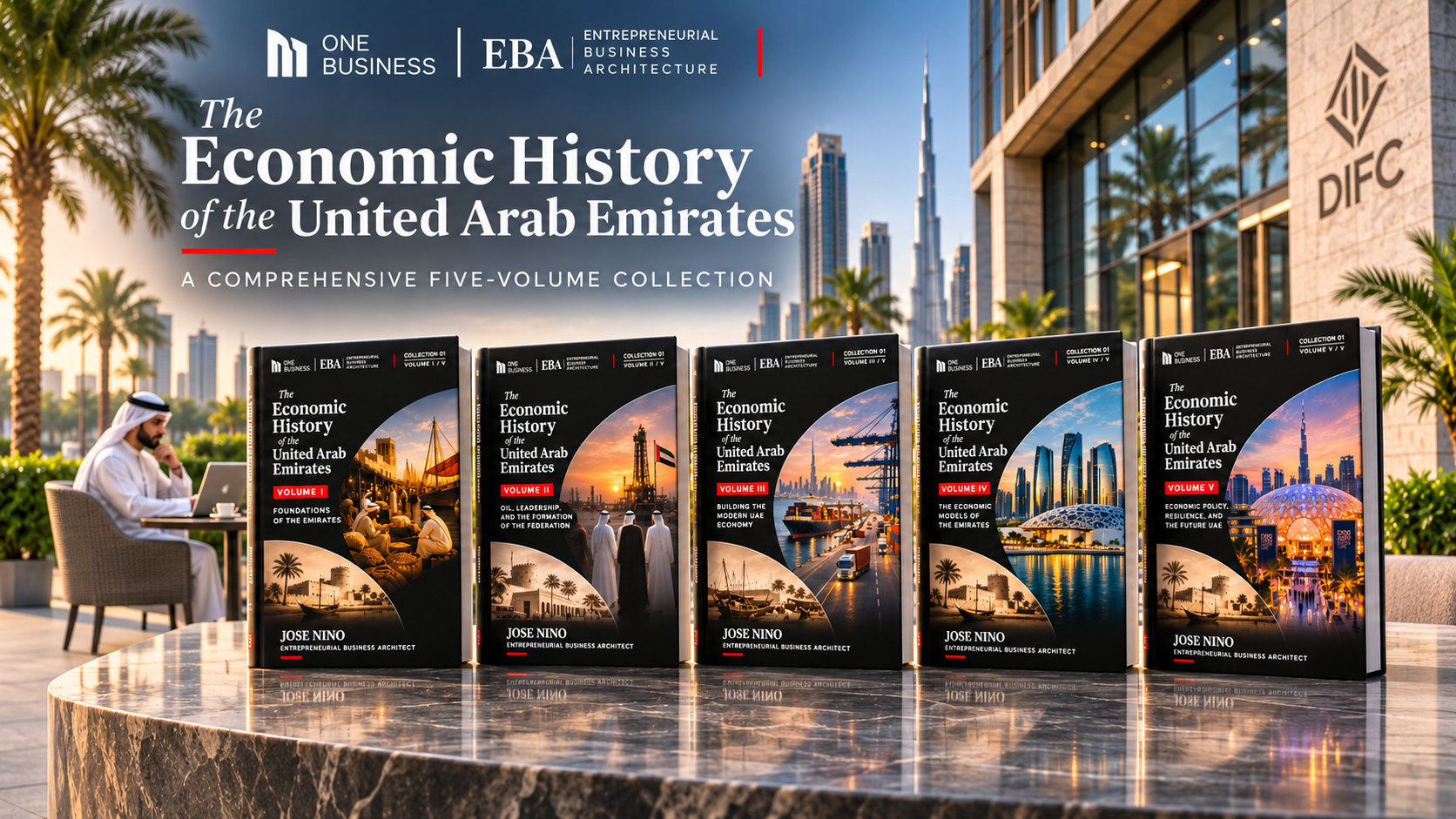
Explore The Economic History of the United Arab Emirates — Complete Five-Volume Collection
The five-volume digital collection provides entrepreneurs, executives, investors, and international business professionals with a historical perspective on the economic transformation of the United Arab Emirates. Through its examination of commercial activity, leadership, institutions, resources, infrastructure, and economic diversification, the collection helps readers understand the circumstances that contributed to the emergence of the country's modern business environment. These insights are particularly relevant to entrepreneurs seeking to establish and expand businesses because they demonstrate that commercial opportunities develop through the interaction of people, capabilities, institutions, and markets rather than through financial resources alone.
The complete five-volume digital collection is available for USD 29.99, and entrepreneurs can explore The Economic History of the United Arab Emirates — Complete Collection through the official ONE Business Dubai book page. Understanding the historical development of the Emirates helps contemporary founders appreciate the importance of long-term commercial relationships and the productive networks through which businesses have contributed to economic transformation.
The historical lessons are relevant to present-day entrepreneurs because the fundamental importance of trust, capability, and cooperation remains unchanged even as industries, infrastructure, and commercial technologies evolve. Businesses continue to depend on customers willing to purchase their products, suppliers capable of fulfilling commitments, professional advisers who provide relevant expertise, and partners whose resources complement their own. The specific mechanisms through which these relationships are organized may change, but the underlying entrepreneurial challenge remains the same: discovering opportunities and coordinating capabilities to create value.
Entrepreneurs who understand this connection can approach networking and partnership development with a more strategic perspective. Instead of treating professional relationships as incidental aspects of doing business, they can recognize them as resources that require deliberate development, sound judgment, and responsible management. The goal is not to build the largest possible network but to establish relationships that contribute meaningfully to opportunity discovery, business creation, market development, and sustainable growth.
Building Businesses Through Relationships: The Entrepreneurial Strategy for Dubai and the UAE
The United Arab Emirates provides entrepreneurs with opportunities to establish businesses within an internationally connected economic environment characterized by diverse industries, specialized commercial communities, and institutions that support different forms of business activity. However, these opportunities do not eliminate the fundamental responsibilities of entrepreneurship. Founders must develop personal capabilities, identify genuine market needs, create suitable organizations, attract customers, manage resources, and establish commercial relationships that support sustainable operations. Strategic networking and partnerships contribute to this process when they help entrepreneurs discover opportunities and coordinate complementary capabilities, but they cannot substitute for the quality of the products, services, and decisions upon which successful enterprises depend.
For entrepreneurs entering Dubai, one of the most productive strategic commitments is to approach professional relationships as a long-term dimension of enterprise development. The objective should not be limited to obtaining immediate sales or introductions. Founders should seek to understand their markets, establish credibility, contribute useful knowledge, and identify opportunities for cooperation that generate meaningful value. This requires patience because trust develops through repeated professional behavior, and commercially significant relationships may emerge gradually as individuals gain experience working together.
Strategic partnerships become particularly important when enterprises begin expanding beyond their initial capabilities. A business may require access to specialized expertise, additional distribution channels, operational infrastructure, or commercial relationships in new markets. Appropriate collaboration can help address these needs, provided that the entrepreneur carefully evaluates the capabilities and objectives of potential partners. Sound governance, transparent agreements, and clear performance expectations are essential because growth increases the complexity of commercial arrangements and the consequences of unsuitable decisions.
The development of these relationships ultimately depends on the entrepreneur's personal and professional capabilities. Confidence, communication, judgment, leadership, integrity, and financial discipline influence the ability to recognize productive opportunities and manage partnerships effectively. These capabilities are central to Entrepreneurial Business Architecture because the individual entrepreneur represents the starting point of the business creation and development process. The enterprise becomes stronger when its founder develops the knowledge and competencies necessary to organize resources, establish relationships, and make decisions that support long-term performance.
The central entrepreneurial lesson is that connections create access, trust creates opportunities, and strategically managed partnerships can transform those opportunities into sustainable business growth. Each element depends on the others. Connections without professional competence may produce little commercial value, while trust without a viable business proposition may remain an important personal relationship without becoming a productive partnership. Strategic collaboration becomes economically meaningful when the participating parties possess complementary capabilities and establish arrangements through which those capabilities contribute to customer value and organizational development.
For international founders ready to establish their enterprises in the UAE, ONE Business Dubai provides professional company formation and business registration services for USD 1,200 plus applicable government, licensing, and third-party costs. Our services help entrepreneurs organize the legal foundation for their intended commercial activities, with registration within 24 hours available for eligible applications when jurisdictional requirements and authority approvals permit. Founders can discover ONE Business Dubai's company formation services and begin developing the enterprise through which they intend to participate in the country's commercial opportunities.
The next stage of the entrepreneurial journey involves transforming that legal foundation into a productive business through market knowledge, customer relationships, operational capabilities, and strategic partnerships. Entrepreneurs who develop these elements systematically can strengthen their ability to compete, expand, and create meaningful economic value within Dubai and across the United Arab Emirates. The greatest opportunities emerge when personal ambition is connected with the capabilities of other individuals and organizations through relationships built on credibility, competence, and mutual benefit.
At ONE Business Dubai, we believe that entrepreneurship represents one of the most powerful instruments for the economic and social transformation of individuals and communities. That transformation begins when people develop the capabilities necessary to discover opportunities and create successful enterprises. Strategic relationships strengthen the process by connecting entrepreneurial ambition with knowledge, customers, resources, and opportunities that can support business development. Entrepreneurs who learn to build relationships thoughtfully, establish productive partnerships, and manage growth responsibly can create organizations whose value extends beyond the ambitions of a single individual.
ONE Business Dubai — Discover Opportunities. Build Connections. Develop Partnerships. Grow Businesses. Transform Your Future.