ONE BUSINESS / INSIGHTS / ARTICLE 33
The Five Cs of Credit: How Banks Assess Entrepreneurs
A practical framework for understanding character, capacity, capital, collateral and conditions when preparing a UAE business for financing.

Entrepreneurs often approach financing as a presentation exercise: explain the opportunity, show the growth plan and persuade a financial institution to support the next stage of the business. A lender approaches the same conversation from another direction. Its task is to decide whether the proposed credit exposure is understandable, appropriately structured and likely to be repaid under both expected and adverse circumstances.
The Five Cs of Credit—character, capacity, capital, collateral and conditions—offer entrepreneurs a practical framework for understanding that decision. They are not a universal scorecard, a statutory formula or a guarantee of approval. Every institution applies its own underwriting policies, risk appetite, product requirements and regulatory obligations. Nevertheless, the framework helps founders organize the evidence that makes a business easier to assess.
In the United Arab Emirates, this preparation matters because regulated financial institutions must conduct robust credit due diligence. The Central Bank of the UAE's in-force Credit Risk Management Standards require lenders to develop a documented understanding of the purpose of a credit facility and relevant financial parameters, including leverage, liquidity, net worth, operating cash flows and debt-service capacity. The Five Cs translate that institutional perspective into questions an entrepreneur can address before submitting an application.
The Five Cs Are Connected, Not Independent Tests
A common mistake is to treat each C as a separate box. In practice, they interact. Strong cash generation may compensate for limited collateral in one product, while substantial assets may not overcome persistent operating losses in another. A credible management team may improve confidence in a growth plan, but credibility cannot replace evidence that the company can service the proposed obligation.
The framework is most useful when it reveals relationships. Character concerns the reliability and transparency of the people and organization behind the application. Capacity examines the cash available to repay. Capital considers the financial commitment and resilience already built into the company. Collateral concerns assets or other protections that may reduce loss if repayment fails. Conditions examine the purpose, structure and external environment surrounding the request.
An entrepreneur should therefore ask a more demanding question than “Which C is strongest?” The better question is “Does the complete financial architecture tell a coherent story?”
Character: Demonstrating Reliability Through Evidence
In commercial credit, character does not mean personality, charm or an inspiring founder story. It concerns whether the borrower and the people directing the enterprise appear willing and able to meet their responsibilities. Lenders may consider repayment conduct, transparency, management experience, ownership structure, corporate governance and the consistency of information presented throughout the application.
Character becomes visible in operational details. Are company and personal transactions clearly separated? Can shareholder transfers be explained? Do bank statements, financial accounts, invoices and tax records describe the same business? Are beneficial owners and related entities disclosed accurately? Does management respond directly when a weakness or unusual transaction requires explanation?
Credit information can form part of this assessment. Depending on the product and institution, lenders may review information concerning the company, owners, active partners or guarantors. Entrepreneurs should not wait for an application to discover inaccuracies or unresolved obligations. They should understand their credit position, address errors through the appropriate channels and maintain records showing how prior difficulties were resolved.
Character is strengthened by candour. Concealing a weak quarter, a customer dispute or an existing obligation can create more concern than the underlying problem. A lender can assess a disclosed risk; it cannot comfortably assess information that appears incomplete or contradictory.
Capacity: Showing How Repayment Will Actually Occur
Capacity is the operational core of most lending decisions. It asks whether the enterprise is expected to generate sufficient cash to meet existing commitments and the proposed financing obligation when payments fall due.
Revenue alone does not establish capacity. A company can report growing sales while experiencing severe cash pressure because customers pay slowly, margins are thin, inventory absorbs funds or supplier obligations arise earlier than customer receipts. Profit also differs from cash. Non-cash accounting items, capital expenditure, debt repayments and changes in working capital can produce a substantial gap between reported earnings and money available for debt service.
A useful preparation exercise is to build a monthly cash-flow forecast that reconciles opening cash, customer collections, operating payments, taxes, capital expenditure, existing financing obligations and the proposed repayment schedule. Assumptions should be connected to evidence: signed contracts, historical collection patterns, confirmed orders, supplier terms and realistic sales conversion rates.
Entrepreneurs should also stress-test capacity. What happens if a major customer pays 45 days late? What if gross margin declines, a project is postponed or an essential input becomes more expensive? The objective is not to predict every disruption. It is to demonstrate that management understands the company's financial sensitivities and has identified actions that can preserve liquidity.
Financial institutions may use ratios such as leverage, liquidity measures and debt-service coverage, but definitions and acceptable thresholds vary. Founders should avoid presenting a single ratio as if it creates an entitlement to financing. The more valuable discipline is to explain the calculation, the source data and the margin available if results fall below plan.
Capital: Understanding the Entrepreneur's Financial Commitment
Capital concerns the financial resources already committed to the enterprise and the ability of the company to absorb losses. It may include paid-in shareholder funds, retained earnings and the net worth accumulated through business activity. A lender examines capital partly because debt should normally support a viable economic structure rather than replace every form of owner commitment.
The appropriate balance between equity and borrowing depends on the industry, development stage, asset base, revenue visibility and purpose of financing. A young technology venture with uncertain early revenue may require a different capital structure from an established distributor financing confirmed purchase orders. There is no universal percentage that makes every business bankable.
Entrepreneurs should be able to explain where their capital came from, how it has been deployed and what resources remain available. They should also distinguish permanent capital from short-term shareholder advances that may be repayable on demand. Ambiguous related-party balances can make it difficult to understand the true financial position of the company.
Capital communicates alignment, but it also creates resilience. A business with an adequate financial cushion may be better able to withstand delayed receivables, seasonal volatility or unexpected operating costs without immediately defaulting on its obligations.
Collateral: Evaluating Protection Without Confusing It With Repayment
Collateral refers to assets or rights that may support a financing arrangement and reduce a lender's potential loss if the borrower fails to repay. Depending on the facility, this may involve equipment, property, inventory, receivables, deposits or other eligible assets. Guarantees and contractual protections can also influence the risk structure, although they are not identical to collateral.
Entrepreneurs sometimes assume that valuable assets automatically produce approval. That assumption overlooks two issues. First, lenders generally prefer repayment from the normal cash generation of the business, not through enforcement. Second, the value available from an asset can differ from its purchase price or accounting value because of depreciation, marketability, legal priority, location, condition and the time and cost required to realize it.
Before offering security, founders should understand exactly what is being pledged, how it may be valued, whether another party already has rights over it and what a default could mean for business continuity. The same caution applies to personal guarantees. A guarantee can create obligations beyond the assets held by the company, subject to its terms and applicable law.
Some financing channels may use risk-sharing mechanisms. Emirates Development Bank, for example, describes credit-guarantee arrangements with partner banks intended to support eligible SMEs that might otherwise face financing constraints. Eligibility varies with the business, project, creditworthiness, viability and alignment with the institution's strategic objectives. The existence of a guarantee program is therefore not a promise of approval.
Conditions: Connecting the Request to Its Economic Context
Conditions cover both the specific purpose and structure of the financing and the wider environment in which the borrower operates. A lender may consider the requested amount, tenor, repayment profile and use of funds alongside industry conditions, customer concentration, regulatory developments, geographic exposure and the economic outlook.
The financing purpose should be precise. “Business expansion” is too broad to explain how capital will generate the cash required for repayment. A stronger request identifies whether funds will purchase equipment, finance inventory, bridge receivables, complete a project or establish additional operating capacity. It then connects that use to measurable commercial activity and an appropriate repayment period.
Structure matters. Short-term working-capital finance may be unsuitable for an investment whose returns emerge over many years. Long-tenor borrowing may be inefficient for a brief and predictable cash-cycle requirement. The timing of the facility should correspond, as far as practicable, with the timing of the economic benefit it finances.
External risks must also be addressed honestly. A trading business may face currency, logistics and inventory risks. A contractor may be exposed to project delays, retention payments and customer concentration. A professional firm may depend on a small number of specialized employees. Showing how the company monitors and mitigates its actual risks is more credible than claiming the business is largely unaffected by uncertainty.
Translating the Five Cs Into a Financing File
The framework becomes valuable when converted into organized evidence. The exact documents vary by institution and product, but a financing file may include valid constitutional and licensing records, ownership and beneficial-owner information, financial statements, recent management accounts, business bank statements, tax records, customer and supplier documentation, receivables and inventory ageing, existing debt schedules, details of the proposed use of funds and forecasts showing repayment capacity.
Documentation requirements are not identical across the UAE market. Publicly stated bank criteria illustrate this variation: some products specify minimum operating history and turnover, request twelve months of bank statements, require audited statements above a stated facility amount or seek credit-bureau consent and detailed commercial records. Entrepreneurs must verify the requirements of the particular lender and product rather than assume that one checklist applies everywhere.
Accuracy matters as much as completeness. Financial records should reconcile with bank activity, VAT or corporate tax information where applicable, and the commercial narrative presented to the lender. The UAE Federal Tax Authority also requires relevant taxpayers to maintain records supporting their tax filings. Good record keeping therefore supports both compliance and financial credibility.
A Practical Five-Cs Self-Assessment
Character questions
Can management explain the ownership structure, business activity and transaction history consistently? Are credit obligations current? Are unusual payments, shareholder movements and related-party transactions documented? Does the application disclose material risks rather than waiting for the lender to discover them?
Capacity questions
What specific cash source will make each repayment? How do historical results support the forecast? What happens under slower collections, reduced margins or lower sales? Can the company meet existing and proposed obligations without depending on continuous emergency borrowing?
Capital questions
How much permanent capital has been committed? What losses or delays can the balance sheet absorb? Are shareholder balances clearly classified? Is the proposed borrowing proportionate to the company's scale, development stage and risk?
Collateral questions
Which assets are available, who owns them and are they already encumbered? How stable and realizable is their value? Would pledging them impair operations? Do the founders understand the consequences of security and guarantees?
Conditions questions
Is the use of funds precise and commercially justified? Does the proposed term match the economic life or cash cycle of that use? Which industry, customer, regulatory and economic risks could alter repayment, and what actions has management prepared?
Building Credit Readiness Through Entrepreneurial Business Architecture
Entrepreneurial Business Architecture (EBA) treats financing readiness as the result of business development, not a document-gathering exercise performed immediately before meeting a bank. Character develops through responsible leadership and transparent governance. Capacity develops through a viable business model, disciplined market development and cash-flow management. Capital develops through appropriate owner commitment and retained value. Collateral develops through productive asset creation. Conditions are managed through strategic awareness and informed structuring.
This integrated perspective changes the objective. The entrepreneur is not merely trying to “pass” five tests. The entrepreneur is building an enterprise whose risks, resources and economic logic can be understood by customers, partners, investors and financial institutions.
Company formation is an early part of that architecture. A correctly selected legal structure, valid licensed activity, transparent ownership record and organized corporate documentation create a foundation for subsequent operations. They do not guarantee a corporate bank account or financing approval, but weaknesses at this stage can complicate later due diligence.
ONE Business Dubai assists international entrepreneurs with company formation and business registration in Dubai and across the United Arab Emirates. Our role is to help establish the legal foundation of the enterprise; lending decisions remain exclusively with the relevant financial institution.
Understand the Economy Behind the Credit Decision
Credit conditions do not develop in isolation. They reflect the evolution of institutions, industries, regulation, infrastructure and economic priorities. Entrepreneurs who understand that wider context can make better decisions about where to establish, how to structure investment and which capabilities their businesses must develop.
Economic History of the UAE for Entrepreneurs, written by J. Nino as a five-volume Entrepreneurial Business Architecture collection, examines the transformation of the Emirati economy from an entrepreneurial perspective. Its relevance to credit readiness lies in helping founders see financing as one component of a larger institutional and economic system rather than as a stand-alone transaction.
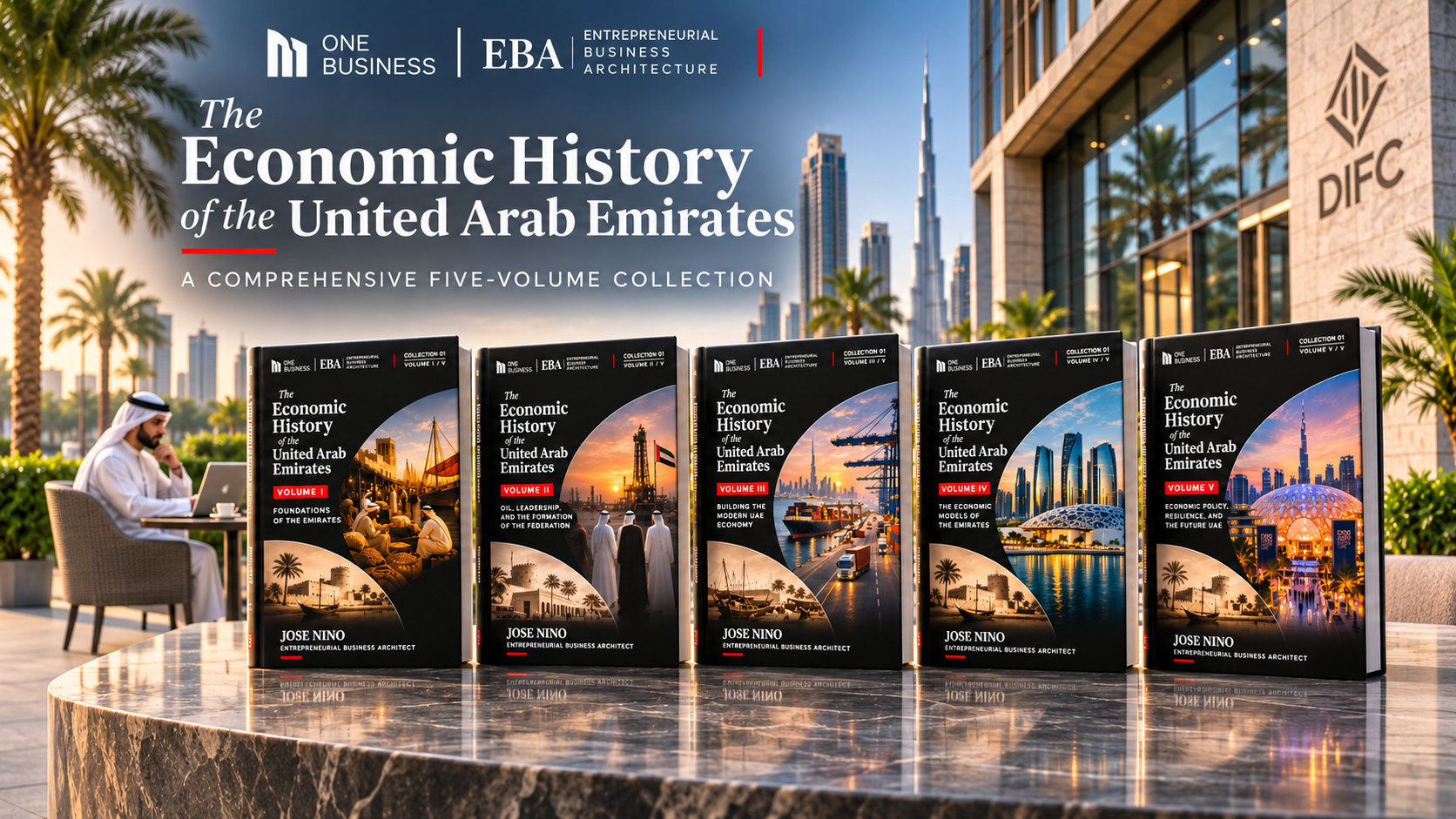
Explore The Economic History of the United Arab Emirates — Complete Collection
From Credit Application to Sustainable Enterprise
The Five Cs provide a language for examining a financing request, but their greatest value appears before an application is submitted. They expose incomplete records, cash-flow weaknesses, inadequate capitalization, misunderstood security risks and financing structures that do not match the underlying business need.
An entrepreneur who addresses those weaknesses may improve the clarity and credibility of an application. More importantly, the same work can create a stronger enterprise. Better cash forecasting supports operational decisions. Clearer records improve governance. Appropriate capital protects resilience. Careful financing structures reduce avoidable pressure.
No framework can promise that a bank will approve a facility. Credit decisions depend on the institution, product, borrower, sector, available evidence and conditions at the time of assessment. The responsible objective is therefore not to manufacture the appearance of bankability. It is to develop the genuine financial capabilities that make sustainable borrowing possible.
Start Your Business in Dubai and the United Arab Emirates
ONE Business Dubai provides professional company formation and business registration services in Dubai and across the United Arab Emirates for a professional service fee of USD 1,200, plus applicable government fees.
To facilitate international business formation, we offer flexible payment options for entrepreneurs worldwide:
- Bank Transfer: USD, EUR, GBP and AED.
- Credit Card: Subject to an additional 5% processing fee.
- Cryptocurrency: USDT via the TRC20 or Polygon network.
Through Entrepreneurial Business Architecture (EBA), our educational resources, our book collection and our professional business formation services, we help international entrepreneurs develop the knowledge and establish the legal foundations necessary to create and grow their businesses in the United Arab Emirates.
Contact ONE Business Dubai today to discuss your business formation requirements, request a personalized quotation and begin your entrepreneurial journey in the UAE.