ONE BUSINESS / INSIGHTS / ARTICLE 30
What UAE Banks Look for When Financing a Business
Understanding how financial institutions evaluate business viability, repayment capacity and entrepreneurial credibility in the United Arab Emirates.

The United Arab Emirates offers international entrepreneurs an increasingly sophisticated financial environment in which businesses can access commercial banking, development finance and specialized funding solutions. However, establishing a legally registered company and obtaining financing for its development are fundamentally different achievements.
While entrepreneurs naturally evaluate their businesses according to their potential for innovation, profitability and growth, financial institutions examine those same enterprises from the perspective of financial risk and repayment capacity.
Understanding this distinction is essential for entrepreneurs seeking to establish, develop and expand businesses in Dubai and across the United Arab Emirates.
Understanding the Perspective of a Financial Institution
When entrepreneurs approach a bank, they frequently concentrate on explaining what they intend to achieve with the requested capital. They describe their products, market opportunities, expansion strategies and expectations for future revenue.
A financial institution must consider these opportunities while addressing a different fundamental question: whether the enterprise will be capable of fulfilling its financial obligations under the proposed financing arrangement.
Banks therefore evaluate not only entrepreneurial ambition but also the economic evidence supporting that ambition. They examine the relationship between commercial activity, financial performance, existing obligations and the resources available to sustain repayment.
A promising business opportunity does not automatically constitute a suitable lending opportunity. An enterprise must demonstrate that its economic architecture can support the financial commitments associated with borrowing.
The Viability of the Business Model
One of the fundamental considerations in business financing is whether an enterprise operates according to a commercially viable business model.
Financial institutions may seek to understand what the company sells, who purchases its products or services, how revenue is generated and whether its operations can produce sustainable economic returns.
For example, a technology entrepreneur may have developed an innovative digital solution with considerable market potential. Nevertheless, if the enterprise has not established a reliable method of customer acquisition or revenue generation, conventional debt financing may be difficult to justify.
Similarly, a trading company may generate considerable sales while operating with extremely narrow profit margins, leaving insufficient resources to absorb unexpected expenses or declining demand.
Entrepreneurs must therefore develop the ability to communicate their business model through measurable economic relationships rather than relying exclusively on descriptions of market potential.
A credible business model connects customer demand, revenue generation, operational expenditure, profitability and financial sustainability.
Revenue Quality and Commercial Stability
The amount of revenue generated by an enterprise is important, but its quality and consistency can be equally significant.
A company generating recurring income from multiple established customers may demonstrate a different financial risk profile from a company generating similar revenue through occasional transactions with a single customer.
Financial institutions may examine historical sales, customer concentrations, contractual arrangements, payment patterns and the sustainability of commercial relationships.
Entrepreneurs should understand that rapid revenue growth does not necessarily indicate financial stability. If growth depends heavily on a temporary market opportunity or an individual commercial relationship, future income may remain uncertain.
Building diversified customer relationships and establishing predictable revenue streams can strengthen the economic resilience of an enterprise.
This process should form part of the company's market development strategy rather than becoming a temporary exercise undertaken immediately before submitting a financing application.
Cash Flow and Repayment Capacity
Cash flow represents one of the most important financial considerations in business lending.
An enterprise may report accounting profits while experiencing significant difficulties meeting its immediate financial obligations. This situation frequently arises when customers receive extended payment terms while suppliers, employees and other operating expenses must be paid much earlier.
Consider a UAE-based distribution company generating AED 300,000 in monthly sales. If most customers pay after 90 days while suppliers require payment within 30 days, the company may encounter substantial working capital requirements despite maintaining profitable operations.
Financial institutions must evaluate whether sufficient cash will be available when scheduled repayments become due.
An entrepreneur should therefore distinguish between revenue, accounting profit and actual cash availability. These financial concepts describe different dimensions of business performance and cannot be treated as interchangeable.
A financially organized enterprise regularly forecasts incoming payments, operating expenses, tax obligations, existing debt repayments and anticipated investment requirements.
Understanding Debt Service Capacity
Financial institutions may use different analytical measures to evaluate whether an enterprise can support additional borrowing.
One commonly used concept in commercial credit analysis is the debt service coverage ratio. This measure compares the cash or earnings available for debt servicing, as defined for the assessment, with the principal and financing costs payable during a corresponding period.
For illustrative purposes, consider a business generating AED 240,000 annually in cash available for debt service while facing annual debt obligations of AED 160,000. Its illustrative coverage ratio would be 1.5.
If available cash subsequently declined to AED 160,000, the company would have no remaining coverage margin under those assumptions.
The precise calculation methods and acceptable thresholds vary among lenders and financing arrangements. Entrepreneurs should not interpret a particular ratio as a universal approval requirement.
The underlying entrepreneurial lesson is that borrowing decisions must accommodate uncertainty. Financial obligations remain payable even when business performance falls below expectations.
The Importance of Reliable Financial Statements
Financial statements allow lenders to examine the economic development of an enterprise beyond the explanations provided by its founders.
Income statements reveal the relationship between revenue and expenditure. Balance sheets provide information about assets, liabilities and equity. Cash flow statements help explain how financial resources move throughout the organization.
Together, these documents allow financial institutions to develop a more comprehensive understanding of business performance.
Depending on the financing product and the circumstances of the applicant, UAE banks may request management accounts, audited financial statements, historical bank statements and additional supporting documentation.
Entrepreneurs should establish appropriate accounting systems from the beginning of their business activities.
Reconstructing several years of financial transactions immediately before applying for financing can create delays, administrative costs and inconsistencies.
Financial reporting should be understood as an entrepreneurial management capability rather than simply a regulatory obligation.
Banking Transactions and Financial Transparency
Business bank statements provide financial institutions with evidence of how an enterprise conducts its economic activities.
Through transaction records, lenders may examine the frequency of customer payments, operating expenditures, supplier relationships, existing financial commitments and fluctuations in available balances.
A company whose banking transactions correspond consistently with its stated commercial activities can provide a more coherent explanation of its financial circumstances.
International entrepreneurs should maintain a clear distinction between personal expenditure and business operations, ensuring that transfers involving shareholders or related companies are appropriately documented.
Transparency does not require every business to demonstrate identical transaction patterns. Different industries naturally operate according to different financial cycles.
What matters is that the financial activity can be explained accurately and supported by legitimate commercial documentation.
Credit History and Financial Responsibility
Credit assessment may extend beyond the financial statements submitted by an enterprise.
Depending on the financing arrangement, financial institutions may obtain relevant credit information concerning the company, its owners or its guarantors, including information available through Al Etihad Credit Bureau.
Existing borrowing, repayment conduct and financial commitments can influence an institution's assessment of additional financing.
Entrepreneurs should recognize that financial credibility develops over time through responsible economic behavior.
Meeting obligations when they become due, maintaining accurate financial records and avoiding unsustainable borrowing contribute to the development of an enterprise's financial reputation.
A newly established company may have limited credit history. However, this does not necessarily prevent access to every financing option. Different products and institutions apply different eligibility and risk assessment criteria.
The Entrepreneur's Capital Commitment
Financial institutions may also consider the amount of capital committed by the founders or shareholders of a business.
An enterprise financed almost entirely through borrowing may present a different risk profile from one supported by meaningful shareholder investment and accumulated earnings.
Equity provides financial resources without the same scheduled repayment obligations associated with conventional debt.
It can also help an enterprise withstand unexpected operating losses, delayed customer payments and temporary changes in market conditions.
Entrepreneurs should consequently evaluate the relationship between their own capital contributions and external financing requirements.
The objective should not necessarily be to minimize personal investment. It should be to establish a capital structure appropriate to the commercial characteristics, risks and development stage of the enterprise.
Collateral, Guarantees and Financial Risk
Depending on the financing arrangement, a lender may request assets as security, shareholder guarantees or other contractual protections.
Commercial property, equipment, receivables and other eligible assets may support certain types of secured financing.
However, the availability of collateral should not be confused with the economic sustainability of the underlying business.
A company whose operations repeatedly fail to generate sufficient cash may experience serious financial difficulties even when its borrowing is secured by valuable assets.
Entrepreneurs must also understand the legal and financial consequences of providing personal guarantees or pledging business assets.
In particular, a personal guarantee can create obligations that extend beyond the financial resources of the company itself, subject to its contractual terms and applicable law.
Before accepting financing, entrepreneurs should examine the potential consequences of unfavorable commercial outcomes, not merely the opportunities associated with obtaining capital.
The Purpose of the Requested Financing
Financial institutions need to understand why an enterprise requires additional capital and how that capital will contribute to its operations or development.
A company requesting financing to acquire productive equipment presents a different financing requirement from a company seeking funds to purchase inventory or bridge delays in customer payments.
The useful life of the financed investment, the timing of anticipated economic returns and the company's operating cycle should influence the selection of a financing arrangement.
Using short-term borrowing to finance investments that generate returns only after several years can create unnecessary repayment pressure.
Similarly, continuously increasing debt to compensate for recurring operational losses may postpone rather than resolve weaknesses in the underlying business model.
Entrepreneurs should identify the economic problem that financing is intended to solve and demonstrate how the proposed use of capital contributes to a sustainable solution.
Management Capability and Entrepreneurial Credibility
A business is not merely a collection of financial assets, commercial agreements and projected revenue. It is an organization whose economic performance depends substantially on the capabilities of the individuals directing it.
Financial institutions may examine the professional experience, industry knowledge and management capabilities of founders and senior executives.
An entrepreneur who understands the operational and financial dimensions of an enterprise is better positioned to identify risks, respond to commercial challenges and allocate resources effectively.
This is particularly important when assessing relatively new enterprises with limited historical financial records.
Entrepreneurial credibility does not depend exclusively on formal qualifications or previous business success. It also emerges from the ability to make informed decisions, communicate realistic plans and demonstrate a disciplined understanding of commercial responsibilities.
Developing these capabilities is a continuous component of entrepreneurial education.
Industry Conditions and External Economic Risks
The financial position of an enterprise cannot be evaluated independently of the economic environment in which it operates.
Changes in customer demand, competition, commodity prices, supply chains, exchange rates and regulatory requirements can influence the future performance of a business.
A construction-related enterprise may face risks arising from project delays and payment cycles. An international trading company may encounter inventory exposure, currency fluctuations or changing transportation costs. A professional services company may depend heavily on the retention of specialized employees.
These businesses require different approaches to financial planning.
Entrepreneurs should demonstrate an understanding of the risks associated with their industries and explain how their organizations can respond to unfavorable developments.
A realistic financial forecast should include more than an optimistic projection. It should consider alternative scenarios and the resources required to maintain operations when circumstances change.
Corporate Governance and Regulatory Compliance
Financial institutions operate within regulated environments and must understand the legal identity, ownership and authorized activities of their business customers.
Entrepreneurs should maintain accurate corporate records, valid commercial licenses, appropriate ownership documentation and financial records corresponding to their actual business activities.
Where applicable, businesses must also comply with relevant corporate tax, VAT, reporting and other regulatory obligations.
A legally established and appropriately organized company provides a clearer foundation for establishing financial relationships.
At ONE Business Dubai, our company formation and business registration services help international entrepreneurs establish the legal foundations of their enterprises in Dubai and across the United Arab Emirates.
However, registration alone does not establish creditworthiness, and neither company formation nor the opening of a corporate bank account guarantees financing approval.
Financial credibility must be developed through the subsequent organization and economic performance of the enterprise.
Understanding Commercial and Development Finance
Entrepreneurs in the UAE can explore financing opportunities through commercial banks and specialized development finance institutions.
Commercial lenders provide different arrangements intended to address operational requirements, investment projects and business expansion.
Emirates Development Bank also supports economic development through financing solutions aimed at eligible companies and strategically relevant activities. Its approach can involve business viability, credit assessment and alignment with its development objectives.
Certain businesses may also benefit from credit guarantee arrangements involving participating financial institutions.
Nevertheless, the existence of a financing program should not be interpreted as an entitlement to capital.
Entrepreneurs must investigate the eligibility requirements associated with the particular product, sector and institution before incorporating anticipated financing into their business plans.
Official information published by Emirates NBD and Emirates Development Bank illustrates the importance of financial documentation, commercial viability, credit assessment and the suitability of the proposed financing purpose.
Designing a Financially Sustainable Enterprise Through EBA
Entrepreneurial Business Architecture (EBA) approaches business development as an integrated process connecting entrepreneurial capabilities, opportunity discovery, business creation, market development and organizational growth.
From this perspective, access to financing should not be treated as an isolated administrative objective.
The financial credibility of an enterprise emerges from the interaction between its business model, commercial relationships, organizational capabilities, financial controls and strategic decisions.
When these elements have been developed coherently, entrepreneurs are better positioned to communicate the economic characteristics of their enterprises to financial institutions.
An entrepreneur who understands customer demand, monitors financial performance, manages working capital and develops realistic growth strategies is building capabilities that extend far beyond the immediate objective of obtaining a loan.
The ultimate objective is to create an enterprise capable of generating sustainable economic value, whether its development is financed through shareholder investment, accumulated profits, external investors or appropriate banking arrangements.
Understanding the Economic Foundations of the UAE
Entrepreneurs seeking to establish businesses in the United Arab Emirates can benefit from understanding the historical transformation of the country's economy and financial institutions.
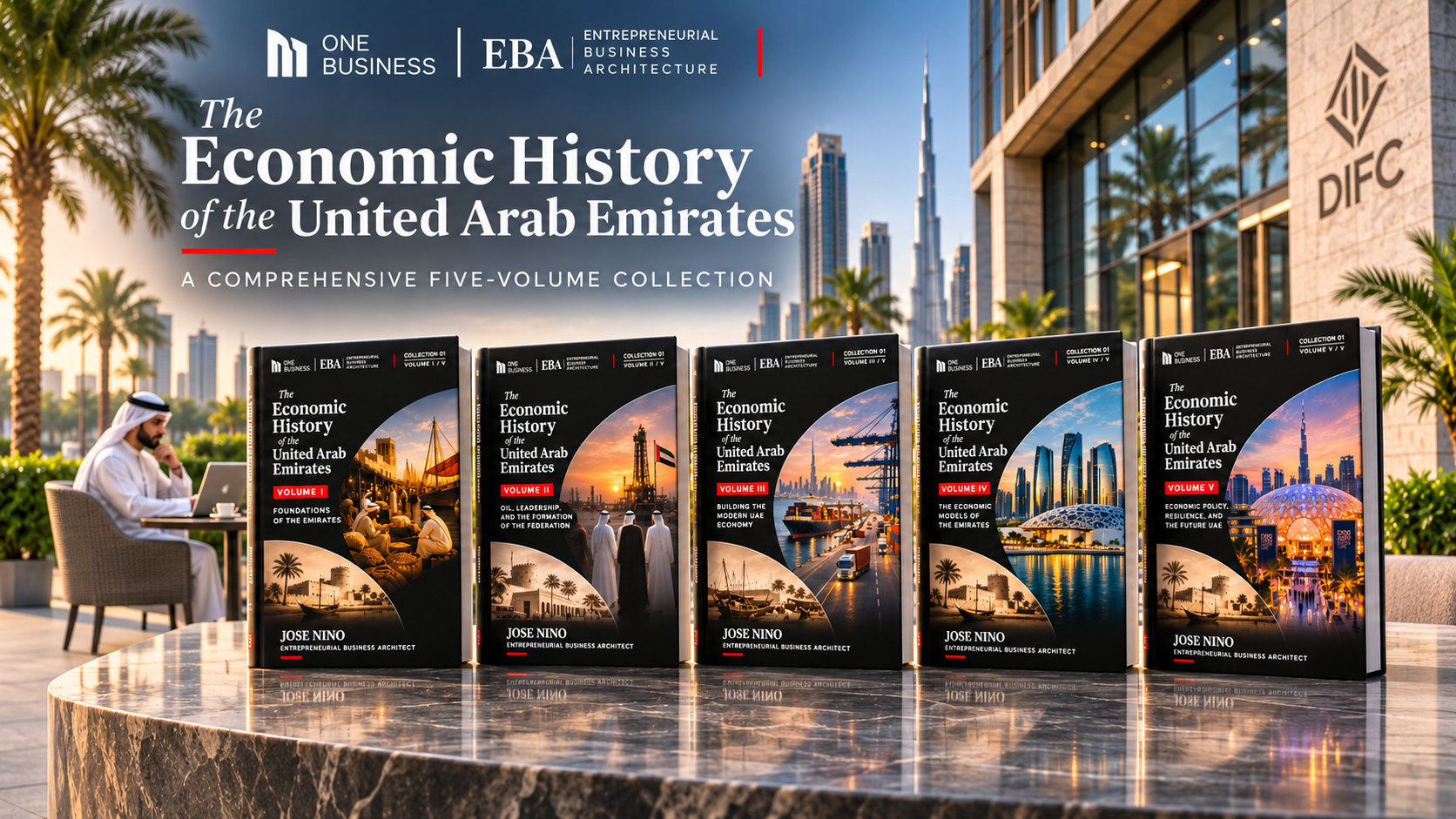
Economic History of the UAE for Entrepreneurs, part of the Entrepreneurial Business Architecture book collection, provides a broader perspective on the economic development of the Emirates and the institutional foundations supporting entrepreneurial activity.
Understanding this transformation allows international entrepreneurs to approach the UAE not simply as a jurisdiction in which companies can be registered, but as an evolving economic environment shaped by infrastructure development, international commerce, institutional innovation and economic diversification.
Explore the Economic History of the United Arab Emirates — Complete Five-Volume Collection.
Start Your Business in Dubai and the United Arab Emirates
ONE Business Dubai provides professional company formation and business registration services in Dubai and across the United Arab Emirates for a professional service fee of USD 1,200, plus applicable government fees.
To facilitate international business formation, we offer flexible payment options for entrepreneurs worldwide:
**Bank Transfer:** USD, EUR, GBP and AED.
**Credit Card:** Subject to an additional 5% processing fee.
**Cryptocurrency:** USDT via the TRC20 or Polygon network.
Through Entrepreneurial Business Architecture (EBA), our educational resources, our book collection and our professional business formation services, we help international entrepreneurs develop the knowledge and establish the legal foundations necessary to create and grow their businesses in the United Arab Emirates.
Contact ONE Business Dubai today to discuss your business formation requirements, request a personalized quotation and begin your entrepreneurial journey in the UAE.