ONE BUSINESS / INSIGHTS / ARTICLE 22
Why Hong Kong and Asian Companies Are Expanding to Dubai: Building a UAE Business Presence for International Growth
How the expanding economic relationship between Hong Kong and the United Arab Emirates creates opportunities for Asian entrepreneurs — and why establishing the right corporate structure in Dubai helps transform international market access into sustainable business growth.

The growing economic relationship between Hong Kong and the United Arab Emirates is creating important opportunities for entrepreneurs, established corporations, technology companies, international traders, and investors seeking to expand their activities between Asia and the Middle East. What was historically associated with maritime commerce, logistics, financial services, and the movement of merchandise is developing into a broader commercial relationship involving technological innovation, institutional investment, advanced manufacturing, digital finance, and the international expansion of enterprises.
For Hong Kong companies and businesses operating throughout Asia, Dubai offers an opportunity to establish a corporate presence within an economy whose infrastructure, commercial institutions, and international relationships support a wide range of cross-border activities. The emirate's economic environment provides access to specialized free zones, international transportation facilities, commercial services, financial institutions, and business communities connecting the Gulf with markets across Africa, South Asia, and other regions. However, the strategic advantage of Dubai is not simply that Asian companies can register a business there. Its importance lies in how a properly established UAE company helps entrepreneurs organize commercial relationships, serve regional customers, develop partnerships, and participate more effectively in international markets.
Understanding this distinction is essential for businesses evaluating expansion beyond Hong Kong, mainland China, Singapore, South Korea, Japan, India, and other Asian economies. International growth requires more than identifying a promising geographical destination. It requires determining how an enterprise will operate within the new market, which corporate structure supports its activities, and what commercial capabilities must be developed to transform market access into sustainable revenue. ONE Business Dubai supports this process by providing professional UAE company formation services for international entrepreneurs and established foreign companies, including businesses headquartered in Hong Kong and other Asian jurisdictions. Our professional UAE company formation service is USD 1,200 plus applicable government and licensing costs. Same-day registration is available for qualifying applications, subject to documentation, the selected jurisdiction, business activities, and approval by the responsible authority.
The commercial context supporting this opportunity is substantial. Information published by the United Arab Emirates Ministry of Foreign Affairs reports bilateral trade between Hong Kong and the UAE of approximately USD 48.95 billion in 2025. This figure demonstrates the scale of the economic relationship, but its importance for entrepreneurship extends beyond merchandise moving between the two markets. Trade creates demand for transportation, distribution, procurement, commercial representation, professional services, technology, and specialized operating capabilities. Each activity can become the foundation of an enterprise when a company identifies a particular need and develops an effective way to satisfy it.
The Hong Kong Economic and Trade Office in Dubai began operations in 2021, providing an institutional presence dedicated to strengthening relationships with the UAE and the wider Gulf. Its fifth anniversary in November 2026 reflects the continuing engagement between these economies. Hong Kong FinTech Week x StartmeupHK Festival 2026 also drew attention to technology commercialization, investment cooperation, and new international markets. These developments support a clear entrepreneurial lesson: establishing a company in another jurisdiction becomes economically valuable when it supports a defined international business strategy. The legal entity provides the foundation, while customers, commercial relationships, management capabilities, and operational arrangements determine whether that foundation produces sustainable revenue.
The Hong Kong–Dubai Economic Corridor and the Business Opportunities It Creates
Hong Kong and Dubai occupy different geographical positions, but their economic histories reveal an important similarity. Both developed internationally significant commercial environments by connecting activities that extended beyond their immediate domestic markets. Their roles in trade, financial services, commercial coordination, and international business illustrate how geographic position becomes economically valuable when supported by infrastructure, institutions, and entrepreneurial capabilities. Hong Kong developed as an international trading and financial center with deep relationships across mainland China and the wider Asian economy. Dubai followed a different trajectory through maritime commerce, merchant activity, infrastructure investment, and the expansion of international trading relationships.
Understanding these differences explains why the two economies can serve complementary functions for expanding enterprises. Hong Kong companies often possess access to Asian manufacturing networks, financial services, technological expertise, and suppliers. Dubai provides an environment in which businesses can organize relationships with customers, distributors, professional service providers, and partners in the Gulf and beyond. The relationship may enable companies to connect productive capabilities developed in Asia with demand located in other markets, although each proposed expansion must be evaluated individually.
This historical perspective is explored in The Economic History of the United Arab Emirates, the five-volume research collection presented by ONE Business Dubai. It examines how the UAE's commercial foundations developed through geographic adaptation, maritime exchange, trading relationships, infrastructure, institutions, and economic diversification. Studying this history helps entrepreneurs understand why Dubai became an international business center and how its commercial position influences opportunities today. Its history does not guarantee the success of any new enterprise, but it provides knowledge for evaluating how that enterprise might participate in the wider economy.
A Hong Kong company may develop an advanced product, establish relationships with manufacturers in mainland China, or possess specialized knowledge of a growing technology. These capabilities may create an advantage in the company's existing market, but international expansion requires additional arrangements. The enterprise must identify demand in the destination region, understand purchasing practices, select suitable distribution channels, comply with applicable requirements, and develop the commercial relationships necessary to reach customers. Dubai can provide a useful location for coordinating these activities, but the right corporate arrangement depends on the business model.
An Asian manufacturer planning to distribute industrial equipment through Dubai may require warehousing, logistics providers, product compliance procedures, and local distribution partners. A technology enterprise may prioritize relationships with corporate customers, technical support providers, and organizations adopting new systems. An international consultancy may have limited physical infrastructure requirements but still need appropriate licensing, contractual arrangements, banking, and a deliberate strategy for acquiring clients. International expansion succeeds through the development of a commercial operating system, not merely through geographical presence.
Consider an established Hong Kong company supplying electronic components to industrial customers. It may already possess reliable manufacturing relationships and substantial technical knowledge. Expanding into the UAE requires investigating which industries use the components, how customers manage procurement, whether local stock or after-sales support influences decisions, and how the proposed operation will differentiate itself from established suppliers. Incorporating a UAE company can provide the legal foundation for developing the appropriate customer relationships and organizing regional operations. The economic value of the company arises from these activities, not from the certificate of incorporation itself.
The same principle applies to innovative companies. A software or artificial intelligence business may possess valuable technical capabilities but lack customers in the Gulf. Establishing an appropriate UAE presence can support regional market research, pilot projects, commercial contracts, and cooperation with local enterprises. Nonetheless, strong technology alone is insufficient. The founder must determine whether the product solves a problem customers recognize, how implementation will work, what approvals are required, and whether commercial revenue can support the operation. Access to substantial regional investment capital does not mean that institutional investors will finance every entrant.
The more useful strategy is to study the markets the company intends to serve and the functions its products can perform. During Hong Kong FinTech Week x StartmeupHK Festival 2026, discussions surrounding international technology commercialization emphasized the importance of moving beyond research and incubation toward external markets and customers. This is an entrepreneurial concern rather than simply a financing problem. Capital may accelerate a viable model, but it cannot permanently substitute for customer demand.
Hong Kong's connection with Asia and Dubai's connection with international business networks can be complementary in another sense. Rising commercial interaction can create demand for companies serving the activities surrounding trade itself: specialized logistics, compliance, digital documentation, technical support, maintenance, professional advice, product inspection, and customer coordination. The opportunity may not involve producing or selling the principal merchandise. A business may create value by improving the reliability, cost, or efficiency of an activity required by other enterprises.
For established Hong Kong corporations, an appropriate regional subsidiary or foreign-branch arrangement may be relevant, subject to the applicable requirements. For individual founders and shareholders based in Asia, incorporation of a new UAE company may be the better option. Each structure creates different legal and operational implications. ONE Business Dubai assists eligible international clients with this company formation process through a professional service fee of USD 1,200 plus government and licensing costs, with same-day registration where the responsible authority and application permit it.
Expand Your Hong Kong or Asian Business into the UAE — Start with ONE Business Dubai
The broader economic lesson is that a new company must perform an identifiable function within its parent organization or the entrepreneur's overall strategy. Whether it serves regional distribution, customer acquisition, technology commercialization, specialized services, or another legitimate purpose, its structure should support the commercial activity. Once that purpose is clear, legal establishment becomes part of a coherent strategy rather than an isolated administrative transaction.
Choosing the Right UAE Company Structure for a Hong Kong or Asian Business
Selecting the right structure is among the most consequential decisions for an Asian enterprise entering the UAE. Dubai offers mainland company formation and a variety of specialized free zones. These environments support different business activities and operating requirements, and a selection based only on the lowest advertised cost can create problems later. The entrepreneur should begin by examining what the proposed UAE presence is intended to accomplish, which customers it will serve, and where the commercial operations will take place.
A consulting or software company serving international clients may need different permissions and facilities from a company importing and distributing physical products. Retail operations require different arrangements from wholesale transactions. Financial technology enterprises conducting regulated services must examine the authorizations applicable to those activities rather than assuming an ordinary trade license permits the delivery of financial products. The UAE's corporate establishment environment is organized around legal structures, permitted activities, and the licensing authorities responsible for them.
Dubai's mainland system provides options for businesses seeking to operate in the domestic market. Foreign ownership is permitted in many sectors, subject to the rules governing particular activities. Free zones offer distinct combinations of licensing arrangements, premises, commercial services, and infrastructure. Foreign investors can generally establish wholly owned companies in these zones, but the permissions and requirements must be considered individually. A free-zone registration does not automatically grant unrestricted permission to undertake every form of business on the UAE mainland. Depending on the activity, additional authorization or a suitable mainland arrangement may be necessary.
For Hong Kong and Asian entrepreneurs, the most appropriate jurisdiction is the one that corresponds to intended customers and operations. A machinery distributor may benefit from facilities connected with logistics and storage, including those associated with Jebel Ali Free Zone. A technology company could investigate environments connected with Dubai Silicon Oasis, while businesses dependent on air cargo may study Dubai Airport Freezone. Digital commerce enterprises might consider the facilities and licensing options associated with Dubai CommerCity. These business environments offer different forms of access and support; their actual suitability depends on the company's specific requirements and the terms available to it.
The Dubai Integrated Economic Zones Authority ecosystem illustrates how institutions and infrastructure can be coordinated around different types of economic activity. That connection was discussed during the Hong Kong FinTech Week x StartmeupHK Festival 2026 programme, where the economic relationship between Hong Kong and Dubai was presented as a potential platform for enterprises pursuing wider regional operations. For the founder, however, infrastructure is valuable only when it contributes to an identifiable commercial need. A service provider has little reason to pay for extensive logistics facilities simply because they exist in an internationally recognized zone.
Dubai International Financial Centre and Abu Dhabi Global Market provide other specialized environments, particularly relevant to businesses requiring their distinct legal and financial regulatory frameworks. These jurisdictions should not be confused with general free-zone incorporation. Companies proposing regulated investment management, banking, virtual-asset or other financial activities must examine the applicable authorization requirements. A license from a Hong Kong financial regulator does not automatically authorize regulated activities in the UAE, and establishment of a legal entity does not replace any necessary regulatory approval.
For conventional consulting, trading, technology, and professional service activities, registration can be more straightforward when the proposed operations fall within eligible licensing categories. ONE Business Dubai provides professional company formation assistance for qualifying international clients, including those based in Hong Kong, mainland China, Singapore, India, Japan, South Korea, and elsewhere in Asia. Our USD 1,200 professional service fee is separate from government and licensing charges, and same-day processing applies only where the application, documentation, and authority procedures allow it.
The distinction between a newly incorporated subsidiary and a foreign branch also deserves attention. A new entity may provide a separate corporate vehicle for suitable operations, while a registered branch extends the operations of an existing foreign legal person. Branch establishment can require corporate documentation concerning the parent, approvals, and other procedures that differ from incorporation of a new company. Taxation, accounting, governance, ownership, and liability considerations may also vary. The entrepreneur should examine those differences before assuming one type of establishment is universally preferable.
A Hong Kong manufacturer opening a representative or market-development operation may have different needs from a group establishing an independently managed UAE subsidiary with employees and customers. A technology enterprise entering into pilot programmes may have to examine local permissions and operational facilities. A company planning to manage international investments raises additional legal and financial questions. These different situations demonstrate why professionally organized formation should begin with a clear understanding of the proposed activity rather than the mechanical selection of a registration package.
Corporate banking is another independent process. Incorporation does not guarantee a UAE bank account. Financial institutions review ownership, identities, source of funds, operating plans, expected transactions, and risk-related information through their own compliance procedures. A foreign-owned company may need to supply documents concerning shareholders and the group structure, and account availability and timelines depend on the bank's assessment. Similarly, ownership of a UAE company does not automatically create personal residency or establish the tax residence of an individual founder.
The UAE's corporate tax rules also require careful attention. Free-zone incorporation does not automatically exempt every company from corporate tax. A Qualifying Free Zone Person may receive a 0% rate on qualifying income if the relevant conditions are met; other income may be treated differently. Cross-border groups may face related-party rules and tax obligations arising in other jurisdictions. Hong Kong shareholders and parent companies should assess their own positions under relevant tax laws, including the implications of management and actual commercial activities. A suitable corporate structure must support the business and its compliance obligations, not merely promise a favorable headline tax rate.
The value of professional incorporation assistance lies in connecting administrative establishment with the business being built. Hong Kong and Asian founders entering the UAE should understand how license categories, jurisdictional rules, operating permissions, corporate ownership, and subsequent requirements interact. ONE Business Dubai's service is designed to help eligible clients navigate that process efficiently while acknowledging that banking, immigration, regulated activities, and other permissions remain separate procedures.
From Asian Innovation to UAE Market Opportunities: Building a Business That Can Expand
Commercial relations between Hong Kong and the UAE extend beyond merchandise trade to include technology commercialization, artificial intelligence, industrial automation, professional services, digital commerce, and financial innovation. Hong Kong's universities, research institutions, technology enterprises, and incubators have developed valuable capabilities. The Hong Kong Science and Technology Parks Corporation supports businesses across different fields of innovation and seeks to connect emerging technologies with commercial opportunities. The challenge for many young companies is turning promising research or products into recurring customer demand.
The UAE provides a potential setting for investigating such opportunities, particularly in industries linked to infrastructure, technology, logistics, and economic development. Yet demand must be established through research and direct commercial engagement. A Hong Kong enterprise developing software for industrial automation may wish to investigate applications in UAE logistics or industrial facilities. It must determine what operational problems prospective customers face, whether the technology is compatible with existing systems, what implementation costs apply, and which purchasing processes govern adoption. Without these answers, even an impressive technical product may be commercially unprepared.
A UAE entity may help organize the work necessary to approach customers, develop pilots, manage contracts, and build appropriately licensed local operations. Its value depends on the strategy implemented around it. The same is true for businesses offering artificial intelligence systems for transport, inventory, energy management, or technical maintenance. Broad investment interest in an industry does not establish that every company can capture it. The entrepreneurial opportunity becomes real when the company demonstrates that its capabilities meet a recognized customer need under commercially viable conditions.
Hong Kong's manufacturing relationships can also complement the UAE's commercial infrastructure. Companies producing specialized equipment or components may investigate new distribution arrangements and commercial partnerships, while enterprises already operating in the Emirates may explore Hong Kong as a point of connection with Asian suppliers, clients, and technologies. The relationship therefore has potential in both directions, although all market entry remains subject to the laws, requirements, and competitive conditions of the destination market.
International expansion generates needs beyond the products being sold. New entrants may require company formation assistance, accounting, contracts, documentation, logistics, recruitment, technology systems, and market-development expertise. An enterprise providing a reliable solution to one of these needs may create value even without participating directly in the headline sector attracting investment. However, increased bilateral trade should not be treated as proof that every adjacent service market is underserved. Founders must examine demand and competition carefully.
This is where Entrepreneurial Business Architecture (EBA) provides a useful analytical perspective. EBA examines the relationships among entrepreneurial capabilities, opportunity identification, market development, enterprise organization, and sustainable growth. From this perspective, registering a company in Dubai is an element of enterprise formation, not the entirety of entrepreneurship. A well-designed business links its legal structure to a clear market purpose, the capabilities required to perform that purpose, and the customers who value its offering.
A Hong Kong company establishing a subsidiary without understanding its intended customers has created a legal structure without necessarily creating a viable commercial opportunity. A company that studies customer demand, evaluates the required capabilities, identifies useful partners, and chooses a corporate structure consistent with its operations is better prepared to build an enterprise in Dubai. The establishment of a company becomes strategically valuable when it connects the founder's existing capabilities with new commercial opportunities.
ONE Business Dubai supports the company formation stage for eligible international clients. For Hong Kong businesses, companies from mainland China, and other Asian entrepreneurs, our professional incorporation service is USD 1,200 plus applicable government and licensing fees, with same-day registration available for qualifying applications. We distinguish clearly between rapid establishment of an eligible legal entity and subsequent operational requirements that may take longer or require additional permissions.
Start Your UAE Business Expansion — ONE Business Dubai Company Formation Services
The service can help founders organize legal establishment while they continue the commercial work of researching markets, engaging customers, evaluating partnerships, and preparing operations. A corporate entity should play a defined role within the enterprise's wider strategy. That role may include distribution, contracting, professional service delivery, technology commercialization, or regional market development. The legal structure should be selected because it supports the business model, not because incorporation alone is advertised as an achievement.
Understanding the Future of UAE–Hong Kong Business Relationships
The developing Hong Kong–UAE economic relationship now includes traditional trade, financial services, technology, institutional cooperation, and movement of companies between regional markets. Hong Kong and the UAE have developed agreements and arrangements intended to support economic cooperation. Nevertheless, a bilateral agreement does not automatically make every benefit available to every enterprise. Tax-treaty provisions, investment protections, and regulatory rules have specific scopes and conditions, and companies must assess them according to their actual activities.
Financial technology provides a useful illustration of both opportunity and complexity. Hong Kong and the UAE have frameworks addressing particular categories of virtual assets and digital financial services, while institutions have participated in international experiments such as Project mBridge. These initiatives indicate substantial attention to payment modernization, but they do not establish that ordinary companies can issue stablecoins, operate virtual-asset platforms, or conduct other regulated services without approval. Nor do they guarantee that every international commercial payment can be completed instantly using a particular system.
For entrepreneurs, the relevant question is how developing financial infrastructure might influence actual customer needs and business arrangements. Companies producing compliance systems, information-security tools, technical software, or related services may investigate opportunities within the changing environment, subject to market demand and applicable regulatory requirements. Similar analysis applies to trade documentation, digital logistics, inventory management, and customs coordination. Greater interaction between Asia and the Gulf creates economic activity that depends on many complementary functions.
The historical foundations of the UAE are important to understanding these relationships. Long before Dubai possessed modern ports, airports, free zones, or digital infrastructure, commercial communities participated in wider systems of exchange through maritime knowledge, merchant relationships, specialization, and geographic connectivity. Modern infrastructure has changed the scale and speed of transactions, but international trade continues to require organizations that connect goods, expertise, capital, and customers across markets.
This broader transformation is explored in The Economic History of the United Arab Emirates. The collection examines early trading foundations, resource-driven economic change, the development of modern infrastructure and institutions, the distinct economic models of the emirates, and the policies influencing future development. Understanding these processes helps business owners evaluate Dubai through economic knowledge rather than through promotional claims alone.
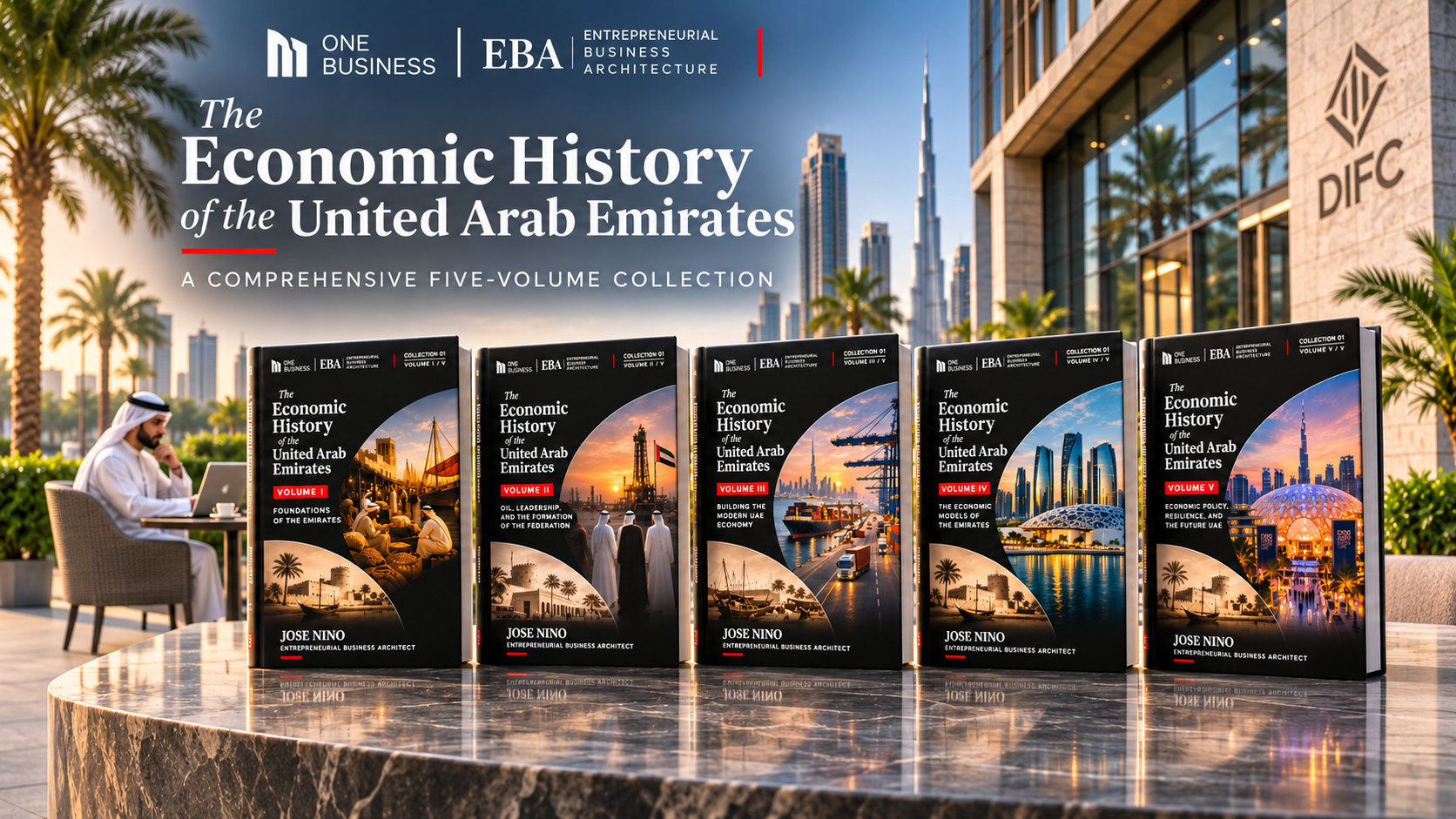
Explore The Economic History of the United Arab Emirates — Complete Collection
International growth becomes more sustainable when the entrepreneur can explain why the new entity is needed, what function it will perform, and how it contributes to the company's wider strategy. For some enterprises, this means a regional distribution presence; for others, technology commercialization, consulting services, or supplier and customer coordination. The correct form of incorporation follows from these objectives and the applicable regulatory conditions.
ONE Business Dubai assists entrepreneurs from Hong Kong, mainland China, Singapore, India, Japan, South Korea, and other Asian markets who want to establish an appropriate corporate presence in the UAE. Our company formation services are designed to make the eligible registration process straightforward, professional, and efficient, while acknowledging that jurisdiction selection, licensing costs, banking, immigration, and other permissions require their own assessment.
UAE Company Formation for Hong Kong and Asian Entrepreneurs: Professional Service Fee USD 1,200 + Applicable Government and Licensing Costs. Same-Day Registration Available for Eligible Applications. Completion depends on the jurisdiction, application documents, proposed activities, and authority approvals. Banking, residence permits, financial regulation, and other additional services are subject to separate procedures.
Establish Your UAE Company with ONE Business Dubai — Begin Your Business Expansion
The future of Hong Kong–UAE economic relations will be shaped by more than trade statistics and institutional announcements. Its economic significance will depend on enterprises that convert international relationships into productive activity, develop technology suited to customers, organize sustainable supply chains, and provide valuable services across markets. Access to an international business center offers possibilities, but those possibilities become commercially meaningful through capable organizations and coherent business models.
Hong Kong and the wider Asian economy provide substantial productive, financial, and technological capabilities. Dubai and the Emirates offer an internationally connected environment in which suitable enterprises can investigate ways to extend those capabilities into additional markets. Understanding how these economic systems complement one another helps entrepreneurs make better decisions about international expansion. Establishing the right UAE company creates the legal foundation through which those decisions can become organized business activity.
Connect Your Asian Business with the UAE. Establish Your Company in Dubai. Build Your Next International Growth Opportunity.
Start Your UAE Company Formation — USD 1,200 + Government Fees
ONE Business Dubai — Strategic Entrepreneurial Business Architecture Advisory Firm.
Editorial research informed by official UAE and Hong Kong trade information, November 2026 developments in the bilateral economic relationship, and contemporary analysis of international entrepreneurship, company establishment, and commercial expansion.
This article provides general economic analysis and entrepreneurial education. Company registration, licensing, taxation, banking, immigration, financial regulation, and cross-border requirements must be assessed according to the relevant jurisdiction and the circumstances of each enterprise.