ONE BUSINESS / INSIGHTS / ARTICLE 32
Your Next Chapter in the UAE: An Emirati Perspective on Growth, Investment, and Rewarding Success
Understanding how institutional alignment, entrepreneurial development and value creation can shape the next stage of your personal and business journey in the United Arab Emirates.

Understanding how institutional alignment, entrepreneurial development and value creation can shape the next stage of your personal and business journey in the United Arab Emirates.
Choosing an Environment Where Your Success Can Grow
Every entrepreneur, investor and business leader eventually reaches a point where the environment in which they operate becomes as important as their individual capabilities. Building a successful enterprise requires vision, discipline, knowledge, resilience and years of sustained effort. However, the ability to transform that success into something greater also depends on the economic, institutional and commercial environment surrounding the entrepreneur.
The United Arab Emirates offers an interesting perspective on this relationship. Rather than relying exclusively on its natural resources, the country has progressively developed an economic model in which international investment, entrepreneurial activity, human capital, technological innovation and commercial development contribute to national prosperity.
For international entrepreneurs, this transformation presents an opportunity to reconsider where and how they develop the next chapter of their business lives. The question is not simply whether Dubai offers attractive taxation, modern infrastructure or access to international markets. The more important question is whether the UAE provides an environment capable of supporting their long-term entrepreneurial ambitions.
Success is rarely the product of favourable circumstances alone. Nevertheless, when entrepreneurial capabilities are combined with supportive institutions, accessible markets, reliable infrastructure and economic opportunities, individuals and enterprises can develop possibilities that might otherwise remain beyond their reach.
Understanding this relationship is fundamental to Entrepreneurial Business Architecture (EBA), a discipline that approaches entrepreneurial development as a structured process connecting personal development, opportunity discovery, business creation, market development and sustainable growth.
Understanding the Emirati Perspective on Entrepreneurial Success
One of the most compelling aspects of the UAE's economic development is the relationship between individual enterprise and national ambition. The country has invested extensively in creating conditions that attract people capable of contributing capital, knowledge, technology, commercial relationships and entrepreneurial expertise.
This perspective has historical foundations. Long before the development of the modern petroleum economy, communities across the Emirates participated in maritime commerce, pearl trading, regional distribution and international commercial networks. Economic survival required adaptability, negotiation, cooperation and the ability to establish relationships beyond geographical boundaries.
These historical experiences provide useful context for understanding contemporary Emirati economic development. International entrepreneurship is not simply a recent addition to the country's identity. Commercial exchange and relationships with people from different cultures have long contributed to its economic evolution.
Today, this orientation can be observed in the development of international business districts, specialised economic zones, investment initiatives, transportation infrastructure and entrepreneurial support programmes.
For the international entrepreneur, the practical implication is significant. Entering the UAE should not be understood exclusively as a process of obtaining a business licence or accessing fiscal advantages. It should be approached as an opportunity to participate in an economy that is actively seeking new sources of knowledge, productivity, investment and innovation.
The entrepreneur who understands this distinction begins to evaluate opportunities differently. Instead of asking only what the UAE can offer their business, they also begin asking what their business can contribute to the UAE.
Institutional Alignment: When National Development and Entrepreneurial Ambition Converge
One of the most valuable characteristics of an entrepreneurial ecosystem is the alignment between public economic objectives and private enterprise.
When governments invest in infrastructure, education, technological development, international connectivity and commercial institutions, they create conditions that entrepreneurs can transform into productive economic activities. Businesses, in turn, generate employment, introduce innovations, develop industries and contribute to economic diversification.
The UAE provides an important example of this relationship. Its long-term economic development strategies reflect an ambition to establish the country as an internationally competitive centre for commerce, investment and innovation.
The Dubai Economic Agenda D33, for example, establishes the objective of doubling the size of Dubai's economy by 2033 and strengthening its position among the world's leading economic cities. Its objectives encompass international trade, foreign investment, private sector development and economic transformation.
For entrepreneurs, these ambitions are more than macroeconomic indicators. They provide direction for identifying opportunities, understanding emerging industries and anticipating areas where additional demand may develop.
A company specialising in artificial intelligence may discover opportunities associated with digital transformation. A logistics entrepreneur may identify opportunities arising from expanding international trade. A professional services company may benefit from the increasing presence of international businesses requiring specialised knowledge and operational support.
Similarly, entrepreneurs working in education, healthcare, sustainability, financial technology, advanced manufacturing and professional development may discover opportunities connected to the country's broader economic priorities.
However, institutional alignment does not mean that government programmes guarantee commercial success. Entrepreneurs must still identify customers, develop competitive solutions, establish viable business models and demonstrate their capacity to deliver measurable results.
The advantage lies in recognising where public investment and economic development are creating conditions that private enterprises can transform into sustainable commercial opportunities.
The Philosophy of Value Creation: Becoming Valuable to the Economy
The relationship between entrepreneurship and economic development can be understood through a fundamental principle: entrepreneurs create opportunities for themselves by creating value for others.
An entrepreneur who introduces an innovative product, solves an operational problem, improves productivity, creates employment or facilitates international commercial relationships contributes something economically meaningful to the communities in which the business operates.
This principle becomes particularly relevant when entering the United Arab Emirates.
An international entrepreneur should not evaluate the country exclusively through the advantages associated with establishing a company. The evaluation should also consider how the entrepreneur's knowledge, experience, capital and commercial capabilities can respond to existing or emerging market needs.
An experienced manufacturing executive may contribute technical knowledge and international supplier relationships. A technology entrepreneur may introduce solutions that improve organisational efficiency. An educator may develop capabilities that support the next generation of business leaders. An investor may provide the financial resources necessary to transform promising ideas into productive enterprises.
Each of these contributions represents a different form of value creation.
From the perspective of Entrepreneurial Business Architecture (EBA), the entrepreneur is not simply the owner of a legal entity. The entrepreneur is the architect of an organisation capable of identifying opportunities, mobilising resources and transforming knowledge into economic and social value.
This distinction explains why relocating a business without developing a clear value proposition is insufficient. A favourable business environment cannot compensate indefinitely for an enterprise that lacks competitive advantages, customer demand or operational capabilities.
The most sustainable entrepreneurial opportunities emerge when the entrepreneur's capabilities correspond with genuine market needs.
Rewarding Success Through Opportunities for Further Development
Entrepreneurs frequently invest years of their lives developing professional expertise, building organisations, overcoming uncertainty and establishing financial stability. Once they have achieved a certain level of success, their priorities often evolve.
They may begin seeking international expansion, access to new customers, investment diversification, greater operational flexibility or an environment in which they can establish long-term personal and business relationships.
The UAE's attractiveness should therefore be evaluated not only from the perspective of starting a business but also from the perspective of continuing an entrepreneurial journey.
An established entrepreneur entering Dubai may already possess intellectual property, successful products, international customers, management experience or financial resources. The strategic challenge is determining how these existing assets can be combined with the opportunities available in a new economic environment.
Dubai's international business community, specialised commercial districts, aviation connectivity and access to regional markets provide possibilities for entrepreneurs seeking to reposition or expand their organisations.
The potential reward extends beyond financial returns. International expansion can provide exposure to new ideas, access to complementary capabilities, relationships with entrepreneurs from different cultures and opportunities to develop new commercial perspectives.
Nevertheless, these benefits must be earned through meaningful participation in the ecosystem. Establishing a company or obtaining residency does not automatically create access to customers, investors or influential business networks.
Entrepreneurs develop these advantages by demonstrating competence, establishing credibility and consistently delivering value.
Moving Beyond the Tax Advantage: Understanding the Real Economics of the UAE
Taxation is frequently one of the first subjects international entrepreneurs investigate when considering the United Arab Emirates. Although the country's fiscal environment can represent an important advantage, taxation should form only one component of a comprehensive entrepreneurial strategy.
The UAE does not impose a general personal income tax on employment income. Its standard federal corporate tax regime generally applies a rate of 0% to taxable income up to AED 375,000 and 9% to the portion exceeding that threshold, subject to applicable rules and exceptions.
Certain natural persons conducting business activities may also fall within the corporate tax regime when their annual business turnover exceeds AED 1 million. Salaries and qualifying personal investment and real estate investment income are treated differently.
Free zone companies are not automatically exempt from corporate taxation. A Qualifying Free Zone Person may benefit from a 0% rate on qualifying income when the relevant statutory conditions are satisfied. Other income, activities and circumstances may result in different tax treatment.
Entrepreneurs must also consider value-added tax, applicable registration requirements, accounting obligations, international taxation and the potential implications of maintaining business relationships or personal tax residency in other jurisdictions.
A more sophisticated evaluation examines the overall economics of operating a business. This includes licensing expenses, office costs, professional services, employee compensation, accommodation, marketing, transportation and the capital required to develop a commercially sustainable operation.
A business with favourable taxation but high customer acquisition costs and insufficient revenue may perform significantly worse than a profitable business operating under a higher tax regime.
Tax efficiency becomes valuable when it supports a viable enterprise. It should not become a substitute for entrepreneurial strategy.
Foreign Ownership and the Architecture of Business Establishment
The UAE has implemented significant reforms to its commercial legal framework, enabling international investors to establish wholly foreign-owned mainland companies across many business activities.
These reforms have expanded the possibilities available to international entrepreneurs who wish to maintain ownership and strategic control over their businesses. Nevertheless, certain activities of strategic importance and regulated industries remain subject to specific requirements, restrictions or additional approvals.
The UAE also offers a diverse network of free zones designed around different industries, commercial activities and operational requirements.
For entrepreneurs, this creates an important architectural decision. The appropriate legal structure must correspond with the commercial objectives of the enterprise rather than simply provide the lowest initial incorporation cost.
A mainland company may be appropriate for an entrepreneur intending to establish extensive operations within the domestic market. A free zone company may offer advantages for businesses whose activities correspond with the jurisdiction's specialised environment and licensing framework.
The ability of free zone companies to conduct activities outside their designated jurisdiction depends on applicable regulations, business activities and required authorisations. Dubai has introduced mechanisms under which certain free zone enterprises may obtain permissions to operate elsewhere in the emirate.
Entrepreneurs should therefore evaluate ownership requirements, permitted activities, customer locations, office requirements, banking considerations, tax implications and future expansion plans before selecting a jurisdiction.
This is where professional company formation and business registration services become strategically valuable.
ONE Business Dubai assists international entrepreneurs with establishing the legal foundations of their businesses in Dubai and throughout the United Arab Emirates. The objective should be to select a corporate structure that supports the entrepreneur's actual commercial activities and long-term business development requirements.
Residency as Part of a Long-Term Entrepreneurial Strategy
For many international entrepreneurs, establishing a business in the UAE represents more than a commercial decision. It also involves evaluating where they intend to live, develop professional relationships and build their future.
The country offers different residency pathways for eligible investors, entrepreneurs, professionals and individuals with specialised capabilities.
Long-term residency programmes, including the Golden Visa, can provide additional stability for qualifying applicants who intend to establish deeper personal and economic connections with the UAE.
However, entrepreneurs must distinguish between company ownership, immigration residency and tax residency. These are separate legal concepts with different requirements and consequences.
Registering a company does not automatically establish personal tax residency, guarantee eligibility for long-term immigration status or eliminate tax obligations in another country.
A comprehensive entrepreneurial relocation strategy must therefore consider personal circumstances, family requirements, immigration eligibility, international tax exposure and the operational needs of the business.
The objective is not simply to relocate. It is to establish an environment in which personal stability and professional development can reinforce one another over time.
Investment as a Catalyst for Entrepreneurial and Economic Growth
Investment is often understood primarily as the allocation of financial capital in pursuit of future returns. However, within a developing entrepreneurial ecosystem, investment performs a much broader economic function.
When investors establish businesses, finance innovation, acquire productive assets or support emerging enterprises, they participate in the development of economic capabilities. Their decisions influence employment, productivity, technological advancement and the commercial competitiveness of the markets in which they operate.
The United Arab Emirates has recognised the importance of attracting international investment as part of its economic diversification strategy. Its development of commercial infrastructure, specialised economic jurisdictions and international business relationships reflects an understanding that capital becomes particularly valuable when it is combined with knowledge, innovation and entrepreneurial execution.
For international investors, this creates opportunities that extend beyond acquiring real estate or establishing corporate holding structures. The UAE offers possibilities for participating in the development of operating businesses, emerging industries, entrepreneurial ventures and international commercial networks.
However, investment opportunities should be evaluated through rigorous commercial analysis. An expanding economy does not guarantee the profitability of every investment. Entrepreneurs and investors must understand market demand, competitive conditions, regulatory requirements, operational risks and the capabilities of the organisations in which they intend to invest.
Within Entrepreneurial Business Architecture (EBA), investment is understood as the mobilisation of resources to develop sustainable value-creating capabilities. Financial capital is essential, but its effectiveness depends on the quality of the entrepreneurial architecture through which it is deployed.
An entrepreneur who invests in market research, professional development, organisational systems and customer relationships may create substantially greater long-term value than one who concentrates exclusively on acquiring physical assets.
The real opportunity is to transform investment into productive economic activity.
Understanding Dubai as an International Business Environment
Dubai's position within the international economy provides entrepreneurs with an opportunity to develop businesses that extend beyond the boundaries of a single domestic market.
Its geographical location, aviation connectivity, maritime infrastructure and multicultural business community facilitate commercial relationships across the Middle East, Africa, Asia and Europe.
For established international entrepreneurs, Dubai can serve as a strategic location from which to develop regional distribution, establish commercial partnerships, coordinate international operations and investigate opportunities in emerging markets.
For new entrepreneurs, the city's diversity offers exposure to different consumer preferences, business practices, professional cultures and approaches to commercial development.
This diversity can become an important source of entrepreneurial learning. Engaging with customers, suppliers, investors and professionals from different backgrounds allows entrepreneurs to develop a broader understanding of how businesses operate across international markets.
However, geographical connectivity should not be confused with automatic market access. Developing business relationships in neighbouring countries requires an understanding of their individual regulations, commercial practices, distribution channels and customer expectations.
Dubai can provide a foundation for international expansion, but the entrepreneur must develop the capabilities necessary to convert that strategic location into commercial results.
Realism Over Hype: Understanding the Challenges of the UAE Market
The attractiveness of the United Arab Emirates should not obscure the practical challenges associated with establishing and developing a business within the country.
Dubai is a highly competitive commercial environment that attracts entrepreneurs, multinational corporations, experienced professionals and investment capital from around the world. Consequently, businesses entering the market frequently encounter sophisticated competitors and customers with demanding expectations.
A product or service that has achieved success in another country may require significant adaptation before achieving comparable results in the UAE.
Consumer behaviour, purchasing decisions, cultural expectations, pricing structures and business relationships may differ substantially from those experienced in the entrepreneur's original market.
Professional credibility also plays an important role. International entrepreneurs must develop trust through consistent communication, reliable service delivery, professional relationships and a genuine understanding of the local business environment.
Networking alone is insufficient. Attending conferences, exhibitions and entrepreneurial events may create valuable introductions, but those introductions must be transformed into meaningful commercial relationships through preparation, follow-up and the delivery of genuine value.
Operational expenses represent another important consideration. Commercial premises, residential accommodation, employee recruitment, licensing, marketing and professional services can require substantial financial commitments.
Entrepreneurs who underestimate these expenses may experience financial pressure before their businesses have developed sufficient revenue.
A disciplined entrepreneur should therefore enter the market with realistic financial projections, adequate working capital and a clearly defined strategy for acquiring and retaining customers.
The UAE provides opportunities for ambitious entrepreneurs, but ambition must be supported by preparation.
Regulatory Compliance as a Foundation for Business Credibility
Entrepreneurs sometimes approach regulatory compliance as an administrative obligation that must be addressed before beginning commercial operations. In reality, compliance forms an integral part of the architecture of a credible and sustainable business.
Businesses operating in the UAE must understand the obligations associated with their legal structures, commercial licences, taxation, accounting, employment relationships and applicable regulatory requirements.
Financial institutions may require detailed information concerning beneficial ownership, sources of funds, business activities, expected transactions and commercial relationships before establishing or maintaining banking relationships.
Certain industries are also subject to specific anti-money laundering obligations, licensing requirements and regulatory supervision.
Entrepreneurs must recognise that establishing a UAE company does not guarantee access to corporate banking facilities, financing or investment. Financial institutions conduct their own assessments according to regulatory obligations and internal risk policies.
Maintaining accurate corporate records, transparent ownership structures, appropriate accounting systems and verifiable commercial documentation can strengthen the credibility of an enterprise.
It is equally important to distinguish current compliance obligations from historical regulatory requirements. For example, the UAE removed separate Economic Substance Regulations reporting obligations for financial years ending after 31 December 2022, although earlier reporting obligations and substance requirements arising under other applicable regimes may remain relevant.
The regulatory environment continues to evolve as the UAE develops its position within the international economy.
Successful entrepreneurs should therefore treat compliance as an ongoing organisational capability rather than an isolated incorporation expense.
A professionally structured and responsibly managed company is better positioned to develop banking relationships, attract investment, negotiate commercial agreements and pursue sustainable expansion.
Personal Development as the Starting Point of International Entrepreneurship
One of the central principles of Entrepreneurial Business Architecture (EBA) is that entrepreneurial development begins with the individual.
Before an entrepreneur can create, develop and scale a business, they must develop the personal capabilities necessary to understand opportunities, make informed decisions, manage uncertainty and mobilise resources effectively.
International entrepreneurship places additional demands on these capabilities.
Entering an unfamiliar market requires adaptability, cultural intelligence, emotional resilience, communication skills and a willingness to reconsider established assumptions.
An entrepreneur who has achieved considerable success in one country may discover that their existing knowledge represents only part of what is necessary to succeed in another.
The ability to learn becomes particularly important. Entrepreneurs must be prepared to investigate local industries, engage with different professional communities, understand institutional requirements and adapt their business models when circumstances demand it.
Relocating to Dubai can therefore represent an opportunity for personal transformation as well as business expansion.
The experience of participating in an international entrepreneurial ecosystem can broaden an individual's understanding of economic development, commercial relationships, leadership and opportunity discovery.
However, these benefits depend on the entrepreneur's willingness to engage actively with the environment.
Changing geographical location does not automatically transform entrepreneurial capabilities. Transformation occurs through intentional learning, disciplined execution and continuous personal development.
Applying Entrepreneurial Business Architecture to Your Next Chapter in the UAE
Entrepreneurial Business Architecture (EBA) provides a structured approach to transforming international entrepreneurial ambitions into sustainable businesses.
Rather than treating international expansion as a single decision, EBA approaches it as a sequence of interconnected development processes.
The first involves strengthening the personal and professional capabilities of the entrepreneur. This includes developing strategic thinking, financial intelligence, leadership, adaptability and the ability to understand unfamiliar economic environments.
The second involves opportunity discovery. Entrepreneurs must investigate the UAE market, identify genuine customer needs, understand competitive conditions and determine whether their capabilities correspond with commercially attractive opportunities.
The third involves business creation. Once an opportunity has been identified and sufficiently validated, the entrepreneur must develop an appropriate business model, establish the necessary legal structure and organise the resources required to begin operations.
The fourth involves establishing a professional market presence. A credible corporate identity, effective communication, digital visibility and professional documentation contribute to the development of trust and recognition.
The fifth involves market development. Entrepreneurs must convert their value propositions into customer relationships, revenue generation and sustainable commercial activity.
Finally, business scaling involves developing the organisational capabilities, financial resources, systems and leadership structures necessary to support expansion.
These processes are not isolated activities. Decisions made during the early stages of entrepreneurial development influence the opportunities and limitations encountered during later stages.
An entrepreneur entering the UAE with a clearly developed entrepreneurial architecture is better positioned to make informed decisions concerning company formation, investment, customer acquisition and long-term growth.
The objective is not merely to establish a business in Dubai. It is to build an enterprise capable of growing sustainably within the United Arab Emirates and beyond.
Understanding the Economic History of the United Arab Emirates Before Investing
International entrepreneurs frequently dedicate considerable attention to understanding contemporary market opportunities while overlooking the historical processes that created those opportunities.
The economic transformation of the United Arab Emirates provides an exceptional opportunity to understand how institutional development, international commerce, infrastructure investment and entrepreneurial activity can contribute to national transformation.
The country's contemporary business environment did not emerge spontaneously. It represents the cumulative result of historical commercial relationships, economic challenges, institutional decisions, strategic investments and long-term development initiatives.
Understanding this evolution allows entrepreneurs to develop a more comprehensive interpretation of the UAE's contemporary economy.
Through the official Entrepreneurial Business Architecture (EBA) book collection, we encourage international entrepreneurs to study this economic transformation as part of their preparation for establishing and developing businesses in the Emirates.
Economic History of the UAE for Entrepreneurs
Written by J. Nino and developed as a five-volume collection within Entrepreneurial Business Architecture (EBA), Economic History of the UAE for Entrepreneurs examines the historical foundations and structural transformation of the Emirati economy from an entrepreneurial perspective.
The collection enables readers to move beyond conventional descriptions of the UAE's economic success and investigate the relationships between commerce, institutional development, investment, economic diversification and entrepreneurial opportunity.
For international entrepreneurs considering their next chapter in the UAE, this knowledge can provide a valuable foundation for understanding the economic environment in which they intend to operate.
Studying the country's economic history can also help entrepreneurs recognise the importance of long-term vision, institutional alignment, adaptability and the continuous development of productive capabilities.
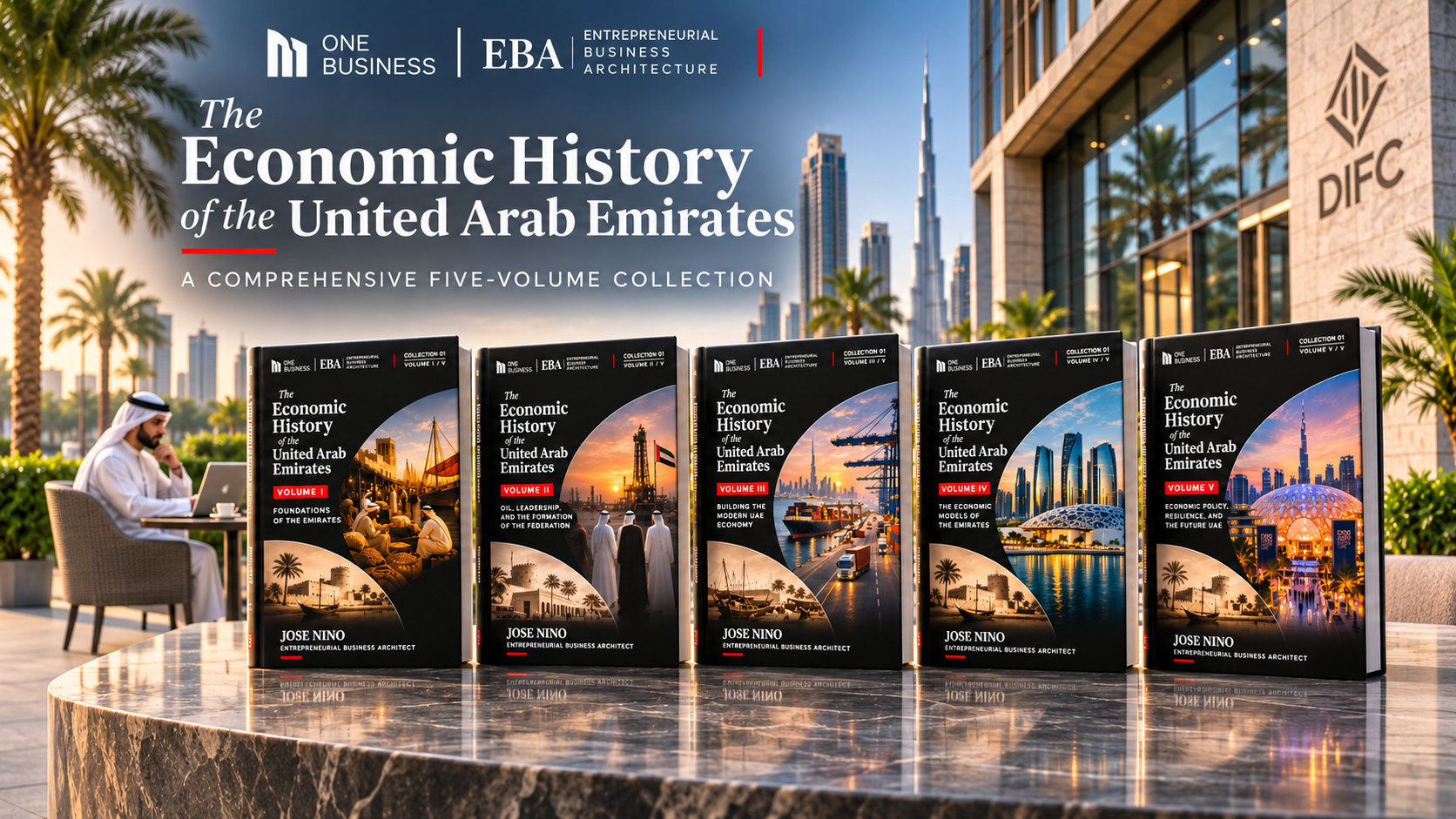
Explore The Economic History of the United Arab Emirates — Complete Collection
Entrepreneurial History of the UAE
The second book within the EBA collection, Entrepreneurial History of the UAE, complements this economic perspective by examining entrepreneurship as a contributor to the development and transformation of the Emirates.
Understanding entrepreneurial history allows readers to investigate how individuals, families, commercial organisations and institutions have participated in the creation of economic opportunities throughout the country's development.
Together, these works provide educational foundations for entrepreneurs who wish to understand the United Arab Emirates not simply as a location for business registration, but as an evolving entrepreneurial ecosystem.
Knowledge of the market begins with understanding the forces that shaped it.
From International Ambition to Business Establishment
The decision to establish a company in Dubai should represent the beginning of a structured entrepreneurial development process.
International entrepreneurs must translate their ambitions into practical decisions concerning business activities, corporate structures, licensing, investment requirements and operational capabilities.
Each of these decisions should reflect the needs of the enterprise.
A technology company developing international software solutions may require a different corporate structure from a trading company importing and distributing physical products. Similarly, a professional services firm serving regional clients may have different operational requirements from an manufacturing enterprise establishing production facilities.
Selecting the appropriate legal foundation requires an understanding of the relationship between the business model and the regulatory environment.
At ONE Business Dubai, our approach connects entrepreneurial education with professional business formation services.
Through Entrepreneurial Business Architecture (EBA), we encourage entrepreneurs to understand the strategic implications of their decisions before establishing their companies.
Through our company formation and business registration services, we assist international entrepreneurs in developing the legal foundations necessary to transform their commercial ambitions into operating businesses.
The objective is to connect entrepreneurial knowledge with practical business creation.
Conclusion: Give Your Entrepreneurial Success Room to Grow
Entrepreneurial success is rarely the result of a single event. It emerges through years of personal development, opportunity discovery, investment, decision-making, calculated risk and sustained execution.
Once entrepreneurs have developed valuable capabilities and established successful businesses, their next challenge may involve identifying an environment in which those achievements can continue to develop.
The United Arab Emirates offers an important perspective on the relationship between individual ambition and collective economic development.
Its commitment to economic diversification, international investment, commercial infrastructure and entrepreneurial development creates opportunities for individuals and organisations capable of contributing meaningful value.
However, the decision to enter the UAE should be guided by strategic understanding rather than promotional narratives.
Entrepreneurs must investigate the market, recognise its challenges, understand its regulatory environment, develop competitive capabilities and establish businesses that respond to genuine economic needs.
From the perspective of Entrepreneurial Business Architecture (EBA), the greatest opportunity lies in connecting personal development with entrepreneurial action, business creation and sustainable economic contribution.
Your next chapter in the UAE should not simply be about changing where you live or where your company is registered.
It should be about what you are capable of becoming, what you are prepared to build and the value you can contribute to an economy that continues to develop its role within the international business environment.
You have invested years in developing your knowledge, experience and entrepreneurial capabilities. The next challenge is determining how those achievements can become the foundation for something greater.
The United Arab Emirates may be the environment in which you choose to write that next chapter.
Start Your Business in Dubai and the United Arab Emirates
ONE Business Dubai provides professional company formation and business registration services in Dubai and across the United Arab Emirates for a professional service fee of USD 1,200, plus applicable government fees.
To facilitate international business formation, we offer flexible payment options for entrepreneurs worldwide:
- Bank Transfer: USD, EUR, GBP and AED.
- Credit Card: Subject to an additional 5% processing fee.
- Cryptocurrency: USDT via the TRC20 or Polygon network.
Through Entrepreneurial Business Architecture (EBA), our educational resources, our book collection and our professional business formation services, we help international entrepreneurs develop the knowledge and establish the legal foundations necessary to create and grow their businesses in the United Arab Emirates.
Contact ONE Business Dubai today to discuss your business formation requirements, request a personalized quotation and begin your entrepreneurial journey in the UAE.