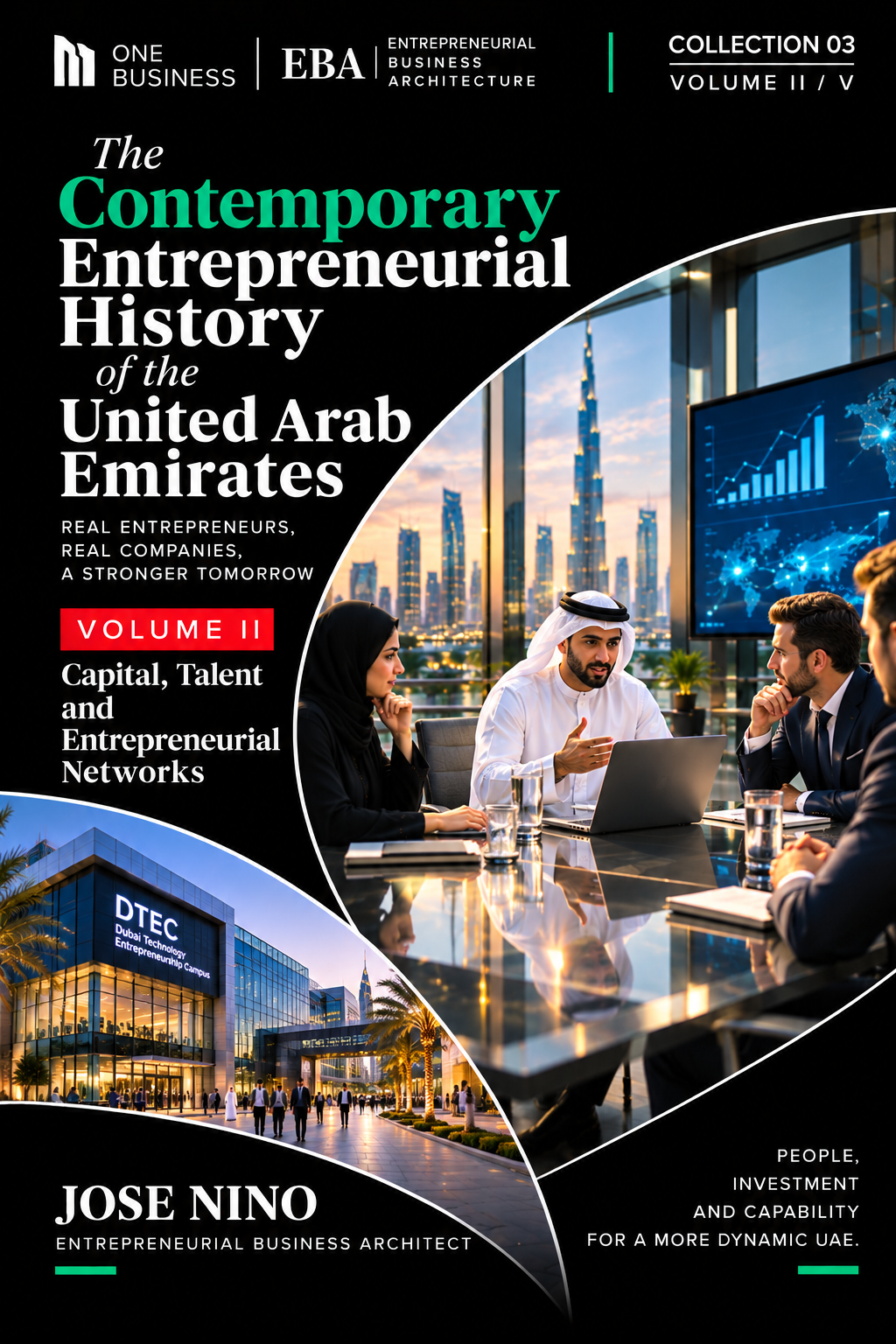
Official cover of The Contemporary Entrepreneurial History of the United Arab Emirates, Volume II
COLLECTION 03 · VOLUME II / V
ONE BUSINESS DUBAI / ENTREPRENEURIAL BOOKS
COLLECTION 03 / THE CONTEMPORARY ENTREPRENEURIAL HISTORY OF THE UAE

The Contemporary
Entrepreneurial History
of the United Arab Emirates

Volume II — Capital, Talent and Entrepreneurial Networks

Capital, talent and relationships behind entrepreneurial development

Explore how entrepreneurs obtained and developed capital, professional talent, investor relationships, accelerators, corporate partnerships and trusted networks to build and expand their businesses.

6 CHAPTERS163 NUMBERED SECTIONSFIRST EDITION · 2026
01 / ABOUT THIS VOLUME

Capital, Talent and Entrepreneurial Networks.

Explore how entrepreneurs obtained and developed capital, professional talent, investor relationships, accelerators, corporate partnerships and trusted networks to build and expand their businesses.

This volume forms part of a five-volume historical study of contemporary entrepreneurs in the United Arab Emirates. It examines the actual founders, decisions, capabilities, operating challenges, businesses and market changes documented in the contemporary entrepreneurial record.

Read this volume as a historical study of individuals developing entrepreneurial capabilities, recognizing opportunities and building businesses in the UAE’s contemporary economic environment.

02 / WHY THIS BOOK MATTERS

Contemporary entrepreneurial history through the decisions of founders.

From digital marketplaces and venture investment to consumer brands, advanced ventures and business reinvention, the UAE presents a contemporary history of entrepreneurial action across many sectors.

The purpose of this work is to understand how contemporary entrepreneurs identified opportunities, organized resources, developed capabilities, attracted customers, built businesses and responded to uncertainty. Evidence about real ventures comes first; Entrepreneurial Business Architecture is used retrospectively to interpret relevant entrepreneurial relationships.

03 / WHAT YOU WILL DISCOVER

6 chapters. One part of a five-volume historical work.

Explore the subjects addressed in this volume using its verified chapter and section headings.

01

Mohamed Alabbar and noon: Re-Entering Entrepreneurship at Scale

Alabbar before noon: the capability stock · Why digital commerce?
02

From Founder Capital to Venture Capital: Financing the New Generation

Before a Specialized Venture Market · Why the New Ventures Created a Financing Gap

03

Accelerators, Incubators and Founder Capability Development

From Money to Capability · What Exactly Is Being Accelerated?

04

Corporate–Startup Relationships: Customers, Partners, Investors and Acquirers

From Program Access to Commercial Relationships · The Corporation as Customer

05

Talent Mobility - From Professional Experience to Founder Capability

People Carry Capability · The UAE as a Destination for Mobile Professional Capability

06

Networks, Trust and Entrepreneurial Access

From Mobile People to Relationships · Networks Are Not Contact Lists

04 / COMPLETE BOOK CONTENTS

Explore what's inside.

Open each chapter to explore the actual numbered section headings from Volume II.

CHAPTER 07Mohamed Alabbar and noon: Re-Entering Entrepreneurship at Scale
  1. 7.1Alabbar before noon: the capability stock
  2. 7.2Why digital commerce?
  3. 7.3Founding noon
  4. 7.4Capital before validation
  5. 7.5Building the digital product
  6. 7.6Merchants, brands and assortment
  7. 7.7Fulfillment as competitive capability
  8. 7.8Customer acquisition and the cost of attention
  9. 7.9Competing with Amazon / Souq
  10. 7.10What transferred from Alabbar's prior experience?
  11. 7.11What did not transfer?
  12. 7.12Building the capability gaps
  13. 7.13Delay, friction and early adaptation
  14. 7.14From e-commerce platform to broader commerce system
  15. 7.15Regional scale: UAE and Saudi Arabia
  16. 7.16Organizational capability beyond the founder
  17. 7.17Network architecture of noon
  18. 7.18Ecosystem-enabled capability development
  19. 7.19EBA reconstruction of entrepreneurial re-entry
  20. 7.20Entrepreneurial architecture research contributions
  21. 7.21Chapter synthesis: the capability transfer test
  22. 7.22Entrepreneurial lessons
  23. 7.23Chapter close and transition
CHAPTER 08From Founder Capital to Venture Capital: Financing the New Generation
  1. 8.1Before a Specialized Venture Market
  2. 8.2Why the New Ventures Created a Financing Gap
  3. 8.3Souq — Financing Regional Market Construction
  4. 8.4Property Finder — Long-Duration Financing and Control
  5. 8.5Careem — Capital for Adaptive Regional Scale
  6. 8.6Mumzworld and Namshi — Specialized Commerce Capital
  7. 8.7noon — Capital Abundance as a Different Starting Condition
  8. 8.8The Angel and Entrepreneurial-Capital Layer
  9. 8.9Wamda and the Early Regional Investment Infrastructure
  10. 8.10BECO Capital and Specialized UAE-Based Venture Investing
  11. 8.11STV and the Arrival of Larger Regional Growth Capital
  12. 8.12Shorooq, Global Ventures and the Broadening Investor Field
  13. 8.13Government-Backed and Institutional Capital
  14. 8.14Corporate and Strategic Capital
  15. 8.15The Entrepreneur's Fundraising Capability
  16. 8.16What Investors Can Contribute Beyond Money
  17. 8.17What Capital Cannot Supply
  18. 8.18Financing Stages and Changing Capability Requirements
  19. 8.19Failure, Down Rounds, Shutdowns and Capital Discipline
  20. 8.20Exit, Liquidity and Capital Recycling
  21. 8.21Network Architecture of Entrepreneurial Capital
  22. 8.22Ecosystem-Enabled Capability Development Through Capital
  23. 8.23EBA Interpretation — Capital Across the Business-Building
  24. 8.24Entrepreneurial Architecture Research Contributions
  25. 8.25Chapter Synthesis — From Money to Entrepreneurial
  26. 8.26Entrepreneurial Lessons
  27. 8.27Chapter Close and Transition
CHAPTER 09Accelerators, Incubators and Founder Capability Development
  1. 9.1From Money to Capability
  2. 9.2What Exactly Is Being Accelerated?
  3. 9.3The Early UAE Support Environment
  4. 9.4in5 — From Infrastructure to Entrepreneurial Use
  5. 9.5AstroLabs — Community, Market Entry and Capability Access
  6. 9.6Sheraa — Entrepreneurship, Universities and Founder
  7. 9.7DIFC FinTech Hive — Sector-Specific Capability Development
  8. 9.8Sarwa — From Program Access to Regulated Business
  9. 9.9Hub71 — Capital, Talent, Market Access and Abu Dhabi
  10. 9.10MBRIF — Supporting Newer Entrepreneurial Experiments
  11. 9.11What Founders Actually Receive
  12. 9.12From Resource Access to Capability Development
  13. 9.13Mentorship — Advice or Capability?
  14. 9.14Peer Learning and Cohort Effects
  15. 9.15Customer Access as Acceleration
  16. 9.16Regulatory Access as Capability Development
  17. 9.17Investor Access and Fundraising Learning
  18. 9.18Talent and Team Development
  19. 9.19Failure, Selection and the Program Success Problem
  20. 9.20When Support Becomes Dependency
  21. 9.21From Founder Capability to Organizational Capability
  22. 9.22Network Architecture of Acceleration
  23. 9.23Ecosystem-Enabled Capability Development — Direct Test
  24. 9.24EBA Interpretation
  25. 9.25Entrepreneurial Architecture Research Contributions
  26. 9.26Chapter Synthesis — From Support Program to Capability
  27. 9.27Entrepreneurial Lessons
  28. 9.28Chapter Close and Transition
CHAPTER 10Corporate–Startup Relationships: Customers, Partners, Investors and Acquirers
  1. 10.1From Program Access to Commercial Relationships
  2. 10.2The Corporation as Customer
  3. 10.3Pilot ≠ Procurement
  4. 10.4Repeatable Procurement as Market Validation
  5. 10.5Corporate Customers as Product-Development Environments
  6. 10.6Fintech — Banks as Customers, Partners and Gatekeepers
  7. 10.7Enterprise Software and Services — Corporate Demand as a
  8. 10.8Industrial and Logistics Ventures — Corporations as Market
  9. 10.9Corporations as Distribution Partners
  10. 10.10Corporations as Technology and Infrastructure Partners
  11. 10.11Corporate Accelerators and the Commercial Conversion Test
  12. 10.12Corporations as Strategic Investors
  13. 10.13Corporate Partnership Management as Entrepreneurial
  14. 10.14Power Asymmetry
  15. 10.15Customer Concentration and Corporate Dependency
  16. 10.16Corporations as Acquirers — Souq / Amazon
  17. 10.17Corporations as Acquirers — Careem / Uber
  18. 10.18Other Strategic Transactions as Relationship Outcomes
  19. 10.19What Acquisitions Can Recycle
  20. 10.20Corporate Relationships as Capability-Development
  21. 10.21Network Architecture of Corporate–Startup Relationships
  22. 10.22Ecosystem-Enabled Capability Development — Corporate
  23. 10.23EBA Interpretation
  24. 10.24Entrepreneurial Architecture Research Contributions
  25. 10.25Chapter Synthesis — From Corporate Access to Business
  26. 10.26Entrepreneurial Lessons
  27. 10.27Chapter Close and Transition
CHAPTER 11Talent Mobility - From Professional Experience to Founder Capability
  1. 11.1People Carry Capability
  2. 11.2The UAE as a Destination for Mobile Professional Capability
  3. 11.3Michael Lahyani — Professional Experience, Mobility and
  4. 11.4Careem — Consulting Experience into Operating
  5. 11.5Namshi — Professional Networks and Co-Founder Formation
  6. 11.6Ambareen Musa — Professional Expertise to Fintech
  7. 11.7Ronaldo Mouchawar — Entrepreneurial Experience Before
  8. 11.8From Employee to Entrepreneur — The Transition Itself
  9. 11.9What Transfers from Professional Life?
  10. 11.10What Does Not Transfer Cleanly?
  11. 11.11Newly Required Founder Capabilities
  12. 11.12Technical Expertise Versus Entrepreneurial Capability
  13. 11.13Professional Networks Become Entrepreneurial Networks
  14. 11.14Co-Founder Complementarity
  15. 11.15Talent Mobility Between Startups
  16. 11.16Careem / Souq Talent-Recycling Question
  17. 11.17Failure as Human-Capability Development
  18. 11.18International Talent Attraction Versus Local Capability
  19. 11.19The UAE as a Capability-Accumulation Environment
  20. 11.20From Individual Capability to Organizational Capability
  21. 11.21Network Architecture of Talent Mobility
  22. 11.22Ecosystem-Enabled Capability Development —
  23. 11.23EBA Interpretation
  24. 11.24Entrepreneurial Architecture Research Contributions
  25. 11.25Chapter Synthesis — From Professional Experience to
  26. 11.26Entrepreneurial Lessons
  27. 11.27Chapter Close and Transition to Chapter 12
CHAPTER 12Networks, Trust and Entrepreneurial Access
  1. 12.1From Mobile People to Relationships
  2. 12.2Networks Are Not Contact Lists
  3. 12.3What Flows Through Entrepreneurial Networks?
  4. 12.4Trust as an Entrepreneurial Resource
  5. 12.5Dense Networks and Network Closure
  6. 12.6Open Networks and Novel Access
  7. 12.7Gulf Business Women Entrepreneur Network Evidence
  8. 12.8Women Entrepreneurs — Networks as Support and Access
  9. 12.9Souq — Building a Multi-Actor Entrepreneurial Network
  10. 12.10Careem — Networks Across Cities
  11. 12.11Property Finder — Networks in a Fragmented Market
  12. 12.12Capital Networks
  13. 12.13Accelerator and Incubator Networks
  14. 12.14Corporate Networks
  15. 12.15Professional Networks and Founder Formation
  16. 12.16Networks and Opportunity Discovery
  17. 12.17Networks and Business Creation
  18. 12.18Networks and Market Development
  19. 12.19Networks and Scale
  20. 12.20Network Failure and Network Risk
  21. 12.21Access Inequality
  22. 12.22Network Diversity and Complementarity
  23. 12.23Network Evolution Over the Entrepreneurial Journey
  24. 12.24Can Entrepreneurs Architect Networks?
  25. 12.25Network Architecture and Capability Development
  26. 12.26Network Resilience
  27. 12.27EBA Interpretation
  28. 12.28Entrepreneurial Architecture Research Contributions
  29. 12.29Chapter Synthesis — Entrepreneurial Network Configuration
  30. 12.30Entrepreneurial Lessons
  31. 12.31Chapter Close and Transition
ALSO INCLUDED

Volume introduction · Historical analysis · Entrepreneurial interpretation

05 / THE CONTEMPORARY ENTREPRENEURIAL HISTORY OF THE UAE
2/05

COLLECTION 03 · FIVE VOLUMES

One volume in a five-part historical study.

The Contemporary Entrepreneurial History of the United Arab Emirates examines founders, digital markets, capital and professional networks, diverse ventures, ecosystem change and the circulation of entrepreneurial capability in the contemporary UAE.

Each volume can be studied separately or as part of the complete collection.

EXPLORE THE COMPLETE COLLECTION ↗
06 / WHO THIS BOOK IS FOR

For readers interested in the people building the contemporary entrepreneurial UAE.

This work is intended for entrepreneurs, business owners, students, researchers and readers interested in the entrepreneurial history of the UAE and the processes through which economic capabilities, enterprises and markets develop.

Its contemporary case studies illuminate capability development, opportunity discovery, business creation, market development, adaptation and growth while recognizing the uncertainty and limitations faced by individual founders.

07 / THE ENTREPRENEURIAL PERSPECTIVE

History as knowledge for entrepreneurial thinking.

Entrepreneurial Business Architecture connects personal development, entrepreneurial capability, opportunity discovery, business creation and sustainable entrepreneurial development.

These volumes examine entrepreneurs and enterprises within their own historical circumstances, then draw analytical lessons where warranted by the evidence. They do not suggest that historical actors were consciously applying a contemporary EBA framework.

EXPLORE ENTREPRENEURIAL KNOWLEDGE ↗
08 / GET YOUR COPY

Explore Volume II.

Choose this volume or explore the complete five-volume collection. Complete your order form before secure payment through Stripe. Your PDF will be sent by email after payment confirmation.

INDIVIDUAL VOLUME

Volume II · Digital Edition

Capital, Talent and Entrepreneurial Networks

USD $6.99
SECURE CHECKOUT · STRIPEBUY VOLUME ↗

Complete the order form, continue to secure Stripe payment, and receive your PDF by email after payment confirmation.

ONE BUSINESS DUBAI

Personal Transformation.
Entrepreneurial Development.
Economic Opportunity.

Advancing personal transformation, entrepreneurial development, and the creation of economic opportunity in Dubai and the UAE.

ONE BUSINESS DUBAI / CONTACT

Get in touch.

Have a question about our knowledge, books, or education? Send us a message.

We use your information to respond to your inquiry and collect your IP address for security and to understand the origin of inquiries. Submissions are processed by our FormMail server.

You can also email us directly at[email protected]