COLLECTION 03 / THE CONTEMPORARY ENTREPRENEURIAL HISTORY OF THE UAE
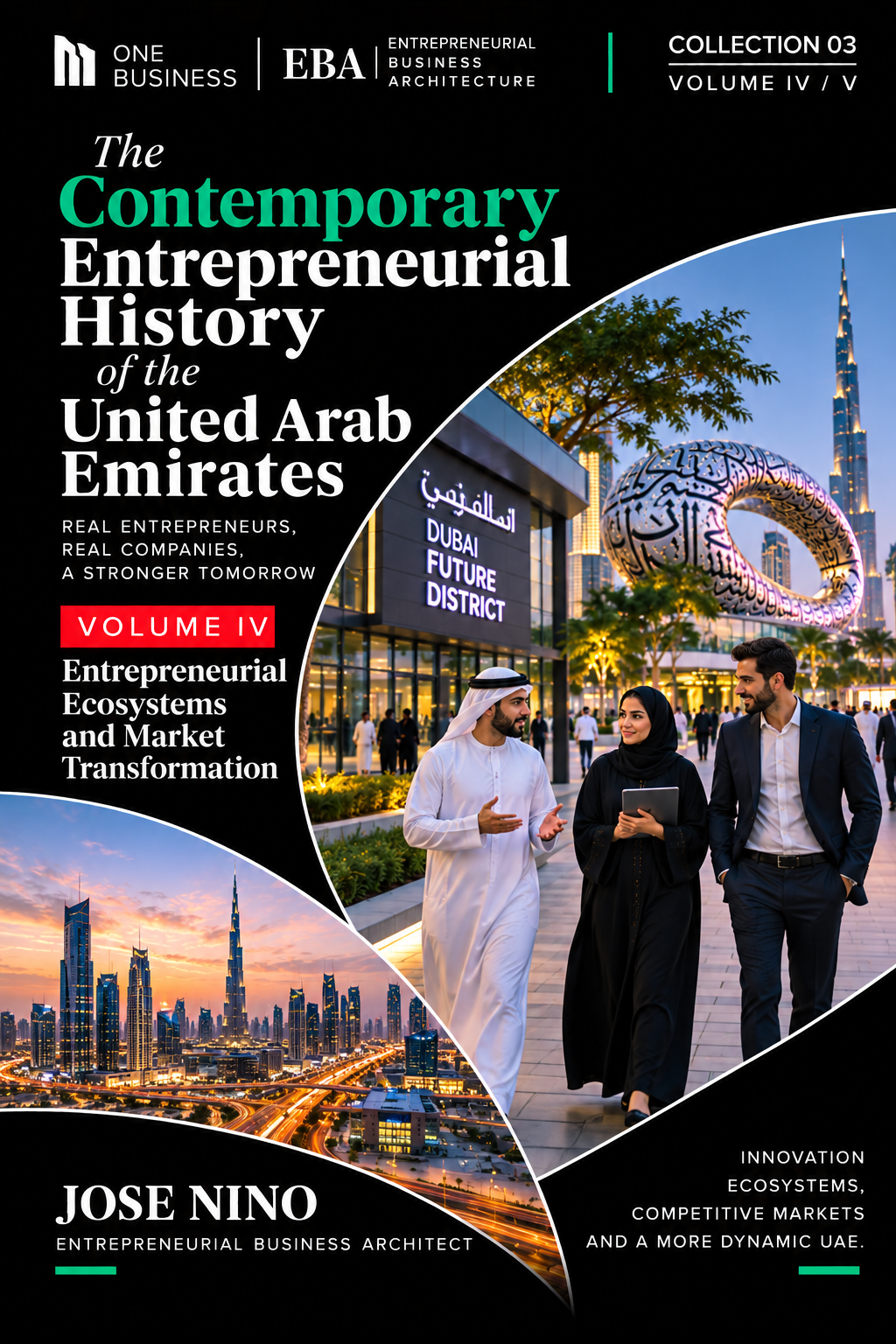
The Contemporary Entrepreneurial History of the United Arab Emirates
Volume IV — Entrepreneurial Ecosystems and Market Transformation
New founders and ventures transforming established markets
Study entrepreneurs who reimagined existing industries, from property and logistics to advanced technology, alongside the expanding participation of Emirati, women and expatriate entrepreneurs.
Entrepreneurial Ecosystems and Market Transformation.
Study entrepreneurs who reimagined existing industries, from property and logistics to advanced technology, alongside the expanding participation of Emirati, women and expatriate entrepreneurs.
This volume forms part of a five-volume historical study of contemporary entrepreneurs in the United Arab Emirates. It examines the actual founders, decisions, capabilities, operating challenges, businesses and market changes documented in the contemporary entrepreneurial record.
Read this volume as a historical study of individuals developing entrepreneurial capabilities, recognizing opportunities and building businesses in the UAE’s contemporary economic environment.
02 / WHY THIS BOOK MATTERS
Contemporary entrepreneurial history through the decisions of founders.
From digital marketplaces and venture investment to consumer brands, advanced ventures and business reinvention, the UAE presents a contemporary history of entrepreneurial action across many sectors.
The purpose of this work is to understand how contemporary entrepreneurs identified opportunities, organized resources, developed capabilities, attracted customers, built businesses and responded to uncertainty. Evidence about real ventures comes first; Entrepreneurial Business Architecture is used retrospectively to interpret relevant entrepreneurial relationships.
03 / WHAT YOU WILL DISCOVER
7 chapters. One part of a five-volume historical work.
Explore the subjects addressed in this volume using its verified chapter and section headings.
01
Atif Rahman and ORO24: Crisis, Learning and Entrepreneurial Reinvention
Opening — Building The Second Time With The First Time · Atif Rahman Before ORO24
02
Muhammad BinGhatti and the New Generation of Real Estate Business Builders
Opening — Building When The Market Is Already Built · Who Is Muhammad BinGhatti?
03
Mobility, Logistics and On-Demand Enterprise
Opening — The App Cannot Move The Box · Movement After Careem
04
From Imported Technology to UAE-Built Advanced Ventures
Opening — Using Technology Is Not the Same as Building It · The UAE Entrepreneurial Baseline Changed
05
Emirati Entrepreneurs Of The Contemporary Generation
Opening — a Different Starting Line · From Merchant Heritage to Contemporary Choice
06
Women Entrepreneurs and the Architecture of Opportunity
Opening — Not a Sidebar · Book 2 to Book 3 — The Change in Question
07
Expatriate Entrepreneurship and the UAE as a Platform for Mobile Capability
Opening — The Entrepreneur Arrives With A History · The UAE Entrepreneurial Story Is Multicultural
04 / COMPLETE BOOK CONTENTS
Explore what's inside.
Open each chapter to explore the actual numbered section headings from Volume IV.
CHAPTER 20Atif Rahman and ORO24: Crisis, Learning and Entrepreneurial Reinvention+
20.1Opening — Building The Second Time With The First Time
20.2Atif Rahman Before ORO24
20.3Learning Dubai Through Work
20.4The Pre-2008 Entrepreneurial Context
20.5Rahman’s Pre-Crisis Exposure
20.62008 — The Shock
20.7What Actually Failed?
20.8Consequence Before Lesson
20.9Did The Crisis Produce Learning?
20.10The Danube Period
20.11Employment As Entrepreneurial Capability Development
20.12Recombining Experience
20.13Why Start Again?
20.14The Founding Of ORO24
20.15What Does ORO24 Mean As A Business Model?
20.16Forward Integration
20.17Control Versus Flexibility
20.18Governance As A Response To Experience
20.19Risk As A Design Problem
20.20Technology — What Problem Does It Solve?
20.21First Project / First Market Test
20.22Customer Value
20.23Sales Capability
20.24Project Delivery Capability
20.25Capital And Cash-Flow Discipline
20.26Building The Organization
20.27Brand And Trust After Crisis
20.28Growth Without Repeating The Past
20.29Dubai As Opportunity Environment — Strict Boundary
20.30Resilience — Founder, Business And Ecosystem
20.31Reinvention — What Actually Changed?
20.32EBA Reconstruction
20.33Network Architecture Of Reinvention
20.34Ecosystem-Enabled Capability Development
20.35Entrepreneurial Architecture Research Contributions
20.36Chapter Synthesis — The Second Business Is Not The First
20.37Entrepreneurial Lessons
20.38Close And Transition
CHAPTER 21Muhammad BinGhatti and the New Generation of Real Estate Business Builders+
21.1Opening — Building When The Market Is Already Built
21.2Who Is Muhammad BinGhatti?
21.3Who Actually Founded Binghatti?
21.4The Family As A Capability Environment
21.5Entry Into Responsibility
21.6What Market Did He See?
21.7Differentiation Before Scale
21.8Design As Business Strategy
21.9Product Architecture
21.10From Building To Brand
21.11Sales Capability
21.12Delivery As Brand Evidence
21.13Operating Model
21.14Vertical Integration — Capability Or Complexity?
21.15Organizational Capability
21.16Capital And Project Economics
21.17The Move Up-Market
21.18Branded Residences As Entrepreneurial Strategy
21.19Bugatti Residences — Case Within The Case
21.20Mercedes-Benz Places — Case Within The Case
21.21Other Brand Partnerships
21.22From One Partnership To Partnership Capability
21.23Global Buyer Access
21.24Market Timing And Dubai’s Post-Pandemic Property Cycle
21.26The Attribution Problem
21.27Next-Generation Entrepreneurship
21.28What Did Muhammad BinGhatti Actually Build?
21.29Founder / Leader Dependence
21.30EBA Reconstruction
21.31Network Architecture
21.32Ecosystem-Enabled Capability Development
21.33Entrepreneurial Architecture Research Contributions
21.34Chapter Synthesis — Inheriting A Platform Is Not The Same
21.35Entrepreneurial Lessons
21.36Close And Transition
CHAPTER 22Mobility, Logistics and On-Demand Enterprise+
22.1Opening — The App Cannot Move The Box
22.2Movement After Careem
22.3Three Entrepreneurial Problems
22.4Gaurav Biswas Before Trukker
22.5The Trukker Insight
22.6The Freight Marketplace
22.7Supply Without Owning Every Truck
22.8Shipper Trust
22.9Pricing, Payments And Working Capital
22.10From Match To Completed Freight
22.11Trukker Scale
22.12Trukker As Capability Case
22.13Vilhelm Hedberg And Ravi Bhusari Before Ekar
22.14The Ekar Insight
22.15A Digital Interface Over A Physical Fleet
22.16Utilization — The Central Physical Economic Problem
22.17Density And Positioning
22.18Customer Trust And Behavior
22.19Ekar Scale And Model Evolution
22.20Ekar As Capability Case
22.21Joy Ajlouny And Idriss Al Rifai Before Fetchr
22.22The Fetchr Insight
22.23From Location Technology To Delivery Company
22.24E-Commerce And The Last Mile
22.25Building Operating Capacity
22.26Capital And Rapid Expansion
22.27Fetchr's Deterioration And Restructuring
22.28Three Points On The Asset--Coordination Spectrum
22.29Asset-Light Versus Asset-Heavy Is Too Simple
22.30Exception Handling As Capability
22.31Physical Density And Digital Scale
22.32Geographic Replication
22.33Eba Reconstruction
22.34Network Architecture Of Movement
22.35Ecosystem-Enabled Capability Development
22.36Entrepreneurial Architecture Research Contributions
22.37Chapter Synthesis — Software Coordinates; The Business
22.38Entrepreneurial Lessons
22.39Close And Transition
CHAPTER 23From Imported Technology to UAE-Built Advanced Ventures+
23.1Opening — Using Technology Is Not the Same as Building It
23.2The UAE Entrepreneurial Baseline Changed
23.3From Import Economy to Capability Question
23.4What Counts as an Advanced Venture?
23.5Case Selection and Evidence Gate
23.6Primary Case A — The Founder Before the Technology
23.7Primary Case A — The Problem
23.8Primary Case A — Build, Buy or Integrate?
23.9Primary Case A — Prototype to Product
23.10Primary Case A — First Customer / Deployment
23.11Primary Case A — Capability Accumulation
23.12Primary Case B — Founder and Capability Origin
23.13Primary Case B — Opportunity and Technical Hypothesis
23.14Primary Case B — Building the Technical Team
23.15Primary Case B — Market Validation
23.16Primary Case B — What Became UAE-Built?
23.17Primary Case C — Founder and Entrepreneurial Origin
23.18Primary Case C — From Knowledge to Enterprise
23.19Primary Case C — Capital and Long Development Horizon
23.20Primary Case C — Commercialization Test
23.21Optional Case D / E — Only If Evidence Justifies
05 / THE CONTEMPORARY ENTREPRENEURIAL HISTORY OF THE UAE
4/05
COLLECTION 03 · FIVE VOLUMES
One volume in a five-part historical study.
The Contemporary Entrepreneurial History of the United Arab Emirates examines founders, digital markets, capital and professional networks, diverse ventures, ecosystem change and the circulation of entrepreneurial capability in the contemporary UAE.
Each volume can be studied separately or as part of the complete collection.
For readers interested in the people building the contemporary entrepreneurial UAE.
This work is intended for entrepreneurs, business owners, students, researchers and readers interested in the entrepreneurial history of the UAE and the processes through which economic capabilities, enterprises and markets develop.
Its contemporary case studies illuminate capability development, opportunity discovery, business creation, market development, adaptation and growth while recognizing the uncertainty and limitations faced by individual founders.
07 / THE ENTREPRENEURIAL PERSPECTIVE
History as knowledge for entrepreneurial thinking.
Entrepreneurial Business Architecture connects personal development, entrepreneurial capability, opportunity discovery, business creation and sustainable entrepreneurial development.
These volumes examine entrepreneurs and enterprises within their own historical circumstances, then draw analytical lessons where warranted by the evidence. They do not suggest that historical actors were consciously applying a contemporary EBA framework.
Choose this volume or explore the complete five-volume collection. Complete your order form before secure payment through Stripe. Your PDF will be sent by email after payment confirmation.
INDIVIDUAL VOLUME
Volume IV · Digital Edition
Entrepreneurial Ecosystems and Market Transformation