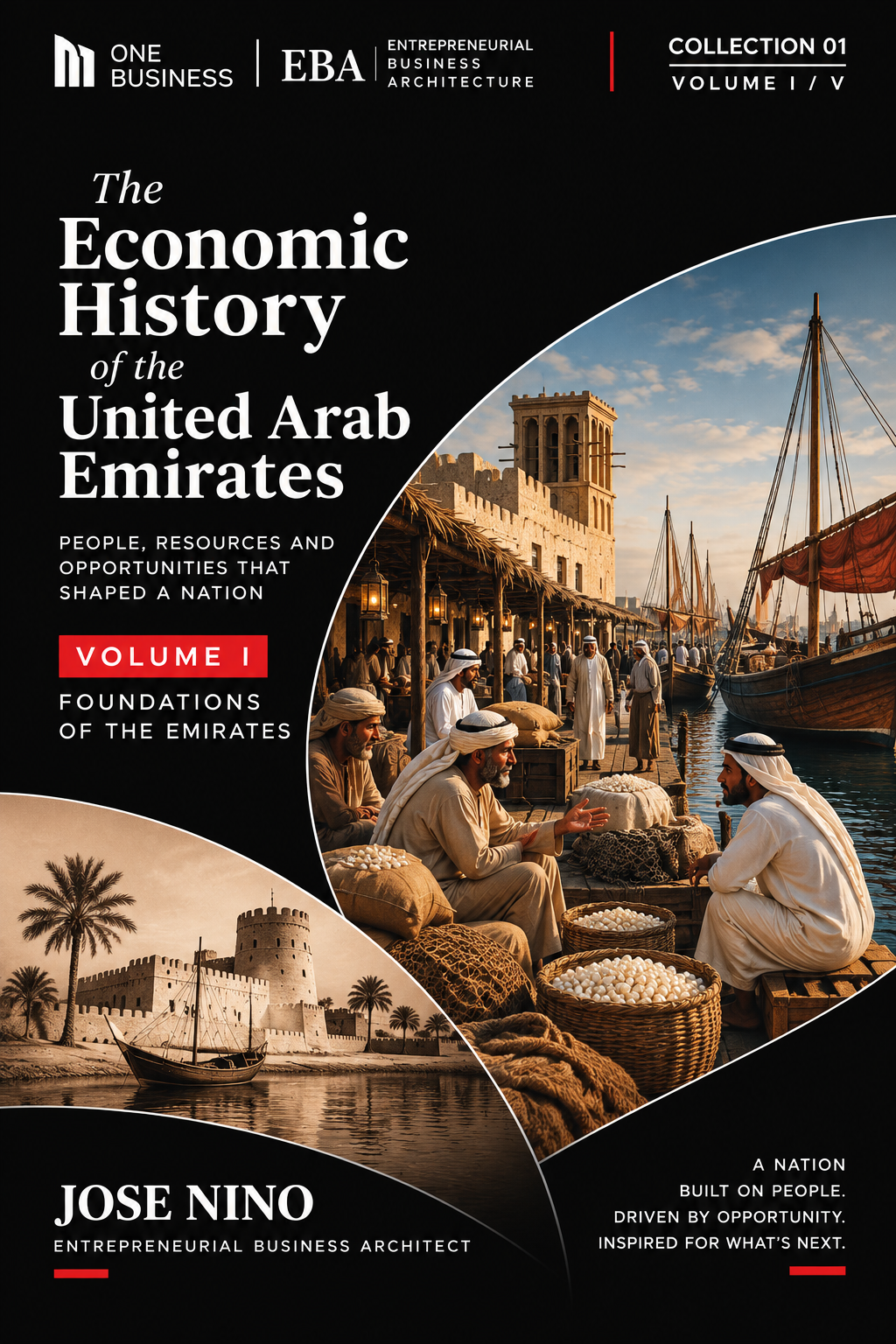
Official cover of The Economic History of the United Arab Emirates, Volume I
COLLECTION 01 · VOLUME I / V
ONE BUSINESS DUBAI / ENTREPRENEURIAL BOOKS
COLLECTION 01 / THE ECONOMIC HISTORY OF THE UAE

The Economic
History of the
United Arab Emirates

Volume I — Foundations of the Emirates

From scarce resources to commercial foundations

The coastal communities, trading networks, ruling families, maritime powers and distinct pre-oil economies from which the Emirates emerged.

9 CHAPTERS72 NUMBERED SECTIONSFIRST EDITION · 2026
01 / ABOUT THIS VOLUME

Foundations of the Emirates.

The coastal communities, trading networks, ruling families, maritime powers and distinct pre-oil economies from which the Emirates emerged.

This volume forms part of a five-volume examination of the economic history of the United Arab Emirates. It traces historical developments in their economic context and examines what can be learned from the decisions, capabilities, institutions, enterprises and opportunities that shaped them.

Read the volume as a historical study and as a foundation for understanding how economic circumstances can change through the creation and development of productive capabilities.

02 / WHY THIS BOOK MATTERS

Economic history through an entrepreneurial lens.

From coastal trade and oil discoveries to infrastructure, markets and enterprise development, the history of the United Arab Emirates presents a rich record of economic transformation.

The purpose of this work is to understand the historical mechanisms behind that transformation and consider what entrepreneurs can learn from them. Historical evidence comes first; the contemporary perspective of Entrepreneurial Business Architecture is applied retrospectively and does not attribute modern frameworks to historical actors.

03 / WHAT YOU WILL DISCOVER

9 chapters. One part of a five-volume historical work.

Explore the subjects addressed in this volume using its verified chapter and section headings.

01

The Coast That Offered Almost Nothing

Geography of the Gulf Coast · Deserts, Oases, Mountains, Ports, and Maritime Routes
02

Early Settlements and Regional Trade Networks

The First Human Settlements · Archaeological Civilizations of the UAE

03

The Ruling Families and the Formation of the Emirates

The Al Nahyan Family and Abu Dhabi · The Al Maktoum Family and Dubai

04

The Maritime Power of the Al Qasimi

The Rise of the Al Qasimi Maritime Power · Regional Commerce and Maritime Networks

05

The Treaties with Great Britain and the Trucial States

The General Maritime Treaty of 1820 · The Maritime Truces

06

Dubai Before Oil: The Architecture of a Commercial Economy

The Establishment of the Al Maktoum Family in Dubai · Dubai Creek: The Natural Foundation of Commerce

07

Abu Dhabi Before Oil: From Oasis Economy to National Transformation

The Oasis and Coastal Economy · Al Ain: The Strategic Heart of Abu Dhabi

08

Sharjah: From Maritime Gateway to Industrial and Cultural Hub

Sharjah as a Historic Maritime Port · Sharjah Airport and the Birth of International Aviation

09

The Smaller Emirates Before and After Oil: The Power of Economic Specialization

Ajman: Small Territory, Entrepreneurial Adaptation · Umm Al Quwain: Natural Resources and Selective Development

04 / COMPLETE BOOK CONTENTS

Explore what's inside.

Open each chapter to explore the actual numbered section headings from Volume I.

CHAPTER 01The Coast That Offered Almost Nothing
  1. 1.1Geography of the Gulf Coast
  2. 1.2Deserts, Oases, Mountains, Ports, and Maritime Routes
  3. 1.3The First Human Settlements
  4. 1.4Trade with Mesopotamia, Persia, India, and East Africa
  5. 1.5The Strategic Importance of the Strait of Hormuz
  6. 1.6Tribal Communities and Traditional Governance
  7. 1.7Economic Activities Before Oil
  8. 1.8Economic Foundations: What This Chapter Adds Up To
CHAPTER 02Early Settlements and Regional Trade Networks
  1. 2.1The First Human Settlements
  2. 2.2Archaeological Civilizations of the UAE
  3. 2.3Regional Trade Networks
  4. 2.4Products, Technologies, and Exchange
  5. 2.5The Emergence of Commercial Communities
  6. 2.6Trade as the First Economic System
  7. 2.7Entrepreneurial Interpretation
  8. 2.8Contemporary EBA Interpretation and Transferable Lessons
CHAPTER 03The Ruling Families and the Formation of the Emirates
  1. 3.1The Al Nahyan Family and Abu Dhabi
  2. 3.2The Al Maktoum Family and Dubai
  3. 3.3The Al Qasimi Family in Sharjah and Ras Al Khaimah
  4. 3.4The Al Nuaimi, Al Mualla, and Al Sharqi Families
  5. 3.5Political Power and Economic Development
  6. 3.6The Emergence of Local Political Institutions
  7. 3.7The Foundations of the Future Emirates
  8. 3.8Economic Architecture: What This Chapter Adds Up To
CHAPTER 04The Maritime Power of the Al Qasimi
  1. 4.1The Rise of the Al Qasimi Maritime Power
  2. 4.2Regional Commerce and Maritime Networks
  3. 4.3The Conflict with the British Empire
  4. 4.4British Military Campaigns
  5. 4.5Maritime Treaties and Political Transformation
  6. 4.6Territorial Fragmentation and Economic Consequences
  7. 4.7Strategic Legacy of the Al Qasimi
  8. 4.8Contemporary Entrepreneurial Architecture Interpretation
CHAPTER 05The Treaties with Great Britain and the Trucial States
  1. 5.1The General Maritime Treaty of 1820
  2. 5.2The Maritime Truces
  3. 5.3The Exclusive Agreement of 1892
  4. 5.4Great Britain and the Governance of the Trucial Coast
  5. 5.5The Emergence of the Trucial States
  6. 5.6Commerce, Navigation, and Sovereignty
  7. 5.7The Institutional Legacy of the Trucial States
  8. 5.8Contemporary Entrepreneurial Architecture Interpretation
CHAPTER 06Dubai Before Oil: The Architecture of a Commercial Economy
  1. 6.1The Establishment of the Al Maktoum Family in Dubai
  2. 6.2Dubai Creek: The Natural Foundation of Commerce
  3. 6.3Commercial Openness and Merchant Attraction
  4. 6.4Trade with Persia and India
  5. 6.5Souks, Merchant Families, and Commercial Communities
  6. 6.6The Rise of Re-export Trade
  7. 6.7From Fishing Village to Commercial Hub
  8. 6.8Contemporary Entrepreneurial Architecture Interpretation
CHAPTER 07Abu Dhabi Before Oil: From Oasis Economy to National Transformation
  1. 7.1The Oasis and Coastal Economy
  2. 7.2Al Ain: The Strategic Heart of Abu Dhabi
  3. 7.3Tribal Relations and Territorial Leadership
  4. 7.4The Discovery of Oil
  5. 7.5Sheikh Zayed and the Transformation of Abu Dhabi
  6. 7.6From Oil Wealth to National Development
  7. 7.7Abu Dhabi Before the Federation
  8. 7.8Contemporary Entrepreneurial Architecture Interpretation
CHAPTER 08Sharjah: From Maritime Gateway to Industrial and Cultural Hub
  1. 8.1Sharjah as a Historic Maritime Port
  2. 8.2Sharjah Airport and the Birth of International Aviation
  3. 8.3Commerce, Logistics, and Regional Connectivity
  4. 8.4Competition and the Rise of Dubai
  5. 8.5Industrial Development and Modern Ports
  6. 8.6Sharjah as a Cultural and Educational Center
  7. 8.7Sharjah's Modern Economic Model
  8. 8.8Contemporary Entrepreneurial Architecture Interpretation
CHAPTER 09The Smaller Emirates Before and After Oil: The Power of Economic Specialization
  1. 9.1Ajman: Small Territory, Entrepreneurial Adaptation
  2. 9.2Umm Al Quwain: Natural Resources and Selective Development
  3. 9.3Fujairah: Gateway to the Indian Ocean
  4. 9.4Ras Al Khaimah: From Traditional Commerce to Industrial
  5. 9.5Comparative Economic Models of the Four Emirates
  6. 9.6Modern Economic Transformation
  7. 9.7The Strategic Role of the Smaller Emirates
  8. 9.8Contemporary Entrepreneurial Architecture Interpretation
ALSO INCLUDED

Volume introduction · Historical analysis · Entrepreneurial interpretation

05 / THE ECONOMIC HISTORY OF THE UAE
1/05

COLLECTION 01 · FIVE VOLUMES

One volume in a five-part historical study.

The Economic History of the United Arab Emirates investigates the foundations of the Emirates, the development of the federation, the enterprises behind its modern economy, the economic models of the seven emirates and the policies and challenges shaping its future.

Each volume can be studied separately or as part of the complete collection.

EXPLORE THE COMPLETE COLLECTION ↗
06 / WHO THIS BOOK IS FOR

For readers seeking to understand how economic transformation happens.

This work is intended for entrepreneurs, business owners, students, researchers and readers interested in the economic history of the UAE and the processes through which economic capabilities, enterprises and markets develop.

Its historical perspective is especially relevant to individuals seeking to understand economic opportunity, enterprise development and the relationship between resources, institutions, decision-making and economic change.

07 / THE ENTREPRENEURIAL PERSPECTIVE

History as knowledge for entrepreneurial thinking.

Entrepreneurial Business Architecture connects personal development, entrepreneurial capability, opportunity discovery, business creation and sustainable entrepreneurial development.

These volumes examine historical events on their own terms, then draw analytical lessons where warranted by the evidence. They do not suggest that past leaders or entrepreneurs knowingly followed a contemporary EBA framework.

EXPLORE ENTREPRENEURIAL KNOWLEDGE ↗
08 / GET YOUR COPY

Explore Volume I.

Choose this volume or explore the complete five-volume collection. Complete your order form before secure payment through Stripe. Your PDF will be sent by email after payment confirmation.

INDIVIDUAL VOLUME

Volume I · Digital Edition

Foundations of the Emirates

USD $6.99
SECURE CHECKOUT · STRIPEBUY VOLUME ↗

Complete the order form, continue to secure Stripe payment, and receive your PDF by email after payment confirmation.

ONE BUSINESS DUBAI

Personal Transformation.
Entrepreneurial Development.
Economic Opportunity.

Advancing personal transformation, entrepreneurial development, and the creation of economic opportunity in Dubai and the UAE.

ONE BUSINESS DUBAI / CONTACT

Get in touch.

Have a question about our knowledge, books, or education? Send us a message.

We use your information to respond to your inquiry and collect your IP address for security and to understand the origin of inquiries. Submissions are processed by our FormMail server.

You can also email us directly at[email protected]