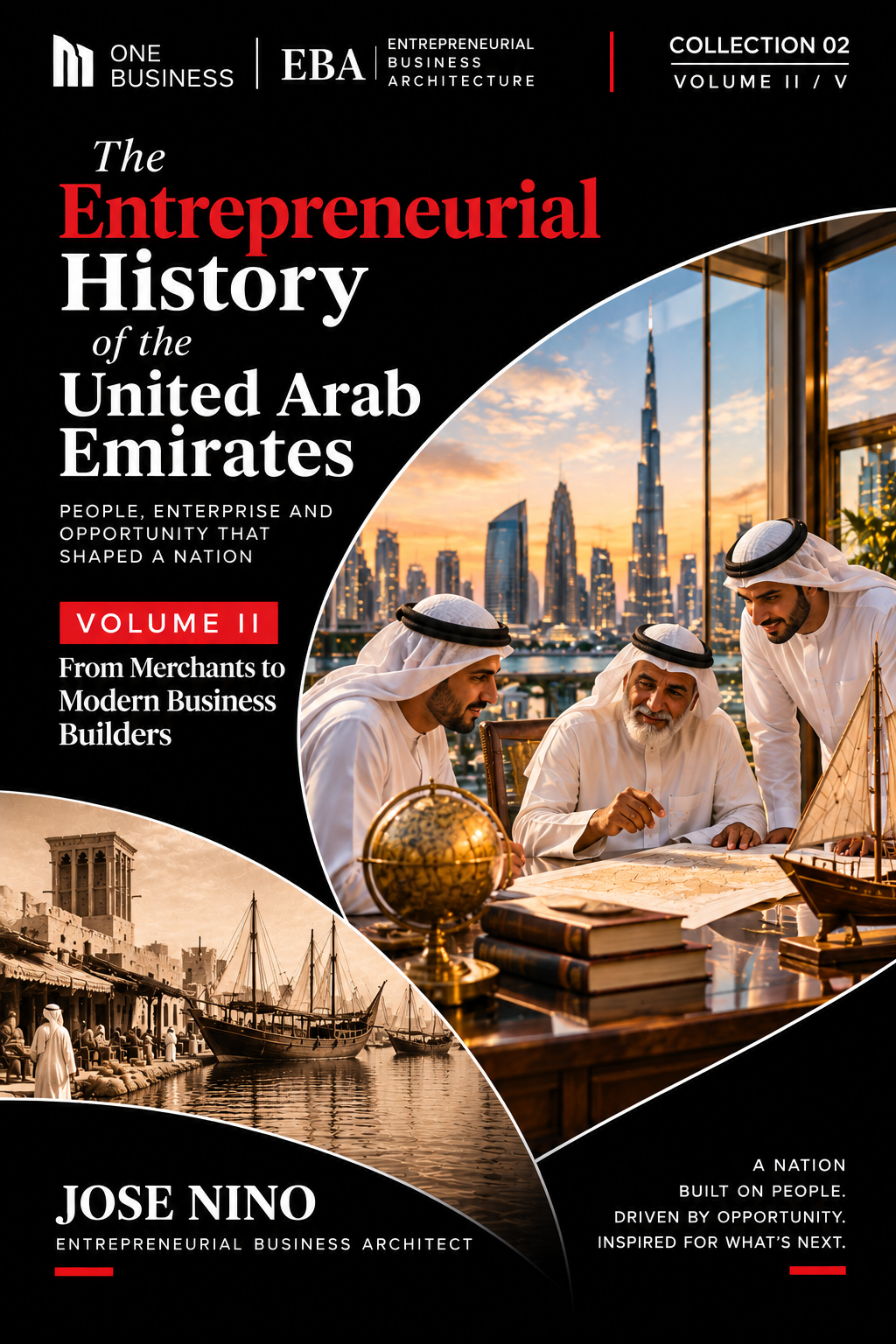
Official cover of The Entrepreneurial History of the United Arab Emirates, Volume II
COLLECTION 02 · VOLUME II / V
ONE BUSINESS DUBAI / ENTREPRENEURIAL BOOKS
COLLECTION 02 / THE ENTREPRENEURIAL HISTORY OF THE UAE

The Entrepreneurial
History of the
United Arab Emirates

Volume II — From Merchants to Modern Business Builders

From merchant relationships to modern organizations

Explore how established merchant families and business builders converted commercial experience, trust, partnerships and distribution capabilities into modern enterprises.

8 CHAPTERS97 NUMBERED SECTIONSFIRST EDITION · 2026
01 / ABOUT THIS VOLUME

From Merchants to Modern Business Builders.

Explore how established merchant families and business builders converted commercial experience, trust, partnerships and distribution capabilities into modern enterprises.

This volume forms part of a five-volume examination of the entrepreneurial history of the United Arab Emirates. It traces the people, commercial decisions, capabilities, relationships, enterprises and opportunities that shaped business development through different stages of the nation’s history.

Read the volume as a historical study of how individuals recognized opportunities, accumulated capabilities, built enterprises and transformed their economic circumstances.

02 / WHY THIS BOOK MATTERS

Entrepreneurial history through the actions of people.

From trading communities and visionary rulers to family enterprises, digital founders and emerging entrepreneurial opportunities, the UAE presents a rich history of people creating and developing businesses.

The purpose of this work is to understand how entrepreneurs identified opportunities, organized resources, built commercial trust, developed capabilities, entered markets and created enterprises. The history comes first; Entrepreneurial Business Architecture is used retrospectively to interpret relevant lessons without attributing a modern discipline to historical actors.

03 / WHAT YOU WILL DISCOVER

8 chapters. One part of a five-volume historical work.

Explore the subjects addressed in this volume using its verified chapter and section headings.

01

From Merchants to Modern Business Builders

The Merchants Who Already Knew How to Organize · People Recognized New Markets Inside Development
02

Nasser Alserkal: The Entrepreneur Who Changed the Market Around Him

Nasser Alserkal Before Market-Building · Nasser Alserkal Recognizes Emerging Commercial Possibilities

03

The Gargash Family: From Trading to Modern Mobility

The People Behind the Gargash Merchant Origins · Early Commercial Activity Before Mobility Became Central

04

The Al Ghurair Story: Opportunity, Diversification, and Scale

The People Behind the Al Ghurair Merchant Origins · Al Ghurair Entrepreneurs Recognize Opportunity in a

05

Juma Al Majid: Building Entrepreneurial Capability

Juma Al Majid Before the Business Group · Learning Through Work and Trade

06

The Al Naboodah Brothers: Building Enterprise While Building Dubai

Saeed and Mohammed Al Naboodah Before the Group · Founding the Enterprise and Learning Through Early Work

07

Abdul Jalil Al Fahim: Entrepreneurial Organization in Abu Dhabi

Abdul Jalil Al Fahim Before the Modern Group · Commercial Life Before Abu Dhabi's Transformation

08

Al Masaood: From Pearling Roots to Industrial Enterprise

The People Behind Al Masaood's Pre-Oil Commercial Roots · Pearling, Maritime Commerce, and Early Enterprise

04 / COMPLETE BOOK CONTENTS

Explore what's inside.

Open each chapter to explore the actual numbered section headings from Volume II.

CHAPTER 13From Merchants to Modern Business Builders
  1. 13.1The Merchants Who Already Knew How to Organize
  2. 13.2People Recognized New Markets Inside Development
  3. 13.3From Transaction to Organization
  4. 13.4Agency, Distribution, and Representation as Entrepreneurial
  5. 13.5Infrastructure Expanded Opportunity Because People
  6. 13.6Building Teams and Operating Systems
  7. 13.7Reinvestment Turned Commercial Surplus into New Capability
  8. 13.8From Personal Reputation to Brand and Customer
  9. 13.9Diversification Was a Decision About Capability, Not Merely
  10. 13.10Family Enterprise Had to Become an Organization
  11. 13.11From Commercial Network to Business Group
  12. 13.12The People Who Became Modern UAE Business Builders
  13. 13.13Conclusion: The Merchant Earns Through Transactions, the
CHAPTER 14Nasser Alserkal: The Entrepreneur Who Changed the Market Around Him
  1. 14.1Nasser Alserkal Before Market-Building
  2. 14.2Nasser Alserkal Recognizes Emerging Commercial Possibilities
  3. 14.3From Merchant Activity to Enterprise-Building Decisions
  4. 14.4The People Behind International Commercial Relationships
  5. 14.5Agency and Representation Become Entrepreneurial Models
  6. 14.6Nasser Alserkal Builds Distribution and Market Access
  7. 14.7Mobility Changes Because Entrepreneurs Build Around the
  8. 14.8Reputation and Relationship Capital
  9. 14.9Building an Enterprise That Could Continue Beyond Nasser
  10. 14.10Nasser Alserkal Changes the Market Around Him
  11. 14.11Limits, Failures, and the Boundaries of the Alserkal Case
  12. 14.12The Alserkal Market-Development Mechanism
CHAPTER 15The Gargash Family: From Trading to Modern Mobility
  1. 15.1The People Behind the Gargash Merchant Origins
  2. 15.2Early Commercial Activity Before Mobility Became Central
  3. 15.3Gargash Leaders Recognize the Emerging Mobility Market
  4. 15.4The People Who Built International Automotive Partnerships
  5. 15.5Distribution Becomes an Operating Capability
  6. 15.6Service, Maintenance, and Customer Trust
  7. 15.7Building the Organization Behind the Brand
  8. 15.8Brand Stewardship Without Brand Ownership
  9. 15.9Diversification and Adaptation Beyond the Original Mobility
  10. 15.10Generational Continuity as Capability Transfer
  11. 15.11Gargash as a Modern Enterprise-Building Case
  12. 15.12A Provisional Reading of the Gargash Trading-to-Mobility
CHAPTER 16The Al Ghurair Story: Opportunity, Diversification, and Scale
  1. 16.1The People Behind the Al Ghurair Merchant Origins
  2. 16.2Al Ghurair Entrepreneurs Recognize Opportunity in a
  3. 16.3Reinvestment Turns Commercial Success Into Enterprise
  4. 16.4From Commerce to Productive Capability
  5. 16.5The People Who Built Al Ghurair Industrial and
  6. 16.6Abdulla Al Ghurair, Mashreq, and the Building of Financial
  7. 16.7Food and Other Business Activities as Tests of Diversification
  8. 16.8The Logic—and Limits—of Al Ghurair Diversification
  9. 16.9Family Enterprise Evolution Across People and Generations
  10. 16.10Organizational Scale and Governance
  11. 16.11The Al Ghurair Branches and the Need for Historical
  12. 16.12A Provisional Analytical Sequence, Not a Formal Architecture
CHAPTER 17Juma Al Majid: Building Entrepreneurial Capability
  1. 17.1Juma Al Majid Before the Business Group
  2. 17.2Learning Through Work and Trade
  3. 17.3Juma Al Majid's First Entrepreneurial Activities
  4. 17.4Juma Al Majid Recognizes Opportunity in a Developing Dubai
  5. 17.5Partnerships and International Relationships
  6. 17.6Distribution and Representation Become Operating
  7. 17.7Reinvestment and Business Expansion
  8. 17.8Building Teams and Organizational Capability
  9. 17.9Diversification Across Sectors
  10. 17.10Values, Reputation, and Long-Term Relationships
  11. 17.11Philanthropy and Education in the Context of the
  12. 17.12A Provisional Capability Development Sequence
CHAPTER 18The Al Naboodah Brothers: Building Enterprise While Building Dubai
  1. 18.1Saeed and Mohammed Al Naboodah Before the Group
  2. 18.2Founding the Enterprise and Learning Through Early Work
  3. 18.3The Brothers Recognize Infrastructure Demand
  4. 18.4Construction as Execution Capability
  5. 18.5Partnerships, Technology, and Technical Knowledge
  6. 18.6Project Complexity Forces Organizational Growth
  7. 18.7Building Reputation Through Delivery
  8. 18.8Reinvestment Expands Delivery Capacity
  9. 18.9Diversification Beyond Contracting
  10. 18.10Professionalization and Enterprise Scale
  11. 18.11Enterprise Growth Alongside Dubai — Opportunity,
  12. 18.12The Al Naboodah Enterprise-Execution Scale Model
CHAPTER 19Abdul Jalil Al Fahim: Entrepreneurial Organization in Abu Dhabi
  1. 19.1Abdul Jalil Al Fahim Before the Modern Group
  2. 19.2Commercial Life Before Abu Dhabi's Transformation
  3. 19.3Abdul Jalil's Early Entrepreneurial Activity
  4. 19.4Reading Abu Dhabi's New Demand
  5. 19.5International Partnerships and Representation
  6. 19.6Automotive and Enterprise Development
  7. 19.7Building the Organization Behind Growth
  8. 19.8Reputation and Long-Term Relationships
  9. 19.9Family Participation and Capability Continuity
  10. 19.10Professionalization and Diversification
  11. 19.11Building Enterprise Within Abu Dhabi's Transformation
  12. 19.12The Al Fahim Entrepreneurial Organization Model
CHAPTER 20Al Masaood: From Pearling Roots to Industrial Enterprise
  1. 20.1The People Behind Al Masaood's Pre-Oil Commercial Roots
  2. 20.2Pearling, Maritime Commerce, and Early Enterprise
  3. 20.3Surviving Economic Transition
  4. 20.4New Opportunities in a Developing Abu Dhabi
  5. 20.5Trading and International Partnerships
  6. 20.6Automotive and Mobility Capability
  7. 20.7Industrial, Engineering, Power, and Marine Capability
  8. 20.8Diversification Across Economic Eras
  9. 20.9Family Continuity and Organizational Change
  10. 20.10Professionalization and Organizational Reinvention
  11. 20.11What Was Preserved—and What Had to Change
  12. 20.12The Al Masaood Intergenerational Reinvention Architecture
ALSO INCLUDED

Volume introduction · Historical analysis · Entrepreneurial interpretation

05 / THE ENTREPRENEURIAL HISTORY OF THE UAE
2/05

COLLECTION 02 · FIVE VOLUMES

One volume in a five-part historical study.

The Entrepreneurial History of the United Arab Emirates traces entrepreneurial origins, visionary builders, merchant families, the development of enterprises and markets, international and digital entrepreneurs, and the next generation through the analytical perspective of EBA.

Each volume can be studied separately or as part of the complete collection.

EXPLORE THE COMPLETE COLLECTION ↗
06 / WHO THIS BOOK IS FOR

For readers seeking to understand how entrepreneurs build their futures.

This work is intended for entrepreneurs, business owners, students, researchers and readers interested in the entrepreneurial history of the UAE and the processes through which economic capabilities, enterprises and markets develop.

Its historical perspective is especially relevant to individuals seeking to understand entrepreneurial initiative, opportunity discovery, business creation, market development and the transformation of personal and economic realities.

07 / THE ENTREPRENEURIAL PERSPECTIVE

History as knowledge for entrepreneurial thinking.

Entrepreneurial Business Architecture connects personal development, entrepreneurial capability, opportunity discovery, business creation and sustainable entrepreneurial development.

These volumes examine entrepreneurs and enterprises within their own historical circumstances, then draw analytical lessons where warranted by the evidence. They do not suggest that historical actors were consciously applying a contemporary EBA framework.

EXPLORE ENTREPRENEURIAL KNOWLEDGE ↗
08 / GET YOUR COPY

Explore Volume II.

Choose this volume or explore the complete five-volume collection. Complete your order form before secure payment through Stripe. Your PDF will be sent by email after payment confirmation.

INDIVIDUAL VOLUME

Volume II · Digital Edition

From Merchants to Modern Business Builders

USD $6.99
SECURE CHECKOUT · STRIPEBUY VOLUME ↗

Complete the order form, continue to secure Stripe payment, and receive your PDF by email after payment confirmation.

ONE BUSINESS DUBAI

Personal Transformation.
Entrepreneurial Development.
Economic Opportunity.

Advancing personal transformation, entrepreneurial development, and the creation of economic opportunity in Dubai and the UAE.

ONE BUSINESS DUBAI / CONTACT

Get in touch.

Have a question about our knowledge, books, or education? Send us a message.

We use your information to respond to your inquiry and collect your IP address for security and to understand the origin of inquiries. Submissions are processed by our FormMail server.

You can also email us directly at[email protected]