ONE BUSINESS / INSIGHTS / ARTICLE 17
Why Every Entrepreneur Starting a Business in Dubai Should Understand the UAE's Economic History
Discover why understanding the economic transformation of the United Arab Emirates can help international entrepreneurs identify business opportunities, make better company formation decisions, and build stronger enterprises.

Dubai attracts entrepreneurs from around the world who want to establish companies, expand internationally, access new markets, and participate in one of the most internationally connected economies in the Middle East. For many, the journey begins with practical questions: How much does it cost to register a company in Dubai? Should the business operate from a free zone or the mainland? Which emirate offers the most appropriate environment? What opportunities exist for foreign entrepreneurs, and how can a new company develop sustainable commercial activities?
These questions are important, but they are incomplete without an understanding of the economic environment in which the business will operate. Before establishing a company in Dubai or elsewhere in the United Arab Emirates, entrepreneurs should understand how the country's economy developed, why its principal industries emerged, and how its institutions and commercial infrastructure created the business opportunities available today. This historical knowledge provides context for evaluating markets, choosing locations, identifying economic opportunities, and making informed decisions about company formation.
This is the central purpose of The Economic History of the United Arab Emirates, a comprehensive five-volume research collection by Jose Nino, Entrepreneurial Business Architect. Through forty chapters, the work examines how seven emirates developed from geographically constrained trading and resource-based economies into a federation with internationally significant capabilities in energy, aviation, logistics, finance, tourism, industry, technology, and enterprise development.
The collection is designed for readers who want to understand the economic foundations behind today's UAE business environment, including entrepreneurs preparing to establish companies in the country. ONE Business Dubai connects this historical and entrepreneurial knowledge with practical company formation services, assisting international entrepreneurs with UAE business registration and business bank account opening assistance. Our professional service fee for eligible UAE company registration services is USD 1,000, plus applicable government, licensing, and third-party costs.
Explore the research: The Economic History of the United Arab Emirates — Complete Five-Volume Collection, USD 29.99
Ready to establish your business? Explore ONE Business Dubai Company Registration Services
Why Economic History Matters When Starting a Business in Dubai
Entrepreneurs frequently evaluate countries through their current economic indicators, business regulations, taxation arrangements, infrastructure, and investment opportunities. These factors influence business formation decisions, but they represent the contemporary outcomes of historical processes that have developed over decades.
Dubai's present commercial environment cannot be fully understood without examining its earlier role in regional maritime trade. Its international logistics capabilities are connected to decisions involving Dubai Creek, Port Rashid, Jebel Ali Port, and the development of specialized business environments. Its aviation sector reflects investments in airport infrastructure and the development of airlines capable of connecting international markets. Its commercial and financial institutions emerged through a longer process of economic adaptation, institutional development, and international integration.
Understanding these historical relationships helps entrepreneurs distinguish between the visible characteristics of a market and the economic mechanisms that created them. A free zone is not simply a jurisdiction offering company registration. It is part of an institutional model developed to support particular forms of investment and commercial activity. A major port is not merely a transportation facility. It contributes to the economic relationships that make trading, logistics, distribution, and related services possible.
For entrepreneurs, this perspective is valuable because business opportunities depend on more than the existence of customers. They also depend on infrastructure, institutions, market access, specialized capabilities, commercial relationships, and the conditions under which enterprises can operate.
Economic history helps entrepreneurs understand why opportunities exist, not merely where they appear to exist today.
This distinction becomes particularly important when entering an unfamiliar international market. An entrepreneur may recognize that Dubai is a major commercial center without understanding which activities benefit from its infrastructure, how different industries interact, or why particular business jurisdictions have developed distinct economic propositions.
Historical knowledge does not replace contemporary market research. It provides the context necessary to interpret that research more intelligently.
The UAE Was an Entrepreneurial Economy Before It Became an Oil Economy
One of the most important misconceptions about the economic development of the United Arab Emirates is that its transformation began with the discovery of petroleum. Oil played a fundamental role in expanding the financial resources available to the country, particularly in Abu Dhabi, but the commercial foundations of the emirates existed long before hydrocarbon revenues transformed their economies.
The communities that developed along the Arabian Gulf participated in maritime trade, fishing, pearling, regional exchange, and other economic activities shaped by geographic conditions and available resources. Their commercial relationships connected them with markets across the Gulf, Persia, India, East Africa, and the wider Indian Ocean trading system.
Dubai developed a particularly significant commercial orientation through its merchant communities and maritime connections. Its economic development depended on the ability to facilitate exchange, maintain commercial relationships, and participate in markets extending beyond its limited domestic population.
This history provides a valuable lesson for entrepreneurs entering the UAE today. The country's international commercial identity did not emerge solely from modern buildings, airports, or free-zone legislation. It developed from a longer tradition of economic exchange, commercial adaptation, and the pursuit of opportunities beyond the immediate local market.
For entrepreneurs considering international trade, professional services, logistics, or regional market development, this historical foundation helps explain why international connectivity became such an important characteristic of Dubai's economic model.
The entrepreneurial lesson is that limited domestic resources do not necessarily prevent the development of substantial economic opportunities when enterprises can connect effectively with wider markets.
These historical foundations are examined in Volume I — Foundations of the Emirates, which explores the region's early economic conditions, maritime relationships, commercial institutions, and the different development paths of the emirates before the emergence of the modern federation.
Discover Volume I — Foundations of the Emirates, USD 6.99
Understanding How the UAE Created the Institutions That Support Business
The discovery of oil, the leadership of Sheikh Zayed bin Sultan Al Nahyan and Sheikh Rashid bin Saeed Al Maktoum, and the formation of the United Arab Emirates in 1971 marked a decisive transformation in the region's economic development.
However, the formation of a federation and the availability of petroleum revenues did not automatically create the institutions necessary for a modern economy. Administrative systems, public infrastructure, financial institutions, government services, education, transportation networks, and other capabilities had to be developed.
These institutions became important components of the environment in which commercial enterprises could operate. Their development influenced the organization of markets, the movement of capital, the provision of public services, and the ability of businesses to participate in increasingly complex economic activities.
For entrepreneurs, the significance of this history lies in understanding the relationship between enterprise and institutional capacity. Businesses do not operate independently of their legal, administrative, financial, and economic environments. Their opportunities and obligations are influenced by the institutions governing commercial activity.
This is particularly relevant when establishing a company in the UAE. Entrepreneurs must consider the applicable licensing framework, the jurisdiction in which their business will operate, the permissions associated with their activities, and the regulatory requirements affecting their proposed commercial model.
Choosing an appropriate business structure requires understanding how the UAE's institutional environment supports different forms of enterprise.
The historical development of these institutions is explored in Volume II — Oil, Leadership, and the Formation of the Federation, which examines how natural resources, leadership decisions, federal formation, and institution-building contributed to the development of the modern UAE economy.
Discover Volume II — Oil, Leadership, and the Formation of the Federation, USD 6.99
The Enterprises That Created Today's Business Opportunities
The contemporary UAE economy contains internationally recognized enterprises operating in energy, aviation, logistics, finance, real estate, tourism, telecommunications, manufacturing, and other sectors.
These industries did not develop independently. Their growth involved relationships among infrastructure, investment, institutions, commercial organizations, and international markets.
Emirates Airline contributed to the development of Dubai's aviation connectivity and its position as an international destination. Port and logistics enterprises strengthened the country's participation in global trade. Energy companies helped develop industrial capabilities and commercial relationships extending beyond the extraction of natural resources. Financial institutions, telecommunications companies, real estate developers, and private enterprises contributed to the expansion of economic activity.
Understanding the development of these industries helps entrepreneurs recognize how business ecosystems emerge. Major enterprises create demand for suppliers, professional services, technology providers, distribution businesses, and specialized capabilities. Their presence may contribute to opportunities for smaller companies, although those opportunities must be evaluated according to actual customer requirements, competition, and commercial feasibility.
For a new entrepreneur, this perspective can change the process of opportunity discovery. Rather than beginning with a general intention to establish a company in Dubai, the entrepreneur can investigate the economic activities already taking place, the needs of particular industries, and the opportunities for providing valuable products or services.
A successful business opportunity is not simply an attractive industry. It is an identifiable customer need that an entrepreneur can satisfy through a commercially viable enterprise.
This distinction is essential for international entrepreneurs who may be attracted by the UAE's economic reputation without having validated their specific business propositions.
The historical development of these enterprises and industries is examined in Volume III — Building the Modern UAE Economy, which explores how the country's economic foundations became productive business capabilities.
Discover Volume III — Building the Modern UAE Economy, USD 6.99
Why Choosing the Right Emirate Requires Economic Understanding
One of the most important decisions facing international entrepreneurs is where to establish their businesses within the United Arab Emirates.
Although Dubai is internationally recognized as a major commercial center, the UAE is a federation of seven emirates with distinct economic histories, resources, geographic characteristics, institutional capabilities, and development priorities.
Abu Dhabi's economic model has been strongly influenced by energy resources, capital accumulation, and strategic investment. Dubai developed through trade, connectivity, commercial infrastructure, and international enterprise. Sharjah has important industrial, educational, cultural, and commercial capabilities. Ras Al Khaimah has developed industrial and tourism-related activities, while Fujairah's geographic position supports maritime and energy-related opportunities. Ajman and Umm Al Quwain possess their own economic characteristics and development priorities.
These differences matter because a business location should be evaluated according to the activities the enterprise intends to undertake.
A company requiring industrial facilities may have different location priorities from a professional services business. An international trading company may emphasize logistics connections, while a technology enterprise may require access to specialized expertise, relevant business environments, and potential customers.
Company formation costs are important, but they should not be the only factor influencing the decision. Entrepreneurs must consider whether the selected jurisdiction permits the intended activities and provides suitable operating conditions.
The most appropriate location for a business is not necessarily the most famous or the least expensive. It is the location whose economic and regulatory characteristics best support the enterprise's commercial objectives.
This is an area where historical knowledge and practical business formation services can complement one another.
ONE Business Dubai assists international entrepreneurs in navigating company registration in Dubai and the UAE, helping them evaluate establishment arrangements in relation to their proposed business activities and requirements.
Explore UAE Company Registration and Business Bank Account Opening Assistance
The historical foundations of the seven emirates' distinct economic models are examined in Volume IV — The Economic Models of the Emirates. This volume is particularly relevant for entrepreneurs who want to understand the economic differences within the federation before evaluating business locations.
Discover Volume IV — The Economic Models of the Emirates, USD 6.99
Learning from Economic Crises, Adaptation, and Future Development
Economic history is valuable not only because it explains successful development. It also reveals how economies respond to uncertainty, financial difficulties, changing international conditions, and structural transformation.
The UAE's economic experience includes periods of disruption and adaptation. Changes in traditional industries, fluctuations in energy markets, international financial conditions, and the global financial crisis of 2008–2009 all influenced the country's economic development.
These experiences are important for entrepreneurs because they demonstrate that growth does not eliminate risk. Economic opportunities must be evaluated alongside financial exposure, market uncertainty, institutional requirements, and the ability of businesses to adapt when conditions change.
Dubai's experience during the global financial crisis provides a particularly important historical case for understanding the relationship between rapid expansion, debt, financial vulnerability, and strategic recovery. Its significance for entrepreneurs extends beyond the specific circumstances of the crisis. It illustrates why ambitious growth must be accompanied by financial discipline and organizational resilience.
At the same time, the UAE continues pursuing economic development through technology, advanced industry, digital transformation, knowledge-intensive activities, sustainability initiatives, and international investment.
Entrepreneurs considering establishing businesses in the country should understand how these developments relate to the country's existing economic capabilities. Emerging opportunities are more effectively evaluated when they are connected to the historical foundations, institutions, industries, and strategic priorities that shape the wider economy.
Understanding the past does not allow entrepreneurs to predict the future with certainty. It helps them recognize economic patterns, evaluate emerging opportunities, and make decisions with greater context.
These themes are explored in Volume V — Economic Policy, Resilience, and the Future UAE, which examines the instruments of economic development, historical crises, resilience, and the strategies influencing the country's future.
Discover Volume V — Economic Policy, Resilience, and the Future UAE, USD 6.99
From Historical Knowledge to Entrepreneurial Decision-Making
The purpose of studying economic history is not to reproduce historical decisions without considering contemporary circumstances. Entrepreneurs operate in markets that differ from those of previous generations, and successful strategies cannot simply be transferred from one period to another.
The value of historical analysis lies in understanding the mechanisms through which opportunities emerged, resources were organized, institutions developed, and enterprises created economic value.
This perspective connects with Entrepreneurial Business Architecture (EBA), a contemporary discipline concerned with developing entrepreneurial capabilities, discovering opportunities, creating viable enterprises, establishing market presence, developing commercial relationships, and supporting sustainable business growth.
EBA provides an analytical framework through which historical lessons can inform contemporary entrepreneurial thinking. The historical record supplies evidence of economic development, while entrepreneurial analysis examines how particular mechanisms may be relevant to business decisions today.
For entrepreneurs considering the UAE, this approach encourages a more disciplined sequence of decisions. They can begin by developing an understanding of the economic environment, investigating potential opportunities, evaluating their capabilities, and determining whether a proposed business model is commercially viable. Company formation then becomes part of a broader entrepreneurial development process rather than an isolated administrative transaction.
This distinction matters because registering a company does not automatically create a successful business. A legal entity provides a structure through which commercial activities may be conducted, but entrepreneurs must still identify customers, develop products or services, organize operations, comply with applicable requirements, and generate sustainable revenue.
The UAE's economic history provides valuable context for these decisions. It helps entrepreneurs understand the environments in which enterprises operate and the relationships between economic development, business capabilities, and market opportunities.
The Economic History of the United Arab Emirates: Five Volumes for Entrepreneurs and Business Professionals
The Economic History of the United Arab Emirates was developed to provide a comprehensive historical and economic perspective on the transformation of the seven emirates.
Across five volumes and forty chapters, the collection examines the development of the UAE from its earliest commercial foundations to the institutions, enterprises, economic models, and strategic priorities shaping its contemporary economy.
Its relevance to entrepreneurs lies in the connection between historical understanding and informed business decision-making. The collection offers readers an opportunity to examine how economic opportunities emerged, how infrastructure and institutions developed, how major industries expanded, and how the country's distinct economic environments evolved.
Rather than approaching Dubai and the UAE solely through current investment promotions or company registration advertisements, entrepreneurs can develop a deeper understanding of the economic structures underlying those opportunities.
The collection is particularly relevant to international entrepreneurs evaluating company formation, business owners considering expansion into the Middle East, investors studying the country's economic development, and professionals seeking to understand the historical foundations of its business environment.
The Economic History of the United Arab Emirates
By Jose Nino — Entrepreneurial Business Architect
Complete Five-Volume Digital Collection: USD 29.99
Individual Digital Volumes: USD 6.99 each
Explore the Complete Five-Volume Collection
Understanding the economic history of the UAE is not a substitute for business planning or professional advice. It is a foundation for asking better questions, interpreting the business environment more intelligently, and recognizing how the country's historical transformation influences the opportunities available today.
Ready to Establish Your Business in Dubai or the UAE?
Historical knowledge can help entrepreneurs understand the economic environment, but turning an opportunity into a functioning enterprise also requires practical decisions about company registration, licensing, operating arrangements, and commercial development.
ONE Business Dubai supports international entrepreneurs and companies seeking to establish businesses in Dubai and the United Arab Emirates.
Our services include assistance with UAE company registration and the business bank account opening process, helping entrepreneurs navigate the practical requirements associated with establishing their business presence.
UAE Company Registration + Business Bank Account Opening Assistance
Professional Service Fee: USD 1,000
Applicable government, licensing, and third-party costs are additional.
Eligible company registrations may be completed within 24 hours, subject to the procedures, documentation requirements, and approvals of the relevant authority. Business bank account opening is subject to independent financial institution eligibility, compliance, and approval processes.
Explore ONE Business Dubai Company Registration Services
The most informed entrepreneurial decisions combine an understanding of the economic environment with careful market research, appropriate business structures, and the capabilities necessary to create commercial value.
Before establishing your business in the UAE, understand the economy you are entering. Before pursuing an opportunity, understand how that opportunity emerged. And before building your future in Dubai, discover the history that helped make its business environment possible.
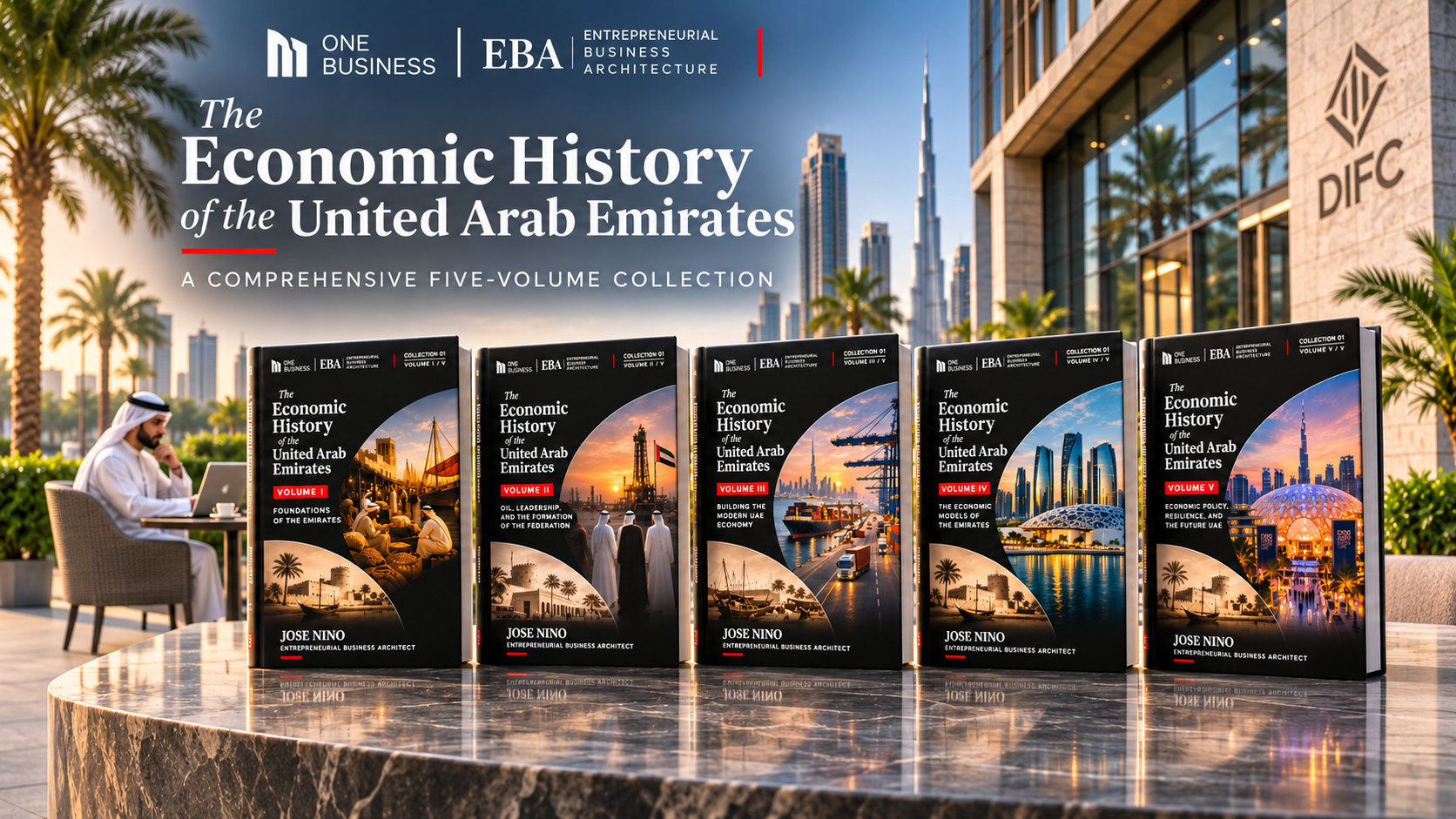
Discover The Economic History of the United Arab Emirates — Complete Collection, USD 29.99
ONE Business Dubai | Strategic Entrepreneurial Business Architecture Advisory Firm
Research foundation: Jose Nino, The Economic History of the United Arab Emirates, Volumes I–V.
This article provides historical analysis and general entrepreneurial education. Business formation, regulatory, taxation, and banking requirements should be verified for each proposed business and jurisdiction before making commercial or investment decisions.