ONE BUSINESS / INSIGHTS / ARTICLE 19
Why Understanding the UAE’s Ancient Trade Networks Helps Entrepreneurs Succeed in Dubai’s Global Economy Today
What the economic history of the Emirates teaches international entrepreneurs about market connectivity, commercial relationships, specialization, competitive positioning, and building successful businesses in Dubai.

Why Understanding the UAE’s Ancient Trade Networks Helps Entrepreneurs Succeed in Dubai’s Global Economy Today
What the economic history of the Emirates teaches international entrepreneurs about market connectivity, commercial relationships, specialization, competitive positioning, and building successful businesses in Dubai.
Dubai has become one of the world’s most internationally connected business environments, attracting entrepreneurs who want to establish companies, develop commercial activities, access foreign markets, and participate in the economic opportunities emerging across the United Arab Emirates. Its airports, ports, financial institutions, free zones, commercial districts, and international business communities provide an infrastructure that connects enterprises with customers, suppliers, investors, and commercial partners across multiple regions. However, the existence of these capabilities does not automatically explain how entrepreneurs should use them, which opportunities deserve attention, or why some businesses develop lasting commercial positions while others struggle despite operating within the same environment.
Understanding the economic history of the United Arab Emirates helps entrepreneurs answer these questions because it reveals how commercial opportunities emerge, how markets become interconnected, and how productive capabilities are transformed into economic value. Dubai’s contemporary commercial position did not develop independently of the region’s earlier experiences with maritime exchange, resource specialization, geographical constraints, and long-distance trading relationships. Those experiences belong to different historical periods and economic systems, but their examination reveals mechanisms that remain useful for understanding how enterprises participate in markets today.
The historical foundations of these relationships are examined in The Economic History of the United Arab Emirates — Volume I: Foundations of the Emirates, part of the five-volume research collection presented by ONE Business Dubai. Its analysis of early settlements and regional trading networks explores how communities inhabiting the territories of the modern Emirates developed economic activities suited to their environments, established relationships with neighboring economies, and participated in commercial exchanges that extended far beyond their immediate territories. This history provides entrepreneurs with a more substantial understanding of the economic foundations from which the UAE’s contemporary commercial identity eventually emerged.
The importance of studying these developments is not simply to discover that trade existed before the discovery of oil. It is to understand the conditions that made trade economically valuable, the capabilities required to sustain it, and the relationships through which local activities became connected to wider markets. An entrepreneur who understands how commercial networks develop is better prepared to evaluate where a business can create value, which relationships are necessary for growth, and how to establish a meaningful position within Dubai’s contemporary economy.
Understanding How Economic Opportunities Emerge from Commercial Relationships
Long before the formation of the United Arab Emirates, the communities inhabiting its present-day territory faced geographical and economic conditions that differed substantially from those of the modern country. Agricultural possibilities were limited by freshwater availability, the coastal environment provided particular maritime resources, and mountainous and oasis regions supported different forms of economic activity. These circumstances influenced where communities settled, which productive activities they developed, and the resources they needed to obtain through exchange with neighboring populations.
The geographical diversity of the region encouraged the development of specialized capabilities. Coastal communities accumulated knowledge of fishing, navigation, maritime transportation, and the resources available in shallow Gulf waters. Oasis settlements developed agricultural practices and water-management arrangements that made productive activity possible in otherwise demanding environments. Communities associated with mountainous regions possessed access to mineral resources and overland routes that connected different economic areas. These activities evolved across distinct historical periods, and the surviving archaeological evidence does not support treating them as a single uniform economy. Nevertheless, their differences help explain why exchange became important: communities possessed particular capabilities and resources while depending on others for goods they could not readily produce themselves.
This relationship between specialization and exchange is fundamental to understanding economic development. A resource may be valuable within a particular geographical environment, but its wider commercial significance depends on the existence of demand, the ability to organize production, and the means required to deliver it to another economic participant. The possession of copper deposits, for example, does not automatically create an export economy. Extraction requires practical knowledge and labor, while participation in external trade requires transportation capabilities, commercial relationships, and buyers who value the resulting product. Economic value emerges through the interaction of these elements rather than through the existence of the resource alone.
The early commercial connections between the southeastern Arabian Peninsula and Mesopotamia provide an important historical example. Mesopotamian records referring to Magan, a geographical designation associated with territories encompassing parts of present-day Oman and the Emirates, demonstrate the significance of copper within regional exchange networks during the Bronze Age. These relationships connected regions possessing different productive capabilities and resource requirements. Mesopotamian agricultural production and the mineral resources available farther southeast formed part of a commercial system in which exchange enabled participants to obtain goods that their own environments could not supply in the same way.
The entrepreneurial importance of this history lies in recognizing that commercial opportunities frequently emerge where the capabilities of one economic participant correspond to the unmet needs of another. A business does not become valuable merely because its founder possesses knowledge, capital, technology, or access to a particular location. Its economic value depends on whether those capabilities can satisfy identifiable demand under commercially viable conditions. The more precisely an entrepreneur understands the relationship between what an enterprise can provide and what a market requires, the stronger the foundation for evaluating the opportunity.
This principle is particularly important for international entrepreneurs establishing businesses in Dubai. The city provides access to numerous commercial activities, but that diversity can encourage unfocused investment when entrepreneurs interpret the existence of many industries as evidence that almost any business idea will succeed. The presence of international trading companies, financial institutions, logistics operators, technology enterprises, and professional services providers creates a complex economic environment with many potential customers. It does not establish that those customers need a particular new service, that they are dissatisfied with their existing suppliers, or that they will pay the price necessary to make a proposed enterprise profitable.
A more disciplined entrepreneur begins by studying the economic functions performed within the chosen market. The investigation identifies the activities already taking place, the capabilities required to perform them, the problems encountered by existing participants, and the areas where demand may not be adequately satisfied. In a logistics-intensive environment, for example, opportunities may arise around specialized inventory management, equipment maintenance, documentation systems, technical services, or the coordination of international suppliers. Each possibility requires separate evaluation because the existence of a substantial logistics industry does not establish that every proposed service represents a commercially attractive opportunity.
The connection with the economic history of the Emirates is therefore direct and practical. Early exchange networks developed because different participants possessed complementary resources and capabilities. Contemporary businesses also create value by addressing specific requirements within wider systems of economic activity. The technologies, institutions, and scale are profoundly different, but understanding the historical mechanism helps entrepreneurs ask a better question when considering Dubai: rather than simply asking which industries are growing, they should investigate which needs exist within those industries and what capabilities their businesses must develop to satisfy them effectively.
Economic specialization also offers an important lesson about competitive positioning. Enterprises frequently weaken their commercial identity by attempting to offer too many unrelated products or services before developing a strong position in any particular market. Although diversification can become valuable under suitable circumstances, a new business must first establish why customers should choose its offering rather than those of existing competitors. Specialization can support this objective by allowing the enterprise to develop relevant expertise, understand customer requirements in greater depth, improve its operating procedures, and build a reputation within a defined market.
For an international entrepreneur establishing a consulting business in Dubai, this might mean concentrating initially on a particular industry, customer category, or professional capability rather than presenting the enterprise as a general solution for every business problem. A company providing specialized services to manufacturing enterprises will encounter different customer expectations, operational processes, and competitive conditions from one focused on hospitality or financial services. Understanding these differences allows the entrepreneur to organize the business around a market that can be investigated, approached, and served systematically.
The historical experience demonstrates another dimension of specialization that entrepreneurs must understand: productive capabilities and commercial connections develop together. A community possessing a valuable resource becomes more economically significant when it can access markets where that resource is needed. Similarly, a contemporary business becomes more valuable when it establishes relationships with customers capable of benefiting from its specialized offering. Neither productive capability nor market access is sufficient independently. Sustainable commercial development requires their effective combination.
From Ancient Trading Routes to Dubai’s Modern Commercial Networks
The early economic history of the Emirates also reveals the importance of geographical connectivity. The Arabian Gulf and neighboring maritime routes connected communities along the southeastern Arabian Peninsula with wider economic systems. The movement of goods, people, and knowledge contributed to commercial relationships extending beyond local settlements, while the economic importance of particular locations depended partly on their access to transportation routes, productive regions, and external markets.
These relationships developed through different stages. The archaeological cultures associated with the Hafit, Umm Al Nar, and Wadi Suq periods provide evidence of changing settlement patterns, material production, and participation in regional exchange. Later developments involved different forms of maritime commerce and relationships with surrounding political and economic centers. The historical record remains uneven, and the existence of trade connections during one period should not be used to assume identical commercial arrangements existed throughout the region’s entire history. Understanding the sequence matters because the formation of economic networks was gradual rather than the result of a single event or predetermined development strategy.
Commercial relationships with Mesopotamia, Persia, and the Indus Valley illustrate the extent to which the region participated in wider systems of exchange. Copper, ceramics, agricultural products, and other materials circulated through networks that required coordination among producers, traders, transporters, and buyers. Goods were not the only elements moving through these relationships. Techniques, material practices, and forms of commercial knowledge could also spread through sustained contact among economic communities. Such exchanges contributed to the accumulation of capabilities that became useful beyond the transactions through which they were initially encountered.
As examined in The Economic History of the United Arab Emirates, particularly its first volume, the importance of these networks cannot be understood exclusively through the commodities exchanged. Their economic significance also involved the relationships, knowledge, transportation capabilities, and organizational practices necessary to make exchange possible. A trading network connected different productive systems and allowed economic participants to access resources and opportunities beyond those available within their immediate environments.
This historical distinction helps entrepreneurs understand why Dubai’s modern connectivity is economically valuable. The city’s international infrastructure makes it possible for companies to establish relationships across geographical boundaries, but connectivity creates business value only when an enterprise can use those connections to satisfy demand, improve commercial efficiency, or provide a service that customers need. An airport, port, financial center, or international business district expands the possibilities available to enterprises, yet each business must develop a specific commercial model capable of transforming those possibilities into actual transactions.
Consider a company intending to import specialized products through Dubai and distribute them to customers in neighboring markets. Its opportunity depends on far more than the availability of international transportation. The entrepreneur must understand customer demand, supplier reliability, applicable import and export requirements, transportation costs, financing needs, customs procedures, inventory risks, and the competitive conditions affecting the selected products. The company’s commercial viability emerges from its ability to coordinate these elements into an operating system that delivers value at an acceptable cost.
A similar principle applies to professional services. An entrepreneur may establish a company in Dubai to serve clients throughout the Middle East, but international market access does not automatically produce customer relationships. The enterprise must understand how potential clients select service providers, which business requirements influence purchasing decisions, what qualifications or regulatory permissions may be necessary, and how its services can be delivered effectively across the markets it intends to serve. The geographical position of Dubai can facilitate certain activities, but the entrepreneur must still construct the commercial relationships and operating capabilities necessary to participate in them.
Studying historical networks helps reveal another important feature of market development: economic relationships are not necessarily organized as isolated transactions between two participants. A producer may depend on transportation providers, financing arrangements, intermediaries, and distribution capabilities before reaching the final buyer. Each participant contributes a function that enables the wider transaction to occur. The resulting commercial system can create opportunities for enterprises that do not produce the principal commodity but provide capabilities essential to its movement, financing, management, or delivery.
This observation has substantial implications for entrepreneurs investigating opportunities in Dubai. Many founders begin by searching for products to sell or industries in which to compete directly. A more sophisticated approach examines the relationships connecting different participants within an industry. An enterprise may discover that its strongest opportunity involves improving coordination between suppliers and customers, providing specialized knowledge, managing information, or solving operational problems that existing businesses cannot address efficiently.
For example, an entrepreneur investigating the international food trade may initially focus on importing and reselling products. Yet a detailed examination of the commercial network might reveal opportunities associated with quality assurance, specialized storage, procurement coordination, regulatory documentation, digital inventory systems, or distribution services. These activities serve different customer needs and require distinct capabilities, but they demonstrate how understanding the architecture of commercial exchange expands the entrepreneur’s ability to recognize opportunities beyond the most obvious transactions.
The same analytical approach can be applied to technology, manufacturing, tourism, international consulting, and other sectors operating within the UAE. The objective is not to identify a superficially attractive industry and assume that participation will generate income. It is to investigate how the industry functions, which relationships create economic value, and where a new enterprise can contribute a capability that customers are willing to purchase.
Understanding how trade networks develop therefore helps entrepreneurs recognize that the most valuable business opportunity is not always located at the most visible point of economic activity. It may exist within the relationships, processes, and services that make that activity possible. This perspective encourages entrepreneurs to study markets as interconnected economic systems rather than collections of unrelated companies.
The historical development of commercial connectivity also demonstrates why business relationships require sustained attention. A trade route becomes economically significant when goods can move through it, but commercial participation depends on more than the physical existence of that route. Traders need knowledge of destinations, reliable counterparties, appropriate transportation arrangements, and practical mechanisms for coordinating exchange. Relationships require maintenance because the conditions affecting participants can change, and commercial systems remain vulnerable when important connections become unreliable.
Modern entrepreneurs face comparable issues through different institutional and technological arrangements. Supplier failure, changes in customer demand, payment disputes, transportation disruptions, and regulatory developments can affect the performance of an enterprise. A business with poorly developed commercial relationships may struggle to respond, even when it operates within a sophisticated economic environment. A company that understands its suppliers, customers, logistical dependencies, and contractual obligations is better prepared to identify vulnerabilities and develop appropriate responses.
This does not mean that every entrepreneur should establish as many commercial relationships as possible. Networks create value when their participants perform useful functions and when the cost of maintaining those relationships is justified by the opportunities they provide. Expanding a network without a clear commercial purpose can increase complexity, administrative requirements, and financial exposure. The objective is to develop a commercially coherent system of relationships that strengthens the enterprise’s ability to serve its market.
An entrepreneur entering Dubai should therefore evaluate relationships according to their actual economic function. A potential partner may provide access to customers, technical expertise, distribution capabilities, specialized infrastructure, or knowledge of a particular market. The value of the relationship depends on whether that contribution improves the enterprise’s commercial position and whether the arrangement can be maintained under terms acceptable to the participants. Historical knowledge encourages this functional understanding of networks rather than an approach based exclusively on the number of contacts accumulated.
Commercial Knowledge, Trust, and the Development of Competitive Advantage
The development of trade networks also depended on the ability of participants to organize exchange under conditions of uncertainty. Merchants operating across geographical distances encountered risks associated with transportation, changing demand, differences in productive practices, and the reliability of commercial partners. The institutions available to them varied across periods, and ancient economic relationships cannot be assumed to have operated according to modern contractual or financial arrangements. Nevertheless, the organization of repeated exchange required practical mechanisms for coordinating economic activity and managing uncertainty.
This history helps entrepreneurs recognize that commercial relationships are supported by more than immediate financial incentives. Knowledge of trading partners, accumulated experience, reputation, and familiarity with established practices can influence the willingness of participants to engage in transactions. These elements do not eliminate risk, but they contribute to the conditions under which commercial cooperation becomes possible. The economic importance of reliability becomes particularly visible when transactions involve participants who must commit resources before receiving the full benefit of an exchange.
In modern Dubai, entrepreneurs operate within a much more sophisticated environment of business legislation, banking services, professional standards, and administrative institutions. Formal protections and documented agreements are essential components of commercial activity, but they do not replace the importance of organizational credibility. Customers still need confidence that suppliers can deliver what they promise, commercial partners still evaluate reliability, and businesses still depend on the consistent performance of people and organizations with whom they maintain economic relationships.
Trust becomes a valuable entrepreneurial asset when it is supported by competence, transparency, and demonstrated reliability. For a new business entering an unfamiliar market, this creates a practical challenge. The enterprise may possess substantial knowledge or a competitive product, but customers who have never worked with it lack evidence of its ability to perform. Developing commercial credibility therefore requires more than promotional communication. It involves professional proposals, realistic commitments, clear contractual terms, reliable service delivery, and consistent behavior over time.
Historical commercial networks also provide an important perspective on the relationship between transactions and accumulated capabilities. A single exchange may generate income, but repeated commercial activity can create additional value when participants develop knowledge that improves their performance. A merchant may learn more about demand, transportation conditions, or the preferences of trading partners. A producer may encounter different techniques or requirements that influence future production. These forms of learning can contribute to economic development when knowledge is retained and used to improve subsequent activity.
The relevance for entrepreneurs in Dubai is substantial because international market entry frequently exposes enterprises to unfamiliar operating conditions. A business that has succeeded in one country may encounter different customer expectations, procurement practices, competitive relationships, or institutional requirements in the UAE. Assuming that an existing commercial model can be transferred without adaptation may weaken the company's position. Studying the historical importance of knowledge exchange encourages entrepreneurs to recognize that entering a new market is also a process of learning how that market functions.
Consider an international technology company establishing operations in Dubai. Its product may have performed successfully elsewhere, but commercial acceptance in the UAE depends on the requirements of the customers it intends to serve. Those customers may use different systems, operate under particular compliance obligations, or require specific forms of technical support. The company must investigate these conditions rather than assume that its previous experience provides all the knowledge necessary for success.
Relationships with prospective clients, specialized service providers, and qualified commercial partners can help the enterprise acquire information relevant to its decisions. Such relationships may reveal operational requirements, purchasing expectations, implementation challenges, or product modifications necessary to serve the market effectively. However, the entrepreneur must distinguish between information that has been verified and assumptions based on limited conversations or promotional claims. Commercial learning becomes valuable when it improves decisions through evidence rather than merely increasing confidence without justification.
This distinction between evidence and assumption is especially important in understanding economic history itself. The historical record of the ancient Emirates is incomplete, and the strength of evidence differs among periods, settlements, and trading relationships. Archaeological findings may demonstrate the presence of particular materials or practices, but they do not always establish the precise commercial arrangements through which those materials circulated. Responsible historical interpretation therefore requires an awareness of uncertainty and an unwillingness to present plausible explanations as established facts.
The same intellectual discipline benefits entrepreneurs. A business proposal may appear promising because the entrepreneur has identified a large industry, encountered enthusiastic potential partners, or observed substantial investment within a particular sector. Yet these observations do not necessarily demonstrate that customers will purchase the proposed offering at a price that supports profitable operations. Market research must examine demand, competing alternatives, purchasing behavior, costs, and the practical conditions affecting commercial execution.
Studying economic history helps entrepreneurs develop the habit of distinguishing visible economic activity from the mechanisms that make an opportunity commercially viable. The historical evidence encourages the examination of relationships among resources, capabilities, institutions, and markets rather than reliance on simplified narratives of prosperity. Applied to Dubai today, that habit strengthens the entrepreneur’s ability to investigate business opportunities with greater precision.
The relationship between knowledge and competitive advantage deserves particular attention. In many industries, access to capital or basic technology is not sufficient to differentiate an enterprise because competing companies may obtain similar resources. A business can strengthen its position by developing specialized knowledge of customer requirements, improving operational processes, establishing reliable relationships, and accumulating experience that competitors cannot immediately reproduce. These capabilities become especially significant when they contribute to better service, reduced operating problems, or more effective responses to changing market conditions.
The ancient commercial networks of the Emirates should not be romanticized as examples of modern corporate strategy. Their participants operated under different circumstances, often with considerable limitations and inequalities. Nevertheless, the historical analysis reveals the importance of accumulated practical capabilities and economic relationships. For contemporary entrepreneurs, the relevant lesson is to understand how knowledge acquired through commercial participation can improve the enterprise’s ability to serve customers and compete over time.
This approach also changes the meaning of business development. The entrepreneur is not merely attempting to complete the next transaction. The enterprise is progressively building a body of capabilities that enables it to operate more effectively within its chosen market. Customer relationships provide information about demand, operational experience reveals areas requiring improvement, and commercial partnerships can expand access to complementary resources. When these developments are organized systematically, the business becomes better prepared to pursue opportunities that would have been difficult to address at an earlier stage.
Applying the Historical Lessons to Entrepreneurial Success in Dubai Today
Understanding the economic foundations of the Emirates becomes most valuable when historical knowledge informs the actual decisions entrepreneurs make before and after establishing their businesses. The purpose is not to imitate ancient commercial practices or assume that the economic conditions of the Bronze Age can be reproduced in a contemporary international business center. The purpose is to understand mechanisms that illuminate how economic opportunities develop and how enterprises can organize themselves to participate effectively in markets.
The first practical implication concerns the evaluation of opportunities. Entrepreneurs entering Dubai should begin with an understanding of the commercial environment rather than with the administrative process of registering a company. This requires investigating the industries relevant to their experience, examining the requirements of potential customers, identifying existing competitors, and determining which capabilities the proposed enterprise can offer. Historical evidence about specialization and exchange helps explain why this process matters: commercial value develops when a productive capability corresponds to an identifiable economic need.
The second implication concerns commercial positioning. Dubai offers access to numerous markets, but geographical access should not be confused with a competitive advantage. An entrepreneur must determine which customers the enterprise intends to serve and why its offering will be valuable to them. The existence of international infrastructure can facilitate certain transactions, but the business still needs an operating model capable of delivering products or services at an acceptable cost and level of quality. The more precisely an enterprise understands its position within the surrounding commercial system, the better prepared it is to allocate resources toward capabilities that support that position.
Commercial relationships constitute another important component of entrepreneurial preparation. A company entering the UAE may require suppliers, professional advisers, operational partners, distribution arrangements, financial services, or access to specialized expertise. Each relationship should be evaluated according to its contribution to the enterprise’s commercial objectives. Understanding historical networks encourages entrepreneurs to recognize that businesses function through interdependent activities and that weaknesses in important relationships can affect the viability of the wider operation.
This perspective is particularly useful when choosing between different establishment arrangements in Dubai and the broader UAE. Free-zone and mainland structures are not interchangeable for every proposed activity, and licensing requirements, operating permissions, customer locations, and commercial objectives may influence the appropriate choice. Entrepreneurs should therefore examine their business model and the activities they intend to conduct before committing to a particular jurisdiction. The economic lesson is that institutional arrangements should support the enterprise’s commercial function rather than become the starting point from which its strategy is improvised.
A company seeking to serve international customers may have different establishment requirements from one intending to operate physical retail premises or provide regulated professional services within a particular market. Similarly, a business importing goods may face operational considerations that differ substantially from those of a digital consulting enterprise. These distinctions require examination of the actual commercial activity, its regulatory environment, and the relationships necessary for execution. A business becomes better prepared for success when its legal structure, commercial strategy, and operational capabilities are developed as parts of the same economic system.
The study of ancient commercial networks also provides insight into the importance of business resilience. Economic relationships can create opportunities, but dependence on a single customer, supplier, transportation arrangement, or source of income can expose an enterprise to disruption. Historical communities faced different forms of uncertainty, including environmental conditions, changing demand, and disruptions affecting economic exchange. Contemporary businesses encounter their own vulnerabilities through market changes, operational dependencies, financial pressures, and external events.
Entrepreneurs benefit from understanding where their business models are particularly exposed. A company relying on one customer for most of its revenue faces a different risk profile from one serving several commercially independent customers. An importer depending entirely on one supplier may experience significant difficulties if that supplier cannot fulfill commitments. A service company whose operations depend exclusively on the personal knowledge of its founder may struggle to maintain continuity as demand increases. These vulnerabilities should be identified through analysis rather than discovered only when disruption occurs.
The entrepreneurial objective is not to eliminate every form of dependence or uncertainty, which would rarely be economically possible. It is to understand which relationships are essential, assess the consequences of their failure, and develop appropriate capabilities for managing those risks. Such measures may involve contractual protections, financial reserves, alternative suppliers, improved information systems, or organizational procedures that allow the business to operate reliably as its activities expand.
Another important application concerns the relationship between entrepreneurship and learning. Entering a new market requires entrepreneurs to revise assumptions as they acquire information about customers, competition, and operating conditions. The early economic history of the Emirates demonstrates that knowledge and productive capabilities accumulated through experience and interaction with wider economic systems. For modern enterprises, continuous learning remains essential because market conditions, customer requirements, and available technologies do not remain unchanged.
An entrepreneur who treats business formation as the completion of an administrative procedure may underestimate this responsibility. Registering a company does not complete the entrepreneurial process; it establishes a legal vehicle through which the process can continue. The enterprise must still acquire customers, organize operations, maintain compliance, develop commercial relationships, and improve its ability to generate sustainable economic value. Studying historical economic development encourages a longer-term understanding of enterprise formation as the progressive development of capabilities rather than a single moment of incorporation.
These relationships connect naturally with Entrepreneurial Business Architecture (EBA), a contemporary discipline concerned with developing entrepreneurial capabilities, discovering and evaluating opportunities, creating enterprises, establishing market presence, and supporting sustainable business development. Within this perspective, entrepreneurship involves the coordination of multiple interdependent elements. Opportunities require capabilities, capabilities must correspond to market needs, commercial activity requires organizational arrangements, and growth creates new operational and strategic requirements.
The economic history of the Emirates offers substantive examples through which these relationships can be understood. Geography influenced the location of economic activity, specialized production created possibilities for exchange, trade networks connected different resources and markets, and accumulated knowledge supported increasingly complex economic relationships. EBA provides a contemporary analytical perspective for examining what entrepreneurs can learn from these mechanisms, without suggesting that historical communities consciously followed a framework developed in a much later period.
The central lesson is that entrepreneurial success is strengthened when business decisions are based on an understanding of the wider economic system rather than isolated opportunities or promotional expectations. A founder who understands customer needs, competitive relationships, operational dependencies, and the institutional environment is better prepared to develop a commercially coherent enterprise. Historical knowledge contributes to that preparation by explaining how economic relationships emerge, why capabilities matter, and how productive activity becomes connected to markets.
For international entrepreneurs considering Dubai, this knowledge helps transform a general ambition into a more disciplined process of business development. The entrepreneur begins to see the city not simply as an attractive location for company registration but as an economic environment composed of industries, institutions, capabilities, and relationships. Opportunities can then be evaluated according to the actual functions a proposed enterprise might perform within that environment.
This is one of the most important reasons for studying the UAE’s economic history before establishing or expanding a business in the country. Understanding the foundations of economic development encourages entrepreneurs to investigate the causes behind present opportunities rather than rely exclusively on their visible consequences. It helps them appreciate the importance of commercial connectivity while recognizing that connections become valuable only when they support real economic activity.
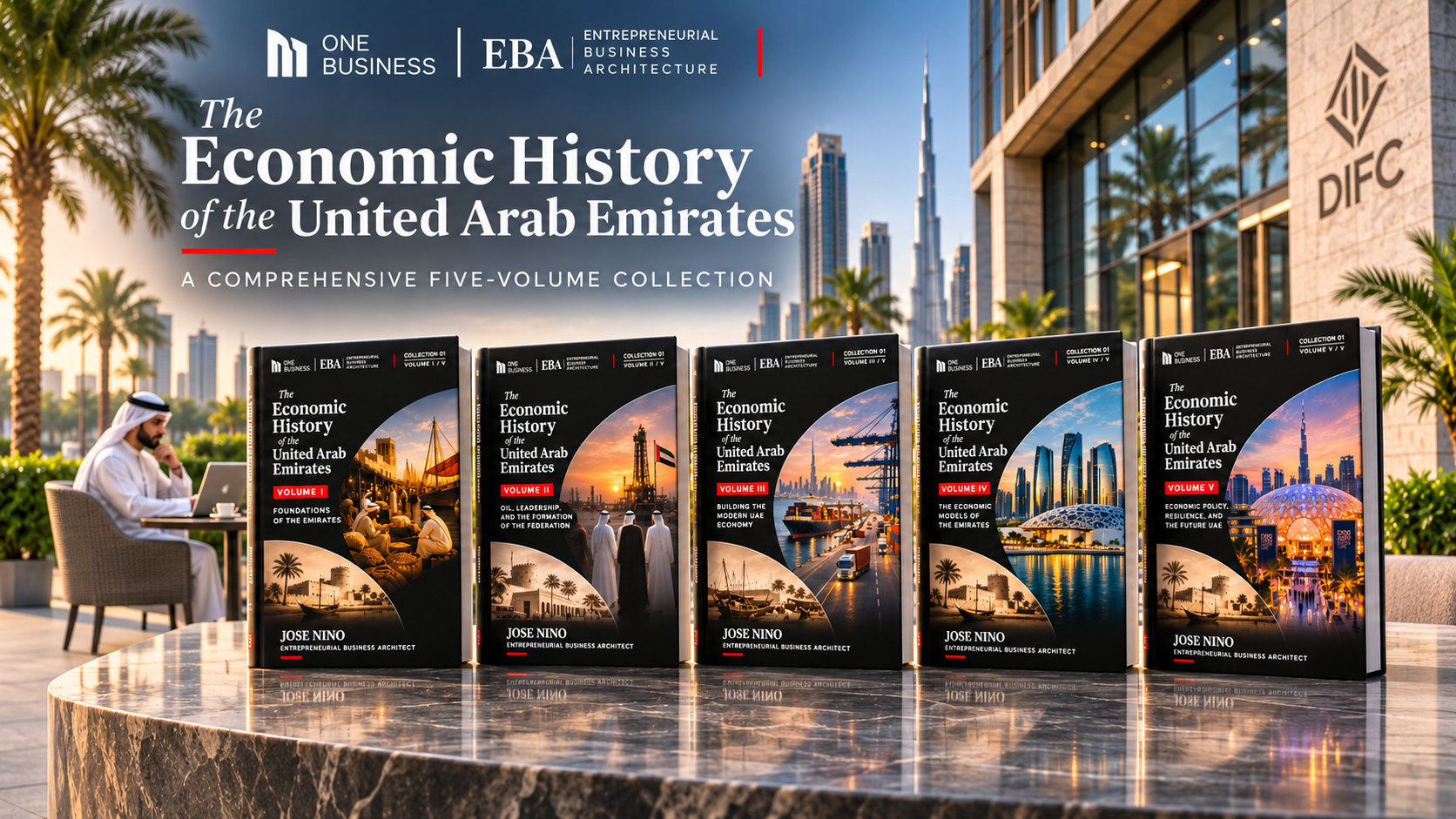
The complete research behind these historical relationships is developed in The Economic History of the United Arab Emirates, presented by ONE Business Dubai as a five-volume collection examining the economic transformation of the seven emirates. Its first volume, Foundations of the Emirates, explores the conditions that preceded the modern federation, including early settlements, regional trading networks, maritime capabilities, political organization, and the distinct economic paths that began emerging across the region. The subsequent volumes examine the discovery of oil, leadership, federation, institutional development, major enterprises, the economic models of the individual emirates, and the strategies influencing the country’s contemporary and future economic development.
For entrepreneurs, investors, executives, and international business professionals, the value of this historical research lies in understanding how the economic environment they encounter today was progressively constructed. Dubai’s commercial infrastructure, international connectivity, business institutions, and entrepreneurial opportunities are not isolated achievements. They belong to a broader history involving the development of capabilities, the organization of economic relationships, investment, adaptation, and the creation of conditions in which commercial activity can expand.
The distinction between understanding an economy and merely observing its achievements is fundamental. A businessperson may recognize Dubai as an international commercial hub without understanding the economic relationships through which its opportunities function. Historical knowledge provides a foundation for developing that deeper understanding, helping entrepreneurs approach market opportunities with greater analytical discipline and stronger preparation for the decisions involved in establishing a business.
The Economic History of the United Arab Emirates — Volume I: Foundations of the Emirates provides the opportunity to explore these historical foundations in depth. Its examination of early settlements, trade networks, and the development of regional economic relationships offers knowledge that helps entrepreneurs understand the origins of the commercial environment in which they seek to participate today.
Discover Volume I — Foundations of the Emirates
The complete five-volume research collection extends that understanding from the earliest economic foundations of the Emirates to the institutions, enterprises, economic models, and development strategies shaping the modern UAE. Together, the volumes provide a comprehensive historical perspective for readers who want to understand not only what the country has achieved, but how its economy developed and why that knowledge matters for contemporary entrepreneurial decisions.
The Economic History of the United Arab Emirates — Complete Five-Volume Digital Collection: USD 29.99
Explore the Complete Collection
Ultimately, the importance of understanding the UAE’s ancient trading networks extends far beyond knowledge of the distant past. Their history demonstrates how specialized capabilities, commercial relationships, accumulated knowledge, and access to markets contributed to economic development long before the emergence of modern infrastructure and institutions. These mechanisms provide a foundation for understanding why business success requires more than access to an attractive market.
For entrepreneurs pursuing opportunities in Dubai, the lesson is to investigate the economic environment with the same seriousness they devote to developing their products, organizing their companies, and managing their financial resources. The quality of their decisions improves when they understand how markets function, what customers require, which relationships matter, and how their enterprises can contribute meaningful value.
Understanding the economic history of the United Arab Emirates helps entrepreneurs recognize opportunities, develop stronger commercial strategies, and make better-informed decisions in Dubai’s modern economy. The past provides knowledge about the development of economic systems; the entrepreneur’s responsibility is to use that knowledge intelligently when building an enterprise within the conditions of the present.
Before deciding where to establish your business in Dubai, understand the economy you intend to enter. Before investing in an opportunity, understand the market relationships that make it possible. And before pursuing success in the UAE’s evolving business environment, discover the economic history that helps explain how its opportunities emerged.
Understand the UAE’s Economic History. Strengthen Your Entrepreneurial Decisions. Build Your Business Future.
ONE Business Dubai — Strategic Entrepreneurial Business Architecture Advisory Firm.
Research foundation: The Economic History of the United Arab Emirates, Volume I — Foundations of the Emirates, particularly Chapter 2: Early Settlements and Regional Trade Networks.
This publication provides historical analysis and entrepreneurial education. Business establishment, licensing, taxation, banking, and regulatory requirements should be verified according to the circumstances and applicable jurisdiction of each proposed enterprise.